Pretty Faces Lyrics – All Songs from the Musical
Pretty Faces Lyrics: Song List
- 42-32-42
- We're Taking Chances
- Too Plump For Prom Night
- Spot Light Solos
- How Do You Like Your Men
- Furs Fortune Fame Glamour
- Talk Of The Tabloids
- Heartbreaker
- What's Missing In My Life
- Midnight Munchies
- The Interviews
- Sleep Walkers Lament Duet
- Pretty Faces
- My Daddy Doesn't Care
- Sleep Walkers Lament
- Don't Talk Dirty
- Waiting For The Curtain
- Global Glamour GIrls
- Twirling For Jesus
- Are You The One
- Woman That I Am
- Purple Hearted Soldiers
- On With The Show
- Tears & Tears Ago
- What's Missing In My Life
- This Moment Is Mine
- Finale & Winners Walk
About the "Pretty Faces" Stage Show
This show is based upon the life of plain people. There are no popular stars here. One of the most attractive features in this musical is probably the closeness to reality. The story is a combination of musical and comedy.Robert W. Cabell – a talented composer, is the one, who has created the staging. He was responsible for the key parts of the spectacle – the music and lyrics. He is also the author of the story itself. His aim was to show plain people and the real world. At the same time, he managed to create the atmosphere of glamour.
The musical was staged in 2005 on Broadway. It was great revival for this spectacle. The actors included L. Holden as Patricia, T. Holden as Carter, B. McCarthy as Roger, E. Jean as Monique, A. Fackrell as Bobby, N. Pagniano as Delores, M. Sellers in the role of Pleasure and J. Hill as Paultette.
The play obtained an award during New York Musical Theatre Festival in 2004. The songs, which have become famous among the spectators, might be found on the Internet. People often buy albums to listen to those creative compositions again and feel that atmosphere.
Release date: 2005
"Pretty Faces" – The Musical Guide & Song Meanings
Review: what the show is trying to do
Beauty pageants are already musical theatre. They have entrances, monologues, costume reveals, set-piece “talent,” and judges who behave like critics with scorecards. “Pretty Faces” takes that built-in theatricality and flips the spotlight onto women who are usually parked in the “best friend” lane. The premise is blunt and useful: what happens when performers who are constantly told they are not the romantic lead get a week of rhinestones, rehearsal time, and an audience trained to judge bodies first?
Robert W. Cabell’s lyric approach is pragmatic. The jokes are there, but the writing keeps swerving away from cheap punchlines about weight and into something more uneasy: how public evaluation becomes private self-talk. The show’s recurring structural device, a set of soliloquy-like refrains associated with “42-32-42,” is a neat idea because it mimics the mental loop of measurement culture. It is catchy, then it starts to feel like a trap. That shift is the point.
Musically, the score is built for quick turns. Short, bouncy numbers can act like scene changes, then a ballad stops the room and forces you to sit with somebody’s backstory. The result feels like a backstage comedy until the material remembers it is also about scarcity: scarce opportunities, scarce kindness, scarce roles written for these women. The show succeeds when it lets those contradictions coexist instead of smoothing them out.
Copyright note: this guide does not reproduce full lyrics. It focuses on scene context and meaning.
How it was made
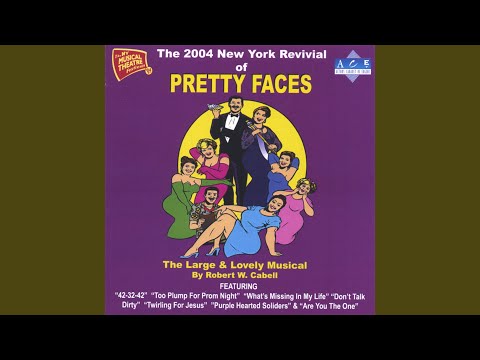
“Pretty Faces” has a longer life than its “2005” tag suggests. Cabell wrote an earlier Off-Broadway “Pretty Faces” in 1990, then reworked and reintroduced the material in the early 2000s as “Pretty Faces: The Large & Lovely Musical,” including a prominent New York Musical Theatre Festival run in 2004. That NYMF framing matters because it explains the show’s personality: fast, presentational, and hungry to win you over in one sitting.
The NYMF advertising is unusually candid about its pitch. It sells the show as “an XXL chorus line,” leans into pageant iconography, and foregrounds the director and musical director as if to reassure you this is a real piece of musical theatre craft, not a novelty act. The cast list in that material also hints at the production’s intended energy: a tight ensemble that can sing harmony, handle comedic timing, and then pivot into genuine emotion without apology.
The album release story is clean. The “NY Cast Album” arrived in 2005 with 27 tracks and a runtime of about 1 hour 11 minutes. It plays like a complete evening rather than a “greatest hits” sampler, which is important for a show where the emotional impact depends on cumulative intimacy. You need to meet the women, watch them rehearse, and then hear what they sing when no one is clapping yet.
Key tracks & scenes
"We're Taking Chances" (Company)
- The Scene:
- Early rehearsals for the fictitious Miss Global Glamour Girl Beauty Pageant. People are unpacking costumes and expectations at the same time. The lighting in most stagings reads like fluorescent backstage reality with a faint promise of stage sparkle.
- Lyrical Meaning:
- This is the mission statement without speeches. The lyric frames participation as risk, not hobby. For women used to being dismissed, simply showing up in heels is an act of defiance.
"Too Plump for Prom Night" (Contestants)
- The Scene:
- A comic release that lands because it is specific. The room feels like a dressing room confession circle: half laughter, half inventory of old humiliations.
- Lyrical Meaning:
- The lyric weaponizes the phrase that once wounded them. It is a reclamation song, but also a reminder: the joke is funny because it is true that people said this.
"42-32-42" (Soliloquy motif)
- The Scene:
- These refrains recur as quick mental check-ins. The staging often isolates a contestant in a narrow light, cutting her out of the ensemble image the pageant is selling.
- Lyrical Meaning:
- Numbers are supposed to be neutral. Here they are emotional. The motif turns measurement into character, an antagonist that follows you even when you are smiling for cameras.
"The Sleepwalkers Lament" (Recurring figure)
- The Scene:
- Repetition with variation, like a thought you cannot stop thinking. It tends to appear when the pageant machinery is most seductive and the contestants are most vulnerable.
- Lyrical Meaning:
- This is the show’s critique of autopilot living. The lyric suggests how easy it is to move through life half-asleep if you are trained to accept smaller dreams.
"Twirling for Jesus" (Bobby Joy)
- The Scene:
- The talent segment, staged with patriotic-pageant flair. It is funny on the surface and a little unnerving underneath, because it is performance as identity armor.
- Lyrical Meaning:
- The lyric is built as a persona act. Bobby Joy sells wholesomeness at high volume, which reads as comedy until you hear the need behind it: if she is loud enough, no one can reject her quietly.
"Purple Hearted Soldiers" (Contestant spotlight)
- The Scene:
- A still, earnest moment placed against a show-business environment. This is where the pageant stops being camp and becomes testimony.
- Lyrical Meaning:
- The lyric widens the show’s world beyond the pageant. It insists these women are not just “types” competing for a sash; they carry grief, loyalty, and real stakes.
"The Interviews" (Company)
- The Scene:
- Press and judges. Quick questions, practiced answers, smiles that feel like work. Lighting often shifts cooler here, as if the room is suddenly more clinical.
- Lyrical Meaning:
- Language becomes strategy. The lyric captures how women are taught to translate their lives into “acceptable” sound bites, and how exhausting that translation is.
"Finale & Winners Walk" (Company)
- The Scene:
- The crowning moment, staged as a public verdict with private consequences. The walk is the point: visibility, at last, on their terms.
- Lyrical Meaning:
- The lyric resolves the show’s argument: glamour can be costume, but it can also be permission. The best endings treat the win as communal, not individual.
Notes & trivia
- The show’s NYMF run played Theatre Three in New York City in September 2004, with a listed running time of about two hours and no intermission.
- NYMF advertising credits direction and choreography to Joe Zingo and musical direction to Jim Roberts.
- The concept is consistently described as a backstage musical set on and off stage at the fictitious Miss Global Glamour Girl Beauty Pageant.
- The 2005 “NY Cast Album” release (digital listings) shows 27 tracks and a runtime of roughly 1 hour 11 minutes, with a rights line under RWC Twin Productions.
- Critical pull-quotes frequently single out “Too Plump for Prom Night” for comedy and the “42-32-42” soliloquy motif for stick-in-your-head persistence.
- Cabell has framed the project as giving voice to actresses often cast in secondary roles because of their size, built from real-life inspiration rather than abstract messaging.
- Piano-vocal selections were published later, supporting the show’s afterlife in concerts and smaller-scale productions.
Reception
The reception pattern is telling: reviewers praised the score’s efficiency and the lyric intelligence when it refused obvious jokes. The show’s strongest notices tend to describe it as brisk, tuneful, and unexpectedly moving once the pageant premise stops being the headline and becomes the setting for confession.
“Pretty Faces starts out looking like a mistake and ends up surprisingly entertaining.”
“His music is snappy, familiar, and the lyrics are clever.”
“Tuneful, humorous and upbeat… a beauty pageant for ‘large & lovely’ ladies.”
My skeptical take: the concept could have been a one-joke evening. It is not, mainly because the lyrics keep insisting on interiority. The show is funniest when it is precise, and it is best when it admits that being seen can feel like danger, even when you want it.
Live updates (2025/2026)
Information current as of January 31, 2026.
“Pretty Faces” is not running on Broadway or a major national tour right now. Its current footprint is the one most niche musicals rely on: streaming availability, concert clips, and do-it-yourself production pathways.
Cabell’s official site remained active through 2024 with dedicated pages for the show’s music, video clips, and reviews, and it explicitly notes that at least one visible “trailer” video comes from a regional revival rather than the original New York production. That detail matters for expectations: the piece is alive in smaller venues, but it is not being marketed as a mainstream commercial property.
For producers and performers, the practical 2025/2026 update is the availability stack: the 2005 cast album remains on major platforms, and the published piano-vocal selections (2014) make the score easier to mount in showcases and cabarets. If you want to track momentum, watch for two signals: a new licensing partner announcement, or a festival remount that assembles a cast with genuine comic chops and a willingness to play the sincerity without winking.
Quick facts
- Title: Pretty Faces: The Large & Lovely Musical
- Year (cast album listings): 2005
- Type: Backstage musical comedy set around a plus-size beauty pageant
- Book / Music / Lyrics: Robert W. Cabell
- Festival run (key reference): New York Musical Theatre Festival, Theatre Three (Sept 21 to Sept 27, 2004)
- Album: “PRETTY FACES - The Large & Lovely Musical” (NY Cast Album)
- Album track count / duration: 27 tracks, about 1 hour 11 minutes
- Label / rights line (digital listings): RWC Twin Productions (? 2005)
- Selected notable placements (story moments): rehearsals and “day one” transformations, interview sequence, talent segment, crowning “winners walk”
- Availability: common on streaming platforms; additional sheet music available via later piano-vocal publication
Frequently asked questions
- Is “Pretty Faces” a Broadway show?
- It is best known for Off-Broadway and festival visibility, including a New York Musical Theatre Festival run in 2004. It has not had a long Broadway commercial run.
- Who wrote the songs and the book?
- Robert W. Cabell is credited as author/composer, and he is described in reviews as writing the music and lyrics.
- What is the show’s setting?
- It is a backstage musical set on and off stage at the fictitious Miss Global Glamour Girl Beauty Pageant, following contestants from rehearsal week through the crowning moment.
- Is there a cast recording?
- Yes. The “NY Cast Album” release is widely listed as a 2005 album with 27 tracks, running about 1 hour 11 minutes.
- What song best explains the show’s voice?
- “Too Plump for Prom Night” captures the comic bite, while the recurring “42-32-42” motif captures the show’s psychological argument about measurement culture.
- Is it being performed now?
- There is no major commercial run announced as of January 31, 2026. The show’s current life is mostly regional and community-based, supported by streaming audio and published vocal selections.
Key contributors
| Name | Role | Contribution |
|---|---|---|
| Robert W. Cabell | Book / Music / Lyrics | Created the musical’s story and score; publicly framed the project as inspired by real performers and their casting realities. |
| Joe Zingo | Director / Choreographer (NYMF materials) | Credited in NYMF promotional material for staging and movement. |
| Jim Roberts | Musical director (NYMF materials) | Credited in NYMF promotional material for musical direction. |
| RWC Twin Productions | Label / rights line | Listed on digital album releases as the rights holder for the 2005 cast album program. |
| Theatre Three | Venue | Hosted the NYMF run in New York City in 2004, a key reference point for the show’s modern identity. |
Sources: TheaterMania; BroadwayWorld; Apple Music; Spotify; Amazon Music; Musicals101; RobertWCabell.com; NYMF promotional PDF.