Pajama Game, The Lyrics – All Songs from the Musical
Pajama Game, The Lyrics: Song List
- Act I
- The Pajama Game Opening
- Racing With the Clock
- A New Town Is a Blue Town
- I'm Not at All in Love
- I'll Never Be Jealous Again
- Hey There
- Racing With the Clock (Reprise)
- Sleep-Tite
- Her Is
- Once A Year Day!
- Her Is (Reprise)
- Small Talk
- There Once Was a Man
- Hey There (Reprise)
- Act 2
- Steam Heat
- The World Around Us
- Hey There (Reprise 2)
- If You Win, You Lose
- Think of the Time I Save
- Hernando's Hideaway
- The Three of Us (Me, Myself and I)
- Seven-And-A-Half Cents
- There Once Was a Man (Reprise)
- Finale/The Pajama Game
About the "Pajama Game, The" Stage Show
The script was written by R. Bissell & G. Abbott. Songs were composed by J. Ross & R. Adler. Broadway’s premiere took place on the stage of St. James Theatre in May 1954. Till November 1956 the histrionics was there and after – moved to the Shubert Theatre. There the performance took place all November 1956. Total 1063 runs were made on Broadway, directed by J. Robbins & G. Abbott, choreographed by B. Fosse. In the musical were involved such actors: J. Paige, J. Raitt, E. Foy, Jr., C. Haney, R. Dunn & S. MacLaine. The London premiere was in October 1955 in Coliseum. Completion of the show was in March 1957 after 588 exhibitions. Director was R. E. Griffith, choreographer – Z. Leporska. The show had cast: E. Hockridge, J. Nichols, M. Wall & E. Seal.The updated version of the play was shown on Broadway at Lunt-Fontanne Theatre from December 1973 to February 1974 with 65 exhibitions. Director was G. Abbott, choreographer – Z. Leporska. In the musical participated: H. Linden, C. Calloway, B. McNair & S. Miller. Try-outs of the new Broadway show were held in January 2006 at the American Airlines Theatre stage. The musical was held from February to June 2006, with 41 preliminaries & 129 regular shows. The director and choreographer was K. Marshall. Adaptation of the script was done by P. Ackerman. In the show were involved: H. Connick, Jr., K. O'Hara, M. McKean, M. Lawrence & R. Poe. From April to June 2013 the musical was held in Minerva Theatre. From May to September 2014, the show was represented in Shaftesbury Theatre. Director was R. Eyre. Production in 1954 received Theatre World and Tony awards. Version of 2006 was noted by Tony, Theatre World, Outer Critics Circle & Drama Desk awards.
Release date: 1954
"The Pajama Game" – The Musical Guide & Song Meanings
Review: What the lyrics are really doing
The setup sounds like a civics worksheet: a pajama factory in Cedar Rapids, a union demanding a 7½-cent raise, and management stalling. The surprise is how the lyric writing refuses to pick a side for long. Adler and Ross (with a couple of key assists in the lore) keep yanking the emotional camera back and forth between the shop floor and the front office, so romance and labor politics keep tripping each other in public.
The show’s core lyrical move is plainspoken argument that turns into flirtation. Babe’s language is made of proof and procedure, until it isn’t. Sid’s is swagger with an anxiety leak. When they sing at each other, the words operate like bargaining positions: offers, counteroffers, walkouts, and grudging admissions. The trick is that the score makes those admissions catchy enough to feel like a win, even when the characters are losing ground.
Musically, it’s mid-century Broadway with pop instincts and dance breaks that are not decorative. Numbers get “motivated” by the world: production speedups, a company picnic, a union rally, a backroom club. If you want a practical listening path before reading any plot summary, play “Racing with the Clock,” “Hey There,” and “7½ Cents” in order. You will hear the full thesis: work as rhythm, love as interruption, and money as the chorus everyone knows by heart.
How it was made
The origin story is unusually clean, and unusually fast. Frank Loesser was first approached to write the score, turned it down, and pointed the producers toward Richard Adler and Jerry Ross. They wrote four songs on spec in two days, landed the job, and finished the rest of the score in roughly five weeks. That speed matters: the lyrics have the snap of people trying to get hired, not people polishing a legacy.
There’s also a great bit of score recycling lore: “Steam Heat,” later treated like an engraved invitation to dance history, began life written for a revue and was rejected. The show keeps that attitude. Even the hits behave like they’re crashing the party. And choreography history rides shotgun: Bob Fosse’s early stamp is tied to the number that is supposed to be “just” entertainment inside the plot, which is exactly why it detonates.
Experience tip, for anyone seeing it live: sit center, not too close. You want full-body geometry for the dance writing and enough distance to clock how the factory staging patterns mirror the romantic blocking. The show is a machine about machines. Better to watch it from a seat that lets you see the whole conveyor belt.
Key tracks & scenes
"Racing with the Clock" (Factory Workers)
- The Scene:
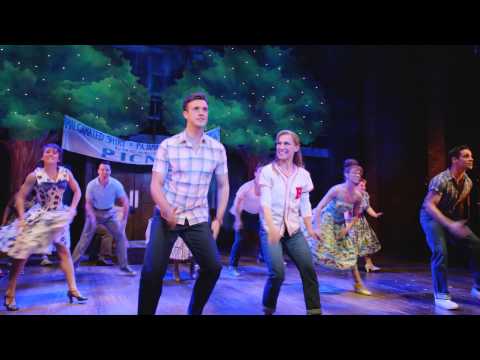
- Shop floor. Double rows of sewing machines. Bright worklight, clipped movement, the feeling of breath counted in timecards. The workers vent about pace and pay as the line never really stops.
- Lyrical Meaning:
- Work becomes percussion, and the lyric makes the factory a metronome. The words are complaint and choreography at once: labor as tempo, grievance as groove.
"A New Town Is a Blue Town" (Sid)
- The Scene:
- Sid arrives, fixes a machine, gets baited by helpers, then gets dressed down by Hasler. The lighting often shifts cooler here, isolating Sid against the factory’s glare.
- Lyrical Meaning:
- This is the outsider’s anthem, but it is also a warning label. Sid’s confidence is real, yet the lyric admits he is performing “belonging” while learning the rules of a town and a workforce that do not need him.
"I'm Not at All in Love" (Babe)
- The Scene:
- The women tease Babe about noticing Sid. Babe denies it, loudly, with the kind of bravado that reads as defense under fluorescent lights.
- Lyrical Meaning:
- Classic denial song, but the lyric is unusually strategic. Babe argues like a union rep: she makes a case, cites evidence, and accidentally reveals exactly what she is trying to conceal.
"Hey There" (Sid)
- The Scene:
- Sid, alone in his office after Babe refuses a date on principle. The room is quiet enough to hear the building hum. The song plays like a private memo he never meant to file.
- Lyrical Meaning:
- Sid’s lyric is persuasion aimed inward. He is selling himself on patience, tenderness, and restraint, which is not his brand. That mismatch is the point, and it makes the ballad land.
"Once-a-Year Day" (Company)
- The Scene:
- Company picnic. Games, drinks, and public flirting. The light opens up, warmer and wider, because the factory has temporarily released its grip.
- Lyrical Meaning:
- The lyric frames leisure as sanctioned rebellion. It is not “freedom,” it is permission. That nuance matters, because the show is always asking who gets to grant it.
"Steam Heat" (In-Show Entertainment at the Union Meeting)
- The Scene:
- A union rally, then an “entertainment portion.” Often staged with tight spotlights and minimalist shapes, like the room suddenly becomes a nightclub inside a meeting hall.
- Lyrical Meaning:
- On paper, the lyric is almost throwaway. In performance, that coolness becomes attitude: the show briefly stops arguing and starts strutting. It is labor politics taking one number off to flirt with pure style.
"Hernando's Hideaway" (Gladys, Sid, Company)
- The Scene:
- A secret club with a code to get in. Low light, Latin-themed atmosphere, and a seduction that is also a paperwork heist: Sid tries to get access to the ledger key.
- Lyrical Meaning:
- The lyric makes secrecy sound like romance, then exposes romance as strategy. It is the show’s most honest moment about power: desire is used, enjoyed, and regretted in the same breath.
"Seven and a-Half Cents" (Prez, Babe, Workers)
- The Scene:
- Union rally math, delivered as a crowd-pleaser. The staging tends to tighten into lines and clumps, a human spreadsheet that keeps growing as the numbers add up.
- Lyrical Meaning:
- This is the score turning negotiation into rhetoric. The lyric translates a tiny hourly bump into years of lived life, which is the show’s clearest statement that wages are biography.
Live updates (2025/2026)
Information current as of January 29, 2026. “The Pajama Game” is not in an open-ended Broadway run right now. It is thriving where it has always thrived: licensing, repertory, schools, and the occasional “event” presentation that treats it as a classic with teeth.
- A licensed production ran April 24 to May 4, 2025 at the University at Buffalo’s Center for the Arts (listed via MTI’s production pages).
- In Australia, Foundry Theatre in Sydney advertised a limited season beginning November 2025.
- Delray Beach Playhouse listed performances beginning November 14, 2025, with individual tickets starting at $55.
- Lakewood Center for the Arts (Oregon) scheduled a concert-style “Lost Treasures” weekend for February 13–14, 2026, with general admission listed at $30.
Trend to watch: modern productions often nudge plot logic to match character psychology. A famous example is the 2006 Broadway revival’s handling of “Steam Heat” and “Hernando’s Hideaway,” where staging choices were used to clarify who would plausibly cut loose, and when. When the show is revived again at scale, expect that same impulse: keep the fun, tighten the motivations.
Notes & trivia
- MTI’s production notes describe an unusually rapid writing timeline: four songs written on spec in two days, the full score in about five weeks.
- “Steam Heat” is explicitly framed in the story as entertainment at a union meeting, which helps explain why it can feel like it arrives from a different universe and still “fits.”
- IBDB lists the original Broadway run as opening May 13, 1954 and closing November 24, 1956, totaling 1,063 performances.
- The show is based on Richard Bissell’s novel “7½ Cents,” and the wage demand is not a metaphor. It is the plot engine.
- Playbill’s 2006 revival reporting highlights a staging idea that let the star’s musicianship become story texture during “Hernando’s Hideaway.”
- The 2006 revival cast recording was released as a two-CD set coupled with “Thou Shalt Not,” under the branding “Harry on Broadway, Act 1.”
- Myth check: people sometimes describe the show as “just” a fluffy workplace romance. The text itself announces the economic stakes up front, and keeps returning to them whenever the love story tries to hog the spotlight.
Reception then vs. now
In 1954, the punchline was that a labor dispute could carry a hit musical. Today, the surprise is that the material still reads cleanly, even as audiences are less willing to romanticize management. Good productions lean into that friction instead of sanding it down.
“Delicious... an immortal pop-hit-spawning score by Richard Adler and Jerry Ross.”
“This is about capital and labour,” a character announces at the start.
“It’s a show sizzling with hit songs... the positive energy... supercharges proceedings.”
One modern-critical angle worth keeping: when performers lean too “cool,” the songs can start sounding like stylish covers rather than character decisions. Reviews of the 2006 revival made that critique sharply, while still praising the moments when performance and plot snapped into alignment.
Quick facts
- Title: The Pajama Game
- Year: 1954 (Broadway premiere)
- Type: Musical comedy
- Book: George Abbott and Richard Bissell
- Music & Lyrics: Richard Adler and Jerry Ross
- Based on: “7½ Cents” (novel) by Richard Bissell
- Original setting: Sleep-Tite Pajama Factory, Cedar Rapids
- Selected notable placements: Union meeting “entertainment” (“Steam Heat”); secret club sequence (“Hernando’s Hideaway”); factory time-study opening (“Racing with the Clock”)
- Original Broadway run: May 13, 1954 to Nov 24, 1956 (1,063 performances)
- Cast album anchor: Original Broadway Cast Recording (Columbia; now surfaced via Sony Masterworks branding)
- Later recording note: 2006 Broadway revival cast recording released as part of a 2-CD set bundled with “Thou Shalt Not”
Frequently asked questions
- Is “The Pajama Game” based on a true story?
- It is adapted from Richard Bissell’s novel “7½ Cents.” The labor dispute is written with realistic workplace mechanics, but the specific factory story is fictionalized.
- Why does “Steam Heat” feel like it drops in from another show?
- Because it is supposed to. In the plot it is presented as the union meeting’s entertainment, which gives the show permission to switch into pure performance mode.
- What is the lyrical “fight” at the center of Sid and Babe’s romance?
- They argue in different languages: management pragmatism vs. labor solidarity. Their songs turn those languages into flirtation, then force each character to pay for the compromise.
- Is there a film version?
- Yes. A 1957 film adaptation exists, and its trailer is widely available.
- Which recording should I start with if I care about lyrics clarity?
- Start with the Original Broadway Cast Recording for pace and intent, then sample a later revival recording for how performers phrase the jokes and the negotiations differently.
Key contributors
| Name | Role | Contribution |
|---|---|---|
| Richard Adler | Composer-Lyricist | Co-wrote the score’s music and lyrics; pop-smart rhymes that keep the story moving. |
| Jerry Ross | Composer-Lyricist | Co-wrote the score; helped define the show’s buoyant, conversational lyric tone. |
| George Abbott | Book / Director (original) | Co-wrote the book and shaped the show’s comedic pacing and workplace mechanics. |
| Richard Bissell | Novelist / Book | Wrote the source novel and co-wrote the book; grounded the wage dispute in story stakes. |
| Bob Fosse | Choreographer (original) | Early signature dance language, especially around “Steam Heat,” that later became iconic. |
| Columbia Records | Original cast album label | Issued the 1954 Original Broadway Cast Recording (now circulated under Sony Masterworks branding). |
Sources: Music Theatre International (Full Synopsis; production notes), IBDB, Playbill, The Guardian, London Evening Standard, Broadway.com, Masterworks Broadway, Theatre Heritage Australia.