Of Thee I Sing Lyrics – All Songs from the Musical
Of Thee I Sing Lyrics: Song List
- Act 1
- Wintergreen for President
- Who Is the Lucky Girl to Be?
- Dimple on My Knee
- Because, Because
- As the Chairman of the Committee / How Beautiful / Never Was There a Girl So Fair / Some Girls Can Bake a Pie
- Love Is Sweeping the Country
- Of Thee I Sing
- Here's a Kiss for Cinderella
- I Was the Most Beautiful Blossom
- Some Girls Can Bake a Pie (Reprise)
- Act 2
- Hello, Good Morning
- Who Cares?
- Garc,on, S'il Vous Plai't / Illegitimate Daughter / We'll Impeach Him Who Cares? (Reprise)
- The (Senatorial) Roll Call
- Jilted
- Who Could Ask for Anything More?
- Posterity Is Just Around the Corner
- Trumpeter Blow Your Horn / Finale
About the "Of Thee I Sing" Stage Show
Music for the play composed by G. Gershwin. Lyrics – I. Gershwin. The script was written by George S. Kaufman, in collaboration with M. Ryskind. The premiere on Broadway was held in Dec. 1931. In October of the next year, the histrionics moved another venue. The final performance was held in January 1933 after 441 exhibitions. Director was George S. Kaufman, choreographer – G. Hale. The spectacular had such cast: W. Gaxton, G. Brinkley, L. Moran, G. Murphy, V. Moore, J. O'Dea, D. Clements, F. Ames & R. Riggs. From May to June 1933, the musical was held at the Imperial Theatre stage & stayed there for 32 performances with such cast: W. Gaxton, A. Sothern & B. Allen among others. From May to July 1952, production took place on Broadway at Ziegfeld Theatre.In 1990, the play was revived & presented in NY by G. & S. Players. In 1996, it was shown at London's Barbican Centre. In May 2006, it took place in Center Encores, directed by J. Rando, choreographed by R. Skinner. In the musical were such cast: V. Garber, J. Mays & J. L. Thompson. In July 2015, histrionics was shown on the stage of London's Royal Festival Hall. The performance included: H. Waddingham, H. Fraser & T. Edden. In September 2015, the play was presented in Concert Hall in Sydney’s Opera House. Broadway production won Pulitzer Prize.
Release date: 1931
"Of Thee I Sing" – The Musical Guide & Song Meanings
Review
How do you write a political musical in 1931 and still land jokes in 2026? You aim the punchlines at human habits, then let the lyrics pretend they are just flirting. Of Thee I Sing is a campaign farce where romance is sold like policy, and policy is treated like gossip. The show’s great trick is that its words move the plot with almost prosecutorial efficiency: every time a character sings “love,” someone is really negotiating power, image, or self-preservation.
Ira Gershwin’s lyrics keep turning public language into private bargaining chips. “Love Is Sweeping the Country” sells civic unity as a fad, and it sounds irresistible precisely because it is a little too eager. The show’s refrain-friendly slogans (“Wintergreen for President,” “Of Thee I Sing”) behave like political ads before political ads admitted what they were. George Gershwin, meanwhile, gives the satire a glossy melodic surface, which makes the cynicism sharper because the tunes are so sincerely pleasurable. In performance, the best productions treat the score like a smile with teeth: bright tempos, clean diction, and no winking that asks permission to be funny.
Musically, the piece sits in that early “integrated” sweet spot: ensemble writing, choral commentary, patter, and big public numbers that function as plot engines. The style matters because the characters are always being watched. When Wintergreen sings, it is rarely “just” a love song. It is a press conference with rhymes.
How It Was Made
Of Thee I Sing comes from a rare Broadway alignment: George and Ira Gershwin partnered with George S. Kaufman and Morrie Ryskind to build a full-evening political satire that did not apologize for being satire. Kaufman’s famous warning about the genre, “Satire is what closes on Saturday night,” hangs over the project like a superstition that the team then dares the audience to disprove. The result did not close on Saturday. It became a hit and, more unusually, it was treated as a real play in awards culture, ultimately winning the Pulitzer Prize for Drama.
The writing process was essentially a collision of disciplines. Kaufman and Ryskind engineer the mechanics: committees, pageants, courts, impeachment chatter. The Gershwins then supply the bait: melodies that can seduce an audience into listening to lyrics that are actively insulting the system onstage. If you want the technical marvel, it is this: the score can sound like a cheerful civic parade while the lyric is quietly pointing out how cheaply the parade was bought.
One more behind-the-scenes reality that matters to listeners today: the show’s life on recordings is largely a reconstruction story. Key releases rely on careful editorial work to preserve orchestration and pacing in a way Broadway’s pit parts did not always archive neatly. If you are hunting for the “sound” of Of Thee I Sing, you are really choosing between interpretive traditions, not just casts.
Key Tracks & Scenes
"Wintergreen for President" (Company)
- The Scene:
- A street parade in “any city in America.” Brass, banners, and the manic confidence of people who have never met a slogan they could not chant. Lighting wants daylight and movement, like a marching poster.
- Lyrical Meaning:
- The lyric is propaganda with a grin. Its job is to establish the show’s operating principle: politics is a chorus number. The comedy lands because the praise is so generic it could fit anyone, which is the point.
"Some Girls Can Bake a Pie" (Wintergreen, Mary, Company)
- The Scene:
- Backstage energy around the pageant operation. The atmosphere is fluorescent and practical, a “work room” mood, until the song turns it into an audition for First Lady.
- Lyrical Meaning:
- This is the show’s most devastating domestic joke: Mary’s corn muffins become a credential. Ira turns a kitchen detail into a referendum on “real” American womanhood, and the plot quietly clicks into place around it.
"Love Is Sweeping the Country" (Sam, Emily, Ensemble)
- The Scene:
- A campaign celebration with showbiz sparkle. The number should feel like a rally staged by ad men: upbeat, crowded, and slightly too choreographed to be sincere.
- Lyrical Meaning:
- It is a national mood ring disguised as a song. The lyric treats “love” like a contagion, which is funny until you realize that is how campaigns sell belonging. The jokes are the mechanism.
"Of Thee I Sing" (Wintergreen, Mary, Company)
- The Scene:
- Wintergreen proposes again and Mary sets terms: marriage if he wins. The stage picture should narrow, as if the campaign noise fades and we suddenly hear the private deal being made.
- Lyrical Meaning:
- The title song is both romance and patriotic pastiche. “Baby” sits next to national rhetoric on purpose. The lyric makes a point about how easily the language of country becomes the language of possession.
"A Kiss for Cinderella" (Wintergreen)
- The Scene:
- Inauguration Day, also his wedding day. Wintergreen performs a public goodbye to old flirtations as if it were part of the official ceremony. Spotlight him, but keep the crowd visible, because he is always performing.
- Lyrical Meaning:
- It is a bachelor farewell that doubles as image management. The lyric’s charm is the strategy: Wintergreen wants to look sentimental so the nation forgives the transaction underneath.
"Hello, Good Morning" (Secretaries)
- The Scene:
- Act II opens in the White House office machine: two dozen secretaries, crisp formation, workday pep. Bright, busy lighting. The choreography should feel like bureaucracy learning jazz.
- Lyrical Meaning:
- The lyric makes government sound like gossip on a schedule. It is funny because it is true: the state runs on small talk, routine, and people who know more than the people in charge.
"Who Cares?" (Wintergreen, Mary, Reporters)
- The Scene:
- Reporters swarm, hungry for scandal, and the rhythm should feel like flashbulbs. Keep it fast, verbal, and slightly aggressive: the press is a percussion section.
- Lyrical Meaning:
- The song is about selective outrage. Ira’s rhyme-work turns civic concern into a punchline and exposes how easily a crowd can be redirected to whatever story sells.
"Posterity Is Just Around the Corner" (Wintergreen, Mary, Company)
- The Scene:
- The impeachment threat collapses when Mary’s pregnancy is revealed. The mood flips into triumph, the kind you get when a crisis is solved by optics instead of ethics.
- Lyrical Meaning:
- “Posterity” becomes a political alibi. The lyric celebrates the future as a talking point, then shows how quickly “the future” can be reduced to one photogenic baby headline.
Live Updates (2025-2026)
There is no standing Broadway production to point you to, and there is no long-running tour circuit for Of Thee I Sing the way there is for modern mega-hits. What the piece does have is a dependable afterlife in concert and semi-staged formats, often paired with its sequel Let ’Em Eat Cake for a double-bill argument about satire and backlash. A notable recent example was the Odyssey Opera and Boston Modern Orchestra Project concert presentation in Boston (Jordan Hall) in October 2024, a reminder that the material plays cleanly when sung by performers who can land text with bite.
For the most current “how to see it” answer in 2025-2026, your best bet is regional licensing and specialist presenters. The show remains licensable through major rights holders, and the Gershwin estate’s publication pages continue to keep it visible for producers looking for a politically sharp classic with a real ensemble payoff. Translation: you may not find it with a Times Square marquee, but you can absolutely find it if you watch concert calendars, opera-adjacent companies, and serious university programs.
Notes & Trivia
- It is the first musical to win the Pulitzer Prize for Drama, which matters because it signaled that a musical book and lyric could be judged as “playwriting,” not just entertainment.
- IBDB lists the original Broadway run as opening December 26, 1931, at the Music Box Theatre, with 441 performances.
- The show’s Act II office number (“Hello, Good Morning”) is staged as a workplace musical before workplace musicals became a genre.
- The corn muffins gag is not throwaway business. It becomes legal logic inside the plot, which is exactly how the piece treats American institutions.
- Modern recordings often emphasize reconstruction and editorial care, because the original Broadway orchestration history includes multiple hands and later scholarship.
- The show’s satire avoids naming real political parties, which is why revivals can tilt the staging toward “current” without rewriting the text.
Reception
In 1931, critics responded to the novelty of a musical comedy that behaved like a satirical play. The Pulitzer committee later praised it as “a biting and true satire on American politics,” effectively blessing the idea that a musical could carry literary weight. Decades later, critics keep returning to the same surprise: the jokes still hit because the targets have not moved very far.
“A biting and true satire on American politics.”
“The laughter that greets the show today is tinged with surprise.”
“Gershwin’s exuberant music remains fresh.”
Quick Facts
- Title: Of Thee I Sing
- Year: 1931 (Broadway opening: December 26, 1931)
- Type: Musical comedy; political satire
- Music: George Gershwin
- Lyrics: Ira Gershwin
- Book: George S. Kaufman, Morrie Ryskind
- Original Broadway venue: Music Box Theatre (run listed at 441 performances)
- Selected notable placements (story locations): campaign parade; Atlantic City pageant machinery; White House office; Supreme Court; impeachment proceedings
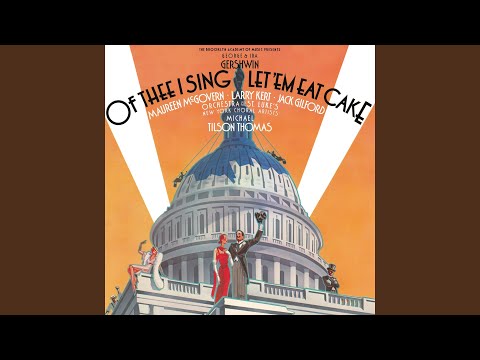
- Album status (listener baseline): A key modern reference is the Michael Tilson Thomas-led studio cast recording paired with Let ’Em Eat Cake, associated with staged concert versions at Brooklyn Academy of Music
- Availability: Widely available via major digital platforms under Masterworks Broadway / Sony Classical branding (often dated by release as early 1990s, with later remastering)
Frequently Asked Questions
- Is there a movie of Of Thee I Sing?
- There is no definitive feature film adaptation that has replaced the stage piece in popular circulation. The title song has lived on independently through recordings, which is part of why people assume there must be a movie.
- Who actually wrote the lyrics, and why do they sound so modern?
- Ira Gershwin wrote the lyrics, and the “modern” feeling comes from his conversational syntax and his habit of treating public language as something to be punctured. The rhymes are elegant, but the intent is blunt.
- Why are corn muffins such a big deal in the plot?
- Because the show is arguing that public life is decided by trivial-seeming symbols. Corn muffins become “authenticity,” then authenticity becomes a legal and political weapon.
- What recording should I start with if I want the whole score?
- Start with the Michael Tilson Thomas studio cast recording (paired with Let ’Em Eat Cake) if you want a comprehensive, performance-driven way into the material with a strong cast and concert-style pacing.
- Is it hard to stage today?
- It is less about spectacle than about clarity. You need an ensemble that can deliver dense text at speed, plus a musical approach that lets the satire stay sharp rather than turning everything into nostalgic swing.
Key Contributors
| Name | Role | Contribution |
|---|---|---|
| George Gershwin | Composer | Score blending campaign pastiche, ensemble writing, and romantic melody with satirical propulsion. |
| Ira Gershwin | Lyricist | Lyrics that weaponize slogans, turn headlines into jokes, and make “love” a political instrument. |
| George S. Kaufman | Bookwriter | Satirical structure and stagecraft that treats institutions (courts, press, committees) as characters. |
| Morrie Ryskind | Bookwriter | Co-engineered the plot’s farce mechanics and the show’s relentless comedic pacing. |
| Michael Tilson Thomas | Conductor (notable studio recording) | Led a major studio cast recording that many listeners use as the modern entry point to the full score. |
| Maureen McGovern | Performer (notable studio recording) | Key vocalist on the widely circulated studio recording, helping translate the show’s text-first style to audio. |
| Larry Kert | Performer (notable studio recording) | Central vocalist on the studio recording, anchoring Wintergreen’s blend of charm and opportunism. |
Sources: IBDB; The Pulitzer Prizes (official site); The Gershwin Estate (gershwin.com); Library of Congress; Musicals101 (synopsis/lyrics PDF); Masterworks Broadway; Boston Modern Orchestra Project; Odyssey Opera; Variety; Boston Classical Review.