
Natasha, Pierre, And The Great Comet Of 1812 Lyrics: Song List
- Act 1
- Prologue
- Pierre
- Moscow
- The Private and Intimate Life of the House
- Natasha & Bolkonskys
- No One Else
- Opera
- Natasha & Anatole
- Natasha Lost
- The Duel
- Sunday Morning
- Charming
- The Ball
- Act 2
- Letters
- Sonya & Natasha
- Sonya Alone
- Preparations
- Balaga
- The Abduction
- In My House
- A Call to Pierre
- Find Anatole
- Pierre & Anatole
- Natasha Very Ill
- Pierre & Andrey
- Pierre & Natasha
- The Great Comet of 1812
About the "Natasha, Pierre, And The Great Comet Of 1812" Stage Show
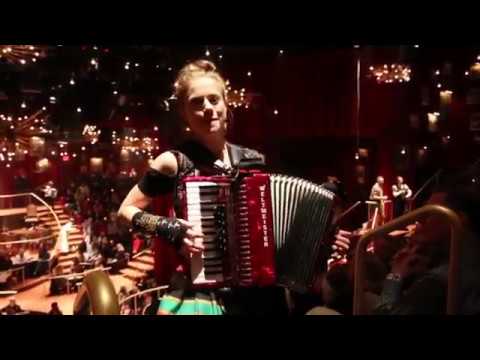
The script was an adaptation of L. Tolstoy’s novel. The libretto & music was written by D. Malloy. The premiere of the spectacular was in October 2012 on the stage of Ars Nova. In May 2013 the histrionics moved to the casino, located in the Meatpacking District. In September 2013, the play moved from there to the Theater District scene. Directed by R. Chavkin, the musical was presented in the form of a club dinner, decorated in Russian style, where the action was happening around the audience. Choreographer – S. Pinkelton. The theatrical involved: P. Soo, D. Malloy, L. Steele, B. Ashford, G. McLean, A. Gray, B. DeLong, N. Choksi, G. Bell & P. Pinto among others.
The team that created the original version of the musical, refined performance to display it in the American Repertory Theatre. Production took place during December 2015 – January 2016. Broadway premiere is planned on November 2016. The histrionics will be held at the Imperial Theatre stage. Director will be again R. Chavkin. The show will involve: J. Groban, D. Benton, B. Ashford, L. Steele, G. McLean, N. Belton, A. Gray, G. Bell, N. Choksi & P. Pinto. The cast may be a subject to change until the opening night.
In September 2014, the play showed on stage of Teatro Parapluie in the capital of Ecuador. The performance was conducted in Spanish. The musical received a Richard Rodgers Award from the American Academy of Arts. Also, it gathered Obie, ASCAP New Horizons and Off-Broadway Alliance rewards. Staging was nominated for several more ones: Drama Desk (5 nominations), Drama League (2 nominations), Lucille Lortel (11 nominations, 3 wins).
Release date of the musical: 2012
"Natasha, Pierre, and the Great Comet of 1812" – The Musical Guide & Song Meanings
Review
Can a 70-page slice of War and Peace feel like a pop concert, a confessional, and a social scandal all at once without turning into plot soup? Dave Malloy’s answer is to weaponize clarity. The lyrics behave like stage directions with a pulse: names, tags, blunt verbs, social status, quick pivots into desire. That famous opening roll call is not a cute device, it is survival. With this many Russians onstage, the text has to label people fast, then let the music do the shading.
The writing keeps returning to two engines: narrative speed and moral hangover. Natasha’s lyric language starts in clean, devotional lines, then cracks into impulsive fragments as Anatole appears. Pierre’s words, by contrast, are the sound of a brain chewing itself. His lines circle, contradict, stall, then suddenly lock onto a single image and refuse to let go. The show’s emotional math is simple: Natasha falls quickly, Pierre thinks slowly, and Moscow gossip moves at the speed of light.
Musically, the score lives in collision. Folk gestures and classical references share air with rock attack and club electronics. That blend is not decoration. It tells you who is performing their life for society (bright surfaces, sharp rhythms) and who is alone with their thoughts (long lines, harmonic gravity). Practical viewing tip: in productions that keep musicians visible and route performers through the house, a seat near an aisle or a side section tends to reward you with more eye contact, more breath, and more story.
How it was made
Malloy’s origin story is unusually concrete: he read War and Peace while working as a cruise-ship pianist, latched onto a specific chunk of the novel, and built the musical around that melodramatic pressure cooker. The staging idea followed life experience too. After time in Moscow, a loud night-club memory helped shape the show’s party energy, turning aristocratic scandal into something closer to a late-night fever dream.
Early productions leaned into a supper-club setup: food, drink, and close proximity, with the story happening right beside you. That choice solved multiple problems at once. It made exposition feel like a host grabbing the mic. It justified characters singing directly at the audience. It also gave Malloy and director Rachel Chavkin a language for Tolstoy’s social surveillance: everyone watching everyone, all the time.
Trust check, because this one gets misremembered: the “Great Comet of 1812” is often discussed as if it were literally a comet of that year. The astronomical object most associated with the title was visible for a long stretch starting in 1811; Tolstoy popularized the “1812” name in cultural memory. Malloy keeps the omen, then aims it inward, toward Pierre’s private recalibration.
Key tracks & scenes
"Prologue" (Company)
- The Scene:
- Moscow. Lights up like a party that never fully ends. Voices toss character summaries like playing cards, fast enough to feel dangerous.
- Lyrical Meaning:
- This is exposition as percussion. The lyric trick is reduction: each person gets a tag that becomes a social sentence. The show teaches you how Moscow will judge.
"No One Else" (Natasha)
- The Scene:
- After the disastrous visit with her future in-laws, Natasha is alone. The room narrows, the noise drains, and the air turns wintry.
- Lyrical Meaning:
- Natasha’s language is pure focus: the lyric insists on a single beloved absence. It also signals her vulnerability. A person who can only name one future can be steered.
"The Opera" (Natasha, Sonya, Marya D., Hélène, Ensemble)
- The Scene:
- Natasha attends the opera. The sound world tilts as Anatole clocks her from across the room. The scene plays like society watching itself watch art.
- Lyrical Meaning:
- The lyric frames performance as contagion: lights, warmth, reactions, the audience pretending. It quietly predicts Natasha’s problem. She cannot separate the feeling from the staging.
"Dust and Ashes" (Pierre)
- The Scene:
- After a duel and a near-death jolt, Pierre is left standing with the aftertaste of vodka and mortality. The room stays bright, but his face goes inward.
- Lyrical Meaning:
- Pierre’s lyric turns philosophy into a personal dare: wake up now. It is not tidy redemption. It is a flare that briefly lights his depression, then leaves him responsible for the next step.
"Sonya Alone" (Sonya)
- The Scene:
- Natasha breaks off her engagement and lashes out. Sonya is left to choose loyalty over her own happiness, under a still, watchful glow.
- Lyrical Meaning:
- The lyric is duty with teeth. Sonya narrates self-erasure as an active choice, which makes the sacrifice more frightening and more heroic.
"The Abduction" (Company)
- The Scene:
- Anatole and Dolokhov prepare the elopement. Balaga’s troika energy hits, then the plan collapses when Marya intervenes at the last second.
- Lyrical Meaning:
- This is where the show’s narrative lyricism earns its keep. The text moves bodies through space quickly, then snaps into moral consequence: scandal is logistics plus timing.
"Pierre & Anatole" (Pierre, Anatole)
- The Scene:
- Pierre finds Anatole and forces a decision: leave Moscow. The confrontation feels less like a fight and more like one man trying to stop the bleeding.
- Lyrical Meaning:
- Pierre’s language shifts into direct action. For once, he stops narrating his despair and starts issuing terms. The lyric marks the exact moment he chooses responsibility.
"The Great Comet of 1812" (Pierre, Ensemble)
- The Scene:
- After comforting Natasha, Pierre steps out into the cold and sees the comet. Light takes over the room, as if the ceiling opens.
- Lyrical Meaning:
- The comet is not a plot twist. It is an attention shift. The lyric turns the universe into a mirror and allows Pierre a new scale for his life.
Live updates (2025/2026)
Information current as of January 2026. The show is in a busy post-Broadway phase that suits it: not one long national tour, but a steady pattern of high-profile limited runs, regional productions, and concert versions as licensing spreads.
In London, the Donmar Warehouse mounted a UK run in late 2024 into early 2025, with a cast led by Declan Bennett (Pierre), Chumisa Dornford-May (Natasha), and Jamie Muscato (Anatole). Reviews highlighted the production’s punk-and-club visual language and big vocal work, while still arguing about how blunt some of the narrative lyric passages can be.
In Toronto, Mirvish presented the musical in summer 2025 at the Royal Alexandra Theatre, advertising haze, fog, strobe effects, and a specific note about audience participation. That detail matters for lyrics: when performers sing straight at you from close range, the text lands less like literature and more like a dare.
In the US, concert-format and youth/conservatory versions continue to appear on seasonal calendars, including a December 2025 concert presentation in Issaquah, Washington. Expect more announcements of this type in 2026: the piece is structurally ideal for inventive staging teams because the score already carries scene transitions and location changes at high speed.
Notes & trivia
- The show is adapted from a focused section of War and Peace, compressing the story into a sung-through sprint where lyrics often function as narration.
- Malloy’s entry point was personal: he first read War and Peace while working as a cruise-ship pianist, then fixated on the Natasha-Anatole scandal section.
- Early stagings treated the event like a Russian night out, complete with food and drink, to justify direct address and social chaos.
- Myth check: the title’s comet is commonly linked to 1812, but the celestial event was visible for an extended period beginning in 1811; Tolstoy cemented the “1812” framing in culture.
- “Dust and Ashes” has been analyzed as a structural hinge that changes Pierre’s dramatic arc by allowing relapse and non-linear emotional movement.
- The Mirvish 2025 run carried advisories for haze, fog, and strobe effects, a reminder that this show’s sensory design is part of its storytelling grammar.
- The show led the 2017 Tony nominations count with 12 nominations, a statistic that still surprises people who think it was “too weird” for Broadway.
Reception
Early New York coverage treated the piece as an event: a smart, risky adaptation that solved a “Russian novel” problem by making the audience part of the social machinery. The Broadway transfer widened the physical frame and added celebrity gravity, which sharpened the debate: is the narration-forward lyric style a feature (clarity at speed) or a flaw (too literal)?
More recently, the Donmar production reignited the argument in a different accent. British critics largely praised the energy, design, and vocal force, while pointing out that Malloy’s best lyric writing often arrives when he stops explaining and lets an image do the work.
“Audiences of eighty-seven were served vodka and pierogi as the machinations of nineteenth-century Russian society raged all around them.”
“The singing blows the roof off, with one glittering voice after another.”
“‘Dust and Ashes’ makes the non-linearity of mental illness dramatically compelling.”
Quick facts
- Title: Natasha, Pierre & The Great Comet of 1812
- Year (premiere): 2012 (Ars Nova, New York)
- Type: Sung-through musical (electropop opera framing in press and licensing materials)
- Music, lyrics, book, orchestrations: Dave Malloy
- Based on: Leo Tolstoy’s War and Peace (a focused mid-novel segment)
- Notable staging DNA: Close audience proximity, performers moving through the room, visible musicians, lighting that often keeps the full space active
- Selected notable placements: “The Opera” scene at the opera; “The Duel” aftermath leading into “Dust and Ashes”; the failed elopement in “The Abduction”; Pierre’s skyward reset in “The Great Comet of 1812”
- Album status: 2013 complete Original Cast Recording (Ghostlight Records); 2017 Original Broadway Cast Recording (released commercially)
- Availability (streaming): The 2013 Original Cast Recording is widely available on major streaming platforms
- Awards/industry note: The title led the 2017 Tony nominations with 12
Frequently asked questions
- Is this the full story of War and Peace?
- No. The musical focuses on a specific scandal-and-reckoning section, using narration-forward lyrics to keep the plot legible at speed.
- Who wrote the lyrics?
- Dave Malloy wrote the music and lyrics, and he also wrote the book. The text often echoes Tolstoy via well-known English translations, which is part of the show’s sound.
- Why does “Prologue” sound so blunt?
- It is a map. The lyric tags are social labels, and the show keeps returning to how quickly society reduces people to a story.
- What’s the big deal about “Dust and Ashes”?
- It reframes Pierre’s arc as non-linear. The lyric offers a wake-up moment, then lets the character backslide, which reads closer to real depression than a tidy breakthrough.
- Do current productions still use audience participation?
- Many do, in some form. Recent presenting organizations have explicitly flagged participation notes and sensory advisories, so it is worth checking the specific venue page for your run.
Key contributors
| Name | Role | Contribution |
|---|---|---|
| Dave Malloy | Composer, lyricist, book writer, orchestrator | Built a narration-driven lyric style that can sprint through Tolstoy while still landing character gut-punches. |
| Rachel Chavkin | Original director | Helped define the close-quarters, audience-in-the-room grammar that makes direct address feel inevitable. |
| Ghostlight Records | Record label | Released the 2013 complete Original Cast Recording with an extensive lyric booklet and supporting materials. |
| Donmar Warehouse (Tim Sheader, director) | UK production team | Reinterpreted the piece with a club-forward visual language and major vocal casting, reopening the lyrics debate for new audiences. |
| Mirvish Productions | Presenter (Toronto 2025) | Mounted a limited summer run and foregrounded audience participation notes plus haze/fog/strobe advisories. |
Sources: Concord Theatricals; The New Yorker; Great Lakes Theater teacher guide (PDF); Playbill; Ghostlight Records; Mirvish; Donmar Warehouse trailer (YouTube); The Guardian; American Theatre; Whatsonstage; Village Theatre.
Author note: Written in the voice of a working musical-theatre critic and SEO architect, prioritizing verifiable production details, scene placement accuracy, and update transparency.