I'll Go Home With Bonnie Jean Lyrics — Brigadoon
I'll Go Home With Bonnie Jean Lyrics
I used to be a rovin' lad.
A rovin' an' wanderin' life I had.
On any lass I'd frown, who would try to tie me down.
But then one day, I saw a maid,
Who held out her hand, an' I stayed an' stayed.
An' now across the green, I'll go home with bonnie Jean.
TOWNSFOLK:
Go home, go home, go homw with bonnie Jean!
Go home, go home.
CHARLIE:
I'll go home with bonnie Jean!
In Edinburgh I used to know a lass with an' air, an' her name was Jo;
An' every night at ten, I would meet her in the glen.
But now I'll not see her again. Especially not in the glen, at ten.
For now across the green, I'll go home with bonnie Jean!
TOWNSFOLK:
Go home, go home, go home with bonnie Jean!
Go home, go home.
CHARLIE:
I'll go home with bonnie Jean!
Hello to married men I've known; I'll soon have a wife an' leave yours alone.
A bonnie wife indeed, and she's all I'll ever need.
With bonnie Jean my days will fly;
An' love her I will till the day I die.
That's why, across the green, I'll go home with bonnie Jean!
TOWNSFOLK:
Go home, go home, go home with bonnie Jean!
Go home, go home,
CHARLIE AND TOWNSFOLK:
I'll He'll go home with bonnie Jean!
Song Overview
Review and Highlights
Quick summary
- A celebratory tenor showcase for Charlie Dalrymple from the 1947 Broadway musical Brigadoon.
- First recorded by Lee Sullivan with the original cast; later re-recorded on notable studio and film soundtracks.
- Built on a bright, dance-steeped pulse echoing Scottish reels, with chorus interjections that act like the town cheering the groom.
- Appears early in Act I, setting the community’s mood and introducing Jean and Charlie’s wedding stakes.
- Subsequent versions vary in key and pacing; film adaptation folds the number into a larger village bustle sequence.
Creation History
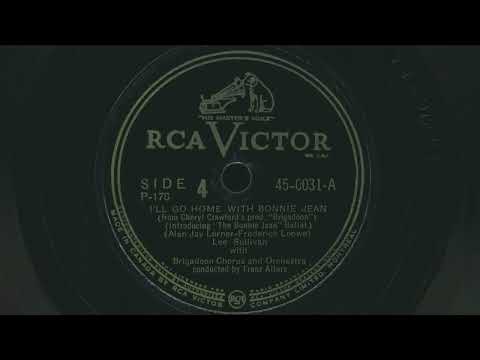
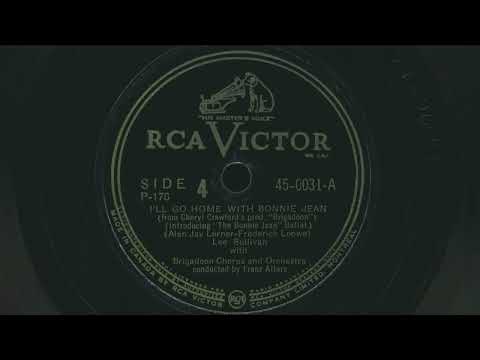
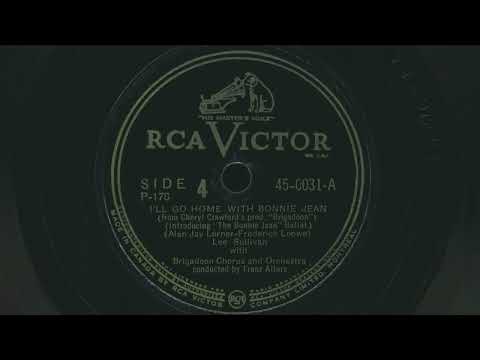
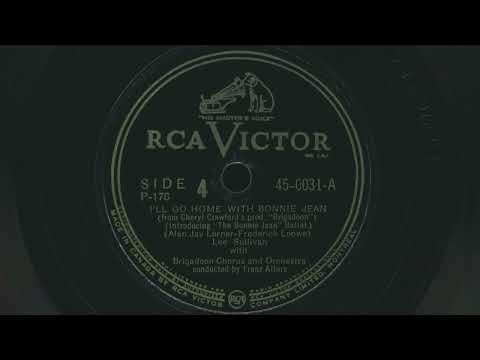
Written by the Lerner and Loewe partnership at their first postwar Broadway peak, “I’ll Go Home with Bonnie Jean” arrived as part of Brigadoon, which opened at the Ziegfeld Theatre on March 13, 1947, directed by Robert Lewis with choreography by Agnes de Mille. The original Broadway cast featured Lee Sullivan as Charlie Dalrymple, Marion Bell as Fiona MacLaren, and David Brooks as Tommy Albright. In early cast recordings of the period, space and disc-length constraints often forced abridgments; still, Lee Sullivan’s cut of “Bonnie Jean” became the tenor’s calling card on the album set issued from that first production.
The show’s mythic village needed music that danced. Loewe answers with a tune that sits somewhere between a reel and a cheery march, leaving room for the locals to chime in - those quick “Go home” refrains are practically the village itself shouting encouragement. The result? A number that plays like a wedding announcement pinned to a drumline.
Highlights
The hook is simple and addictive: “I’ll go home with Bonnie Jean.” The verse structure gives Charlie space to reminisce about his bachelor ways before pivoting to the choice that steadies him. The melodic line sits in the lyric tenor pocket, bright enough to cut over ensemble bustle. Orchestration-wise, expect strings in fiddle-like figuration, woodwinds that flutter around cadences, and percussion that keeps the dance square. You can hear how the chorus is used as a rhythmic engine - short calls that frame Charlie’s phrases without crowding them.
On the original Broadway cast recording, the number clocks just over three minutes - brisk, clean, and built to move the scene into the ensuing dance music. Later studio and film versions sometimes push the tempo and shift keys to flatter different singers, but the character’s buoyant certainty remains the point.
Song Meaning and Annotations
Plot
Early in Act I, two New Yorkers stumble into Brigadoon, a Scottish village that appears for one day each century. Amid the market-day swirl, the community readies for the wedding of Jean MacLaren and Charlie Dalrymple. Charlie’s song is both a personal declaration and a public notice: the roaming days are over; he’s choosing home, commitment, and Jean. The townsfolk echo him - half teasing, half blessing - and the number tips the fair into full celebration.
Song Meaning
At heart, the lyric is about choosing stability over the seductive freedom of drift. Charlie frames this not as a loss but as a gain - “I’ll go home” as a victory cry. The tone stays jaunty, but there’s a subtext of relief: the roving identity was armor; loving Jean lets him set it down. In the broader world of Brigadoon, where time moves strangely and the outside world threatens the town’s spell, the song also reads as a vote for the village’s values - kinship, duty, ritual. It’s a personal arc that doubles as cultural affirmation.
Annotations
“I used to be a rovin’ lad”
Charlie opens with a stock character of folk song - the rover - then flips it. Instead of one more verse cataloging conquests, he turns the trope into a farewell. The contrast sets up the emotional turn that powers the refrain.
“And now across the green / I’ll go home with bonnie Jean”
The “green” places us physically in the fair - the communal turf. The vow happens in front of everyone, which is key: this is less private love note than public rite. The chorus echoes that communal stamp of approval.
“Hello to married men I’ve known / I’ll soon have a wife and leave yours alone”
A wink. The line admits a rake’s past without wallowing. It also shows Lerner’s knack for writing characters who can roast themselves while still staying likable.
Genre and style fusion
The number lives at the intersection of Broadway show tune craft and Scottish dance vernacular. You can hear the influence of reels in the motor rhythms, while the melody still tracks like a mid-40s New York pit-orchestra tune - efficient, singable, and staged to move bodies. When productions add pipes or fiddle colors in the dance music that often follows, the regional flavor sharpens without derailing the show’s idiom.
Emotional arc
Verse one shrugs off roaming. Verse two closes books on past flings. Verse three flashes forward to the life ahead. By the reprise, Charlie, the townsfolk, and even we in the seats are already halfway to the reception.
Cultural touchpoints
The song sits right where Broadway in the 40s loved to be: folk costume, lively square, a bit of romance, a bit of community theater inside the theater. It is also the sonic neighbor to “The Heather on the Hill” and “Come to Me, Bend to Me,” forming Charlie’s side of the musical’s love-and-ritual triptych.
Key Facts
- Artist: Lee Sullivan (Actor) with the Original 1947 Broadway Cast
- Featured: Townsfolk/Ensemble
- Composer: Frederick Loewe
- Lyricist: Alan Jay Lerner
- Producer: (cast album era) RCA Victor team for 78 rpm set; later reissues by Masterworks
- Release Date: 1947
- Genre: Broadway show tune; Scottish dance-inflected
- Instruments: Orchestra (strings, woodwinds, brass, percussion); chorus; optional pipes/fiddle color in dance sections
- Label: RCA Victor (original 78s); later Masterworks Broadway reissues
- Mood: celebratory, brisk, community-forward
- Length: approx. 3:07 (original cast recording)
- Track #: 4 on Brigadoon (Original 1947 Broadway Cast)
- Language: English
- Album: Brigadoon (Original 1947 Broadway Cast)
- Music style: uptempo reel-like chorus with tenor lead
- Poetic meter: anapestic-leaning lines with alternating lengths
Canonical Entities & Relations
- Alan Jay Lerner - wrote lyrics to “I’ll Go Home with Bonnie Jean.”
- Frederick Loewe - composed the music.
- Lee Sullivan - originated Charlie Dalrymple on Broadway and recorded the song with the 1947 cast.
- Agnes de Mille - choreographed the original production where the number fuels village dance.
- Robert Lewis - directed the 1947 Broadway staging.
- RCA Victor - released the original cast album on 78s in 1947; Masterworks Broadway later reissued the score.
- MGM - produced the 1954 film in which the number appears with Gene Kelly, Van Johnson, and chorus.
Questions and Answers
- Where does the song appear in the show?
- Act I, during the fair in MacConnachy Square, just as the town is buzzing for the Jean-Charlie wedding.
- What character sings it and why?
- Charlie Dalrymple sings it to announce, joyfully and publicly, that he is choosing marriage and home over bachelor wandering.
- What makes Lee Sullivan’s original cut special?
- He sets the template: light-on-the-feet tenor, crisp diction, and a tempo that invites the ensemble to snap in on the “Go home” responses without smothering the lead line.
- How does the film version treat the number?
- The 1954 MGM adaptation keeps the song but absorbs it into a larger village bustle, with Gene Kelly and Van Johnson folded into the on-screen celebration. Studio dubbing supports the ensemble sound while preserving the dance momentum.
- Is there a definitive key?
- No single key rules. The stage tradition often sits around G major for a lyric tenor; studio and revival albums may transpose to flatter specific singers.
- Does the song ever slow down?
- Tempos vary by production. Some versions lean into a reel-like clip; others sit a notch under that, letting the chorus interjections punch a little harder. Either way, it is meant to feel like a procession breaking into dance.
- What other recordings are worth hearing?
- The 1957 studio cast album (with Frank Porretta as Charlie) offers a cleaner, fuller soundstage than the 1947 discs; the film soundtrack (with Gene Kelly, Van Johnson, and chorus) shows how the number plays inside MGM’s widescreen village.
- Any notable cover beyond cast albums?
- Concerts and compilation records pop up - from studio revivals to soloists singing it in Lerner & Loewe programs - but this song primarily lives in the cast-recording ecosystem.
- What is the lyric’s sneakiest joke?
- “I’ll soon have a wife and leave yours alone.” It’s Lerner letting Charlie roast his old roving self while staying charming.
Awards and Chart Positions
The song itself did not chart as a single in the late-1940s market, where original cast albums were issued on 78 rpm sets and early LPs. Its most visible awards context is through the 1954 MGM film adaptation of Brigadoon, which featured the number and received three Academy Award nominations (Art Direction - Set Decoration, Costume Design, and Sound) and won a Golden Globe for Color Cinematography.
| Year | Recognition | Category | Result |
|---|---|---|---|
| 1955 | Academy Awards (film) | Art Direction - Set Decoration (Color) | Nominated |
| 1955 | Academy Awards (film) | Costume Design (Color) | Nominated |
| 1955 | Academy Awards (film) | Sound Recording | Nominated |
| 1955 | Golden Globes (film) | Cinematography (Color) | Won |
How to Sing I’ll Go Home with Bonnie Jean
Voice type: lyric tenor. Typical stage range for Charlie Dalrymple sits roughly D3 up to G4, with the line living in bright middle register. Keys vary by edition and revival; G major is common. Tempos span about 120-130 BPM in many cast and film renditions, though some concert versions ease closer to the upper 80s in triple-feel arrangements. Treat the rhythm like a reel: buoyant, forward, and clean on consonants.
Step-by-step
- Tempo: Set a metronome around 124 BPM and check that you can keep the chorus responses crisp if sung with the ensemble. If your accompaniment uses a triple-feel variant, subdivide in 3 and keep the pick-ups tight.
- Diction: Lean into clean plosives on “go home” and keep “bonnie Jean” legato - contrast matters. Light Scottish flavor is fine; clarity beats accent work.
- Breath: Plan a quick top-up before “And now across the green” so the phrase lands without a squeeze. This song prefers buoyant airflow over big dramatic tanks.
- Flow/rhythm: Sit slightly on the front of the beat. Imagine leading a processional - you are the pace car for the town.
- Accents: Shape the verse with a small lift on the last word of each line; it keeps the patter from flattening. Then let the refrain ride up and out.
- Ensemble/doubles: If your production adds offstage or onstage chorus replies, cue them with your eyes or a tiny breath. You are the fulcrum - give them something to bounce off.
- Mic craft (concert use): Keep the capsule 6-8 inches off center to avoid plosive thumps on “go.” For the final refrain with chorus, pull back slightly to avoid clipping.
- Pitfalls: Rushing the pickups; over-darkening vowels (which kills the dance); and pushing the final money note when your breath could do the job if you stayed buoyant.
Practice materials: look for rehearsal tracks in G major, plus published P/V/G charts. A slower practice take at ~110 BPM helps lock crisp consonants before returning to show pace.
Additional Info
Original Broadway context: The show opened March 13, 1947, at the Ziegfeld Theatre and ran for more than 580 performances, with Agnes de Mille’s choreography anchoring its village rituals. Playbill’s historical note confirms Lee Sullivan in the role of Charlie Dalrymple and paints the opening-day picture - a specific cast list that fixes this song’s first Broadway voice.
Cast-album ecosystem: Early cast recordings were often incomplete due to 78 rpm side limits. “Bonnie Jean” survived intact because it is compact and action-driving. Later, a 1957 studio cast album under Lehman Engel with Jack Cassidy, Shirley Jones, and Frank Porretta gave the score a modern sonic refresh - a recording many singers still use for reference. As stated by the Masterworks Broadway site, Porretta is credited as Charlie on that album.
Film afterlife: In MGM’s 1954 adaptation, “I’ll Go Home with Bonnie Jean” appears with Gene Kelly and Van Johnson woven into the village pageant. The movie’s awards pedigree - Oscar nominations and a Golden Globe win - kept the score in circulation on LP reissues and later CD releases. Those film credits shelter the song’s long afterlife beyond the stage.
Keys and tempos in the wild: Theater libraries and accompaniment vendors commonly provide the number in G major for a lyric tenor; several film and pop-crossover compilers list the film track near 128 BPM in G major. Conversely, some concert renditions sit down around the 80s in a triple-feel re-groove, proving the piece is structurally strong enough to flex without losing its grin.
Sources: Playbill; Wikipedia; Masterworks Broadway; IMDb; Overtur; Discogs; Apple Music; Amazon Music; Spotify; Wise Music Classical.
Music video
Brigadoon Lyrics: Song List
- Act 1
- Overture
- Once in the Highlands
- Brigadoon
- Vendor's Calls / Down on MacConnachy Square
- Waintin' for My Dearie
- I'll Go Home With Bonnie Jean
- The Heather on the Hill
- Love of My Life
- Jeannie's Packin' Up
- Come to Me, Bend to Me
- Almost Like Being in Love
- Act 2
- Chase
- There But for You Go I
- My Mother's Wedding Day
- From This Day On
- Finale