From This Day On Lyrics — Brigadoon
From This Day On Lyrics
Dinna ye know, Tommy, that ye're all I'm livin' for?
So how can ye go, Tommy, when I'll need ye more an' more?
TOMMY:
(spoken)
No, Fiona. You won't remember that way. And neither will I.
(sung)
You and the world we knew will glow, till my life is through;
For you're part of me from this day on.
And someday if I should love, it's you I'll be dreaming of,
For you're all I'll see from this day on.
These hurried hours were all the life we could share.
Still, I will go with not a tear, just a prayer
That when we are far apart, you'll find something from your heart
Has gone! Gone with me from this day on.
(spoken)
You see? We mustn't be sorry about anything.
FIONA:
I'm not. In fact, I shouldna be surprised if I'll be less
lonely now than I was afore ye came. I think real loneliness
is no' bein' in love in vain, but no' bein' in love at all.
TOMMY:
But it'll fade in time.
FIONA:
No. It winna do that.
(sung)
Through all the years to come, an' through all the tears to come,
I know I'll be yours from this day on.
Song Overview
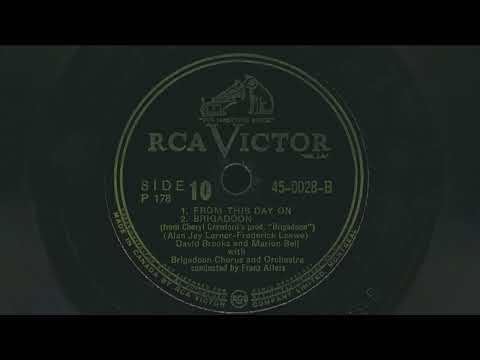
“From This Day On / Brigadoon” is the musical’s parting heartbeat - a quiet pledge that swells into a communal benediction. In the 1947 Broadway production, David Brooks and Marion Bell carry the intimate duet, then the ensemble answers with a final invocation of the town’s name. The structure is simple and potent: private promise, public memory. By the time the chorus lifts “Brigadoon,” the lovers’ fragile plan has become a wider vow - the village itself singing them forward.
Review and Highlights
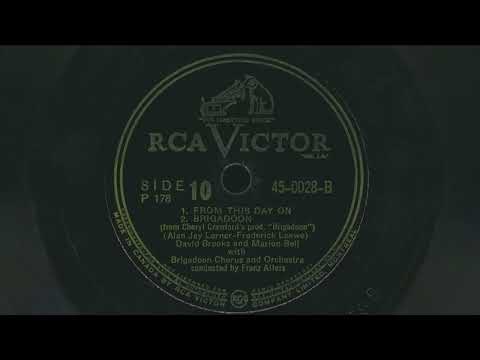
Quick summary
- Function: Late Act II love duet that resolves Tommy and Fiona’s dilemma, pivoting into the show’s closing tableau.
- Forces: Two principal voices - Tommy and Fiona - then chorus and orchestra shaping the closing cadence on “Brigadoon.”
- Recordings: Preserved on the 1947 original cast album and reinterpreted in the 1954 film soundtrack and later revivals, including the 2017 City Center cast recording.
- Story impact: The lyric seals the emotional contract while the reprise of the title word folds personal love back into the town’s mythology.
- Style: A lyrical Broadway ballad set in clean, unhurried phrases, expanding into a ceremonial choral close.
Creation History
Song and scene were crafted to solve two problems at once: give the leads an honest, unfussy farewell and land the musical with a firm sense of place. Alan Jay Lerner’s lyric moves in direct statements - no grand metaphors, just quiet claims - while Frederick Loewe answers with legato lines designed for breath and blend. In the pit, the orchestrations shape a corridor from intimacy to pageant: strings cushion the duet, winds answer with short sighs, and then the brass enters on the choral “Brigadoon.” Onstage, Agnes de Mille’s original staging treated the coda as a living picture - townsfolk assembling into a final pattern as the promise hangs in the air. Film and later concert versions follow the same arc, sometimes renaming the closing material “Farewell Music.”
Highlights and takeaways
- Duet-to-chorus architecture: The song starts in two solo lines and ends as a crowd ritual - a smart way to carry private feeling into public myth.
- Plainspoken poetry: Lines like “For you’re part of me” and “These hurried hours” read almost like letters, which keeps the ending human.
- Motivic recall: The final “Brigadoon” re-centers the title idea - the town as an ideal - so curtain falls on place as much as on people.
- Revival resilience: The number adapts well across mediums, from cast albums to the MGM film and modern concert presentations.
- Performance grace note: The music invites restraint. When sung cleanly, the piece lands with more light than weight.
Song Meaning and Annotations
Plot
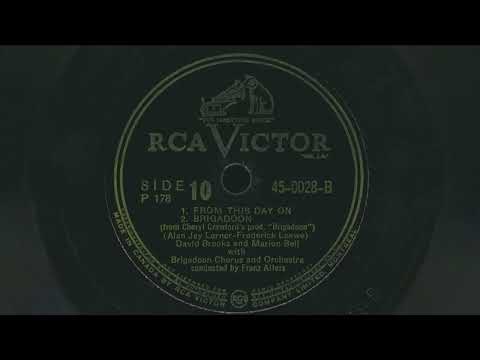
Near the end of Brigadoon, Tommy must decide whether to return to New York or trust the legend and stay with Fiona. “From This Day On” is the pivot - an oath said softly. They don’t sing about forever; they sing about this day on, which is braver in context. Then the ensemble’s “Brigadoon” rises like a lantern, carrying their vow into the square. It’s not just curtain music; it’s the town affirming that the choice has meaning beyond two people.
Song Meaning
The lyric frames love as continuity rather than conquest. “You and the world we knew will glow” sounds less like a fireworks show, more like afterlight. The music agrees: cadences avoid overreaching, and the harmony sits close to the home key until the finale asks the chorus to make the promise communal. In a story about time slipping, the phrase “from this day on” is deliberately modest - a tether to the present that admits uncertainty and still chooses.
Annotations
“These hurried hours were all the life we could share”
The show never hides its time pressure, and this line is the cleanest distillation of that theme. The lovers refuse to dress it up; they recognize the short window and sing into it without flinching.
“Still I will go with not a tear, just a prayer”
The ethics of leaving - and its cost - ride in that contrast. No sobbing finale, just a grown-up wish. The restraint gives weight to the later choice to return.
“Through all the years to come”
Fiona’s voice opens the time horizon again. Placed next to Tommy’s grounded lines, it sketches a relationship with two kinds of courage: his practical hope, her long view.
Harmony, melody, and the folk tint
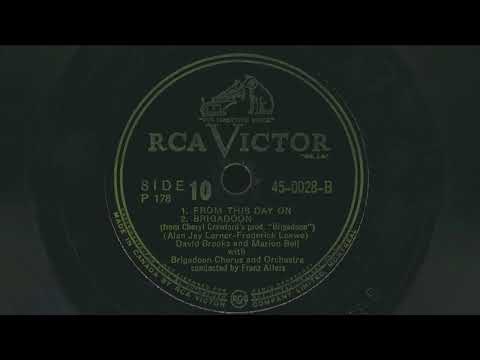
The ballad sits in a comfortable major key with brief modal turns that hint at Highland color without leaning on caricature. Melodic intervals are stepwise, with just enough lift on words like “glow” and “prayer” to let the voice bloom. When the chorus enters on “Brigadoon,” the harmony widens - thirds and sixths blooming into fuller triads - giving the finale its ceremonial air.
Emotional arc
The song keeps its head. It starts at the human scale and grows only as far as it needs to. That coolness is a feature, not a bug: by refusing to oversell, it trusts the audience to feel the risk of love against the clock. It’s the opposite of a barn-burner, and that’s why it works.
Touchpoints and echoes
Mid-century Broadway loved a last-scene vow - “Some Enchanted Evening” has a cousin in this number - but Brigadoon avoids copying the operetta template. The closing choral word centers the show’s idea of community, and later revivals preserve that choice. According to NME magazine’s capsule on Lerner and Loewe’s Broadway legacy, the pair consistently placed character honesty over vocal showboating, and you hear that instinct here.
Key Facts
- Artist: David Brooks and Marion Bell (Original Broadway cast)
- Featured: Ensemble on the “Brigadoon” finale refrain
- Composer: Frederick Loewe
- Lyricist/Book: Alan Jay Lerner
- Producer (stage): Cheryl Crawford
- Orchestrations (original Broadway): Ted Royal
- Release Date (premiere production): March 13, 1947
- Primary genre: Broadway musical theatre
- Music style: Intimate ballad opening that evolves into ceremonial chorus
- Instruments (pit palette): Strings, woodwinds, horns, harp, discreet percussion
- Label (OBC album): originally issued by RCA Victor; multiple reissues
- Mood: Tender, steady, quietly exultant
- Length (OBC track): roughly 3:20
- Track # on OBC album: 10
- Language: English
- Album: Brigadoon (Original 1947 Broadway Cast)
- Poetic meter: Mostly iambic and anapestic phrases shaped for legato singing
Canonical Entities & Relations
- Alan Jay Lerner - wrote lyrics and book - Brigadoon.
- Frederick Loewe - composed music - Brigadoon.
- David Brooks - portrayed Tommy Albright - originated duet lead.
- Marion Bell - portrayed Fiona MacLaren - originated duet lead.
- Agnes de Mille - choreographed - original Broadway production; won 1947 Tony for Best Choreography.
- RCA Victor - issued - 1947 original cast album on 78 rpm set, later reissued on LP and digital.
- Vincente Minnelli - directed - 1954 MGM film adaptation featuring the song and finale in soundtrack form.
- Ghostlight Records - released - 2017 City Center recording with “From This Day On / Farewell Music.”
Questions and Answers
- Where does “From This Day On / Brigadoon” fall in the show?
- It’s part of the late-Act II sequence that resolves the central love story and ushers in the finale, closing with the ensemble’s “Brigadoon.”
- Who premiered the duet on Broadway?
- David Brooks and Marion Bell on March 13, 1947, at the Ziegfeld Theatre in New York, with the company joining for the closing refrain.
- Is the number in the 1954 film?
- Yes - the song appears on the MGM soundtrack, and film releases feature it in combination with the finale. Gene Kelly’s film recording history includes this title alongside the closing sequence.
- What modern recording should I check out?
- The 2017 New York City Center Encores! album features “From This Day On / Farewell Music,” sung by Patrick Wilson and Kelli O’Hara, offering a clear, contemporary take on the scene-to-finale arc.
- How is the lyric different from bigger show-ending anthems of the era?
- It opts for clarity over fireworks. Short, direct lines build trust. The grandeur lives in the chorus entry, not in vocal acrobatics.
- Are there notable covers away from the stage?
- Studio-cast and film versions dominate. You will find pop and concert renditions, but the piece mostly thrives as theatre music carried by cast albums.
- What does the final “Brigadoon” accomplish dramatically?
- It widens the lens. The lovers’ promise is absorbed into the town’s identity, so the curtain falls on community as well as romance.
- Why does the piece feel so singable?
- Legato lines sit in conversational ranges, with cadences that reward breath control rather than brute power.
- Is this a good audition duet?
- Yes - if you keep it simple and connected. It showcases blend, text honesty, and musical poise without demanding high-velocity pyrotechnics.
Awards and Chart Positions
Stage awards and run: The original Broadway production opened March 13, 1947 and ran 581 performances. Agnes de Mille received the inaugural Tony Award for Best Choreography for Brigadoon. Performers Marion Bell, James Mitchell, and George Keane earned Theatre World Awards that season. The number itself was not a chart single, but the show’s recording history kept it in circulation for decades.
Screen recognition: The 1954 film version, which includes the duet in its soundtrack arc, received multiple Academy Award nominations and is widely anthologized on later soundtrack releases.
How to Sing From This Day On / Brigadoon
Tempo & feel: Treat it as an andante ballad. Conductors often give the verse an easy two-in-a-bar to keep the text buoyant, then broaden slightly for the choral “Brigadoon.” Avoid dragging - the lyric wants forward motion.
Key & transposition: Published vocal selections make the piece transposable. Many cast albums place the duet in a comfortable mid-range major key, with modest stepwise motion that suits lyric baritone-tenor and lyric soprano.
Vocal range notes: Tommy’s line favors middle voice with occasional climbs to a ringing top, while Fiona’s line stays in the speech-lyric pocket with one or two radiant peaks. The ranges are friendly to classically trained and legit Broadway voices.
Common issues: Oversinging the confession, smearing consonants on long legato lines, and losing ensemble focus when the chorus enters. The fix is almost boring: breathe, place, release.
Step-by-step
- Tempo placement: Establish an andante that lets the duet feel conversational. Keep a subtle pulse under sustained syllables so phrases do not stall.
- Diction first: Aim for vowel clarity on sustained notes - “glow,” “prayer,” “heart” - and finish consonants without biting.
- Breathing: Map shared breaths between the duet partners so the thought feels continuous. Save a deeper renewal before the ensemble entry.
- Flow and rhythm: Release vibrato at phrase starts, then let it spin as breath settles. Let the barline pass under you - no bar-by-bar underlining.
- Accents: Lean into meaning words - “world,” “life,” “yours” - with gentle dynamic shaping rather than punchy attacks.
- Ensemble handoff: When the chorus enters on “Brigadoon,” step the solo color back a notch so the choral sonority can bloom without fighting for space.
- Mic craft: If amplified, stay closer in the confession and ease off the mic as the texture opens. Resist breathy whispering - clarity beats haze.
- Pitfalls: Do not rush to sentiment. The song is sturdier when sung as promise, not plea.
Practice material: Work the duet as spoken rhythm first, then sing on a neutral vowel to set legato, then reintroduce text. For the finale, rehearse chorus hums under the solo to practice blend before full text returns.
Additional Info
Recording lineage worth hearing: The 1947 original cast album captures the gentle focus of Brooks and Bell. The 1954 MGM film soundtrack places the number within a studio-shaped finale arc - Gene Kelly’s recorded version is easy to find. Decades later, the 2017 New York City Center cast recording reframes the scene as “From This Day On / Farewell Music,” with Patrick Wilson and Kelli O’Hara carrying the duet into a lean, modern mix. As stated in the 2024 Rolling Stone’s study of cast album listening, revival recordings often reset the ear for classic scores - this track is a model case.
Onstage credits and context: The show’s original run starred David Brooks and Marion Bell and was choreographed by Agnes de Mille, whose work - rooted in Scottish step-dance patterns - helped the musical win early acclaim. According to Playbill’s production vault and IBDB records, the production ran 581 performances and picked up a suite of awards that season. The City Center Encores! staging in 2017, directed and choreographed by Christopher Wheeldon, further burnished the score’s late-modern profile and produced a fresh recording.
Soundtrack presence: The MGM soundtrack places “From This Day On” in combination with the finale, and later reissues document alternate takes and restored material. Cast-album databases and label listings show the title alongside the closing “Brigadoon,” keeping the link between private vow and public farewell intact.
Sources: Masterworks Broadway; Legacy Recordings; Apple Music; CastAlbums; Discogs; Ghostlight Records; Playbill; IBDB; Wikipedia; Spotify; Amazon Music.
Music video
Brigadoon Lyrics: Song List
- Act 1
- Overture
- Once in the Highlands
- Brigadoon
- Vendor's Calls / Down on MacConnachy Square
- Waintin' for My Dearie
- I'll Go Home With Bonnie Jean
- The Heather on the Hill
- Love of My Life
- Jeannie's Packin' Up
- Come to Me, Bend to Me
- Almost Like Being in Love
- Act 2
- Chase
- There But for You Go I
- My Mother's Wedding Day
- From This Day On
- Finale