
Funny Thing Happened On The Way To The Forum, A Lyrics: Song List
About the "Funny Thing Happened On The Way To The Forum, A" Stage Show
The opening of a musical took place on Broadway in May of 1962 in the Alvin Theatre, and then it was transferred to other place, with time.
The show closed only by September 1964 (August), after it revealed 964 exhibitions along with 8 previews, but the idea revived for more than once, not only in the Broadway production, but also in London, Hong Kong, Startforde, and even in Melbourne, where it was shown for the last time in October of 2012. In London's West End musical was shown twice, both times in 1963.
During pre-running on Broadway, spectacle’s productions received scant reviews, but after J. Robbins was brought in as an advisor, the production found a second life and a following success. This show is quite deservedly won 8 Tony Award, among which occupies a honorably place of Best Musical (of that year). Actors were not left without attention, as the Best Actor award in a Musical received Zero Mostel, who played Pseudolus, the slave. The musical was staged based on the eponymous book by B. Shevelove and L. Gelbart, music was written by fabulous S. Sondheim, it was his first experience on Broadway in writing not only lyrics, but also music.
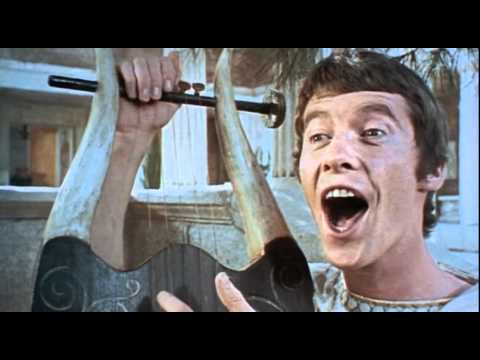
In 1966, the film was shot on the setting, in which Z. Mostel also received a major part, and motion picture, by the way, was nominated for a Golden Globe in the category of "Best Motion Musical / Comedy" in 1967. Choreography did J. Cole & J. Robbins, costumes – T. Walton, and lighting design was handled by J. Rosenthal.
Release date of the musical: 1962
"A Funny Thing Happened on the Way to the Forum" – The Musical Guide & Song Meanings
Review: why these lyrics hit so hard
What’s the trick here: a farce set in ancient Rome that keeps sounding like vaudeville, Broadway, and a con artist’s sales pitch at once? “Forum” is built on speed. Doors slam. Identities swap. The lyrics have to move like feet in a chase, then stop on a dime for a joke that lands cleanly. Sondheim’s words are bright, but they are also sharp. They keep reminding you that this world runs on ownership: of bodies, contracts, houses, even punchlines.
The score is often described as “light” Sondheim, and that is half-true. The craft is already strict. Internal rhyme, exact meter, and comic logic are doing heavy lifting. “Comedy Tonight” functions like a user manual for the whole evening. It tells you what you’re going to get, then dares the show to deliver. The deeper gag is that Pseudolus is a narrator who keeps trying to become an author. His lyrics are bargaining chips. He sings for freedom, then realizes freedom is also a transaction.
Listener tip: try “Free” on two recordings back-to-back. The 1962 original cast album treats it as a clean vaudeville turn. The 1996 revival leans harder into the grin of the scam. Same song, different temperature. The lyric starts to sound less like a dream and more like a hustle.
How it was made
“Forum” opened on Broadway on May 8, 1962, with a book by Burt Shevelove and Larry Gelbart, and music and lyrics by Stephen Sondheim. It was Sondheim’s first Broadway score where he held both jobs at once, and it was built from Plautus with the instincts of TV comedy writers who loved classical mess and modern punchlines.
The famous origin story is also a practical lesson in audience psychology. During the out-of-town tryouts, the show was struggling. Jerome Robbins was brought in as a fixer and pushed for a new opening number that would tell the audience, fast, exactly what kind of night this was. The result was “Comedy Tonight,” written late in the process to replace earlier openers. The number is not subtle. That’s why it works. It resets the room’s expectations before the plot starts racing.
There is a second, quieter behind-the-scenes fact hiding in plain sight. The show’s structure often pauses the story for musical set-pieces. Critics noticed that from the start. That is not a flaw by accident. It is the form. It borrows the rhythm of old comic traditions, where the plot exists to keep the clowns supplied with fresh problems.
Key tracks & scenes
"Comedy Tonight" (Pseudolus / Prologus)
- The Scene:
- Before the plot, before the lovers, before you have time to ask who is who. A presenter steps into a bright wash of light, backed by Proteans who seem to appear from everywhere. The stage feels like a public square and a backstage corridor at the same time.
- Lyrical Meaning:
- This lyric is expectation management as art. It labels the evening’s “ingredients,” then turns the audience into co-conspirators. Pseudolus is telling you the rules so he can break them later without losing you.
"Love, I Hear" (Hero)
- The Scene:
- Hero is alone with a crush so loud it becomes sound effects. The lighting usually narrows, softening the farce into something sincere for a minute.
- Lyrical Meaning:
- The lyric makes him a romantic stereotype on purpose. In a farce, the lovers are not engines, they are triggers. Hero’s earnestness is the spark that lets Pseudolus start selling his big plan.
"Free" (Pseudolus, Hero)
- The Scene:
- A bargain is struck in the open street. The staging often plays like two men signing a contract while smiling too hard. The world around them stays busy, as if Rome itself is eavesdropping.
- Lyrical Meaning:
- It’s the show’s central idea stated plainly: freedom is desired, but it is also priced. The funniest lines are the ones that admit the moral ugliness without slowing the tempo.
"The House of Marcus Lycus" (Lycus, Pseudolus, Courtesans)
- The Scene:
- The brothel becomes a sales floor. Characters are presented like merchandise. Lighting can shift toward nightclub brightness, a hard gloss that matches the transaction.
- Lyrical Meaning:
- The lyric treats exploitation as patter. That choice is the critique. It shows how easily charm can launder something rotten into “business.”
"Everybody Ought to Have a Maid" (Senex, Pseudolus, Hysterium, Lycus)
- The Scene:
- Senex arrives with appetite and entitlement, and the stage suddenly feels smaller. The number often plays in broad, sunny light, which makes the hypocrisy look even sharper.
- Lyrical Meaning:
- It is funny because it is shameless. The lyric paints privilege as a sing-along. Underneath, it tells you exactly what kind of Rome this is: one where service is assumed and desire is defended as tradition.
"I’m Calm" (Hysterium)
- The Scene:
- Chaos piles up. Hysterium tries to keep the household from combusting. The staging often turns him into a human pressure valve, twitching in a tight spotlight while everyone else barrels past.
- Lyrical Meaning:
- This is panic written as precision. The lyric is a comic lie that keeps repeating until it becomes music. It also reveals the cost of being the person who has to “manage” everyone’s farce for them.
"Bring Me My Bride" (Miles Gloriosus, Company)
- The Scene:
- A soldier arrives like a marching band with an ego problem. The lighting usually goes hotter and bolder. Helmets gleam. The street becomes a parade route.
- Lyrical Meaning:
- The lyric is conquest as romance, and it is meant to be repulsive and hilarious at once. The joke is the certainty. Miles never doubts he deserves what he wants, so the song becomes a portrait of entitlement.
"That Dirty Old Man" (Domina)
- The Scene:
- Domina returns with suspicion already loaded. Many productions sharpen her presence by cooling the light, making her feel like the one character who can freeze the clowning on contact.
- Lyrical Meaning:
- The lyric weaponizes moral clarity. Domina’s anger is also a kind of justice, even when the show frames it as comic. She sees the system and she names the men who benefit from it.
"Funeral Sequence and Dance" (Company)
- The Scene:
- A staged death becomes a logistical circus. Bodies move. Stories get invented on the spot. The number can look like a choreographed accident, with the stage picture constantly re-forming.
- Lyrical Meaning:
- Farce reaches its purest form here: lies multiply faster than anyone can track them. The lyric function is momentum. It keeps the audience laughing while the plot runs near the edge of collapse.
Live updates 2025/2026
Information current as of January 24, 2026. “Forum” is not in an active Broadway run, but it is very alive in the licensing ecosystem, which is exactly the kind of show this is built for: big ensemble energy, a single street set, and roles that let performers go for broke. Music Theatre International continues to represent the title for productions and materials.
Recent and upcoming staging trends lean into reinvention. A notable example in the Washington, D.C. area was Signature Theatre’s 2024 production, reviewed as a gender-bending update with mixed payoff: the concept intrigued, the laughs were not always as automatic as the material’s reputation suggests. That push-and-pull is the modern “Forum” question. How much do you stylize the carnality, and how much do you let the language do the work?
On the calendar, smaller and mid-size venues keep the show visible. Axelrod Performing Arts Center publicized a May 1–17, 2026 run in Deal, New Jersey. In Australia, CentreStage announced performances scheduled for September 18 to October 4, 2026. These are not “revivals” in the Broadway sense. They are the real afterlife of a classic: repeated, local, and shaped by the room’s taste.
Notes & trivia
- The original Broadway production opened May 8, 1962 and closed August 29, 1964, after 964 performances and 8 previews.
- “Comedy Tonight” was added late in the process after Jerome Robbins advised that the audience needed a clearer signal of tone.
- The show’s entire action is built on one Roman street, in front of three neighboring houses, which is why directors can turn pacing into the main special effect.
- MTI lists the vocal range top as G5 and bottom as B3 (useful when casting the comic extremes).
- Every Broadway actor who opened as Pseudolus (Mostel, Silvers, Lane) won a Tony for the role, a statistic that tells you what the part is: a prizefight.
- Many productions trim “Pretty Little Picture,” and revivals have swapped songs in and out (including Sondheim additions for the 1972 revival).
- The 1966 film adaptation is also remembered for featuring Buster Keaton in his final on-camera appearance.
Reception
Critics have long agreed on the main point: it works when the performers attack it with fearless rhythm, and when the production embraces the show’s formal wink. The book is a machine. The lyrics are the oil that lets it run hot without seizing. Over time, “Forum” has also become a useful lens on changing comfort levels with sexual comedy. Modern productions often re-balance the joke target, shifting the laugh away from “the women” and toward the men who treat women as prizes.
“A Funny Thing Happened on the Way to the Forum is both a nostalgic throwback and a pioneering experiment.”
“Stephen Sondheim has inserted a group of songs that literally stop the show.”
“A production most intriguing for its gender-bending updates.”
Quick facts
- Title: A Funny Thing Happened on the Way to the Forum
- Year: 1962 (original Broadway opening)
- Type: Musical comedy farce
- Book: Burt Shevelove, Larry Gelbart
- Music & Lyrics: Stephen Sondheim
- Setting: A street in ancient Rome, in front of the houses of Erronius, Senex, and Lycus
- Original Broadway run: May 8, 1962 to Aug 29, 1964 (964 performances; 8 previews)
- Selected notable placements: “Comedy Tonight” as a prologue that defines tone; “Free” as the freedom bargain; “Everybody Ought to Have a Maid” as the entitlement anthem; “I’m Calm” as the panic engine; “Funeral Sequence and Dance” as peak farce momentum
- Album status: Original Broadway cast recording (1962, Capitol) widely available on major streamers; 1996 Broadway revival cast recording (Angel); motion picture soundtrack (1966) also in circulation and has seen expanded reissues
Frequently asked questions
- Is “Forum” typical Sondheim?
- It is early Sondheim, and it is deliberately broad. The lyric technique is already meticulous, but it is pointed at farce: speed, clarity, and punchline logic.
- Why is “Comedy Tonight” so important?
- It teaches the audience how to watch the show. It was added late after the creative team realized the evening needed a clearer tone-setter.
- What is the show actually about, underneath the jokes?
- It’s about bargaining. Pseudolus bargains for freedom. Everyone else bargains for love, sex, status, or safety. The comedy comes from watching those deals go wrong at high speed.
- Is there a movie version?
- Yes. A film adaptation was released in 1966, and it helped keep the title in the public ear between stage revivals.
- What recording should I start with?
- Start with the 1962 original Broadway cast recording for the cleanest sense of the show’s musical architecture. Then try the 1996 revival cast recording to hear how modern comic timing reshapes the same lyric patterns.
- Is it being staged in 2026?
- Yes, in licensed productions. Examples announced for 2026 include a May run at Axelrod Performing Arts Center in New Jersey and a September to October run announced by CentreStage in Australia.
Key contributors
| Name | Role | Contribution |
|---|---|---|
| Stephen Sondheim | Composer, lyricist | Wrote a score engineered for farce: exact meter, fast patter, and jokes that land on musical accents. |
| Burt Shevelove | Book writer | Helped shape Plautus into a modern comic machine of disguises, doors, and escalating complications. |
| Larry Gelbart | Book writer | Brought TV-comedy precision and a taste for punchy structure to the show’s farce mechanics. |
| Harold Prince | Producer | Produced the original Broadway production and helped steer the show through a difficult tryout period. |
| George Abbott | Director (original Broadway) | Directed the Broadway production that cemented the show’s street-set pacing and comic clarity. |
| Jerome Robbins | Creative consultant / staging | Advised key tryout fixes, including the push for a new opening number that became “Comedy Tonight.” |
| Jack Cole | Choreographer (original Broadway) | Built movement that reads quickly and supports the chase-like rhythm of the farce. |
| Tony Walton | Scenic & costume design (original Broadway) | Created a Roman world that could hold both classical reference and comic exaggeration. |
| Jean Rosenthal | Lighting design (original Broadway) | Used light to keep focus clean and timing sharp on a set where entrances are everything. |
Sources: IBDB, Music Theatre International, Everything Sondheim, The Guardian, The Washington Post, Apple Music, Spotify, Discogs, Overture (ovrtur), CentreStage, Axelrod Performing Arts Center, CastAlbums.org, Washingtonian.