
Big Fish Lyrics: Song List
- Act 1
- Prologue
- Be the Hero
- The Witch
- Take Another Look
- Stranger
- Two Men in My Life
- Ashton's Favorite Son
- Out There on the Road
- Little Lamb from Alabama
- Time Stops
- Closer to Her
- Daffodils
- Act 2
- Red, White and True
- Fight the Dragons
- Showdown
- I Don't Need a Roof
- Start Over
- What's Next
- How It Ends
- The Procession
- Be the Hero (Reprise)
About the "Big Fish" Stage Show
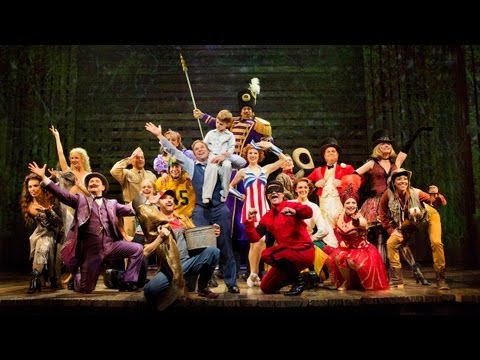
Big Fish is a musical with music and lyrics by Andrew Lippa and a book by John August. It is based on Daniel Wallace’s 1998 novel, Big Fish: A Novel of Mythic Proportions, and the 2003 film Big Fish written by August and directed by Tim Burton.
Big Fish revolves around the relationship between Edward Bloom, a travelling salesman, and his adult son Will, who looks for what is behind his father’s tall stories.
The story shifts between two timelines. In the present-day real world, sixty-year-old Edward Bloom faces his mortality while Will prepares to become a father himself. In the storybook past, Edward ages from a teenager, encountering a Witch, a Giant, a Mermaid, and the love of his life, Sandra. The stories meet as Will discovers the secret his father never revealed.
The musical plot differs from the 2003 film in certain aspects. The mythical town of Spectre - and Edward's quest to save it from destruction -- has been folded into Edward's home town of Ashton. In the musical, The Witch and Jenny Hills are two distinct characters. In the film, Jenny Hill and The Witch were aspects of the same character played by Helena Bonham Carter. The character of Norther Winslow, played by Steve Buscemi in the film, doesn't exist in the musical, nor do conjoined twins Ping and Jing.
Release date of the musical: 2013
“Big Fish” – The Musical Guide & Song Meanings
Review
Is Edward Bloom a liar, or just a man who can’t bear to be ordinary in front of the people he loves most? Big Fish turns that question into a tug-of-war between a father and a son, and it does it with lyrics that often sound like they were written to be understood on the first listen. That simplicity is the strategy. Andrew Lippa’s text keeps returning to the same emotional mechanism: when the facts are painful, Edward changes the frame, not the feeling. John August’s book, adapted from his own film screenplay and Daniel Wallace’s novel, makes the storytelling itself the plot. Will doesn’t need more stories. He needs a reason his father chose stories over answers.
Musically, Lippa writes with two engines running at once. One is bright, theatrical momentum, built for ensemble storytelling and Stroman’s kinetic stage pictures. The other is a quieter, plainspoken line that keeps surfacing in the love songs and late-show reckonings. That split mirrors the central relationship: myth on the outside, grief underneath. When the score lands, it gives you a rare Broadway sensation, a big stage choosing intimacy at the exact moment it could go louder.
How It Was Made
The creation story of Big Fish is almost on-theme: a chain of “can you believe this happened?” moments that ends in a real show. John August has said the impulse was there even while the film was being finished, because a story about storytelling “lends itself naturally to song.” The partnership clicked fast once Andrew Lippa joined. In a Broadway Direct interview, Lippa describes calling producer Bruce Cohen after meeting him at a party, only to learn Lippa was already on the shortlist. Then August and Lippa met in 2003, drove to Palm Springs, rented a house “which had a piano and a pool,” and wrote the first two scenes with two songs in a few days. The producers heard them and committed. It’s not romantic because it’s easy. It’s romantic because it sounds like an Edward Bloom anecdote that turns out to be documented.
On the production side, the scale was never modest. Susan Stroman directed and choreographed. The Broadway run opened at the Neil Simon Theatre in October 2013 and closed that December. The show’s afterlife has been shaped by edition choices. Some licensed versions swap in songs like “Magic in the Man” and “The River Between Us,” adjusting how the family conflict is voiced, and how directly the score puts Sandra’s inner life in front of us.
Key Tracks & Scenes
“Be the Hero” (Edward, Company)
- The Scene:
- Act I begins in a story-space that can flip from real to myth in a breath. Edward teaches a fisherman, and the stage leans into rhythmic folk-play. The lighting usually reads warm and open, like a memory you can walk into, while the ensemble helps Edward “build” the tale around Will.
- Lyrical Meaning:
- The hook is a mission statement. Edward’s lyrics don’t argue that you should be famous. They argue you should be active inside your own life. It’s the seed of both Edward’s charm and his damage: heroism as a refusal to sit still with pain.
“The Witch (I Know What You Want)” (The Witch, Edward, Company)
- The Scene:
- Teenage Edward meets the Witch, and the stage language shifts into a ritual. In synopsis and song listings, this moment is anchored early in Act I, before adult relationships harden. Designers often treat it like a controlled nightmare: angled shadows, smoke, and a sense of the woods watching back.
- Lyrical Meaning:
- The Witch offers a deal that is also a philosophy: fear shrinks the life you get. The lyric makes destiny sound like a choice you can rehearse. It’s seduction through certainty, and it becomes Edward’s lifelong habit, naming the ending so he can sprint away from the present.
“Stranger” (Will)
- The Scene:
- In the present-day timeline, Will faces the audience without the comfort of Edward’s fantasy machinery. The staging often clears. The light tightens. It’s a son asking what it means to live next to a man who is famous in the room but absent in the details.
- Lyrical Meaning:
- Will’s lyric is the inverse of Edward’s. Edward inflates. Will subtracts. The song frames resentment as grief that never got translated. The title word matters: the wound isn’t just that Edward lies, it’s that Will doesn’t feel known.
“Two Men in My Life” (Sandra)
- The Scene:
- Still in Act I, Sandra is placed between father and son, and the stage stops treating the conflict as a joke. In some editions this slot is replaced by “Magic in the Man,” shifting the focus, but the dramatic job remains: Sandra as the human bridge.
- Lyrical Meaning:
- Sandra’s lyrics are the show’s moral pressure. She loves Edward’s light, but she also has to live in his shadow. Her language is clear, not ornamental, because she’s the character who pays bills, keeps appointments, and stays when the magic stops being cute.
“Time Stops” (Edward, Sandra)
- The Scene:
- Edward and Sandra fall in love inside a stage picture designed to feel suspended. Many productions treat this as a soft-focus memory: slowed movement around them, warmer color temperature, and the sense that the ensemble has turned into scenery.
- Lyrical Meaning:
- Edward’s gift is making a moment feel infinite. The lyric sells romance as a kind of spell. It’s beautiful, but it also warns you. If time “stops” only when Edward narrates it, what happens to the parts of life that don’t flatter him?
“Daffodils” (Edward, Sandra, Ensemble)
- The Scene:
- Act I’s famous love gesture blooms into a full stage event, and most productions play it as the point where myth becomes communal. Yellow floods the visual field. The effect is engineered to feel impossible, even when you can guess the stagecraft.
- Lyrical Meaning:
- The lyric is a promise delivered as spectacle. Edward doesn’t say “I love you” once. He says it a thousand times in the form of effort. It’s romantic and slightly alarming, because Edward’s language of love is escalation.
“Fight the Dragons” (Edward, Young Will)
- The Scene:
- Act II turns toward legacy. Edward coaches Young Will, and the staging often echoes bedtime storytelling but with a tougher edge. Light and blocking frequently put Will lower, looking up, while Edward’s confidence fills the space like a sermon.
- Lyrical Meaning:
- Edward translates fear into myth so his son can carry it. The lyric is both blessing and burden. “Dragons” become the catch-all metaphor for life’s bruises, but the song also hints at what Edward can’t say plainly: “I’m scared too.”
“How It Ends” (Edward)
- The Scene:
- Near the end, Edward is dying and asks Will to tell him the story of his death. The show often narrows to a hospital-world that gradually fills with Edward’s characters, as if imagination is arriving to escort him out. The lighting typically softens, not to sweeten the moment, but to make room for surrender.
- Lyrical Meaning:
- This is the score’s reckoning with control. Edward has tried to author everything. Here, he lets Will write. The lyric is simple because the character is finally out of tricks. He can’t out-story mortality. He can only choose the emotional truth he leaves behind.
Live Updates
As of 2025 and 2026, Big Fish is not a current Broadway production, and it is not circulating as a single branded commercial tour. Its active life is licensing driven. Theatrical Rights Worldwide continues to offer the title for production, alongside a School Edition and a Small Cast Edition, which keeps the show programmable for schools, community theatres, and regional houses with different resources.
Recent and upcoming listings underline that reality. Forest Theater in California documented a 2025 run, and Mesa Arts Center’s listing shows performances in January 2026 with ticket pricing published as an “all-in” range. For summer 2026, Trinity Theatre Company’s teen intensive advertises a School Edition that explicitly swaps “Two Men in My Life” and “The Showdown” for “Magic in the Man” and “The River Between Us,” a change that can alter how the father-son argument reads on stage. BroadwayWorld listings also show July 2026 dates for a Pennsylvania production. If you are tracking momentum, this is the metric: not Broadway grosses, but the steady drumbeat of new casts choosing the title.
One more data point worth remembering: even in 2013, the show’s commercial fate was tied to demand. Vulture reported that the Broadway production’s ticket sales dipped below 50 percent of potential gross shortly before the early closing notice. In 2026, the story is different. The show’s value is less about premium pricing and more about whether a local audience wants to cry about their parents.
Notes & Trivia
- The Broadway production opened October 6, 2013 and closed December 29, 2013, after 34 previews and 98 performances.
- Andrew Lippa wrote both music and lyrics, with John August writing the book.
- The story’s structure is built on two timelines: present-day family conflict and a “storybook past” of witches, giants, and mermaids.
- John August has said he didn’t want the stage version to feel like he was adapting his screenplay, pushing himself to ask what the “best stage version” of each idea was.
- Some editions and schools programs replace “Two Men in My Life” and “The Showdown” with “Magic in the Man” and “The River Between Us.”
- The original Broadway cast recording was released digitally on February 7, 2014, with a physical release shortly after, produced by Lippa and Michael Croiter.
- Many licensed productions publish explicit “Setting and Musical Numbers” pages in their programs, emphasizing the show’s fluid movement between Ashton, Alabama and Edward’s imagination.
Reception
Big Fish has always split critics along one blunt line: do you hear the score as earnest in the right way, or earnest in the exhausting way? The 2013 Broadway reviews were mixed, with some critics praising the theatrical craft and some arguing the writing stays literal when it needs to be strange. The London Off-West End revival in 2017 reopened the debate, with reviewers often framing the show as close to working, then slipping away at the last moment.
“Apart from a choice hook or two, the score is stillborn, the lyrics so inert they’re tautological.”
“REMARKABLE! A show for everyone who loves musicals.”
“Grammer’s turn as a dad with a penchant for tall tales is the best part of this middling paean to narcissistic fantasy.”
Technical Info
- Title: Big Fish
- Broadway year: 2013 (Neil Simon Theatre)
- Type: Musical drama; adaptation of Daniel Wallace’s novel and the 2003 film (screenplay by John August)
- Book: John August
- Music & Lyrics: Andrew Lippa
- Director/Choreographer (Broadway): Susan Stroman
- Musical director (Broadway): Mary-Mitchell Campbell
- Orchestrations (Broadway): Larry Hochman
- Setting (core): Ashton, Alabama, plus story-realms inside Edward’s imagination
- Selected notable placements (story-locked): “Be the Hero” (Edward’s first story framework), “The Witch (I Know What You Want)” (teen Edward receives his philosophy of fear), “Stranger” (Will defines the wound), “Daffodils” (Edward’s grand romantic myth), “Fight the Dragons” (Edward instructs Young Will), “How It Ends” (Will authors Edward’s final story)
- Cast recording: Big Fish (Original Broadway Cast Recording), released Feb. 7, 2014 (digital), 21 tracks, label: Broadway Records; produced by Andrew Lippa and Michael Croiter
- Licensing / album status: Licensed by Theatrical Rights Worldwide; editions include School Edition and Small Cast Edition
FAQ
- Who wrote the lyrics for Big Fish?
- Andrew Lippa wrote the music and lyrics, with John August writing the book.
- Is the musical based more on the film or the novel?
- It is based on Daniel Wallace’s novel and the Columbia Pictures film, with John August adapting the story for the stage. In interviews, August has emphasized building the “best stage version” of each idea rather than recreating his screenplay.
- What is the main lyrical idea that keeps returning?
- The score keeps circling the belief that you can choose the story you live inside, and that fear is the enemy of a “big” life. Songs like “Be the Hero,” “The Witch (I Know What You Want),” and “How It Ends” treat storytelling as both romance and survival.
- Why do some productions use different songs in Act I and Act II?
- There are licensed editions (including School Edition) that swap specific numbers. One widely noted change replaces “Two Men in My Life” and “The Showdown” with “Magic in the Man” and “The River Between Us.”
- Is Big Fish touring in 2025 or 2026?
- It is not a single headline commercial tour at the moment, but it is actively produced through licensing, with multiple listed runs and school or community productions across 2025 and 2026.
Key Contributors
| Name | Role | Contribution |
|---|---|---|
| Andrew Lippa | Music & Lyrics | Writes the show’s two emotional registers: showtime myth and plainspoken family truth. |
| John August | Book | Turns “storytelling” into structure, framing Will’s investigation as the engine of the plot. |
| Susan Stroman | Director & Choreographer (Broadway) | Builds the physical language of Edward’s tales, then clears space for the quieter confrontations. |
| Mary-Mitchell Campbell | Musical Director (Broadway) | Guides the score’s stylistic pivot between folk-pop lift and intimate dramatic underscoring. |
| Larry Hochman | Orchestrations (Broadway) | Expands Lippa’s melodies into a full theatrical palette that can switch worlds quickly. |
| Theatrical Rights Worldwide | Licensing | Keeps the title in circulation via standard, School Edition, and Small Cast Edition materials. |
Sources: IBDB, Theatrical Rights Worldwide, Playbill, Broadway Direct, Vulture, The Guardian, Apple Music, Wikipedia, BroadwayWorld, Mesa Arts Center, Forest Theater, Trinity Theatre Company.