
Beautiful: The Carole King Lyrics: Song List
- Overture
- So Far Away
-
1650 Broadway Medley

- It Might as Well Rain Until September
- Be-Bop-A-Lula
- Some Kind of Wonderful
- Happy Days Are Here Again
- Take Good Care of My Baby
- Who Put the Bomp
- Will You Love Me Tomorrow
- He's Sure the Boy I Love
- Will You Love Me Tomorrow (Reprise)
- Up on the Roof
- The Locomotion
- You've Lost That Lovin' Feeling
- One Fine Day
- Chains
- Walking in the Rain
- Pleasant Valley Sunday
- We Gotta Get Out of This Place
- Uptown
- It's Too Late
- You've Got a Friend
- (You Make Me Feel Like) A Natural Woman
- Beautiful
- I Feel the Earth Move
- On Broadway
About the "Beautiful: The Carole King" Stage Show
San Francisco hosted the play in 2013 as a part of framework of pre-Broadway run, for 1 month of autumn in Curran Theatre. Director is M. Bruni, J. Prince was responsible for the choreography & J. Howland was the musical director. Jessie Mueller was starring. The high quality of production confirms by the fact that during the whole month, musical tickets have been sold out.
It is not surprising that the Broadway production took place (at Stephen Sondheim Theatre) and played for 4 months, and in autumn of 2015 a tour in the United States began (from September), starting from the Providence Performing Arts Center.
Actors in addition to J. Mueller were the following: J. Spector, A. Larsen & J. Epstein.
West End musical spotted the appearance in February 2015 in the Aldwych Theatre, furthermore the full composition of the cast had been replaced and now there were: L. Want, K. Brayben, I. McIntosh, A. Morrissey, G. Barber & G. Trainor. Since the end of November 2015, there was a change of actors – C. Janson instead of K. Brayben, and D. Keen instead of G. Barber.
US tour began in Rhode Island and throughout the year, till August 2016, with the end in San Francisco, it has to go according to the planned. Abby Mueller will take a major role – the sister of Jessie Mueller, who originally played Carole, and other actors in the lead roles will be L. Tobin and B. Gulsvig.
Release date of the musical: 2013
"Beautiful: The Carole King Musical" – The Musical Guide & Song Meanings
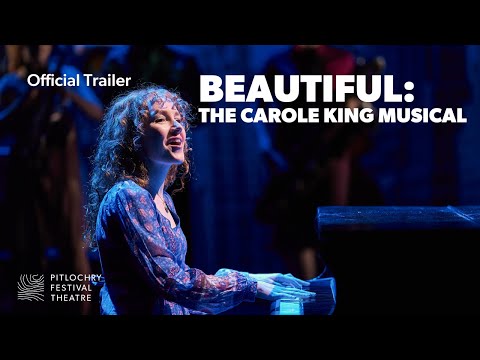
Review
What if the most dramatic thing about a musical is a woman sitting at a piano, trying to stop apologizing for taking up space? Beautiful: The Carole King Musical is built on that friction. It sells you hit songs, sure. But the deeper hook is how the show insists that songwriting is not magic. It is routine, pressure, and taste under fluorescent office light.
Douglas McGrath’s book makes the Brill Building feel like a workplace comedy that keeps turning into a marriage story. The lyric content lands differently because the songs are framed as assignments. “Will You Love Me Tomorrow” is not nostalgia first. It is a deadline. “One Fine Day” is not just a girl-group sparkle bomb. It becomes a performance that Carole has to watch while her own life shifts underneath it. Even when the dialogue is tidy, the lyrics do the heavy emotional lifting. They reveal who gets to speak plainly, who hides inside craft, and who learns to stop asking permission.
Musically, the show is a timeline of American pop on stage: early rock-and-roll cheer, Brill Building polish, then the quieter 1970s singer-songwriter turn where the words have nowhere to hide. That stylistic pivot is the character arc. Carole’s writing moves from “we” to “I”. The score makes that change audible, not just stated.
How It Was Made
The production year in your prompt matters. The musical’s pre-Broadway run premiered in San Francisco in October 2013, before its Broadway opening the following January. That tryout-to-transfer pipeline shaped the show’s tone: brisk, plot-forward, and calibrated for audiences who want story without losing the concert payoff.
There is also a rare kind of authorship anxiety here, discussed openly by the book writer years later: writing a living legend without turning her into a brand mascot. In a published interview, McGrath admits he initially said no because he feared the subject hovering over the script, then changed his mind when he realized she did not present herself as “perfect.” That hesitation is baked into the show’s posture. It keeps returning to the idea that achievement can coexist with mess.
On the licensing side, the current version of the show is tightly standardized. MTI’s licensing listing specifies territorial limits (US and Canada only) and a time-bound performance window for the licensed version, which is a strong indicator of how actively the property is being managed for schools, community theatres, and regional houses.
Key Tracks & Scenes
"So Far Away" (Carole)
- The Scene:
- Carnegie Hall, 1971. A lone piano. The light is concert-clean: warm on her hands, cool beyond the edge of the bench. The story begins at the moment she has “made it,” then refuses to stay there.
- Lyrical Meaning:
- Distance becomes the show’s first metaphor: fame as mileage, love as geography, adulthood as a long commute. The lyric reads like a thesis statement for the whole night.
"It Might As Well Rain Until September" (Carole)
- The Scene:
- 1650 Broadway. A young writer plays in an office building that feels like a hive. The air is ambition and stale coffee. She performs as if her rent depends on the chorus, because it does.
- Lyrical Meaning:
- The lyric is bright, but the subtext is bargaining. Early Carole writes emotional weather reports that double as sales pitches.
"Will You Love Me Tomorrow" (Carole & Gerry, then The Shirelles)
- The Scene:
- Don Kirshner’s office becomes a battleground with smiles. Two songwriting couples audition. When the song is chosen, the stage shifts into the recorded performance, as if the walls turn into a radio.
- Lyrical Meaning:
- Consent, vulnerability, and risk, wrapped in pop simplicity. Within the plot, the lyric also foreshadows a marriage that will keep asking the same question in harsher tones.
"One Fine Day" (Janelle Woods, then Carole)
- The Scene:
- A TV special taping. Glamour hits the stage like a flashbulb. During a break, Gerry admits he wants to sleep with the star and not lie about it. When the number resumes, Carole takes the song over, almost as self-defense.
- Lyrical Meaning:
- The lyric is a fantasy of vindication. In the show’s hands, it becomes a survival move: if your private life is collapsing, you borrow a chorus that promises a future where you win.
"Pleasant Valley Sunday" (Ensemble)
- The Scene:
- Suburbia as an attempted reset. The palette goes pastel. The rhythm is tighter, more mechanical. It feels like a chore list set to harmony.
- Lyrical Meaning:
- In context, the song becomes irony. “Normal” is a costume. The lyric comments on the fantasy of fixing a relationship by changing the zip code.
"It’s Too Late" (Carole)
- The Scene:
- The Bitter End. No costumes, no characters to hide behind, just a microphone and a room that can judge you in real time. Nick urges her to sing. She finally does.
- Lyrical Meaning:
- A break-up lyric that refuses melodrama. The calmness is the knife. The song marks her shift from writing for other voices to claiming her own.
"(You Make Me Feel Like) A Natural Woman" (Carole)
- The Scene:
- Los Angeles studio, the final song. She hesitates because it was written with Gerry and the memory is still hot. Lou Adler convinces her to record it. The room holds its breath.
- Lyrical Meaning:
- The lyric is about being seen. In the plot, it is also about reclaiming work that came from a complicated partnership. The performance turns the past into something she can carry without collapsing.
"Beautiful" (Carole)
- The Scene:
- Back to Carnegie Hall. She enters alone, sits at the piano, and lets the concert frame complete the arc. The light widens. The stage becomes a room big enough for joy.
- Lyrical Meaning:
- Not triumph as revenge. Triumph as relief. The lyric is a permission slip she finally signs for herself.
Live Updates
In 2025, the most “current” version of Beautiful is not a single Broadway run. It is a touring-and-regional ecosystem. Carole King’s official site posted an updated list of 2025 engagements across US regional theatres and presenting houses, which signals ongoing demand outside the old national tour model. MTI’s licensing page for the show also states that performances of the licensed version must take place by a listed cutoff date, reinforcing that the title is actively circulating in the amateur and regional market.
UK demand remains visible into 2026. Ticketmaster UK lists “Beautiful: the Carole King Musical (Touring)” with 2026 show dates, suggesting a continuing venue pipeline even when specific city-by-city announcements vary by presenter.
For 2025–26, the title is also being programmed as a season anchor. A 2025–26 season announcement from Houston’s Theatre Under The Stars includes Beautiful as a late-season slot in 2026, a sign that presenters still treat it as a reliable bridge between classic-theatre subscribers and pop-catalog audiences.
The movie adaptation is in flux. Sony announced a film version years ago, and a later casting announcement put Daisy Edgar-Jones in the lead with Lisa Cholodenko directing. Reporting in 2024 indicates Edgar-Jones exited the project, leaving the adaptation’s next steps unclear and worth watching, especially if a new star attachment changes the timeline.
Notes & Trivia
- The show’s pre-Broadway tryout opened in San Francisco in October 2013, before its Broadway opening in January 2014.
- IBDB lists the Broadway production’s first preview as November 21, 2013, opening night January 12, 2014, and closing October 27, 2019.
- The cast recording was released in 2014 and later won the Grammy Award for Best Musical Theater Album (presented at the 2015 ceremony).
- MTI’s synopsis bakes song placement into the narrative: “One Fine Day” is staged as a TV special performance that Carole takes over mid-crisis.
- MTI’s licensing listing specifies a US/Canada territory note and a performance window for the licensed version, reflecting the show’s present-day life in regional and amateur spaces.
- Reviews at the time often praised Jessie Mueller’s star-making performance, even when critics argued with the book’s neatness.
Reception
Critics in 2014 largely agreed on the same trade: the show is crowd-friendly, and the storytelling is intentionally straightforward. Where they split is on whether that simplicity is a flaw or a feature. Over time, the reputation has settled into a clearer consensus: Beautiful is less about surprise and more about craft, the pleasure of watching songs get built, then watching a woman decide she deserves to sing them.
“Friendly, formulaic bio-musical.”
“Snazzy stagecraft and a moving performance by Jessie Mueller help this bio-musical overcome its plodding book.”
“We do not get the dramatic coherence of book biomusicals like Funny Girl.”
Technical Info
- Title: Beautiful: The Carole King Musical
- Year: 2013 (pre-Broadway premiere); 2014 (Broadway opening)
- Type: Jukebox biographical musical
- Book: Douglas McGrath
- Words and music by (catalogue): Carole King, Gerry Goffin, Barry Mann, Cynthia Weil (plus other credited writers via included songs)
- Orchestrations: Steve Sidwell
- Broadway theatre and run: Stephen Sondheim Theatre; first preview Nov 21, 2013; opening Jan 12, 2014; closing Oct 27, 2019
- Selected notable placements (script-anchored): “So Far Away” at Carnegie Hall (1971); “Will You Love Me Tomorrow” as a Kirshner office pitch; “One Fine Day” at a TV special; “It’s Too Late” at The Bitter End; finale “Beautiful,” with curtain call “I Feel the Earth Move”
- Cast album: Original Broadway Cast Recording (2014); producers credited on album releases include Billy Jay Stein, Jason Howland, and Steve Sidwell; label releases commonly list Ghostlight with Razor & Tie
- Current availability and status: Ongoing regional engagements (including 2025 listings on Carole King’s official site); UK touring listings show dates into 2026; licensing handled by MTI with a stated performance window for the licensed version
- Film adaptation status: Sony film announced; later casting attached Daisy Edgar-Jones, who reportedly exited in 2024
FAQ
- Is Beautiful a full biography of Carole King’s life?
- No. It focuses on her early songwriting years, her partnership and marriage with Gerry Goffin, and her emergence as a performer, framed by a 1971 Carnegie Hall concert.
- Where do the songs come from in the story?
- Many are shown as “work”: pitches in Don Kirshner’s office, rehearsals, TV performances, and recording sessions. MTI’s synopsis explicitly ties several songs to specific plot events.
- Does the show include songs that are not strictly Carole King solo hits?
- Yes. The score includes Brill Building-era material associated with other artists and songwriting teams, including Barry Mann and Cynthia Weil numbers, because the show is about a whole pop ecosystem.
- Is there a movie version?
- A film adaptation has been announced by Sony, and later reporting attached then removed a lead actor. As of the most recent reporting, the project’s timeline and cast are unsettled.
- Can theatres license the show right now?
- Yes, in the US and Canada through MTI, subject to their listed licensing terms and performance window.
Key Contributors
| Name | Role | Contribution |
|---|---|---|
| Douglas McGrath | Book | Turns pop history into a workplace-and-marriage narrative, using song creation as plot propulsion. |
| Carole King | Songwriter / subject | Core catalogue that tracks the shift from behind-the-scenes writer to center-stage performer. |
| Gerry Goffin | Lyricist (catalogue) | Provides the show’s central creative partnership and its most painful personal conflict. |
| Barry Mann | Songwriter (catalogue) | Represents friendly rivalry and an alternate model of partnership, often in counterpoint to Carole and Gerry. |
| Cynthia Weil | Lyricist (catalogue) | Gives the show its sharpest peer mirror: friendship, competition, and professional honesty. |
| Steve Sidwell | Orchestrations | Builds a theatre-ready sound that can mimic radio pop, studio polish, and intimate piano writing. |
| Jessie Mueller | Original Broadway Carole King | Originated the role on Broadway; frequently cited as the production’s emotional center by early critics. |
Sources: MTI (Full Synopsis, Song List, Licensing listing), IBDB, CaroleKing.com (tour updates), Ticketmaster UK, Variety, Vulture, New York Theatre Guide (NYT excerpt), Wikipedia (show and album pages), Houston Chronicle.