
Adrift In Macao Lyrics: Song List
- In A Foreign City
- Grumpy Mood
- Tempura's Song
- Mister McGuffin
- Pretty Moon Over Macao
- Mambo Malaysian
- Sparks
- Adrift In Macao
- So Long
-
Rick's Song

- The Chase
- I'm Actually Irish
- Ticky Ticky Tock
About the "Adrift In Macao" Stage Show
TL;DR: Christopher Durang wrote the book and lyrics for this musical, and Peter Melnick (a native of Ukraine) – wrote a very interesting music, under the direction of Jonathan Goldberg. All choreography was on Stephen Terrell, with which he did a fine job.
This musical is a noir staging, which, apart from situation comedy, involves a lot more elements that affect the basest and most primitive instincts of people – laughing because of obviously ridiculous situations, people and events. The book is written by one of the most amusing playwrights who takes care even with a bad plot, filling the stage with ongoing jokes, sparkling humor and incendiary characters.
All critics compose the praises to this story and the execution. For example, Boston Phoenix wrote: "The whole surroundings in which we are immersed – with beautiful women, a parody of the Eastern Man named Tempura (translated as shrimp – editor's note), with opium addicts, with the owners of go-go clubs and other clandestine brothels – created thanks to this wonderful Broadway show". Highly noted by the ability to make music – all praise Peter Melnick, who accurately and clearly feels the atmosphere.
In general, it should be said that this is a parody on the movies of Hollywood of period of 1940 – 1960, where there were more laughter because of the absurdity of the situation, rather than because of the great humor. And there were beautiful women and men too.
Release date of the musical: 2008
"Adrift in Macao – The New Musical (Original Off-Broadway Cast Recording)" – Album Guide to Tracks and Key Scenes
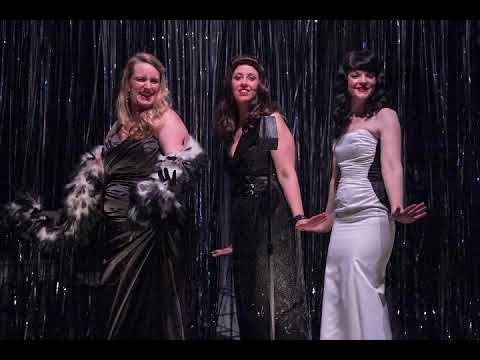
Review
What if Casablanca crashed headfirst into a nightclub act that refuses to take itself seriously? The cast recording of Adrift in Macao – The New Musical answers that question with a wink and a rim-shot. Set in a highly stylised 1952 Macao full of fog, trench coats and suspiciously familiar character types, the album follows blonde chanteuse Lureena, grumpy American drifter Mitch, shady club owner Rick Shaw and inscrutable pianist Tempura (who may or may not be someone else) as they stumble through a deliberately tangled noir plot. On disc, the story feels like a radio comedy with a lush pastiche score, all wisecracks, fake danger and swoony torch songs that know exactly how silly they are.
Because the musical is short and tightly written, the recording comes off like a complete little comic universe. Peter Melnick’s score hops from smoky nightclub ballads (“In a Foreign City,” “Pretty Moon Over Macao”) to faux-exotic production numbers (“Mambo Malaysian”) and gag-heavy specialty songs (“Rick’s Song,” “I’m Actually Irish”) without ever losing the easy melodic line critics keep connecting to his grandfather, Richard Rodgers. Christopher Durang’s lyrics land punchlines at a fast clip, and the Off-Broadway cast — led by Rachel deBenedet, Alan Campbell, Michele Ragusa, Orville Mendoza and Will Swenson — lean into every parody cliché as if their lives depended on it. The album’s biggest strength is that balance: it sounds light and throwaway, but underneath, the craft is sharp.
Genre-wise, the recording moves in stages. Early tracks live in classic Broadway-meets-nightclub territory — swing rhythms, sax-inflected reeds, lush but compact orchestration. Mid-album numbers push harder into Latin pastiche and “exotic” Hollywood film music, used here to poke fun at how movies once portrayed Asia. Later songs bring in bright, almost TV-theme pep for the chase sequences and finale. Each style maps directly to meaning: smoky cabaret equals allure and mystery; hyperactive mambo equals catfight and competition; jaunty finales underline how low the stakes really are. It’s a score that uses period pastiche to satirise the period, and the album lets you hear that game clearly.
How It Was Made
Adrift in Macao took a long route to its 2008 cast recording. The show started as a commission for New York Stage and Film at Vassar College in 2002, where Durang (book and lyrics) and Melnick (music) first tested their film-noir spoof in workshop form. A world-premiere production followed at Philadelphia Theatre Company in 2005, refining the script and replacing songs; notably, an early favourite of the composer’s was dropped in favour of the later torch ballad “So Long.” Along the way, the creative team locked onto the idea that this was less about murder and more about ambience — fog, neon, slinky dresses and people who speak in hard-boiled clichés.
The New York premiere came with Primary Stages at 59E59 Theaters in early 2007, directed by Sheryl Kaller with choreography by Christopher Gattelli and musical direction by Fred Lassen. That production, with a seven-actor company, ran only a few weeks but picked up strong notices for Melnick’s music and a Drama Desk nomination for Best Music. The world-premiere Off-Broadway cast recording followed in 2008 on the LML Music label, with Melnikov Music as the imprint owner. Produced by Peter Melnick and Grammy/Oscar-winning engineer Joel Moss, the album captures the New York cast essentially intact: Alan Campbell (Mitch), Rachel deBenedet (Lureena), Orville Mendoza (Tempura), Michele Ragusa (Corinna), Will Swenson (Rick Shaw), Jonathan Rayson and Elisa Van Duyne.
Instrumentally, the score sits on a compact combo — piano-conductor, reeds, bass, drums and synthesizer — designed to evoke big-band, cocktail jazz and noir film scores without needing a full orchestra. On the album, that means tight rhythmic playing, plush sax lines and a lot of colour from the synth doubling strings or “movie” textures. Since the show runs about ninety minutes and music covers much of that, the recording ends up nearly complete: fourteen tracks, just under forty minutes, with very little dialogue and only a few trims from scene transitions. It feels less like a souvenir EP and more like a distilled audio version of the evening.
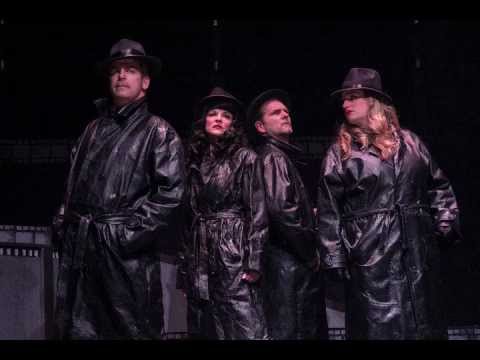
Tracks & Scenes
The songs in Adrift in Macao line up very closely with the show’s main scenes. Below are key numbers and how they play onstage, with enough detail that you can match what you hear on the album to the film-noir spoof happening in your head.
“In a Foreign City” (Lureena)
- Where it plays:
- Right after the brief orchestral prologue, we meet Lureena on the docks of Macao, standing in a pool of foggy light with no luggage, no money and only a dangerously slinky gown to her name. Sailors and trenchcoated figures drift in and out while she sings about finding herself in “a foreign city,” stranded but oddly confident that things will work out. Before the song ends, Rick Shaw appears, gives her the once-over and casually offers her a job singing at his surf-and-turf casino. It’s non-diegetic at first, but the last bars slide seamlessly into her first night in the club, so it feels like both inner monologue and audition.
- Why it matters:
- This is the show’s “I am” number and sets the comic tone: Lureena’s plight is serious to her, but the lyrics keep undercutting the drama, and the music has that slightly Weill-ish, smoky swing that tells us we’re in a heightened movie world.
“Grumpy Mood” (Mitch)
- Where it plays:
- Shortly after Lureena arrives, we cut to Mitch, the American drifter framed for a murder back home, brooding over a drink in Rick’s casino. Surrounded by gamblers and chorus members in trench coats, he launches into a self-pitying catalogue of annoyances, from the weather to his bad luck with women and law enforcement. The staging usually tracks him weaving through the crowd as they freeze or echo his lines, turning the casino into a hall of mirrors. The underscoring stays firmly in film-noir mode — low reeds, muted brass, brushed drums — while the rhythm plods like a man who has been stuck in the same bad mood for years.
- Why it matters:
- On the album, this track nails Mitch’s archetype: he’s the Humphrey Bogart figure who knows the script he’s supposed to be in, and the lyrics are full of meta-jokes about how “grumpy” film-noir heroes actually sound.
“Tempura’s Song” (Tempura)
- Where it plays:
- In the nightclub, Tempura — the sardonic, “local” pianist who is secretly the mysterious villain McGuffin — steps forward from behind the piano and delivers a biting solo. He complains about Americans’ eating habits, manners and cluelessness while the onstage band vamps along, and patrons lounge at tables or drift through the haze. The number is explicitly diegetic: he is performing “for” the customers in Rick’s place, but the lyrics peel back his contempt for the Westerners flooding his city and, by extension, for the clichés of the genre itself.
- Why it matters:
- As recorded, it’s a compact villain song that plays more like a stand-up routine set to music. It gives Tempura/McGuffin a distinct point of view and makes his later reveals feel like the logical continuation of a long-running joke.
“Mister McGuffin” (Tempura, Corinna, Joe & Daisy)
- Where it plays:
- In a back room of the casino or out on the foggy dock, characters trade rumours about the shadowy figure known as McGuffin, the man who framed Mitch. The scene often plays like a vaudeville routine: Tempura, chorus members Joe and Daisy, and drug-addled dancer Corinna each add their own conflicting description as the ensemble builds a musical dossier on someone we technically haven’t met. Staging tends to shuffle the company between shadowy corners and lit “memory spots,” with quick costume flourishes to suggest flashbacks or half-remembered encounters.
- Why it matters:
- The song is both plot exposition and meta-joke — McGuffin is literally a MacGuffin — and the recording lets you enjoy how Durang and Melnick push the idea until it becomes punchline and story engine at once.
“Pretty Moon Over Macao” (Lureena)
- Where it plays:
- Later in Act I, Rick shoves Lureena onto the nightclub stage and tells her to sing the club’s signature ballad… which she doesn’t actually know. The lights go soft, a breeze machine kicks in, and she more or less fakes her way through the song, improvising lyrics about the moon, the water and her own legs while the band faithfully plays the “standard” underneath. Corinna fumes in the wings, watching the new girl steal her spotlight. In some productions, Lureena checks a cheat sheet or hilariously butchers the melody; in others, she miraculously nails it, which is its own kind of joke.
- Why it matters:
- On the album, it registers as a straight-up torch song — sultry, melodic, very singable. Knowing the stage joke adds another layer: this is parody that also functions as a genuine audition piece, which is why the track has a life in cabaret beyond the show.
“Mambo Malaysian” (Corinna & Lureena)
- Where it plays:
- In another club sequence, Corinna finally gets the spotlight back and launches into “Mambo Malaysian,” an over-the-top “ethnic” number that gleefully skewers Hollywood’s habit of mixing Asian cultures into one cliché. Midway through, Lureena barges in with her own “Pretty Moon Over Macao” reprise, and the two women end up singing on top of each other in what the writers call a musical catfight. Onstage, it’s often staged as a full-on diva duel, with dancers, feathered costumes and the band whipping into an increasingly frantic mash-up of the two songs.
- Why it matters:
- This is one of the album’s showpiece tracks. You can hear how the pastiche shifts — mambo rhythms, mock-“exotic” intervals — and how the counterpoint between the two songs turns character rivalry into musical comedy.
“Sparks” (Mitch & Lureena)
- Where it plays:
- After circling each other for much of the first act, Lureena and Mitch finally admit there might be chemistry between them. Usually set on the casino balcony or a quiet corner of the dock, the scene lets the fog clear a bit as they sing about the literal and figurative “sparks” they feel. The band dials into a smooth, mid-tempo ballad groove; lights soften; the ensemble fades away. Even here, Durang sneaks in jokes about genre conventions, but for a few minutes the show allows them a semi-sincere movie-romance duet.
- Why it matters:
- On disc, “Sparks” is the closest thing the score has to an un-ironic love song. It proves that the show can play the romance straight when it wants, which in turn makes later send-ups of noir heartbreak land harder.
“Adrift in Macao” (Mitch, Lureena, Corinna & Tempura)
- Where it plays:
- The title song functions as a kind of Act I climactic ensemble. Everyone in the club — romantic leads, villain in disguise, rival singer, trenchcoat chorus — pauses to reflect on how they all ended up stuck in this half-glamorous, half-sleazy corner of the world. The staging tends to scatter them across the stage, each in their own spotlight, as their verses overlap against a sweeping, minor-key melody. Behind them, the casino crowd drinks, gambles and occasionally freezes in tableau, like extras in a black-and-white film.
- Why it matters:
- It’s the big thematic thesis: everyone is “adrift,” not just geographically but emotionally. The recorded arrangement swells just enough to feel like a movie main-title, but keeps the running gag of overly on-the-nose lyrics.
“So Long” (Lureena)
- Where it plays:
- As the plot knots tighter — Mitch on the run, McGuffin closing in, loyalties shifting — Lureena contemplates leaving Macao behind. Alone onstage, sometimes with just a chair and a hint of the club behind her, she sings this torchy farewell to the city, to Rick, to Mitch and to the idea of being a “mysterious dame” at all. The band strips down; the vocal line stretches out; the jokes mostly step aside for genuine regret and self-awareness.
- Why it matters:
- The composer swapped an earlier favourite song for “So Long,” and you can hear why. On album, it gives Lureena a true eleven-o’clock moment, which in turn makes her a real character rather than just a parody of one.
“Rick’s Song” (Rick Shaw)
- Where it plays:
- Rick, who has spent most of the show playing the deadpan host in the background, finally stops the action to complain about not having had a number. He explains that, as a solution, he “went out and bought one,” then proceeds to deliver a swaggering, mock-anthemic solo about his own importance, complete with backup riffs from the ensemble. Staging often turns this into a mini Las Vegas act, with Rick at a mic stand and lights flashing his name across the set.
- Why it matters:
- On the recording, it’s a textbook Durang gag: a character breaks musical-theatre rules by acknowledging them. Musically, it also gives the score a more overtly brassy, showbiz flavour for a few minutes.
“The Chase” (Company)
- Where it plays:
- Toward the end of the show, everyone bursts into action as secrets spill and Macao stops being safe. The company races through a stylised chase that covers “several thousand miles,” ricocheting from the docks to New York alleys in a single musical sequence. Onstage, this is the big physical comedy set piece: characters fire guns, narrowly miss each other, dash through shutters that flip to become different locations, and eventually all end up alive in New York. The music pops with up-tempo, almost cartoonish energy, and vocals overlap in half-sung commentary.
- Why it matters:
- On album, it works like a mini radio play. You can’t see the pratfalls, but the orchestrations and vocal chaos make the joke clear: noir’s climactic violence becomes an overextended farce where nobody dies and everyone just changes cities.
“I’m Actually Irish” (Tempura)
- Where it plays:
- Once Tempura’s true identity and backstory come to light, he confesses — in song, naturally — that he’s not who anyone thought he was. The scene typically happens late in the show, with the others circling him as he admits he’s “actually Irish” and not the exotic stereotype they projected onto him. The number plays like a comic reveal with a patter-song engine, using jaunty rhythms and key changes to underline the absurdity of Hollywood’s casting habits.
- Why it matters:
- It’s a direct satire of the way old movies used to slap “foreign” labels on visibly non-Asian actors. The album preserves the joke without visual makeup, which arguably makes the point even clearer.
“Ticky Ticky Tock” (Company)
- Where it plays:
- The finale jumps forward and sideways, collapsing time zones and movie genres as the whole company sings a ticking, clock-obsessed closing number. The song spans those “several thousand miles” all the way to New York, where the characters end up safe, slightly confused and ready for another adventure. Onstage, it often becomes a meta-ending, with the cast leading a mock sing-along and acknowledging how arbitrary the final “wrap-up” feels in these films.
- Why it matters:
- As a closer, it’s ridiculously catchy. On the album, “Ticky Ticky Tock” feels like a novelty song and curtain call fused together, sending you out humming nonsense syllables that still somehow feel very noir.
Trailer & non-album moments
- Where they play:
- Regional trailers and promo clips — including the TheatreWorks New Milford trailer tied to the YouTube ID used in the figures above — typically cut together brief snippets of “In a Foreign City,” “Grumpy Mood,” “Mister McGuffin” and “Ticky Ticky Tock.” These are laid over images of fog-drenched docks, nightclub sets and frantic chase choreography, sometimes with a voiceover selling the Drama Desk–nominated score.
- Why it matters:
- Marketing leans on the album’s most instantly graspable hooks: the sultry opener, the grumpy hero’s riff and the finale earworm. If those cues grab you in the trailer, the full recording doubles down on that mix of pastiche and punchline.
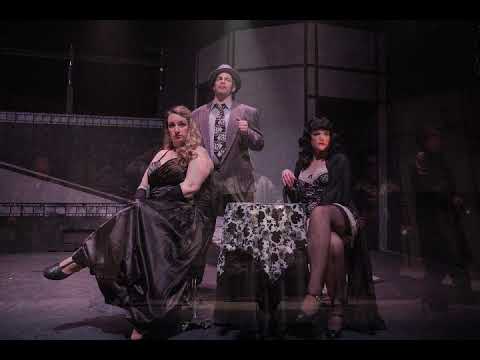
Notes & Trivia
- The musical keeps the broad outline of a film noir — fugitive, mysterious femme fatale, shadowy villain — but the score focuses more on atmosphere than on the crime plot, which Durang and Melnick both stress in interviews.
- “Pretty Moon Over Macao” and “Mambo Malaysian” were reworked into a competitive duet, so what started as separate star turns became a musical duel between Lureena and Corinna.
- Tempura is both a noir “piano man” and the villain McGuffin, so his songs sit on a knife-edge between comic commentary and actual plot; the recording makes those double meanings easy to hear even without staging.
- Rick Shaw’s showcase number literally jokes that he “went out and bought” a song, a meta-explanation for why the nominal Bogart stand-in gets an eleven-o’clock solo at all.
- The Off-Broadway production was short-lived, but the cast album helped keep the title in circulation; later regional and college productions often discovered the show through the recording first.
Reception & Quotes
Critics greeted Adrift in Macao as a small but stylish oddity — a “pocket-sized musical” that survives almost entirely on the charm of its pastiche and the precision of its jokes. The New York premiere earned Melnick a Drama Desk nomination for Best Music, and reviewers repeatedly singled out how deftly the score hops from Kurt Weill–ish cabaret colours to big-band swing and faux-Asian exotica. Some reviews found the book thinner than Durang’s sharpest plays, but even detractors usually admitted that the music was “lethally catchy” and the lyrics “shamefully silly” in the best way.
The album benefited from that goodwill. Theatre press and specialist sites called it an “excellent cast album” that captures a show many people missed in its three-week Off-Broadway run, and one review even flagged the disc as the best way to experience the piece if you never saw the production. Because the scoring is tight and the vocals are recorded close, the wit of Durang’s lyrics comes through clearly, making the record feel like a radio musical more than a standard highlights disc. Over time, tracks like “In a Foreign City,” “Pretty Moon Over Macao” and “So Long” have slipped into the audition-song ecosystem, while “Ticky Ticky Tock” remains a cult favourite finale among cast-album nerds.
“A drop-dead funny book… shamefully silly lyrics… and lethally catchy music.” – BroadwayWorld on the show and score
“Melnick’s music hops effectively among genres, evoking period music from Kurt Weill to big band.” – The New York Times
“This musical takeoff on film noir is as light as a helium balloon… the music manages to be delightful pastiche.” – John Simon
“The only downside of this excellent cast album… is a tinge of regret if you missed the absurdly brief premiere.” – Album review quoted on Peter Melnick’s site
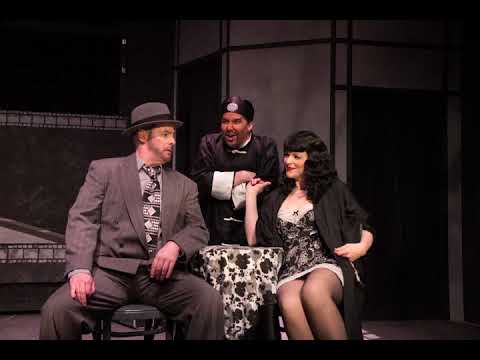
Interesting Facts
- The Off-Broadway run at 59E59 Theaters lasted only a few weeks, yet the show still snagged a Drama Desk nomination for Best Music.
- Peter Melnick is a grandson of Richard Rodgers; reviewers can’t resist pointing out the melodic through-line from classic R&H scores to this tiny noir parody.
- The cast album came out on LML Music, but digital releases list the copyright as Melnikov Music, reflecting Melnick’s own company.
- Because the orchestra is just five players, orchestrator and reed player get a workout: the reed book covers soprano sax, tenor sax, clarinet and flute to give the illusion of a much larger band.
- Mitch’s hometown murder framing involves a “McGuffin” in name only — the show riffs on Hitchcock’s term by turning it into the literal surname of the unseen villain.
- Some regional productions play up the finale sing-along, encouraging audiences to join in on “Ticky Ticky Tock,” which turns the noir cool into something closer to a TV variety show.
- Guides like The Guide to Musical Theatre and theatre wikis list the musical numbers almost exactly as they appear on the album, so this recording is effectively the canonical score.
Technical Info
- Title: Adrift in Macao – The New Musical (Original Off-Broadway Cast Recording)
- Year: 2008 (commercial album release; recordings drawn from 2007 Off-Broadway production)
- Type: Stage musical cast recording / soundtrack album
- Main creative work: Adrift in Macao (full-length stage musical parody of film noir)
- Music: Peter Melnick
- Book & lyrics: Christopher Durang
- Source inspirations: Hollywood film-noir and “exotic locale” pictures of the 1940s–50s, especially Casablanca-style nightclub stories
- Original New York production: Primary Stages at 59E59 Theaters (Off-Broadway, previews from January 23, 2007; opening February 13, 2007)
- Principal cast on album: Alan Campbell (Mitch), Rachel deBenedet (Lureena), Orville Mendoza (Tempura / McGuffin), Michele Ragusa (Corinna), Will Swenson (Rick Shaw), Jonathan Rayson, Elisa Van Duyne
- Album label: LML Music; ? 2007 Melnikov Music
- Producers (album): Peter Melnick and Joel Moss
- Length & format: 14 tracks; approx. 39–40 minutes; CD and digital download/streaming
- Orchestration / band: Small combo (piano-conductor, reeds, bass, drums, synthesizer) designed for a classic Broadway/film-noir sound in a compact pit
- Notable numbers on recording: “In a Foreign City,” “Grumpy Mood,” “Tempura’s Song,” “Pretty Moon Over Macao,” “Mambo Malaysian,” “Sparks,” “Adrift in Macao,” “So Long,” “Rick’s Song,” “The Chase,” “I’m Actually Irish,” “Ticky Ticky Tock”
- Awards context: Musical nominated for the 2007 Drama Desk Award for Outstanding Music; widely cited for its witty score and lyrics in reviews
- Availability: Streaming on major platforms (Spotify, Apple Music, Amazon); CD available via online retailers specialising in cast recordings
Key Contributors
| Subject | Relation | Object |
|---|---|---|
| Christopher Durang | wrote book & lyrics for | Adrift in Macao (stage musical) |
| Peter Melnick | composed music for | Adrift in Macao (stage musical) |
| Elmer Rice–style film noir | inspired tone of | the musical’s parody of classic Hollywood thrillers |
| Sheryl Kaller | directed | the 2007 Off-Broadway production at 59E59 Theaters |
| Christopher Gattelli | choreographed | the Off-Broadway staging of Adrift in Macao |
| Fred Lassen | served as | musical director for the New York premiere |
| Alan Campbell | performed role of | Mitch (framed American drifter) in the Off-Broadway cast |
| Rachel deBenedet | performed role of | Lureena, the nightclub singer, in the Off-Broadway cast |
| Orville Mendoza | performed role of | Tempura / McGuffin, the piano player–villain, on stage and on album |
| Michele Ragusa | performed role of | Corinna, the rival entertainer, in the Off-Broadway cast |
| Will Swenson | performed role of | Rick Shaw, casino owner, in the Off-Broadway cast |
| LML Music | released | the original Off-Broadway cast recording on CD |
| Melnikov Music | published | the score and controlled album copyright |
| 59E59 Theaters | hosted | the New York premiere of Adrift in Macao |
| Philadelphia Theatre Company | produced | the 2005 world-premiere production in Philadelphia |
Questions & Answers
- Is the cast recording basically the whole score of Adrift in Macao?
- Yes. With fourteen tracks covering every listed musical number, the album presents the full song stack and gives a very clear impression of the complete show.
- Do I need to know film noir movies to enjoy the album?
- It helps, because the score riffs on Casablanca-style tropes, but the jokes, melodies and character types are broad enough that you can enjoy it cold.
- How “modern” does the music sound?
- It’s firmly in classic-Broadway and cabaret territory — tuneful, witty and pastiche-heavy — rather than pop-rock. Think vintage show tunes with sly genre jokes built in.
- Is this recording tied to a particular production?
- It documents the 2007 Primary Stages Off-Broadway production at 59E59 Theaters, with that exact cast and small-band orchestration.
- What track should I start with if I just want a quick taste?
- Try “In a Foreign City” for the noir mood and jokes, “Pretty Moon Over Macao” for torchy pastiche, or “Ticky Ticky Tock” if you want the zany finale energy.
Sources: Concord Theatricals title page and media notes; Christopher Durang’s official site; BroadwayWorld and Playbill production coverage; TheaterMania album announcement; Apple Music, Spotify and Amazon Music album listings; Discogs release entry; CurtainUp, Talkin’ Broadway and other review archives; Peter Melnick’s official site and blog; Theatre and film-noir commentary pieces and regional production notes.