
110 in the Shade Lyrics: Song List
- Act 1
- Gonna Be Another Hot Day
- Lizzie's Comin' Home
- Love, Don't Turn Away
- Poker Polka
- The Hungry Men
- The Rain Song
- You're Not Fooling Me
- Cinderella
- Raunchy
- A Man and a Woman
- She Walked Out On Me...
- Old Maid
- Act 2
- Evenin' Star
- Everything Beautiful
- Stay and Talk...
- Melisande
- Simple Little Things
- Little Red Hat
- Is It Really Me?
- Wonderful Music
- The Rain Song (Reprise)
About the "110 in the Shade" Stage Show
Music composed by Harvey Schmidt. Lyrics wrote Tom Jones. The libretto was developed by N. Richard Nash. Pre-Broadway tour began in September 1963. A show was exhibited in Boston and Philadelphia Shubert Theatre. Broadway Premiere was hosted by Broadhurst Theatre in October 1963. It ended in August 1964, after 2 preliminaries and 330 regular performances. Production carried out by director Joseph Anthony and choreographer Agnes de Mille. The cast involved S. Douglass, I. Swenson, R. Horton, S. Roland & S. Teague. In 1964-1965 there was a national tour featuring R. Danton, I. Swenson, S. Douglass & J. Carter. In February 1967, the Palace Theatre hosted the British premiere. There were shown 101 performances. Production was developed by director Charles Blackwell and choreographer Rae Landor. In the show were acting I. Emmanuel, J. Warfield, M. Latimer, G. Hancock, I. Swenson & S. Douglass.
From May to June 1982, production took place in the Church of the Heavenly Res, directed by Fran Soeder. The participating actors were R. Stoeckle, J. Pessano, S. Ellis, R. Gunderman & L. Sickle. From July to August 1992 in the New York State Theatre was presented a new version of the play. Performance was carried out by director Scott Ellis and choreographer Susan Stroman. The cast was the following: R. Muenz, H. Forsythe, K. Ziemba & B. Sutherland. In April 2007, the new tryouts began for the reconsidered pre-Broadway version. Staging was shown at Studio 54 from May to July 2007 with 27 preliminaries and 94 regular performances. Production done by director Lonny Price and choreographer Dan Knechtges. This version of the play had this cast: A. McDonald, J. Cullum, S. Kazee, C. Butler, B. Steggert & C. Innvar. The show was nominated for several awards.
Release date of the musical: 1963
"110 in the Shade" – The Musical Guide & Song Meanings
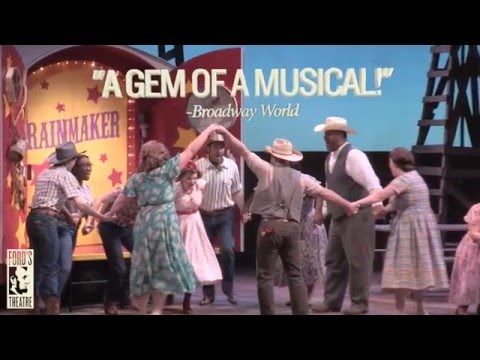
Review
What do you do with a romance where the weather has better timing than the men? "110 in the Shade" tries to turn heat, dust, and small-town scrutiny into dramatic pressure, then dares its heroine to stop apologizing for taking up space. It mostly succeeds, because the lyrics refuse to decorate Lizzie Curry. They argue with her. They flinch. They double back. The score keeps offering her a vocabulary for desire that she does not yet trust.
Tom Jones writes with a plainspoken bite that feels borrowed from front-porch conversation, then quietly engineered into song form. The lyric strategy is consistent: let the town speak in choruses and slogans, then isolate Lizzie with language that sounds like thinking out loud. When Sheriff File finally sings, his words are careful, self-protective, and rhythmically fenced in. When Starbuck arrives, the verbal temperature spikes. His lines sell confidence the way a carnival barker sells miracles, and the show never lets you forget that salesmanship and self-delusion share a border.
Musically, it sits in classic Broadway writing, but with a size and seriousness that can feel closer to a through-composed drama than a light comedy. That matters for the lyrics, because the songs are often built as arguments, not postcards. If you want the cleanest first-listen path, play these three numbers in order: "Love, Don't Turn Away" (Lizzie makes a private bargain), "You're Not Foolin' Me" (a public fight that turns personal), "Old Maid" (the bill comes due). You will hear the show explain itself.
Listener tip: the ensemble numbers can read as local color until you notice how often they crowd Lizzie's choices. If you are new to the piece, follow the pronouns. When the lyric shifts from "we" to "you," the town has decided to put someone on trial.
How It Was Made
"110 in the Shade" is the moment when the Tom Jones and Harvey Schmidt partnership went from intimate off-Broadway invention to a producer-driven Broadway machine. The producer David Merrick hired them to musicalize N. Richard Nash's "The Rainmaker," and the process turned into an endurance sport. In a later recollection, the creative history gets almost comically literal: by the Boston tryout in September 1963, the writers had created well over a hundred songs, swapping in new material when something failed rather than polishing a single number to death. That volume is not trivia for trivia's sake. It explains why the finished lyric tone is so selective: the show feels curated, like the final draft after a lot of honest wrong turns.
There is also a structural tell that helps lyric-watchers: Nash's story is built on confrontation and intimacy, so the songs have to earn their existence as turning points. The best lyrics do not "sum up" a scene; they force a decision. Lizzie's writing is full of conditional verbs and self-editing. File's writing is full of warnings. Starbuck's writing is full of promises that sound like prophecy until the show asks who benefits from believing them.
Key Tracks & Scenes
"Another Hot Day" (File, Toby, Chorus)
- The Scene:
- Early morning at the train station. The air already looks heavy. The townspeople gather with that ritual fatigue of people who have complained about the same drought for so long it has become community theater.
- Lyrical Meaning:
- The lyric establishes the show's key device: weather as fate, and fate as an excuse. Everyone sings the forecast, but you can hear the real subject: resignation dressed up as realism.
"Love, Don't Turn Away" (Lizzie)
- The Scene:
- Lizzie returns from her failed husband-hunting trip. The men in her family hustle around her with plans, picnics, and good intentions. She stands still, trying to decide whether hope is bravery or humiliation.
- Lyrical Meaning:
- This is Lizzie's private manifesto, but it is written like a negotiation. The lyric does not claim certainty. It asks for a small opening, a temporary stay against disappointment. That restraint is the point: she cannot risk grand language yet.
"The Rain Song" (Starbuck, Chorus)
- The Scene:
- Starbuck arrives like a bright disturbance, cutting through the picnic crowd. Staging usually treats him as motion: a man who makes people look up, even when the sky has refused them for months.
- Lyrical Meaning:
- Starbuck's lyric is persuasion as performance. He sells rain, but he is really selling permission: permission for the town to feel something again. The number works because the rhyme and repetition mimic a pitch, then slip into something that sounds almost like belief.
"You're Not Foolin' Me" (Lizzie, Starbuck)
- The Scene:
- They collide away from the crowd, the heat turning every sentence sharp. It plays like a duel staged in daylight, with no shadow to hide in.
- Lyrical Meaning:
- The lyric is mutual exposure. Lizzie attacks the con. Starbuck attacks the wound. The smartest choice here is that the title line cuts both ways: each character insists on insight, while revealing exactly where they are easiest to manipulate.
"A Man and a Woman" (File)
- The Scene:
- At the picnic, File finally speaks honestly. The mood shifts from public festivity to private confession, often under a slightly cooler light as the day begins to move toward late afternoon.
- Lyrical Meaning:
- File's lyric is a cautionary tale written in self-defense. He frames love as injury, then treats emotional distance as maturity. The song's power is that it makes him understandable, even as it makes him culpable.
"Old Maid" (Lizzie)
- The Scene:
- End of Act I. Lizzie is left alone with the word everyone has been thinking. The stage picture is usually spare: the picnic ground emptied, the heat still hanging on, and nowhere to hide from the future.
- Lyrical Meaning:
- The lyric turns a slur into a prophecy and then tries to survive it. Listen for the way the language tightens. The number is not self-pity; it is panic trying to sound composed, which is far more brutal.
"Everything Beautiful Happens at Night" (Chorus)
- The Scene:
- Evening settles on the picnic grounds. The town becomes softer in the dark. Couples appear. The sky finally offers relief, not rain, just a different temperature.
- Lyrical Meaning:
- The lyric gives the town a romantic philosophy, and it is seductive. Night becomes a loophole where people can act without being watched. For Lizzie, that idea is both invitation and danger.
"Is It Really Me?" (Lizzie, Starbuck)
- The Scene:
- At Starbuck's camp, after intimacy has changed the temperature of Lizzie's self-image. This is often staged with gentle, close light: not glamour, just visibility.
- Lyrical Meaning:
- This lyric is identity shock. Lizzie is not asking whether she is lovable in theory; she is asking whether she is allowed to be the woman she has briefly experienced. The song lands because it does not erase doubt, it gives doubt a melody.
"Wonderful Music" (Lizzie, File, Starbuck)
- The Scene:
- The love triangle becomes explicit as the town closes in and consequences arrive. It plays like overlapping pleas in a public square, the emotional noise rising as the sky finally changes its mind.
- Lyrical Meaning:
- The lyric mechanics are the drama: competing promises, competing definitions of safety, competing futures. Lizzie's power here is not which man she chooses, but that she is finally choosing at all.
Live Updates
Information current as of February 2, 2026. "110 in the Shade" is not on Broadway right now, and there is no single official touring production to track. What it does have is steady licensing life and periodic high-profile reminders that the leading role remains catnip for major singers and serious actors. Concord Theatricals continues to license the title and publishes detailed running order information, including incidental cues, which matters if you are mapping lyric beats to plot turns.
Recent and near-recent activity is mostly regional and community-based, with productions advertised across 2024 and 2025. One example: a listed 2025 run at Skyline Theatre Company (Bloomfield, New Jersey) underscores that the show still circulates as a "sleeper" pick for companies that want classic writing without the usual warhorses.
On recordings: the 1963 original cast recording remains the anchor listen, and the history around the overture is unusually audible. Later releases restored the overture on CD, which changes how the score announces its emotional scale before a single lyric is sung. If you are lyric-focused, follow up with the 2007 revival-era recording context as well, because that production team had a different sonic and theatrical vocabulary (notably in orchestration and overall gloss).
Notes & Trivia
- The show is set on July 4, 1936, in the Texas Panhandle town of Three Point, with the drought functioning as both plot engine and metaphor.
- Producer David Merrick hired Schmidt and Jones for a musical version of "The Rainmaker," and the writers reportedly generated more than a hundred songs during development, giving the final score a "best-of" feeling by necessity.
- The original Broadway run opened October 24, 1963, and played 330 performances.
- Concord's published running order includes several named incidental cues between major songs, a useful roadmap for where dialogue and underscoring carry story weight.
- The 1963 cast album is associated with a long-running lore point: the overture was missing from the LP sequence, later restored on CD releases.
- Concord notes that multiple versions exist, and licensing applicants are prompted to double-check which version they are requesting.
- The lyric architecture of the show leans on public chorus pressure versus private confession, which is why the picnic setting keeps returning as a social microscope.
Reception
The critical story of "110 in the Shade" has always been slightly bifurcated: the craft gets respect, the material gets described as gentle, and then the leading lady becomes the gravitational center. That was true in 1963, it was true in the 2007 revival cycle, and it remains true when the show pops up in later productions.
"This 1963 musical version of 'The Rainmaker' gets by on its charming score, old-fashioned romantic heart and, most of all, its magnetic lead..."
Variety's phrasing is revealing: the score is the engine, but the lead performance is the fuel. For lyric-watchers, that means the writing is built to be inhabited, not merely sung.
"In 110 in the Shade, the composer-lyricist team Harvey Schmidt and Tom Jones and librettist N. Richard Nash tell the story of a terrible drought..."
New York Magazine frames the piece as narrative first, which is fair. The best lyrics here are not detachable hits; they are scene carpentry.
"Dodge's wonderfully pleasant show is as earnest and honest as Lizzie and, like Starbuck, just a little bit larger than life."
The Washington Post review (of a later production) lands on "earnest and honest," which is exactly what Jones's lyric voice is chasing: candor without sentimentality.
Quick Facts
- Title: 110 in the Shade
- Year: 1963
- Type: Full-length Broadway musical (book musical), adapted from "The Rainmaker"
- Book: N. Richard Nash
- Music: Harvey Schmidt
- Lyrics: Tom Jones
- Original Broadway opening: October 24, 1963 (Broadhurst Theatre)
- Original Broadway run: 330 performances
- Selected notable placements: Train station opening; Fourth of July picnic; Starbuck's arrival pitch; Act I closer "Old Maid"; night picnic chorus; final rain payoff
- Album context: 1963 original cast recording remains the primary lyric reference listen; later CD editions restored the overture
- Licensing/versions: Multiple versions are noted in licensing materials
Frequently Asked Questions
- Who wrote the lyrics for "110 in the Shade"?
- Tom Jones wrote the lyrics, partnering again with composer Harvey Schmidt after their success with "The Fantasticks."
- What is the show actually about, beyond "it is hot"?
- A drought-stricken town becomes the stage for a different drought: Lizzie Curry's fear that she is unlovable. A self-proclaimed rainmaker arrives and forces the town and Lizzie to confront what they are willing to believe.
- Where should I start if I only want the essential lyric moments?
- Try "Love, Don't Turn Away," then "You're Not Foolin' Me," then "Old Maid," then jump to "Is It Really Me?" and "Wonderful Music." That sequence tracks Lizzie's internal argument from hope to self-recognition.
- Is there a major revival recording?
- Yes. The 2007 Broadway revival generated substantial attention and documentation, and the revival era also reinforced how much the show depends on a powerhouse Lizzie.
- Why does "The Rain Song" matter if Starbuck is a con man?
- Because the lyric is not only about meteorology. It is about how communities authorize belief. The song dramatizes the transaction: money for hope, hope for social cohesion.
- Is "110 in the Shade" still being produced now?
- Yes, primarily through licensing and regional/community productions rather than a single centralized commercial run.
Key Contributors
| Name | Role | Contribution |
|---|---|---|
| N. Richard Nash | Book | Adapted his own "The Rainmaker" into a musical structure built around confrontation and intimacy. |
| Tom Jones | Lyricist | Wrote lyrics with vernacular bite and private confession, centering Lizzie's shifting self-image. |
| Harvey Schmidt | Composer | Classic Broadway writing with moments of muscular scale, especially for Starbuck and Act I's closer. |
| David Merrick | Producer | Commissioned the songwriting team for a Broadway adaptation and pushed a high-output development process. |
| Concord Theatricals | Licensing | Publishes official song order and version notes used by producing organizations. |
| Masterworks Broadway | Label/Publisher (catalog) | Provides album synopsis and catalog access points for the original cast recording. |
Sources: Concord Theatricals; Masterworks Broadway; IBDB (Internet Broadway Database); Variety; New York Magazine; The Washington Post; BroadwayWorld; Overtur (cast recording database).