
Zorro Lyrics: Song List
-
Flamenco Opening

-
Baila Me
-
Serenade
-
Libertad
- Hope
- In One Day
- Falling
- Bamboleo
- There's A Tale
-
Freedom
-
Bamboleo (Reprise)
- A Love We'll Never Live
- One More Beer
- Djobi Djobi
- Hope (Reprise)
- Man Behind The Mask
-
Fiesta
About the "Zorro" Stage Show
The libretto was developed by Helen Edmundson and Stephen Clark. Music was composed by John Cameron and a band ‘Gipsy Kings’. Lyrics were written by S. Clark. The world premiere of the show took place in March 2008 in Working's New Victoria Theatre. Production was carried out by director C. Renshaw and choreographer R. Amargo. The actors’ list was: M. Rawle, A. Cooper & A. Atkinson. West End performance took place in the Garrick Theatre from mid-July 2008 to March 2009, directed by C. Renshaw and choreographed by R. Amargo. The cast was the following: M. Rawle, E. Williams, A. Levy, L. Margherita, N. Cavaliere & J. Newth. From November 2009 to June 2010, the staging was in Paris, in Folies Bergère, developed by C. Renshaw and R. Amargo. The cast involved G. Beller, L. Ban, B. de Gaulejac, G. Larossa, Y. Duffas & L. Pastor.
From October 2010 to May 2011, the theatrical was held in Moscow’s Youth Palace. Production was carried by all the same C. Renshaw and R. Amargo. The spectacle involved: A. Birin, D. Ermak, N. Grishaeva, L. Rullus, A. Stotskaya, V. Lansky, N. Bystrov, A. Makeeva, A. Frandetti, A. Yemtsov, E. Banchik, O. Kazancheev & I. Portnoy. The American premiere of the show took place in Hale Centre Theatre, where the musical was shown from February to April 2012, directed by David Tinney, choreographed by Brad Schroeder. The cast involved: D. Smith, C. Elliott, M. Heaps, J. Jones, P. Cartwright, P. Yates, V. Greco & R. Raboy. In April 2013, the show began in Atlanta's Alliance Theatre, prepared by C. Renshaw and R. Amargo, including such actors: A. Jacobs, N. Carrière, N. Diaz, A. Goss, B. Harding, M. Kincaid & R. Mann. The staging had been presented in 12 countries. Show was 5 times nominated for Laurence Olivier Aw., winning in 1 category.
Release date of the musical: 2008
"Zorro" – The Musical Guide & Song Meanings
Review
How do you write lyrics for a hero whose entire brand is silence? Stephen Clark’s answer is to make the mask itself the argument. “Zorro” (2008) runs on a push-pull between public performance and private truth: Diego de la Vega learns to hide in daylight, while the chorus sings about freedom like it is a community value. The catch is that the community keeps needing a vigilante to enforce it.
The score does a second job: it turns justice into a dance language. The Gipsy Kings’ rumba-flamenco energy supplies heat, speed, and swagger, while John Cameron’s theatre-savvy shaping keeps the evening from becoming a concert with capes. Clark’s lyrics stay functional, often built for momentum and punch rather than poetic lacework. When they land best, they land because they are blunt: a vow, a warning, a dare you can sing while running.
There is a tactical reason it works. Zorro stories can collapse into iconography: sword, hat, letter Z. The show prevents that by giving the romance a real cost. Luisa is not waiting for a hero. She is asking for a man to stop hiding behind a joke, a title, and a family expectation.
How It Was Made
The musical is credited with music by The Gipsy Kings and John Cameron, with book and lyrics by Stephen Clark and an original story by Clark and Helen Edmundson. Its narrative DNA traces back to Isabel Allende’s 2005 novel “Zorro,” a prequel-style origin take that lets the stage version focus on becoming the legend rather than merely repeating it.
The 2008 path to the West End was classic tryout engineering: a short run in Eastbourne, then the transfer to London’s Garrick Theatre for previews and an official opening on July 15, 2008. Those first London steps were not frictionless. Early preview plans shifted when producers delayed the first performance, citing safety and technical readiness. That kind of pressure shapes lyrics in a practical way: choruses must land cleanly, scene transitions must sing you out of a set change, and story clarity becomes a survival trait.
One more behind-the-scenes detail that matters for the album: the Original London Cast Recording locks the show into a tight, listenable narrative. You can hear where the writers rely on repeatable ideas: liberty as a chorus rallying cry, hope as Diego’s private motor, and the mask as a romantic obstacle that refuses to behave like a harmless costume.
Key Tracks & Scenes
"Baila Me" (Diego, Inez & Company)
- The Scene:
- Early Act I. A burst of street-life: guitars, footwork, bodies in motion. Diego is present, but not fully claimed by the story yet. Light tends to run warm here, festival-bright, because the show is still selling pleasure before it sells consequences.
- Lyrical Meaning:
- The lyric is seduction and recruitment. It teaches you the show’s vocabulary: rhythm as power, performance as camouflage, desire as a lever. It also frames Inez as the engine that pushes Diego toward risk.
"Libertad" (Women of the Pueblo)
- The Scene:
- Act I chorus. The pueblo sings what it wants and, in the same breath, reveals what it fears. Staging often places the women front and center, with guards or authority figures visible at the edges, turning the number into a public act of nerve.
- Lyrical Meaning:
- Clark writes “freedom” as an urgent, communal noun. The song’s sting is that the community can sing the word while still tolerating the systems that deny it. The lyric becomes a yardstick the story uses to measure hypocrisy.
"Hope" (Diego)
- The Scene:
- Act I solo. Diego’s private room, or at least a private corner. The choreography calms down; the lighting narrows. This is where the hero admits he is not simply brave. He is motivated.
- Lyrical Meaning:
- “Hope” is the show’s cleanest statement of purpose. It reframes heroism as persistence rather than swagger, and it gives Diego an inner life that the mask would otherwise swallow.
"In One Day" (Luisa & Women of the Pueblo)
- The Scene:
- Act I. Luisa’s world speaks back to her: social expectations, gossip, urgency. The music keeps a forward lean, like time is nudging her down the road even before she chooses to move.
- Lyrical Meaning:
- This is a lyric about impatience with a romantic shine. Luisa is not dreaming in soft focus. She wants change on a schedule. The words set up her later anger when Diego tries to solve everything with charm and secrecy.
"Bamboleo / There's a Tale" (Inez & Company)
- The Scene:
- Late Act I. The room turns into a storytelling arena. The energy is communal, almost conspiratorial, with the crowd leaning in as the myth begins to harden into a symbol.
- Lyrical Meaning:
- The song uses a famous hook as a narrative device: familiarity becomes fuel. The “tale” portion frames Zorro as a folk solution to political rot. The lyric is effectively propaganda, delivered with a grin.
"Freedom" (Inez, Citizens & Gypsies)
- The Scene:
- Act II ignition. The uprising mood catches. Lighting and movement often sharpen into strong diagonals: bodies forming lines, opposition forming blocks. It is the show announcing its second act priorities.
- Lyrical Meaning:
- The lyric takes “Libertad” from longing to action. It also clarifies Inez’s role as more than a love-interest: she is the political conscience with a beat.
"A Love We'll Never Live" (Diego & Luisa)
- The Scene:
- Mid-to-late Act II. A romantic pause that feels risky because it steals time from the plot’s danger. Often staged with minimal movement and more breath, letting the voices carry what the sword cannot.
- Lyrical Meaning:
- The lyric is the cost ledger. It makes explicit that a heroic double life is not an attractive quirk. It is a relationship tax. The song is where the show briefly stops flirting and starts admitting damage.
"Man Behind the Mask" (Luisa)
- The Scene:
- Late Act II. The reveal is emotional before it is logistical. The lighting often isolates Luisa, because her question is not “who is he?” but “why did he choose this over us?”
- Lyrical Meaning:
- This is Clark’s sharpest relationship writing in the score. The lyric argues with the Zorro myth directly. It insists that the legend is incomplete without accountability.
"Fiesta" (Company)
- The Scene:
- Finale. The pueblo celebrates, and the stage becomes a public square again. Bright light returns, but with the earned fatigue of a story that has bled for its happy ending.
- Lyrical Meaning:
- The lyric restores community. It also closes the loop: Zorro’s victory becomes a shared story, not a private triumph. The chorus claims the outcome as a collective identity.
Live Updates
Info current as of February 2026. “Zorro” stays alive through international remounts and licensed productions rather than one long flagship run. In Tokyo, the Takarazuka Revue’s Cosmos Troupe mounted “ZORRO THE MUSICAL” at Tokyu Theatre Orb from June 14 through July 3, 2025, performed in Japanese and billed with a three-hour running time including intermission.
London remains the modern reference point for recent staging revisions. The Charing Cross Theatre revival ran April 2 through May 28, 2022, with a creative team listing that includes director Christian Durham and a detailed advisory for effects. That run matters for lyric-reading because it emphasizes speed and spectacle: the songs function as engines for action beats as much as interior confession.
Looking ahead, Spain has a major commercial stake. Teatro La Latina lists “El Zorro, el musical” for Madrid with pricing tiers and a Meet & Greet option, noting that David Bustamante performs select dates and that the story spans Spain and Los Angeles between 1805 and 1815. If you are tracking the brand’s momentum, that is a clear signal: the title is being positioned as a star-led event again.
Notes & Trivia
- The West End production officially opened July 15, 2008 at the Garrick Theatre, after schedule changes to early previews were reported by Playbill.
- The show earned five Laurence Olivier Award nominations, including Best New Musical, with Lesli Margherita winning for Best Performance in a Supporting Role in a Musical.
- Official London Theatre reported the show’s Olivier nominations while announcing the West End closing date of March 14, 2009.
- The Original London Cast Recording is widely listed with a release date of November 10, 2008, and a 19-track program.
- The cast album track list opens with “Prologue” and runs through “Fiesta,” making it unusually friendly for plot-following on headphones.
- In 2022, Charing Cross Theatre advertised a running time of approximately 2 hours and 40 minutes including interval and listed effects such as haze, smoke, fire effects, and occasional strobe.
- Tokyu Theatre Orb’s 2025 listing shows some performances marked sold out, a small but telling indicator that the title travels well outside its original market.
Reception
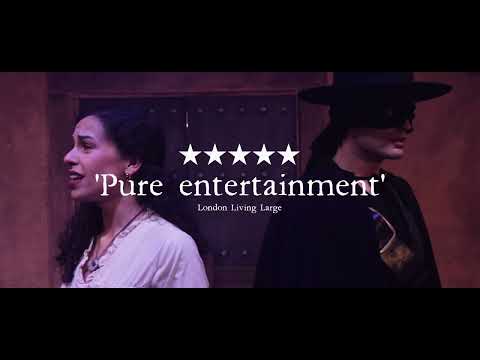
Critics largely treated “Zorro” as popular entertainment with a distinct sonic identity. The praise tended to land on the Hispanic-influenced sound palette and the physical production values. The skepticism, when it appeared, was usually about story thinness and the tension between narrative clarity and dance momentum.
The show may not be high art but it's great fun and brings a refreshingly different, Hispanic sound to the jaded world of West End musicals.
Michael Billington, The Guardian
...an onstage flamenco fiesta that sets feet tapping and blood racing round the stalls...
Michael Coveney, Whatsonstage.com
“Energy, talent and excitement.”
Paul Vale, The Stage
Awards
- Laurence Olivier Awards (2009): Best New Musical (nominated).
- Laurence Olivier Awards (2009): Best Actor in a Musical (Matt Rawle, nominated).
- Laurence Olivier Awards (2009): Best Actress in a Musical (Emma Williams, nominated).
- Laurence Olivier Awards (2009): Best Performance in a Supporting Role in a Musical (Lesli Margherita, won).
- Laurence Olivier Awards (2009): Best Theatre Choreographer (Rafael Amargo, nominated).
Quick Facts
- Title: Zorro
- Year: 2008 (West End opening)
- Music: The Gipsy Kings and John Cameron
- Book & Lyrics: Stephen Clark
- Original story: Stephen Clark and Helen Edmundson
- Based on: “Zorro” (2005) by Isabel Allende; also drawing from the wider Zorro canon
- West End opening: July 15, 2008 (Garrick Theatre, London)
- 2008 album: Zorro (Original London Cast Recording), 19 tracks, release date widely listed as November 10, 2008
- Signature numbers: “Baila Me,” “Libertad,” “Hope,” “Bamboleo,” “Freedom,” “A Love We'll Never Live,” “Man Behind the Mask,” “Fiesta”
- Licensing: Music Theatre International (MTI)
- Recent notable productions: Charing Cross Theatre (London, April to May 2022); Tokyu Theatre Orb (Tokyo, June to July 2025); Teatro La Latina (Madrid listing for 2026)
Frequently Asked Questions
- Is “Zorro” a jukebox musical?
- Partly. It uses famous Gipsy Kings hits as anchor moments, while also including new material shaped for theatre storytelling and character arcs.
- Who wrote the lyrics for “Zorro”?
- Stephen Clark wrote the lyrics and book, with music credited to The Gipsy Kings and John Cameron.
- Where should I start if I only have the cast recording?
- Listen in order. The album sequencing tracks the plot from “Prologue” through “Fiesta,” and you can hear how recurring ideas like liberty and hope keep returning with different stakes.
- What is the show’s big lyrical theme?
- Identity management. The songs keep asking who you are when everyone is watching, and who you can be when you finally stop performing for approval.
- Did the show win any major awards?
- Yes. It earned five Olivier nominations, and Lesli Margherita won for Best Performance in a Supporting Role in a Musical.
- Is the show still produced today?
- Yes, mostly through international productions and licensed runs, including a major 2025 engagement in Tokyo and a Madrid listing that positions the title as a star-led event.
Key Contributors
| Name | Role | Contribution |
|---|---|---|
| Stephen Clark | Book & Lyrics | Builds a fast, chorus-forward text where the mask becomes a relationship problem and a political tool. |
| Helen Edmundson | Original story (co-credit) | Helps shape the origin framework that keeps the plot focused on becoming Zorro, not merely wearing Zorro. |
| The Gipsy Kings | Music | Provide the show’s rhythmic spine and recognisable hooks, particularly in the crowd-driving numbers. |
| John Cameron | Co-composition & adaptation | Translates band energy into theatre architecture: scene timing, reprises, and musical continuity. |
| Christopher Renshaw | Director (West End) | Steers the piece toward kinetic storytelling, balancing romance, politics, and spectacle. |
| Rafael Amargo | Choreographer (West End) | Turns flamenco vocabulary into narrative grammar, central enough to earn an Olivier nomination. |
| Paul Kieve & Scott Penrose | Illusions | Support the myth-making: the show’s delight depends on Zorro seeming impossible at least once per act. |
| Christian Durham | Director (London revival listing) | Leads a later staging iteration that emphasizes pace and audience proximity in a smaller venue context. |
| David Bustamante | Performer (Madrid listing) | Fronts a 2026 Madrid event version, signaling the title’s continuing star-casting strategy. |
References & Verification: Reporting and listings verified via The Guardian, Playbill, Official London Theatre, Whatsonstage.com, MTI Europe licensing page, Charing Cross Theatre production listing, Tokyu Theatre Orb lineup page, Teatro La Latina production page, and major theatre-news coverage. Album release metadata cross-checked via Apple Music and Presto Music track-release listings.