
Meet Me In St. Louis Lyrics: Song List
- Act 1
- Meet Me in St. Louis
- Be Anything But a Girl
- The Boy Next Door
- Skip to My Lou
- Under the Bamboo Tree
-
Banjos

- Ghosties and Ghoulies and Things That Go Bump in the Night
- Halloween Ballet
- Wasn't It Fun?
- The Trolley Song
- Act 2
- Ice
-
Raving Beauty
- Touch of the Irish
- You Are for Loving
-
Day in New York
- Irish Jig (The Ball)
- Diamonds in the Starlight
- Have Yourself a Merry Little Christmas
-
Paging Mister Sousa
About the "Meet Me In St. Louis" Stage Show
In 1944, during World War II, the film was created: a light, cheerful, able to distract people from the horrors of the war. H. Wheeler’s book served as the basis for this performance. The authors of the libretto & music are H. Martin & R. Blane.
The musical was featured in the Gershwin Theatre on Broadway from autumn 1989 till summer 1990. The play was staged by L. Burke. Author of choreography – J. Brickhill. From 2006 to 2007, the show was held in the Irish Repertory Theater. From December 2013 to January 2014, it was in the Landor Theater in London. The play was nominated for best musical, best script, music & choreography.
Release date of the musical: 1989
"Meet Me in St. Louis" – The Musical Guide & Song Meanings
Review: the lyrics as a family’s weather report
Meet Me in St. Louis has a built-in problem that most adaptations would envy: audiences already know the hits, and they already have Judy Garland’s phrasing living rent-free in their heads. The stage musical’s job is not to “add songs.” It’s to justify why these songs happen now, in this family’s year, under this particular kind of pressure. The 1989 Broadway version (book by Hugh Wheeler, songs by Hugh Martin and Ralph Blane) leans into seasonal vignettes. That structure shapes the lyric experience: each number is less a plot lever and more an emotional bulletin. Who’s hopeful. Who’s panicking. Who’s pretending not to care.
The lyric writing is deceptively direct. It trades in polite surfaces, then lets anxiety leak through the cracks: a crush that becomes a lifestyle, parental love that comes with rules, a city pride that turns into fear when a move threatens to erase it. When it works, the show makes domestic life feel like choreography. When it drifts, you can feel the material begging for the camera’s ability to cut away. That tension is the story of this adaptation, and it is why different productions rise or fall on pacing.
Listening tip: if you’re coming from the film, start with the stage cast recording’s opening sequence and follow the order. The stage version is built around transitions, reprises, and scene-change music. Hearing the connective tissue first makes the “famous” songs land with more context and less souvenir-shop glow.
How it was made
Chronology matters here. The songs were written first for the 1944 MGM film, then reassembled for the stage decades later. Martin and Blane wrote standards that outgrew their original scenes. The American Film Institute’s “100 Years…100 Songs” list includes both “The Trolley Song” and “Have Yourself a Merry Little Christmas,” a reminder that this score entered the culture before it entered the licensing catalog. The stage musical, opened on Broadway in 1989, builds a book around that cultural weight, using Wheeler’s dialogue to stitch seasonal scenes into a theatrical evening.
The stage craft is more technical than the show’s soft-focus reputation suggests. Concord’s current materials spell out an orchestration that includes a guitar-banjo and a dedicated trolley bell among the percussion options. That is not trivia. It’s a mission statement: the sound has to carry period texture while still punching through a big house, and those choices help the lyrics read clearly without getting swallowed by sentiment.
One useful “version” note for lyric readers: the show has had more than one musical-number order over time, and Concord’s currently published sequence reflects that later shape. If you are comparing recordings, make sure you are comparing the same edition, or you will blame the lyrics for what is actually an edition change.
Key tracks & scenes
"Meet Me in St. Louis" (Smith Family & Ensemble)
- The Scene:
- Overture into a bright, community-facing opening. Early summer 1903 energy. The family is introduced as an octet, staged like a living photograph that can suddenly move. Lighting tends to feel porch-warm and optimistic.
- Lyrical Meaning:
- This lyric is civic romance. It turns a city into a promise and sets the emotional stakes: leaving St. Louis will feel like losing identity, not just changing zip code.
"The Boy Next Door" (Esther)
- The Scene:
- Front-porch intimacy, with the world just out of reach. A softer palette than the opener, often a tight pool of light that makes Esther’s crush feel private even when the family is nearby.
- Lyrical Meaning:
- The lyric is a masterclass in romantic projection. Esther isn’t describing a boy so much as describing the life she wants to live beside him, which makes later disappointments sting.
"You’ll Hear a Bell" (Mrs. Smith)
- The Scene:
- A mother’s advice delivered like kitchen wisdom. Concord’s synopsis frames it as guidance on love early in Act I. Staging often keeps it domestic and practical: a tune sung while doing something ordinary, because that is where mothers hold power.
- Lyrical Meaning:
- The lyric sells romance as certainty, which is both comforting and slightly dangerous. It trains the daughters to look for “signs,” then quietly sets up how easily signs can be misread.
"A Raving Beauty" (Rose & Warren)
- The Scene:
- Lon’s going-away party. A flirtation staged as a social event, not a confession. Lighting brightens and the room fills, because Rose’s world is public-facing.
- Lyrical Meaning:
- This duet is status anxiety in a velvet glove. Rose’s lyric posture is polished, but the subtext is negotiation: what does love cost if it also purchases security?
"Under the Bamboo Tree" (Tootie, Agnes & Esther)
- The Scene:
- Still the party, later. The kids are caught watching from the stair landing, then pulled into the entertainment as a “turn” for the guests. Stage lighting often shifts into vaudeville mode, making the family home briefly resemble a parlor theater.
- Lyrical Meaning:
- The lyric plays like innocent fun, but it also shows the girls learning performance early. Their charm becomes currency, which echoes through the show’s social rituals.
"Over the Bannister" (John & Esther)
- The Scene:
- After the guests leave. Quiet house, late-night glow. Concord specifies John helping Esther turn down the gaslights, which productions often stage with literal dimming as the song deepens.
- Lyrical Meaning:
- Awkward tenderness gets the lyric’s full respect. The words are tentative by design. They let romance arrive as behavior before it arrives as certainty.
"The Trolley Song" (Esther & Company)
- The Scene:
- Esther’s emotional victory lap. The stage world expands into movement and chorus, with rhythmic clangs implied by orchestration. It is the show’s big kinetic release, and it needs space and speed.
- Lyrical Meaning:
- It’s flirtation turned momentum. The lyric turns anticipation into music that cannot sit still, which is why it stays one of the great “falling in love” documents in American songwriting.
"A Touch of the Irish" (Katie with Esther & Rose)
- The Scene:
- Halloween night, in the kitchen. Concord places Katie alone with the older girls, instructing them in romance while the kids are out. Lighting is usually hearth-like, with comic sharpness in the blocking.
- Lyrical Meaning:
- The lyric shifts authority. The maid becomes the teacher, and the show briefly admits what polite households often hide: class knowledge runs both directions.
"Have Yourself a Merry Little Christmas" (Esther)
- The Scene:
- Late in Act II, as the family’s future tightens. Concord lists it as Esther’s solo near the decision point and the reprise sequence. Most productions strip the stage picture down and let the song sit in stillness, with winter lighting that feels bluish and spare.
- Lyrical Meaning:
- This is the score’s emotional trapdoor. The lyric sounds like comfort, but it’s actually a coping mechanism in real time. It asks people to hold joy while the world changes without their permission.
Live updates (2025–2026)
Information current as of January 29, 2026.
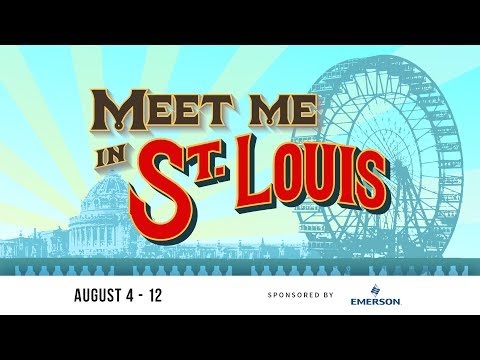
The biggest clearly documented 2026 “event” for this title is The Muny in St. Louis, which has scheduled Meet Me in St. Louis for August 6–13, 2026 with an 8:15 p.m. nightly curtain. MetroTix lists May 18 (9:00 AM) as the on-sale time for that engagement, and The Muny’s own page frames it as a hometown favorite returning after eight years. If you want the show in its most natural habitat, that is a strong bet: a St. Louis audience hearing a St. Louis love letter, outdoors, at scale.
At the grassroots level, the show remains active in regional and community spaces. One example with firm dates: Lamoille County Players in Vermont listed a run from July 24 to August 3, 2025. That pattern fits the material. The show’s pleasures are communal, multi-generational, and friendly to companies that can cast widely across ages.
For listening, the Original Broadway Cast recording is widely available on streaming platforms, with Apple Music listing it as a 1991 DRG Records release (20 tracks, about an hour). If you’re comparing editions, keep your eye on the song list order. Concord’s currently published numbering reflects the licensable stage sequence, while recordings and older documents may preserve different running orders.
Notes & trivia
- The musical opened on Broadway November 2, 1989 and played 252 performances, per IBDB and Concord’s history notes.
- IBDB lists 1990 Tony nominations for Best Musical, Best Book (Hugh Wheeler), Best Original Score (Hugh Martin & Ralph Blane), and Best Choreography (Joan Brickhill).
- Concord describes the score as including seven film songs plus ten additional Martin and Blane songs written for the stage.
- Concord’s orchestration details include period-flavored choices like guitar-banjo, celeste, and a trolley bell option in percussion.
- AFI’s “100 Years…100 Songs” includes “The Trolley Song” and “Have Yourself a Merry Little Christmas,” both credited to Martin and Blane, underscoring the songs’ life beyond the show.
- “The Trolley Song” was nominated for the Academy Award for Best Original Song (for the 1944 film), a rare awards paper trail that still shapes audience expectations.
- The Muny’s 2026 engagement lists an on-sale date and time via MetroTix, which is useful if you’re planning travel around the run.
Reception then vs. now
The 1989 Broadway reception, in short, was courteous and unconvinced. Contemporary coverage of critics’ reactions makes it clear that goodwill existed for the property, but skepticism followed the adaptation choices: how much charm can you transfer without the film’s texture? Later commentary tends to frame the show as likable, even “summer stock” friendly, while questioning whether it belonged in a giant Broadway house.
Where the title has gained ground is in revival contexts that treat it as holiday programming or as community repertory. Reviews of the Irish Repertory revival in 2006 leaned into that framing, and The Muny’s frequent returns suggest the show’s strongest case is local: the material breathes when it feels like a town telling its own story.
Frank Rich: it spread “the good will earned by the overture.”
Newsday called it “a bankrupt idea with a major bankroll.”
Variety said Irish Rep “gift-wrapped” it “as holiday fare.”
Quick facts
- Title: Meet Me in St. Louis
- Year: 1989 (Broadway opening)
- Type: Full-length musical, dramatic comedy
- Book: Hugh Wheeler
- Songs (music & lyrics): Hugh Martin & Ralph Blane
- Based on: Sally Benson’s stories and the MGM film
- Broadway venue: Gershwin Theatre
- Broadway run: Opened Nov 2, 1989; closed Jun 10, 1990; 252 performances
- Tony nominations (1990): Best Musical; Best Book; Best Original Score; Best Choreography
- Selected notable placements (per Concord synopsis): “Meet Me in St. Louis” (opening); “Under the Bamboo Tree” (party turn); “Over the Bannister” (gaslights); “A Touch of the Irish” (Halloween kitchen); “Have Yourself a Merry Little Christmas” (late Act II decision point)
- Cast album: Meet Me in St. Louis (Original Broadway Cast) released on DRG Records (streaming metadata lists 1991; 20 tracks)
- 2026 staging highlight: The Muny (St. Louis) Aug 6–13, 2026, 8:15 p.m. nightly; MetroTix on-sale May 18 at 9:00 AM
Frequently asked questions
- Who wrote the lyrics?
- The songs (music and lyrics) are credited to Hugh Martin and Ralph Blane, with the stage book by Hugh Wheeler.
- Is the stage musical the same as the 1944 film?
- It shares many of the famous songs and the seasonal family framework, but the stage version is built as vignettes shaped for theatre pacing, with additional songs written for the stage.
- Where do the biggest songs sit in the story?
- Concord’s synopsis places “Under the Bamboo Tree” as entertainment during Lon’s party, “Over the Bannister” during the gaslight moment, “A Touch of the Irish” on Halloween night in the kitchen, and “Have Yourself a Merry Little Christmas” late in Act II.
- Is there a major 2026 production?
- Yes. The Muny has scheduled the show for August 6–13, 2026 (8:15 p.m. nightly), with MetroTix listing May 18 at 9:00 AM as the on-sale time.
- Which recording should I start with?
- The Original Broadway Cast recording is an efficient entry point, and streaming platforms list it as a DRG Records release with a full 20-track program. If you are comparing editions, check the song order against the currently licensed sequence.
- Why do these songs feel “bigger” than the plot?
- Because the songs were born as film standards and then repurposed for the stage. The best productions treat the numbers as emotional turning points, not as decorative nostalgia.
Key contributors
| Name | Role | Contribution |
|---|---|---|
| Hugh Martin | Composer & lyricist | Co-wrote the songs that became American standards, then anchored the stage adaptation’s musical identity. |
| Ralph Blane | Composer & lyricist | Co-wrote signature titles including “The Trolley Song,” balancing wit, momentum, and singable clarity. |
| Hugh Wheeler | Book writer | Structured the seasonal family narrative for the stage, stitching scenes around already-famous numbers. |
| Joan Brickhill | Choreographer (Broadway) | Built movement language for the show’s social set pieces; nominated for a 1990 Tony per IBDB. |
| Ken Billington | Lighting designer (Broadway) | Helped define the show’s seasonal shifts and domestic intimacy in a large venue, per production history notes. |
| DRG Records | Cast recording label | Released the Original Broadway Cast album (streaming metadata lists a 1991 release). |
| The Muny | Producing venue | Continues to keep the title in active repertory, with a major August 2026 engagement announced. |
Sources: Concord Theatricals; IBDB; Playbill Vault; LA Times Archives; Variety; The Muny; MetroTix; Apple Music; AFI; Wikipedia (song and production cross-checks); TheaterEngine.