Grease Lyrics – All Songs from the Musical
Grease Lyrics: Song List
- Prologue
- Alma Mater
- Grease
- Summer Nights
- Those Magic Changes
- Freddy, My Love
- Greased Lightnin’
- Rydell Fight Song
- Mooning
- Look at Me, I’m Sandra Dee
- We Go Together
- Shaking at the High School Hop
- It’s Raining on Prom Night
- Born to Hand-Jive
- Hopelessly Devoted to You
- Beauty School Dropout
- Sandy
- Rock ‘n’ Roll Party Queen
- There Are Worse Things I Could Do
- Look At Me, I’m Sandra Dee (Reprise)
- You’re The One That I Want
- We Go Together (Reprise)
- Greased Lightnin’ (Karaoke)
About the "Grease" Stage Show
Release date: 2007
"Grease" – The Musical Guide & Song Meanings
Review: why these lyrics still cut, even when you already know every hook
What makes Grease tricky is not the plot. It is the social weather. The lyrics keep changing the pressure in the room, line by line, like teenagers testing what they can get away with. Jim Jacobs and Warren Casey write in punchy, conversational bursts, then spike the sweetness with a sneer, a brag, a rumor. That is the real story: language as status, desire as performance, vulnerability treated like a punishable offense.
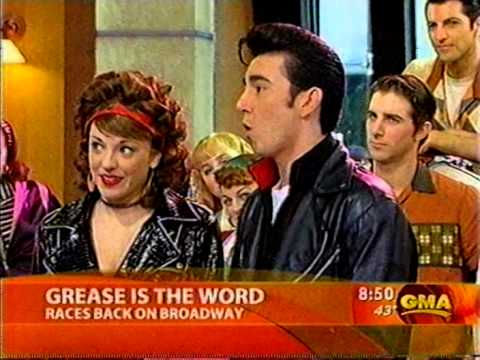
The 2007 Broadway revival leaned into the “pop memory” version of the title by folding in the film songs and letting the sound skew brighter and more radio-ready. Playbill’s 2007 track listing announcement spells out those film additions clearly, and it matters because the lyric voice shifts when you move from Jacobs and Casey’s streetwise satire to the film’s smoother romantic packaging. In a good production, that tension becomes a feature: you can hear the kids trying on identities that do not quite fit yet.
Listener tip, especially for the 2007 cast album: do not treat “Summer Nights” as a cute duet. It is a group trial. Each side of the stage polices the story, forcing Danny and Sandy to describe the same event in two incompatible dialects. The rhymes are not just jokes. They are peer pressure in musical form. You can practically hear the room closing in. The stage directions even keep both groups visible as the number plays, which turns the lyric into a public negotiation.
How it was made: from a gritty teen satire to a 2007 “vote-in” Broadway event
Grease began as a sharper, rougher piece than its screen afterlife suggests. The School Edition script’s front matter points back to the 1972 Eden Theatre premiere and the original creative team, a reminder that this started as a specific memory of a specific kind of teenage cruelty and comedy, not a nostalgia product.
Then 2007 made the show into a national casting story. NBC’s televised competition Grease: You’re the One That I Want fed directly into the Broadway revival. Playbill’s reporting is direct: Max Crumm and Laura Osnes were the winners, and the production opened at the Brooks Atkinson with Kathleen Marshall directing and choreographing. That history bled into the way audiences heard the lyrics. Suddenly, “You’re the One That I Want” was not only a plot moment. It was also a meta-commentary on fame, voting, and who gets crowned as the “right” Danny and Sandy.
The cast recording became the other 2007 artifact. The Masterworks Broadway release page frames the album as story-forward, number by number, and the track listing Playbill published in September 2007 underscores the deliberate blend of stage score plus film songs. If you are writing about the lyrics, that blend is not trivia. It changes the moral tone of the evening.
Key tracks & scenes: 8 lyrical moments that steer the story
"Summer Nights" (Danny, Sandy, T-Birds, Pink Ladies)
- The Scene:
- The girls hold the space. Then the lights stay up on them as the guys snap into view, turning a private memory into a public contest. The stage directions keep both groups playing at once, like rival juries.
- Lyrical Meaning:
- This is the show’s thesis: reputation writes the script. The same romance becomes two stories because the lyrics are shaped by the crowd listening to them.
"Greased Lightnin’" (Kenickie and the guys)
- The Scene:
- A car fantasy becomes a full-body anthem. The number ends with a dance break, then a siren interrupts and the guys scramble, piling onto the car as the scene shifts, still singing as they flee.
- Lyrical Meaning:
- The lyric is pure adolescent sales pitch: sex, speed, and control. Underneath, it is economic envy. They cannot buy adulthood, so they sing it into existence.
"Freddy, My Love" (Marty)
- The Scene:
- A sleepover vibe curdles into wishful shopping. As the number winds down, the girls literally fall asleep one by one, leaving Marty’s dream hanging in the air.
- Lyrical Meaning:
- Marty’s rhymes are funny because they are honest. She confuses affection with gifts, then admits she does not mind. It is a teen romantic comedy beat with a faintly brutal edge.
"Look at Me, I’m Sandra Dee" (Rizzo)
- The Scene:
- After a tense bench-side scuffle and a radio tease for the upcoming dance, Rizzo flips into parody, weaponizing the “good girl” image as a joke.
- Lyrical Meaning:
- This is self-defense as comedy. Rizzo’s lyric mocks purity culture because she knows it is used as a ranking system. Every “I don’t…” line is also “don’t you dare judge me.”
"Hopelessly Devoted to You" (Sandy)
- The Scene:
- Act II opens with a DJ voiceover, then lights come up on Sandy alone in her bedroom, bathrobe on, radio up. The world shrinks to a private confession.
- Lyrical Meaning:
- This is the film’s lyric language entering the stage world: less slang, more ache. It reframes Sandy as emotionally articulate, not simply “nice,” and it makes her later transformation read as a choice, not a trick.
"Born to Hand Jive" (Vince Fontaine, Johnny Casino, Company)
- The Scene:
- Rules are announced like a courtroom procedure, including a warning against “vulgar movements.” Then the contest begins and couples are eliminated one by one as Vince taps shoulders, thinning the stage like a reality show before reality TV.
- Lyrical Meaning:
- The lyric is nonsense on purpose. It is about permission. The kids need a sanctioned ritual where they can touch, show off, and compete, without admitting that is what they need.
"Beauty School Dropout" (Teen Angel)
- The Scene:
- Frenchy, outside the Burger Palace chaos, wishes for a guardian angel. Then the Teen Angel arrives with “spooky angelic guitar chords,” swinging in, followed by a chorus of Angels in rollers and plastic.
- Lyrical Meaning:
- The lyric is a glittery scold. It frames Frenchy’s dream as both ridiculous and real, which is why the number lands: it laughs at her, then admits the stakes of being stuck.
"You’re the One That I Want" (Danny and Sandy)
- The Scene:
- The lyric negotiation becomes literal. Sandy demands he “shape up,” he pleads his case, and the scene resolves with a kiss and a blunt, comic affirmation.
- Lyrical Meaning:
- It is a contract disguised as a bop. The lyric says “want,” but it also says “terms.” That is why it closes so hard: romance becomes agreement, in public, with witnesses.
"We Go Together" (Company)
- The Scene:
- After the couple moment, the whole gang rebuilds the social circle, pulls Patty in, and launches the doo-wop syllables like confetti as they head off laughing and horsing around.
- Lyrical Meaning:
- These lyrics barely mean anything, and that is the point. Community is the happy ending. The words are texture, the rhythm is belonging.
Live updates 2025–2026: where “Grease” is showing up right now
In 2025–2026, Grease is less a single “official” production and more a constant ecosystem: licensed performances, touring revivals, and high-profile live events that keep feeding the public memory of the songs. For producers, TRW’s current licensing notices also underline a practical detail: the songs are licensed for performance within the full musical, and the rights-holders restrict other uses. That boundary shapes school concerts, cabarets, and social clips more than people realize.
In the UK market, Playbill reported that the West End revival would tour the UK and Ireland beginning April 2024, with dates scheduled through late 2024. In London, a separate large-scale “movie musical experience” ran at Evolution London in Battersea Park in August 2025, with LondonTheatre and the official site reflecting the run window and its “closed for now” messaging afterward.
On the continental calendar, Ticketmaster France lists multiple “Grease” dates in early 2026, a signal that branded productions of the title continue to circulate across venues even when Broadway is quiet.
Information current as of January 27, 2026.
Notes & trivia
- The 2007 Broadway revival opened August 19, 2007 at the Brooks Atkinson Theatre and closed January 4, 2009 (554 performances), per IBDB.
- The 2007 revival folded in film songs, including “Hopelessly Devoted to You,” “Sandy,” “Grease,” and “You’re the One That I Want,” as Playbill noted when announcing the cast album track list.
- The School Edition script’s opening pages document the 1972 Eden Theatre premiere and list Tom Moore (director) and Patricia Birch (choreography) in the original stage history.
- “Hopelessly Devoted to You” is staged with Sandy alone in her bedroom, radio on, before the dance sequence begins, a sharp structural contrast with the show’s crowd-driven numbers.
- “Born to Hand Jive” is built like an elimination round: Vince taps couples out one by one, which makes the lyric feel like a soundtrack to competition rather than pure celebration.
- In the School Edition script, the “Beauty School Dropout” entrance is explicitly supernatural in tone, cued by “spooky angelic guitar chords” and a stylized Angel chorus.
- Myth check: many people remember Grease as purely sweet nostalgia, but the stage text repeatedly uses insult comedy and social policing as the engine of scenes. You can feel it even before a song starts.
Reception: the 2007 hype hangover, and the show’s long afterlife
The 2007 revival arrived with built-in noise: a national TV casting funnel, a famous brand name, and an audience primed to compare everything to the film. The reviews reflected that tension. Some critics admired the energy but questioned whether the production deepened the material. Others were simply irritated by the “event” framing. What matters for lyric analysis is this: the writing is sturdy enough that it survives both scorn and adoration. The jokes still land. The longing still lands. The cruelty still lands.
“Only ‘Grease,’ the propulsive opening number … really takes off.”
“It feels like a musical put on by a high school.”
“The cast sing the film’s theme song like a manifesto, full of rebellion and disaffection.”
My read: the best productions do not sand down the lyric bite. They let the show be funny and a little mean, because that is what makes the tenderness register as earned.
Quick facts
- Title: Grease
- Year focus: 2007 Broadway revival and cast album
- Type: Musical comedy
- Book, music & lyrics: Jim Jacobs and Warren Casey
- 2007 Broadway revival: Directed and choreographed by Kathleen Marshall
- Broadway theatre (2007): Brooks Atkinson Theatre
- Broadway dates (2007 revival): Opened Aug 19, 2007; closed Jan 4, 2009
- 2007 cast album: Grease (New Broadway Cast Recording)
- Album release look-up: Masterworks Broadway lists the 2007 track program; streaming listings include Spotify and Apple Music
- Selected notable placements (in-story): Cafeteria confession (“Summer Nights”); car build fantasy (“Greased Lightnin’”); bedroom ballad (“Hopelessly Devoted to You”); dance contest (“Born to Hand Jive”)
- Licensing: TRW (many international markets) and Concord Theatricals (US licensing portal) publish current licensing guidance for the title
Frequently asked questions
- What is special about the 2007 version of Grease?
- It turned casting into a televised event and leaned into the film’s song additions. The result is a stage score that can swing between Jacobs and Casey’s sharper teen satire and the film’s cleaner romantic language.
- Who wrote the lyrics?
- Jim Jacobs and Warren Casey wrote the book, music, and lyrics for the stage musical. The 2007 revival also uses several songs written for the 1978 film, as Playbill noted when publishing the cast album track list.
- Where does “Hopelessly Devoted to You” happen onstage?
- In the School Edition script, it opens Act II with Sandy alone in her bedroom, bathrobe on, listening to the radio, before the dance sequence begins.
- Why does “Summer Nights” feel like gossip instead of romance?
- Because the lyric is shaped by the listeners. Each chorus becomes a crowd interrogation, pushing Danny and Sandy into versions of themselves that win approval.
- Is “Greased Lightnin’” just a joke song?
- It is a joke with stakes. The lyric sells a car, but it is really selling a fantasy of adulthood, status, and sexual control, which is why the number hits so hard in a teen story.
- Is Grease touring in 2025–2026?
- Branded productions and licensed runs keep circulating. Public listings show UK touring activity scheduled through late 2024, a London “movie musical experience” in August 2025, and early-2026 dates on Ticketmaster France.
Key contributors
| Name | Role | Contribution |
|---|---|---|
| Jim Jacobs | Book, Music, Lyrics | Core lyric voice: teen slang, satire, and status games. |
| Warren Casey | Book, Music, Lyrics | Co-created the score’s rock-and-roll pastiche and comedic bite. |
| Kathleen Marshall | Director & Choreographer (2007 Broadway) | Shaped the 2007 revival’s pacing and performance style. |
| Max Crumm | Danny (2007 Broadway) | Originated Danny in the 2007 revival after the NBC casting series. |
| Laura Osnes | Sandy (2007 Broadway) | Originated Sandy in the 2007 revival after the NBC casting series. |
| Masterworks Broadway | Label / Release hub | Published the 2007 cast album program and synopsis-forward track listing. |
| TRW / Concord Theatricals | Licensing | Current performance licensing guidance and materials access portals. |
Sources: IBDB, Playbill, Masterworks Broadway, Time, New York Magazine, The Guardian, TRW (Theatrical Rights Worldwide), Concord Theatricals, LondonTheatre, Ticketmaster France, Grease: You’re the One That I Want (NBC series page reference), Grease School Edition script PDF.
Author note: Written from the perspective of a working musical-theatre critic and SEO editor: emphasis on verifiable credits, lyric analysis, and staging-aware listening notes.