
Five Guys Named Moe Lyrics: Song List
- Act 1
- Early In The Mornin'
- Five Guys Named Moe
- Beware, Bother, Beware
- I Like 'Em Fat Like That
- Messy Bessy
- Pettin' And Pokin'
- Life Is So Peculiar
- I Know What I've Got
- Azure Te
- Safe, Sane And Single
- Push Ka Pi Shi Pie
- Act 2
- Saturday Night Fish Fry
- What's The Use Of Gettin' Sober
- If I Had Any Sense
- Dad Gum Ya Hide Boy
- The Cabaret: Five Guys Named Moe / Let The Good Times Roll / Reet, Petite And Gone
- The Cabaret: Caldonia
- Ain't Nobody Here But Us Chickens
- Don't Let The Sun Catch You Crying
- Look Out
- Choo Choo Ch'Boogie
- Medley: Hurry Home
- Five Guys Named Moe
- Band Play Out
About the "Five Guys Named Moe" Stage Show
The musical’s libretto was by Clarke Peters. Louis Jordan wrote the music, in collaboration with others. Start of the musical was in April 1992, and it was running till May, 1993 in the Eugene O'Neill Theatre, New York, experiencing 464 hits, 19 of which were preliminary. Cameron Mackintosh was the producer. The opening took place at The Theatre Royal, from which the musical moved afterwards to its starting point. C. Roberts did vocal arrangements; R. Royal was a music producer; N. McArthur – conductor; J. Joubert – assistant of director. T. Goodchild did stage design; A. Bridge was illuminator; N. Howard – dresser. The actors in it were: J. Dixon, M.–L. Wooley, D. Eskew, W. E. Porter, M. C. Nealy, P. Gilmore, K. Ramsey, G. Turner, J. D. Sams.
West End took musical for more than 4 years in the Theatre Royal Stratford East (until 1995), which is 4 times bigger in the length of its stay on Broadway. It was renewed in 2010, under the Edinburgh Festival. This show has won two Laurence Olivier Awards in 1991 and received two more nominations on it. The following year, spectacle was awarded with 2 nominations on Tony, but did not receive any. The composition of the actors in the West End was: O. F. Okai, C. Peters, K. Andrews, C. Derricks–Carroll, P. J. Medford, D. Wayne & P. A. Newton. Albery Theatre in the West End was a host for its re-opening in 1995, after which it was closed a year later. There was a set of such actors: F. Williams, T. J. Jenkins, R. D. Sharp, T. Kendall, J. Pennycooke & M. Kent III.
In addition, it is one of those cases when the musical originated in West End and then was transferred onto Broadway. Usually it is the other way around.
Musical recordings were produced with both its versions, from Broadway and West End.
In Illinois, in 2002, the musical played with such actors: N. Dimone, S. Blake, B. G. Willis, J. S. Crowley, P. Collier & A. P. Christopher, and was directed by Marc Robin.
Release date of the musical: 1992
“Five Guys Named Moe” – The Musical Guide & Song Meanings
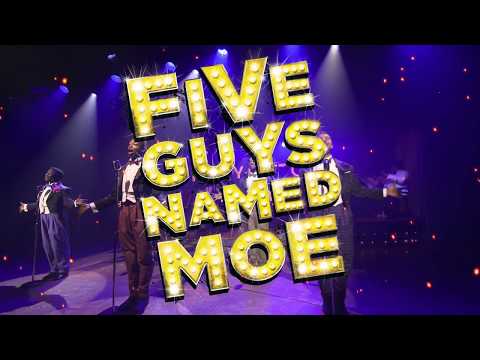
Review: what kind of “jukebox” show is this, really?
What if the late-night radio did not just soundtrack your bad decisions, but walked into your room and started naming them? “Five Guys Named Moe” turns that idea into a two-act intervention. Nomax is awake at the wrong hour, broke, heartsore, and trying to outsmoke the silence. Then the music pushes back. The Moes arrive with grins, harmonies, and a philosophy that moves faster than remorse: if life is rough, keep the rhythm, keep the joke, keep moving.
The lyrical engine here is Louis Jordan’s language: slangy, compact, and built like miniature sketches. Even when a song sounds like pure party, the text usually sneaks in a rule, a warning, or a confession. That duality is the show’s secret. It can sell you a punchline and a bruise in the same chorus, and the band never has to slow down to do it. Critics sometimes call the plot thin, but the words are doing narrative work anyway. They are character study by accumulation: advice songs, brag songs, cautionary songs, hangover songs. Nomax’s arc is less “changed man” than “man who finally hears what he has been hearing.”
Musically, it sits in jump blues and early R&B swing, with bright brass, backbeat drive, and call-and-response that invites the room into the show. In some stagings, that invitation is literal: the set can behave like a club, and the audience becomes part of the temperature. The style is not neutral. It pressures the characters toward motion. Standing still starts to feel like the real failure.
How it was made
Clarke Peters built the book around Louis Jordan’s catalog, framing it as an overnight visitation: five figures stepping out of sound to straighten a life that has drifted out of time. The Broadway run opened April 8, 1992 at the Eugene O’Neill Theatre and played 445 performances, a real feat for a revue-structured piece that relies on momentum more than plot mechanics. The producing muscle behind that leap mattered too: Cameron Mackintosh brought the show across the Atlantic after its UK success.
Peters has described the show’s early life as scrappy and fast-moving. In London, he traced the spark to a lyric that made the staging idea unavoidable: a line that practically dares the director to make the impossible happen onstage. Later revivals leaned into reinvention rather than preservation. A 2017 London production was designed as a purpose-built, in-the-round “jazz bar” environment, with Peters talking openly about flipping the songs’ angles for a contemporary audience without losing their bite.
Key tracks & scenes
“Early in the Morning” (Nomax)
- The Scene:
- Near-dawn. A small room, a radio, and the stubborn loneliness of a man who cannot sleep. The sound feels too loud because the rest of his life has gone quiet. Neighbors complain. He snaps back. The song lands like an alibi he almost believes.
- Lyrical Meaning:
- The lyric frames love as geography: you go back to places, you retrace steps, you try to re-enter a better version of yourself. It is the show’s opening thesis: the past is not gone, it is playing on repeat until you answer it.
“Five Guys Named Moe” (The Moes)
- The Scene:
- A crash. A puff of smoke. The room transforms because the music insists it can. Five men materialize with the swagger of a band that never needed permission. The lighting often pops into saturated club color, as if the radio has switched from appliance to portal.
- Lyrical Meaning:
- The hook is a brag, but the lyric also establishes their logic: they “came out of nowhere,” and that becomes the entire device. The Moes are not subtle metaphors. They are the externalized voice of the soundtrack that has been scoring Nomax’s worst habits.
“Beware, Brother, Beware” (The Moes)
- The Scene:
- The Moes close in like coaches and hecklers at once, turning the apartment into a street-corner seminar. Fingers snap. Heads nod. The choreography can feel like a warning label printed in syncopation.
- Lyrical Meaning:
- On paper, it is comic advice. In context, it is Nomax’s fear of commitment given a beat. The lyric teaches him a worldview he has already been using as an excuse, which is why the number can play as both instruction and indictment.
“Safe, Sane and Single” (The Moes)
- The Scene:
- A mock anthem, often staged as a polished “presentation,” with the Moes dressed like they are selling an idea that is already corroding Nomax’s life. The audience laughs because the rhymes are clean, then notices the loneliness underneath.
- Lyrical Meaning:
- The lyric turns self-protection into ideology. It is funny, but it also maps how men can praise isolation as maturity. The show lets the song be entertaining while still exposing the damage of its logic.
“What’s the Use of Getting Sober” (The Moes)
- The Scene:
- The room shifts into party mode, and that is the point: temptation arrives as a great band. Many productions play it with a wink that still feels dangerous, the kind of number that makes the audience complicit.
- Lyrical Meaning:
- The lyric is a rationalization machine. It is the voice of addiction dressed as common sense. Placed inside a supposed “reform” story, it becomes the show’s most honest contradiction: good music can carry bad advice brilliantly.
“Ain’t Nobody Here But Us Chickens” (The Moes)
- The Scene:
- A comic showcase that often goes full costume gag. The band hits a groove that feels like a cartoon sprint, and the Moes commit to the silliness without apology.
- Lyrical Meaning:
- The lyric is denial as theater: everyone pretending nothing is happening while chaos is obvious. In the Nomax story, that doubles as emotional avoidance, a bright distraction from the phone call he knows he has to make.
“Choo Choo Ch’Boogie” (The Moes)
- The Scene:
- The show leans into forward motion. Stomps, claps, and a rhythmic pattern that seems built to pull bodies out of chairs. In some stagings, this is where the room starts behaving like a dance floor.
- Lyrical Meaning:
- Jordan’s lyric loves propulsion. In the show, that becomes psychological: keep moving, or you will sit in your mess and call it fate. Nomax does not need more self-pity. He needs a rhythm strong enough to interrupt it.
“Is You Is or Is You Ain’t Ma’ Baby?” (The Moes, with Nomax’s choice hanging in the air)
- The Scene:
- Late in the night, the temperature changes. The comedy steps aside for a question that has teeth. Often staged with tighter lighting and a cleaner vocal focus, as if the show suddenly wants you to hear every syllable.
- Lyrical Meaning:
- The lyric is a demand for clarity. It is playful on the surface, but it presses a relationship to define itself. For Nomax, that becomes a test: stop performing regret and start speaking plainly to Lorraine.
Live updates 2025/2026
In 2025, “Five Guys Named Moe” continued its afterlife as a regional and repertory favorite. Westcoast Black Theatre Troupe in Sarasota, Florida, ran the show March 5 through April 6, 2025, reinforcing its appeal as an audience-forward party piece with a compact cast and a band that can steal the night.
As of January 23, 2026, there is no announced Broadway or West End engagement that functions as a single “official” current home. The more accurate way to track the show in 2026 is by production calendars and licensing pipelines. MTI continues to present it as a small-cast option that plays especially well for companies centered on strong singers and high-energy stagecraft. That means the next major “moment” may not be a commercial transfer. It might be a regional run that finds the right room, turns the house into a club, and lets the songs do their work again.
One recent staging idea that still ripples through the show’s presentation is the club model: the 2017 London revival was framed as an in-the-round New Orleans jazz bar environment, built to feel like an event rather than a museum piece. That concept keeps resurfacing because the score thrives when the audience is treated like part of the bandstand.
Notes & trivia
- The Broadway production opened April 8, 1992 and closed May 2, 1993, with 19 previews and 445 performances.
- The onstage “arrival” is baked into the premise: Nomax is up around 5:00 a.m., and the Moes appear out of the radio, often staged with a crash and smoke.
- A study-guide note often shared in production materials credits one lyric in “Five Guys Named Moe” with sparking the staging concept: the idea that they “came out of nowhere” becomes literal.
- A Cleveland Play House student guide quotes B.B. King praising Jordan’s rhythmic, rhyming delivery, and it also points to “Beware” as an early example of rap-like phrasing.
- An Arena Stage study guide uses the phrase “father of rock, rap and roll” for Jordan and describes modernized revival concepts that treat the Moes like a contemporary tribute group.
- The Original Broadway Cast Recording is widely available on streaming platforms and is listed as a 27-track album; Apple Music lists a 1992 release date (October 12, 1992) under Sony Music.
- You can still watch the show’s 1992 Tony Awards performance online, a reminder of how easily this score reads in a high-pressure, short-form TV slot.
Reception
Reviews tend to converge on the same verdict: the narrative is light, the night is heavy on pleasure, and Jordan’s songwriting is the star. When critics lean in, the lyric craft is what wins them over.
“A masterclass in close-harmony singing, funky choreography and back-beat swing.”
The songs are “catchy, playful, clever and foot-tapping,” with “warm affection for people and our foibles.”
“A compilation of feel-good soulful tunes linked with some short funny scenes of dialogue.”
Quick facts
- Title: Five Guys Named Moe
- Broadway year: 1992 (opened April 8, 1992)
- Type: Musical revue / “revusical” built on Louis Jordan’s catalog
- Book: Clarke Peters
- Music & primary lyrics: Louis Jordan (with additional songwriters credited per song)
- Original Broadway theatre: Eugene O’Neill Theatre
- Original Broadway run: 445 performances (closed May 2, 1993)
- Producer associated with major commercial productions: Cameron Mackintosh
- Selected notable placements: 1992 Tony Awards performance clip; frequent regional revivals
- Cast album status: Original Broadway Cast Recording; widely available on streaming
- Label/availability note: Apple Music lists the OBCR under Sony Music (1992 release date); also available on Spotify
- Awards: Tony nominations (Best Musical; Best Book); Olivier Award (Best Entertainment) for the UK run
Frequently asked questions
- Is “Five Guys Named Moe” a bio-musical about Louis Jordan?
- No. It is a story about Nomax, built as a fantasy intervention using Jordan’s songs. Productions often frame it as a “night out” in a club-like environment, but the plot stays centered on Nomax’s mess and his chance to repair it.
- Who wrote the lyrics?
- Louis Jordan wrote many of the show’s key songs and lyrics, and additional writers are credited depending on the number. The score is a catalog-driven mix, presented through Peters’ book framing.
- Where do the Moes “come from” onstage?
- They appear out of Nomax’s radio in the early morning hours, usually staged with a sudden jolt of theatrical magic: smoke, a crash, and a room that stops behaving like a real apartment.
- Why do some songs sound like they contradict the show’s “self-improvement” message?
- Because the show is honest about temptation. A number like “What’s the Use of Getting Sober” can sound like a celebration of the problem. That tension is part of the joke and part of the sting.
- Is the show running anywhere in 2026?
- There is no single commercial “home” as of January 23, 2026, but the show remains a frequent regional and licensed title. A notable recent run was in Sarasota in March to April 2025. For current listings, check local theatres and licensing-driven calendars.
- Is there a cast recording?
- Yes. The Original Broadway Cast Recording is available on major streaming services and digital storefronts.
Key contributors
| Name | Role | Contribution |
|---|---|---|
| Clarke Peters | Book | Created the Nomax framing device that threads Jordan’s catalog into a single-night story. |
| Louis Jordan | Music & lyrics (primary catalog) | Songwriting voice and musical language that power the show’s humor, advice, and emotional turns. |
| Cameron Mackintosh | Producer (major commercial productions) | Commercial champion who helped scale the show’s UK success into Broadway visibility. |
| Charles Augins | Director & choreographer (Broadway) | Original Broadway staging language and movement style that married revue energy to character beats. |
| Abdul Hamid Royal | Music director (notable productions) | Credited in later revivals as a musical anchor tied back to the original Broadway sound. |
| Andrew Wright | Choreography (2017 London revival) | Helped shape a modern event-style staging built for a club-like environment. |
Sources: IBDB, Playbill, Masterworks Broadway, Music Theatre International, LondonTheatre.co.uk, The Guardian, Los Angeles Times, Variety, Westcoast Black Theatre Troupe, Apple Music, Spotify, YouTube.