Wizard Of Oz, The Lyrics – All Songs from the Musical
Wizard Of Oz, The Lyrics: Song List
- Act 1
- Overture
- Nobody Understands Me
- Over The Rainbow
- Wonders of the World
- The Twister
- Tornado (Cyclone)
- Come Out, Come Out...
- It Really Was No Miracle
- Ding-Dong! The Witch Is Dead
- Arrival In Munchkinland
- We Welcome You to Munchkinland
- Follow The Yellow Brick Road!
- If I Only Had A Brain
- If I Only Had A Heart
- If I Only Had the Nerve
- Optimistic Voices / We're Outta The Woods
- Merry Old Land of Oz
- Bring Me The Broomstick
- Poppies / Act I Finale
- Act 2
- Haunted Forest
- March of the Winkies
- Red Shoes Blues
- Red Shoes Blues (Reprise)
- Jitterbug
- Over The Rainbow (Reprise)
- If We Only Had a Plan
- The Rescue - Melting
- Hail – Hail! The Witch is Dead
- The Wizard’s Departure
- Already Home
- Finale
About the "Wizard Of Oz, The" Stage Show
In chronological order, there are several versions of the musical in which the libretto is similar, but the authors of the music, libretto and lyrics have introduced some variety to the original version. Firstly, it is a musical of 1902, based on the lyrics of songs by F. Baum, with music by P. Tietjens. In 1902, it was staging in Chicago in Grand Opera House, in 1903 on Broadway, in the Majestic Theatre. Songs became widely known outside the USA. However, the performance had not included a dog Toto nor the Wicked Witch.The next performance was in 1942 in the St. Louis Municipal Opera. In was strongly influenced by released in 1939 film directed by V. Fleming, which script was already very closely to the essence of what was happening in the novel by Mr. Baum. The film, and then the show, have brought creators a huge commercial success.
In 1987, started a theatrical adapted by Shakespeare Company. In 2000, the histrionics was delivered to Toronto’s Civic Light Opera Company. And in the final version as of 2011, Andrew Lloyd Webber and Tim Rice invested their musical talents in it. Composers took care of the music sources, adding some new songs, making unique arrangements of them. In many countries around the world, this spectacular was going from 1987 to 2011.
Most of the songs of the play of 2011 were taken from the movie of 1939. New items by Webber and Rice, in particular, belonged to the Wicked Witch of the West and to a girl. Critics agreed that the music show significant gains in entertainment, but loses in heart-openness and charm compared to the eponymous film. The story on the stage misses love and drama. But it has a lot of design and engineering discoveries in scenography, which pleases the eye so much.
Release date: 2011
"The Wizard of Oz" – The Musical Guide & Song Meanings
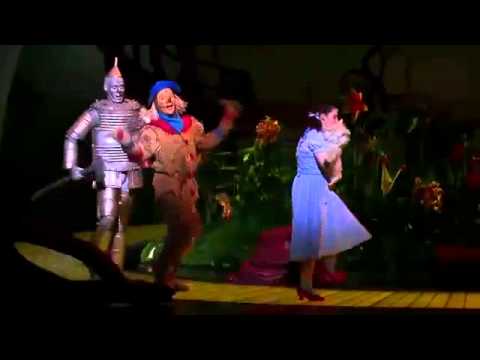
Review
Can you “improve” lyrics that have already fossilized into public memory? Andrew Lloyd Webber’s 2011 stage edition tries anyway, and the result is less a rewrite than a practical retrofit: Harburg’s film lyrics stay the emotional spine, while Tim Rice’s new material patches the places where a movie can cut away, but a live stage has to justify the next two minutes of attention. When it works, it feels like dramaturgy disguised as melody. When it doesn’t, you can hear the engineering.
The core lyric engine is still E. Y. Harburg: conversational rhymes, bright internal logic, and a knack for turning plain yearning into language you can whistle. That matters because “Oz” is a fable about wanting, and Harburg writes wanting without self-pity. Rice’s additions, by contrast, tend to explain the plot’s mechanics and sharpen character intention. Dorothy’s new opener is the clearest example: it front-loads the social pressure in Kansas so “Over the Rainbow” lands as escape rather than a pretty pause. The show is essentially arguing with its own most famous song: “Yes, you know this moment, but here’s why she needs it right now.”
Musically, the palette remains classic American screen musical, but the new songs lean pop-theatre contemporary. That shift changes the characters in subtle ways. The Witch’s new lyric framing pushes her from pure threat into motivated obsession. Professor Marvel’s patter becomes a conman’s sales pitch delivered with genial varnish. Glinda’s late-show ballad turns her from cameo deity into a guiding voice with a point of view. If you are listening to the cast album, you can hear the aesthetic handshake: Arlen and Harburg give you myth. Webber and Rice give you connective tissue.
Listener tip: play the 2011 cast recording in sequence once before cherry-picking. The new songs are designed like signposts. They feel thinner out of context, then suddenly “click” when you hear what they are trying to solve.
How It Was Made
The most modern thing about the 2011 “Wizard of Oz” is not a projection cue. It is the casting pipeline. Dorothy was chosen via the BBC talent series “Over the Rainbow,” turning the role into a nationally auditioned prize, and turning the show into an event before the first preview even started. That choice also shaped the lyric approach. When you build a show around a newly discovered Dorothy, you give her something to do immediately. Hence the new opening number that frames her isolation before the iconic rainbow wish.
Webber has been blunt about the stage problem he was trying to fix: the 1939 film can lean on editing, close-ups, and cinematic momentum; theatre has to earn transitions in real time. The solution was to add songs in the gaps: a Dorothy thesis statement up front, a Marvel patter number to clarify the “home” argument, a Witch number to energize Act II, and additional Wizard material to give the title character more than smoke and timing.
There is also a structural truth hiding in the lyric tweaks: the movie is “a story with songs,” and stage “Oz” wants to behave like a full musical. You can hear that ambition in where the new numbers sit: openings, act turns, and emotional summations. Those are not random slots. They are load-bearing.
Key Tracks & Scenes
"Nobody Understands Me" (Dorothy)
- The Scene:
- Kansas. A constrained domestic space, staged like a pressure cooker. Dorothy is surrounded by adults and near-adults who mean well, but keep missing her frequency. The lighting stays plain, almost stubbornly un-magical, because the point is claustrophobia.
- Lyrical Meaning:
- This is Dorothy’s case for escape, stated before the legend arrives. The lyric job is not poetry. It is motivation. It reframes “Over the Rainbow” as the answer to a question the show has already asked.
"Over the Rainbow" (Dorothy)
- The Scene:
- A quiet pocket inside the Kansas noise. Dorothy pulls focus as the stage stops trying to entertain and simply listens. The stillness is the special effect.
- Lyrical Meaning:
- Harburg writes yearning as a clean line rather than a sob story. That restraint is why the song survives every staging concept thrown at it. In this version, it also functions as rebuttal: Dorothy is not “misunderstood” because she is dramatic, she is misunderstood because her imagination is bigger than her environment.
"The Wonders of the World" (Professor Marvel)
- The Scene:
- Outside Marvel’s caravan. Toto interferes. Marvel produces magic-lantern style images like a street lecturer selling wonder by the slide. The scene plays as showmanship with a faintly predatory softness.
- Lyrical Meaning:
- Rice and Webber turn Marvel into a philosopher-huckster: he dazzles Dorothy with “wonders” while sneaking in the moral that home itself is one. The lyric is persuasion, not confession, and that is exactly why it fits Marvel.
"Follow the Yellow Brick Road / You're Off to See the Wizard" (Dorothy and Company)
- The Scene:
- Munchkinland detonates into color, then sends Dorothy forward with a literal route and a moral instruction. Ensemble staging does the work of “world-building” in one blast.
- Lyrical Meaning:
- These lyrics are travel rules disguised as a pep talk. The brilliance is how easily they carry exposition. You leave the scene knowing where Dorothy is going, why she is going, and what “hope” sounds like in communal rhythm.
"The Merry Old Land of Oz" (Dorothy, Scarecrow, Tin Man, Lion, Ensemble)
- The Scene:
- Emerald City as a theatrical payoff: movement, crowds, and the sensation of arriving somewhere that looks like it can solve your problems. The staging tends to push toward spectacle because the lyric is basically civic propaganda.
- Lyrical Meaning:
- Harburg’s language satirizes boosterism while still being catchy enough to sell it. The song is about belief as tourism: you want to be impressed, so you let the city impress you.
"Bring Me the Broomstick" (The Wizard)
- The Scene:
- The Wizard’s demand lands like a job interview that suddenly becomes a threat assessment. The friends are trapped between awe and bureaucracy.
- Lyrical Meaning:
- This number clarifies power. On stage, the Wizard needs a musical moment that asserts control rather than hiding behind effects. The lyric is transactional: wishes are granted only after violence is outsourced.
"Red Shoes Blues" (Wicked Witch)
- The Scene:
- Act II needs a jolt, and the Witch provides it. Her world is darker, louder, and more rhythmically aggressive. The staging often leans into march energy from her followers.
- Lyrical Meaning:
- The Witch becomes legible. Instead of generic evil, the lyric gives her a fixation and a grievance. That makes her funnier and nastier at the same time, which is exactly what a family musical villain requires to keep tension without shutting the room down.
"Already Home" (Glinda)
- The Scene:
- Late in the story, after the road has done its work. Glinda finally steps forward not as glitter, but as guide. The light softens. The staging usually clears space so the moral can land without clutter.
- Lyrical Meaning:
- This is the show’s thesis, stated as comfort. The lyric argues that Dorothy’s quest has changed her ability to recognize what she already had. It also repairs a stage-musical problem: Glinda needs an emotional signature, not just entrances and exits.
Live Updates
Information current as of 2 February 2026. The most visible recent life of the Webber-Sams stage version ran through the 2023 London Palladium revival (summer limited engagement), then a UK and Ireland tour that concluded in 2024, followed by a short West End return at the Gillian Lynne Theatre in August to early September 2024. Since then, major commercial dates for this specific production have not been broadly advertised, but the show remains active in licensing and regional programming, and “Oz” as a brand continues to spawn new adaptations and seasonal productions.
If you are tracking the piece for SEO or audience intent, note the split: many listings that say “The Wizard of Oz” are not this Webber-Rice augmented version. They may be the MGM screen-to-stage editions, pantomimes, or new plays using the Baum premise with original music. The lyric fingerprints are your giveaway: if you see “Nobody Understands Me,” “Red Shoes Blues,” or “Already Home,” you are in the 2011-derived lineage.
Notes & Trivia
- Dorothy was cast through the BBC series “Over the Rainbow,” making the lead role a televised public vote before the show opened.
- The 2011 cast album release date is 9 May 2011, and it preserves the “new song first” structure with “Nobody Understands Me” leading into “Over the Rainbow.”
- Professor Marvel’s “Wonders of the World” is staged as showman education, often using projected or lantern-style images to sell wonder as a product.
- Glinda’s “Already Home” is a late addition by stage-musical standards: it gives a character with huge symbolic weight an actual emotional argument.
- Critics repeatedly singled out “Red Shoes Blues” as the most effective of the added numbers because it gives the Witch a specific obsession instead of generalized menace.
- Some versions and related editions omit “If I Were King of the Forest,” a film number many audiences assume is always present.
- The 2024 West End return at the Gillian Lynne Theatre was marketed as a strictly limited run tied to the end of the UK and Ireland tour.
Reception
The 2011 critical story is consistent: admiration for the original film songs, skepticism about whether any additions were necessary, and grudging respect when the new material solved a real stage problem. Reviews also tended to diagnose the adaptation challenge bluntly: the movie’s structure is not naturally “musical theatre shaped,” so the stage version either had to embrace that weirdness or smooth it out.
“The additions by Lloyd Webber and Rice are also perfectly acceptable.”
“He shows Dorothy magic lantern slides and sings ‘The Wonders of the World’ ...”
“Predictable and doggedly faithful.”
Quick Facts
- Title: The Wizard of Oz (2011 stage musical version)
- Year: 2011 (Original London production at the London Palladium)
- Type: Stage musical adaptation of the 1939 film and Baum’s novel lineage
- Core Songwriters: Music by Harold Arlen; lyrics by E. Y. Harburg
- Additional Music: Andrew Lloyd Webber
- Additional Lyrics: Tim Rice
- Book: Andrew Lloyd Webber and Jeremy Sams
- Cast Recording: “Andrew Lloyd Webber’s New Production of the Wizard of Oz (Original London Cast Recording)” (released 9 May 2011)
- Label / Rights Line (digital): LW Entertainment Limited under exclusive license to The Other Songs Records Limited
- Selected notable placements (song-to-story): “Nobody Understands Me” (Kansas opener), “Red Shoes Blues” (Act II engine), “Already Home” (final moral)
Frequently Asked Questions
- Is the 2011 stage version the same as the 1939 film score?
- Mostly, but not entirely. The spine is Arlen and Harburg, while Webber and Rice add new numbers and occasional new lyric material so the story reads cleanly on stage.
- How can I tell if a production is using the Webber-Rice additions?
- Look for song titles like “Nobody Understands Me,” “The Wonders of the World,” “Red Shoes Blues,” and “Already Home.” Those are strong identifiers of the 2011-derived version.
- Why add an opening song before “Over the Rainbow”?
- The stage needs Dorothy’s problem stated out loud. In a film, a close-up can do that. In a theatre, a lyric often has to carry the psychology.
- Is there an official cast album for the 2011 London production?
- Yes. The Original London Cast Recording was released in May 2011 and is available on major streaming platforms.
- Did the show return recently in London?
- Yes. A revival played the London Palladium in summer 2023, followed by a UK and Ireland tour that concluded with a limited West End run at the Gillian Lynne Theatre in August to early September 2024.
Key Contributors
| Name | Role | Contribution |
|---|---|---|
| Harold Arlen | Composer | Music for the core film songs that remain the foundation of the stage score. |
| E. Y. Harburg | Lyricist | Lyrics for the classic numbers, including “Over the Rainbow” and the road-to-Oz sequences. |
| Andrew Lloyd Webber | Additional composer / co-adaptor | New songs and additional music to strengthen stage structure and character motivation. |
| Tim Rice | Additional lyricist | New lyrics for added numbers, sharpening narrative clarity and Act II propulsion. |
| Jeremy Sams | Co-adaptor / director (2011) | Stage adaptation shaping pacing, dialogue, and transitions for live performance. |
Sources: Playbill, WhatsOnStage, LW Theatres, AndrewLloydWebber.com, The Guardian, Variety, British Theatre Guide, Apple Music, Spotify, WestEndTheatre.com, Musicals On Tour.