Titanic Lyrics – All Songs from the Musical
Titanic Lyrics: Song List
- Act 1
- Overture In Every Age
- How Did They Build Titanic?
- Fare-thee-well
- There She Is
- I Must Get On That Ship
- The 1st Class Roster
- Godspeed Titanic
- Barrett's Song
- What A Remarkable Age This Is
- To Be A Captain
- Lady's Maid
- The Proposal/ The Night Was Alive
- Hymn/ Doing The Latest Rag
- I Have Danced
- No Moon
- Autumn / Finale Act 1
- Act 2
-
Wake Up, Wake Up!
- Dressed In Your Pyjamas In The Grand Salon
- The Staircase
- The Blame
- To The Lifeboats
- We'll Meet Tomorrow
- Still
- To Be A Captain (reprise)
-
The Foundering
- Mr. Andrews' Vision
- Epilogue: In Every Age
About the "Titanic" Stage Show
In April 1997, the premiere of the musical ‘Titanic’ was in New York's Lunt-Fontanne Theatre. Presentation, produced by R. Jones, was closed after 2 years, withstanding more than 800 productions. Roles played by A. Cuervo, D. Garrison, M. Cerveris, V. Clark, D. Stephenson, L. Keith, J. Cunningham & B. D. James. To help to beholders to imagine a full grandeur of this vessel, multi-level decorations were built on a stage, displaying an actual structure of the ship. A real list of passengers of Titanic has been inserted on the walls, including names of those who survived this tremendous tragedy (712 people, according to the existing data).After a very successful premiere on Broadway, a musical went to the national tour. In July 2012, D. Stephenson & L. Gennaro staged the new version of the famous story. They cut the cast up to 20 people & used a projection of the actual ship, not the scenery, as in the previous version & the original orchestral parts. New reading earned the grateful reviews from critics & was nominated for 11 Broadway World Awards.
In January 2014, it was the premiere of a new version in the Broadway Theatre. Director was S. Weinstein & musical director – E. Doran.
Over the years, the musical has been produced on many large & small stages around the world. In 2001, the production was shown in the Royal Theatre Carre (Netherlands). A year later, the musical came to Germany & in 2005 – to Ireland. By the way, in this country a musical started at 23:40 – the time when the ship was struck by an iceberg. Ireland was in many ways epochal country for creation of this sea vessel, as over 1000 Irish people were building this at the dockyard.
From 2006 to 2012, the musical was also in the US, Canada, Wales, Belgium, Japan & Norway.
Release date: 1997
"Titanic" – The Musical Guide & Song Meanings
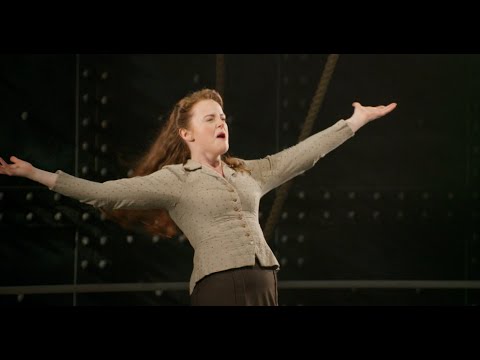
Review
How do you write lyrics for a story where the audience knows the ending, and the ending is mass death? Maury Yeston and Peter Stone’s answer is bracingly practical: make the Titanic itself the lead, then let every character sing as if the future is negotiable. The score moves like a ship’s engine room, steady, layered, indifferent. The lyrics, at their best, work like a manifest: names, classes, intentions, the little self-mythologies people pack when they travel.
The show’s lyric engine is ambition. First Class sings permanence, Second Class sings arrival, Third Class sings escape, and the crew sings duty as if duty were a religion. Yeston’s language rarely tries to be cute. It aims for clarity and lift, because the real drama is structural: a hierarchy that looks elegant in daylight and turns lethal at 11:40 p.m. When the text turns hymn-like, it is not piety; it is people trying to keep their dignity intact as the rules break.
Musically, “Titanic” behaves more like a choral symphonic drama than a romance-forward book musical. That matters. It lets the lyric writing function as a chorus of competing worldviews, not a single hero’s diary. It also explains why this show keeps coming back in concert and semi-staged formats: the storytelling is already in the music, and the words are designed to ride that wave.
How It Was Made
Yeston has traced the show’s first spark to the mid-1980s, when the discovery of the shipwreck made the Titanic feel newly physical, not just legendary. Then the Challenger disaster hit, and the theme snapped into focus: modern faith in technology, and the human cost when that faith gets lazy. In interviews, he has also pointed to early-20th-century English symphonic colors (think Elgar and Vaughan Williams) as a musical vocabulary that matches the mindset that could imagine an “unsinkable” ship. That choice is not cosmetic. It is the show’s lyric strategy in disguise: the music creates the civilization; the words reveal its blind spots.
Stone’s framing is equally pointed. He insisted the show should not treat the Titanic as scenery for a fictional melodrama. The ship is the central character, and the people are the evidence. That one structural decision is why the lyrics keep returning to roles, jobs, and class signage. Everyone is introduced in relation to systems, not just feelings, and the score makes the systems sing.
Key Tracks & Scenes
"In Every Age" (Andrews)
- The Scene:
- Prologue. The stage becomes a dockside dream of iron and confidence. Andrews speaks into the future while the ensemble gathers like a living blueprint.
- Lyrical Meaning:
- The lyric thesis: each era believes it has solved fear with invention. The song flatters progress, then quietly warns that progress always ships with ego inside the crate.
"How Did They Build Titanic?" (Barrett)
- The Scene:
- Launch day energy. Working-class muscle turns into percussion. Barrett sings from inside the labor that made the luxury possible.
- Lyrical Meaning:
- Wonder as a working person’s right, not just a rich person’s purchase. The lyric celebrates craft, then plants the show’s recurring irony: the builders understand the risks better than the buyers.
"Godspeed Titanic" (Company)
- The Scene:
- Departure. The ship leaves as if blessed by the whole harbor. Voices stack across classes; everyone borrows the same prayer.
- Lyrical Meaning:
- A communal spell. The lyric is deliberately simple, because mass optimism is simple. The dread comes from how sincerely everyone means it.
"Lady's Maid" (The Three Kates)
- The Scene:
- First Class routines. Bright, quick, professional. The servants move like a backstage crew inside someone else’s life.
- Lyrical Meaning:
- Language as social choreography. The lyric is funny on the surface, but the subtext is transactional intimacy: the rich outsource even their private selves.
"The Proposal / The Night Was Alive" (Barrett & Bride)
- The Scene:
- Private joy against public grandeur. The ship’s party atmosphere softens into something close and human, often staged with warmer light and a sudden hush around the couple.
- Lyrical Meaning:
- One of the score’s sharpest contrasts: personal permanence being declared on a vessel built to embody permanence. The lyric is romantic, but it lands as dramatic irony the audience cannot un-know.
"No Moon" (Fleet & Company)
- The Scene:
- Night watch. The temperature drops. The lookout stands in darkness that feels almost featureless, and the ship keeps moving anyway.
- Lyrical Meaning:
- A lyric about missing information. “No moon” becomes a metaphor for the limits of human perception: you cannot avoid what you cannot see, especially when pride tells you sight is optional.
"The Blame" (Ismay, Andrews & Smith)
- The Scene:
- After impact. Authority gathers to narrate itself. The song plays like an inquiry held while the floor is tilting.
- Lyrical Meaning:
- The lyric is a three-way duel of excuses: commerce, design, command. The brilliance is that nobody is lying; they are simply telling the truth that helps them survive the mirror.
"Still" (Ida & Isidor Straus)
- The Scene:
- Late Act II. The panic is everywhere, but this is sung as a pocket of calm. Two people refuse the show’s usual currency (self-preservation) and choose each other.
- Lyrical Meaning:
- Yeston writes love without bargaining. The lyric refuses melodrama; it is devotion stated as fact. That restraint is why it hurts.
Live Updates
“Titanic” has had a useful second life as an event piece. New York City Center’s Encores! mounted a concert revival in June 2024, leaning into the score’s choral and orchestral muscle. That’s not a gimmick; it is arguably the cleanest way to hear what Yeston wrote.
On the accessibility front, a filmed capture of a recent U.K. touring production began streaming on BroadwayHD in December 2023 after U.S. cinema screenings through Fathom Events. For anyone researching the lyric pacing and how the ensemble storytelling lands in performance, that release matters more than a thousand plot summaries.
For 2025 and into 2026, the clearest “where can I experience it?” signals are regional and licensed productions, plus special screenings of the filmed version. There is also a separate, camp parody musical, “Titaníque,” that has its own ecosystem and headline cycle; it is not the same piece, and the music is entirely different.
Notes & Trivia
- Peter Stone described the musical as a factual story where the central character is the ship itself, not invented romance.
- Maury Yeston has linked his initial interest to the discovery of the wreck in the 1980s, and later to the Challenger disaster as a modern echo of technological overconfidence.
- Yeston has cited early-20th-century English symphonic influence (including Elgar and Vaughan Williams) as a tonal model for the score’s worldview.
- The original Broadway run opened in 1997 at the Lunt-Fontanne Theatre and played 804 performances.
- The Tony Award for Best Orchestrations was introduced in 1997, and Jonathan Tunick won for “Titanic.”
- Yeston has noted that every character name is taken from a real Titanic passenger or crew member, a restraint that keeps the lyric writing anchored to history.
- A filmed U.K. tour production was screened in U.S. cinemas in November 2023 and then streamed via BroadwayHD beginning December 2023.
Reception
“Titanic” arrived with a built-in punchline (a musical about a shipwreck) and left with major awards. The modern case for the show is less about spectacle and more about craft: a score that can create scale without demanding a ten-million-dollar set, and lyrics that treat class as fate rather than decoration.
“Stirring melodies and heartfelt lyrics” fill one of Yeston’s “most complex scores.”
A concert approach can emphasize “crystalline storytelling through song,” sometimes hitting harder than Broadway-scale machinery.
The filmed tour underlines a practical truth: “Titanic” can travel, scale, and still keep the score’s weight intact.
Quick Facts
- Title: Titanic
- Broadway year: 1997 (opened April 23, 1997)
- Type: Historical musical / ensemble drama
- Story & Book: Peter Stone
- Music & Lyrics: Maury Yeston
- Original Broadway venue: Lunt-Fontanne Theatre (New York)
- Orchestrations (original): Jonathan Tunick
- Selected notable musical moments: “In Every Age,” “Godspeed Titanic,” “No Moon,” “The Blame,” “Still”
- Album: “Titanic: A New Musical – Original Broadway Cast Recording” (1997)
- Label/Album status: Released as an Original Broadway Cast Recording; widely available on streaming (example listing: Spotify)
- Filmed stage capture: U.K. tour production released via Fathom Events (cinemas) and BroadwayHD (streaming)
- Licensing: Available in an Original version and an Ensemble version
Frequently Asked Questions
- Is this connected to James Cameron’s film “Titanic”?
- No. The stage musical is a separate work, focused on real passengers and crew and structured as an ensemble history piece.
- Who wrote the lyrics?
- Maury Yeston wrote the music and lyrics; Peter Stone wrote the book.
- Is there a proshot or filmed version?
- Yes. A filmed capture of a U.K. touring production screened in U.S. cinemas in November 2023 and later streamed on BroadwayHD.
- Where does “In Every Age” sit in the story?
- It functions as the prologue. It frames the show’s argument about ambition and progress before the ship even sails.
- Is there a cast album?
- Yes. The Original Broadway Cast Recording was released in 1997 and remains available on major music services.
- What is the difference between the Original and Ensemble versions?
- The Ensemble version is a licensed adaptation designed for fewer performers through doubling, while keeping the narrative architecture intact.
Key Contributors
| Name | Role | Contribution |
|---|---|---|
| Maury Yeston | Composer-Lyricist | Wrote the score and lyric text; leaned into symphonic color to mirror the era’s faith in progress. |
| Peter Stone | Book Writer | Built an ensemble structure with the ship as central character; minimized invention to keep the piece historical. |
| Jonathan Tunick | Orchestrator | Created the orchestral architecture that gives the show its scale; won the Tony for orchestrations in 1997. |
| Richard Jones | Original Broadway Director | Staged the 1997 Broadway production that established the show’s modern reputation. |
| Thom Southerland | U.K. Tour Director | Directed the recent tour that was filmed and released for cinemas and streaming. |
| Anne Kauffman | Encores! Director | Led the 2024 concert revival, emphasizing storytelling through vocal and orchestral clarity. |
| Rob Berman | Music Director (Encores!) | Conducted the Encores! orchestra, foregrounding Yeston’s choral writing and Tunick’s instrumentation. |
Sources: Concord Theatricals; IBDB; The Tony Awards (American Theatre Wing); Masterworks Broadway; Playbill; TitanicTheMusical.co.uk; TheaterMania; Observer; Fathom Entertainment; BroadwayHD release coverage; Wikipedia (for high-level reference and cross-checking).