
Summer Stock Lyrics: Song List
- Overture
- If You Feel Like Singing, Sing
- Happy Harvest
- Dig-Dig-Dig for Your Dinner
- Mem'ry Island
- You, Wonderful You
- Friendly Star
- Fall in Love
- All for You
- The Blue Jean Polka
- You, Wonderful You (Reprise)
-
Heavenly Music

- Get Happy
- Happy Harvest (Finale)
About the "Summer Stock" Stage Show
Initially, the producer J. Pasternak planned to invite to the main role M. Rooney, a constant companion on the stage of actress Judy Garland. But later the decision was reversed, and on the main role was approved G. Kelly. However, difficulties have arisen with the main female role too, when initially approved J. Garland didn’t do that well, suffering from drug addiction. For this reason, the making process stretched by as much as 8 months. In place of Judy Garland was predicted another actress, J. Allyson, after the first one was 3 months in the drug clinic, in parallel gaining weight. In general, the filming process was challenging both for the actress and for the whole team who worked on the histrionics. For example, “Get Happy” song could be written only when the actress dropped the extra 20 pounds, and it was 2 months later.
In the post of director was originally approved B. Berkeley, but before shooting the reins received C. Walters. The latter, like G. Kelly, agreed to take part in this musical only out of respect for Judy Garland, whose career required support. During filming, J. Pasternak has repeatedly discussed his participation with the management of the studio Metro-Goldwyn-Mayer. The reason was the lack of respect from the main actress to him in the process. She was often late for filming, or did not appear at all, but the management was adamant: Judy Garland gets a chance again and again. Metro-Goldwyn-Mayer studio was grateful to the actress that she influenced their success in the past very much, and the least they could do for her is to support and be there in not the best of her days. They feared that if the producer refuses to perform, it would negatively affect the state of Judy. After the shooting, she was fired, but a show with her participation was a box office success.
Release date of the musical: 1950
"Summer Stock" – The Musical Guide & Song Meanings
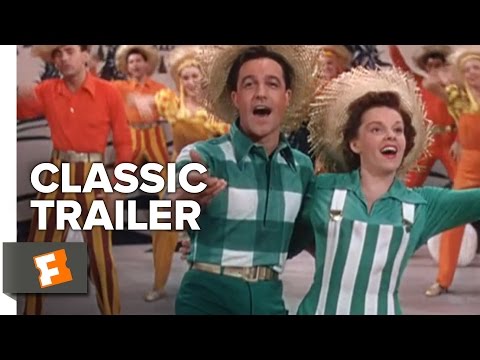
Review
“Summer Stock” is a movie musical about labor that keeps slipping into fantasy, then snapping back with a grunt. Jane Falbury is running a Connecticut farm that is one bad season from going under. Then a touring theatre troupe moves into her barn and treats it like free real estate. The film’s lyrical writing, mostly by Mack Gordon to Harry Warren tunes, does something sly: it frames work as rhythm. Not moral virtue, not tragedy, just motion. If you can keep moving, you can keep breathing.
The lyrics aren’t “character studies” in the modern Broadway sense. They are short, functional, and built to ride performance. Garland’s numbers tend to be plainspoken pep talks that read like self-management. Kelly’s numbers lean into craft and control, an artist solving problems with his body and a prop. The script’s romantic friction is essentially about ownership. Who owns the barn. Who owns the schedule. Who gets to decide what the work is called. And the best songs keep answering that question with the same shrug: whoever can sell the room.
Then “Get Happy” arrives and changes the movie’s temperature. It is a performance that knows it is being watched, and it plays with that fact like a live-wire. The lyric is simple, almost sermon-like. The staging does the heavy lifting, turning a tune into a declaration about presence. It is also why the film’s reputation survives beyond its plot mechanics. The lyrics do not get smarter in the finale. The performance does.
How it was made
Here is the behind-the-scenes fact that colors the whole soundtrack. “Get Happy” was added as a late “payoff” for Garland, and she wore the same costume she had used for “Mr. Monotony,” a number cut from “Easter Parade.” That is not trivia for trivia’s sake. It tells you the studio knew what the audience really came for, and it tells you how much this film was being solved in post-production logic, not just on set. The result is a soundtrack with two centers: the farm-and-troupe plot, and the star moment that outmuscles the plot.
AFI’s catalog notes the choreography split and even who choreographed which numbers, including Kelly handling “You Wonderful You,” “All for You,” and “Portland Fancy.” It is a reminder that the “lyrics” conversation is incomplete without the bodies singing them. The movie is often remembered as a warm MGM musical. Production accounts suggest it was not warm at all.
Key tracks & scenes
"If You Feel Like Singing, Sing" (Jane)
- The Scene:
- Morning on the farm. Jane sings while “showering” behind a modesty setup, then keeps singing as she gets ready and faces the day. Bright, domestic light, the kind that makes chores look survivable.
- Lyrical Meaning:
- A self-issued permission slip. The lyric is not denying hardship. It is arguing that mood is a tool. Jane is trying to stay solvent and sane, and the song is her cheapest resource.
"(Howdy Neighbor) Happy Harvest" (Jane and Company)
- The Scene:
- Community and productivity, staged as a celebration. Jane is often framed in open outdoor space, moving through the farm like a hostess who cannot afford to host.
- Lyrical Meaning:
- Public optimism as cover. The lyric sells abundance because that is what the neighbors need to believe. Underneath, the film is quietly admitting that the farm is one storm away from disaster.
"Dig-Dig-Dig Dig For Your Dinner" (Joe, Herb, Company)
- The Scene:
- Rehearsal chaos with a work-song backbone. The barn becomes a job site. Blocking is blunt, percussive, and crowded, with the lighting reading like midday sweat.
- Lyrical Meaning:
- It is the film’s thesis in one joke: art still needs labor, and labor still needs food. The lyric makes a pragmatic bargain sound like entertainment, which is exactly what Joe is doing to Jane.
"Portland Fancy" (Company, Joe, Jane)
- The Scene:
- A New England folk dance inside the barn-theatre experiment. The staging leans lantern-warm, with circles and partner changes that turn community into choreography.
- Lyrical Meaning:
- This is where the show-within-the-show starts to justify its existence. The lyric and tune function like local color, but the subtext is trust. Jane is letting the troupe into her world.
"All for You" (Joe and Jane)
- The Scene:
- A flirtation built out of rehearsal intimacy. The space feels temporarily private, even though it is still a barn with people nearby. Softer light, less bustle.
- Lyrical Meaning:
- Affection as persuasion. The lyric is romantic, but it is also Joe negotiating terms. In this movie, romance is never fully separate from logistics.
"You Wonderful You" (Joe and Jane)
- The Scene:
- Near-finale romance, filmed with a calmness the rest of the plot rarely allows. The camera and lighting give the couple room to breathe, like the movie is briefly trying on sincerity.
- Lyrical Meaning:
- A direct compliment that lands because the film has made compliments scarce. The lyric is simple by design. It is the rare moment where neither character is selling anything else.
"You Wonderful You" (Joe solo)
- The Scene:
- Kelly’s craft number: a squeaky board, a newspaper, and a dancer solving rhythm in real time. Bright rehearsal light, with the “found object” props turned into percussion.
- Lyrical Meaning:
- Same title, different purpose. Here the lyric becomes a performance frame for virtuosity. It is Joe proving that control is his love language.
"Friendly Star" (Jane)
- The Scene:
- Jane alone in motion, often associated with her tractor ride and the farm’s long horizons. The light reads late-day, the kind that makes you feel the work in your shoulders.
- Lyrical Meaning:
- Hope with a crack in it. The lyric reaches for reassurance, but the emotional color is more complicated. It is the sound of someone trying to act fine so she can keep functioning.
"Get Happy" (Jane and Chorus)
- The Scene:
- The big performance number, staged on a simplified, graphic set with chorus hands and suit silhouettes. Garland appears in a sharply tailored black costume and tilted hat, with lighting that feels theatrical rather than “real.”
- Lyrical Meaning:
- A sermon disguised as a club act. The lyric is about joy, but the performance reads like command. It is the film’s clearest argument that show business is not escape, it is power.
Live updates (2025/2026)
Information current as of February 2026. “Summer Stock” remains widely accessible as a classic-catalog title. In current listings, it is available for digital rental or purchase through major storefronts, and it also has a Warner Archive Blu-ray release (2019). If you are building an evergreen “how to watch” section, the most stable links are the major storefront listings and the Warner Archive physical edition.
The property also has a modern stage afterlife. Goodspeed Musicals premiered a stage musical adaptation in 2023 with a new book and additional lyrics, produced in special arrangement with Warner Bros. Theatrical Ventures. That is the 2025/2026 story that matters: not a tour, but a rights-holder-backed attempt to translate the barn premise back onto a stage, where it originally belonged.
Listener tip: if you are coming for “Get Happy,” do not start there. Start with “If You Feel Like Singing, Sing,” then “Dig-Dig-Dig Dig For Your Dinner,” then one version of “You Wonderful You.” When “Get Happy” hits, you will feel why it lands like a curtain call instead of a random insert.
Notes & trivia
- The film’s song list is dominated by Harry Warren and Mack Gordon, but “Get Happy” is an older standard by Harold Arlen and Ted Koehler, inserted as the late-film knockout.
- AFI’s catalog notes Kelly choreographed himself in “You Wonderful You,” “All for You,” and “Portland Fancy,” while other musical staging was handled separately.
- “Get Happy” is recognized by the American Film Institute in its “100 Years…100 Songs” list at #61.
- The original film soundtrack was released by MGM Records in 1950, originally across 78 rpm discs and a 10-inch LP configuration.
- Billboard’s 1950 review of the soundtrack (as later reprinted and summarized in reference sources) praised Garland and Kelly’s performances and singled out specific ballads as standouts.
- In critical memory, the movie’s reputation often hinges on a single sequence, which is rare even for MGM musicals.
Reception
In 1950, the reviews tended to separate the film’s routine plot from its star electricity. Bosley Crowther’s take is a neat summary: he called the narrative fairly standard, but highlighted Garland’s chance to shine and pointed directly at “Get Happy.” In other words, the movie arrived already carrying its own footnote, and the footnote was the performance.
Modern reception is even more blunt. The story is a serviceable container. The musical numbers are the event, and the lyrics do their best work when they are pragmatic and fast, not poetic. The film does not win by profundity. It wins by timing, and by letting Garland walk onstage and refuse to blink.
“‘Get Happy’ finds Miss Garland looking and performing her best.”
“Get Happy” (Performer: Judy Garland) listed at #61.
AFI catalog notes the choreography breakdown across key numbers.
Quick facts
- Title: Summer Stock
- Year: 1950
- Type: MGM Technicolor film musical
- Director: Charles Walters
- Producer: Joe Pasternak
- Stars: Judy Garland, Gene Kelly
- Primary songwriters: Harry Warren (music), Mack Gordon (lyrics)
- Signature inserted standard: “Get Happy” (Harold Arlen, Ted Koehler)
- Soundtrack label: MGM Records (original 1950 issue)
- Home video: Warner Archive Blu-ray release (2019)
- Where to watch: Commonly listed for rent or purchase on major digital storefronts; availability varies by region and date
- Modern adaptation: Stage musical premiered at Goodspeed Musicals (2023) under Warner Bros. Theatrical Ventures arrangement
Frequently asked questions
- Who wrote the lyrics?
- Most of the film’s new songs use music by Harry Warren with lyrics by Mack Gordon. “Get Happy” is a separate standard with lyrics by Ted Koehler and music by Harold Arlen.
- Is there an official soundtrack album?
- Yes. MGM Records released a film soundtrack in 1950, and the music has been reissued in various formats over time, including modern streaming editions.
- Where does “Get Happy” happen in the story?
- Late in the film, as the show-within-the-movie reaches its performance peak. The staging is intentionally theatrical, with Garland fronting the sequence as a star turn rather than a plot beat.
- What is the best “first listen” path if I only want the essentials?
- Try “If You Feel Like Singing, Sing,” “Dig-Dig-Dig Dig For Your Dinner,” the solo “You Wonderful You,” then “Get Happy.” That sequence captures Jane’s mindset, the barn-work bargain, Joe’s virtuosity, and the film’s final punch.
- Is “Summer Stock” only a film, or is there a stage version?
- There is a modern stage musical adaptation that premiered at Goodspeed Musicals in 2023, built around the barn-to-theatre premise with added material.
Key contributors
| Name | Role | Contribution |
|---|---|---|
| Charles Walters | Director | Guided the film’s tone from rural comedy into full-stage musical set pieces. |
| Joe Pasternak | Producer | Oversaw the MGM production and its star-driven musical strategy. |
| Harry Warren | Composer | Wrote most of the film’s original songs, giving the score its brisk, practical bounce. |
| Mack Gordon | Lyricist | Supplied lyrics that emphasize motivation and motion over introspection. |
| Harold Arlen | Composer | Wrote the music for “Get Happy,” the film’s signature inserted standard. |
| Ted Koehler | Lyricist | Wrote the lyrics for “Get Happy,” framing joy as a command and a promise. |
| Gene Kelly | Star, choreographer (select numbers) | Performed and choreographed key dance sequences including versions of “You Wonderful You.” |
| Judy Garland | Star | Anchored the film’s emotional and musical center, culminating in “Get Happy.” |
| Cheri Steinkellner | Stage adaptation writer | Wrote the book and additional lyrics for the 2023 Goodspeed stage musical adaptation. |
Sources: American Film Institute (AFI) Catalog, AFI 100 Years…100 Songs, Film Forum, Warner Archive, JustWatch, Apple TV, IMDb (soundtrack list), MGM Records soundtrack reference pages, Goodspeed Musicals.