Shrek Lyrics – All Songs from the Musical
Shrek Lyrics: Song List
- Act 1
- Overture / Big Bright Beautiful World
- After Big Bright Beautiful World
- Story of My Life
- The Goodbye Song
- Don't Let Me Go
- Regiment #1
- Farquaad's Chamber
- Regiment Reprise
- Holiday for Duloc
- What's Up, Duloc?
- The Raffle
- What's Up, Duloc? Reprise
- Fiona Tower Move
- I Know It's Today
- Travel Song
- Forever
- Donkey Pot Pie
- This Is How Dreams Come True
- Act I Sunset
- Who I'd Be
- Act 2
- Morning Person
- I Think I Got You Beat
- Farq in A
- The Ballad of Farquaad
- It's Duloc
- Make a Move
- When Words Fail
- Morning Person (Reprise)
- The Arrival of Farqaad
- Build A Wall
- Freak Flag
- Wedding Procession
- Big Bright Beautiful World (Reprise)
- More to the Story
- This is Our Story (Finale)
- I'm a Believer
- Forever
About the "Shrek" Stage Show
Release date: 2008
"Shrek The Musical" – The Musical Guide & Song Meanings
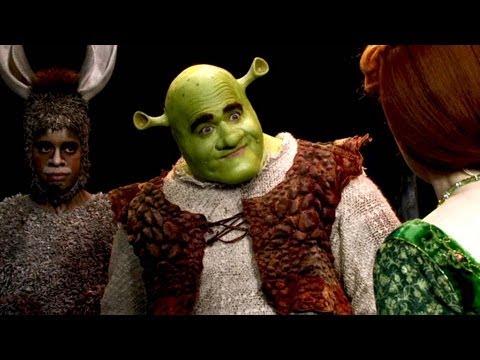
Review: why the lyrics work better than you remember
Here’s the paradox of “Shrek The Musical”: it’s built from a film that already lands its jokes, yet the stage version’s best moments arrive when it stops chasing the movie and starts writing around it. David Lindsay-Abaire’s lyrics do their real job in the gaps, giving inner monologues to characters who, on screen, mostly survive on reaction shots. The show aims for a community fable about shame and belonging, and it largely succeeds when the text treats “fairy-tale misfit” as a psychological condition rather than a costume category. (Music Theatre International’s synopsis is blunt about the engine: exile, discrimination, and the scramble to define “normal.”)
Musically, Jeanine Tesori plays a practical game: genre-switching as characterization. When the score flips from faux-anthem to pop pastiche to old-school theatre punchline, it’s not random variety-night behavior; it’s the show’s way of labeling who is performing confidence versus who is begging for it. That matters because the lyrics repeatedly draw a line between public identity (“what the town sees”) and private language (“what the character admits when the lights narrow”). The result is a musical that is at its sharpest when it is least interested in being cute. It can be cute anyway.
Listener tip (before you watch): if you only sample two numbers to follow the plot cleanly, go with “Big Bright Beautiful World” (Shrek’s worldview) and “When Words Fail” (Shrek’s emotional bottleneck). Everything else hangs on the difference between those two sentences.
Seat-and-visual tip (for staged productions): in make-up-heavy versions, front mezzanine or mid-orchestra often gives the best read on prosthetic detail and puppet choreography without losing the full-body comedy. In the newer “actor-forward” touring approach, closer seats reward facial acting more than spectacle.
How it was made: from “no songs” to a full score
The key production problem was obvious: the original movie had no pre-existing song structure to borrow. In a 2008 interview, Lindsay-Abaire said DreamWorks had “no interest in duplicating the movie onstage,” and stressed the stage script is far more rewritten than people assume. That mandate is the tell. The musical isn’t a transcript; it is a negotiation between brand recognition and theatre mechanics, with lyrics doing the legal work of “new.”
The project also had the classic tryout-to-Broadway squeeze. Playbill’s cast-album reporting places the out-of-town tryout at Seattle’s 5th Avenue Theatre, with the cast recording session happening January 12, 2009 at Legacy Studios in Manhattan. If you want the practical meaning of “Broadway polish,” it’s that timeline: the show is still metabolizing notes while the album is already being locked.
One origin-story detail worth keeping: Lindsay-Abaire has credited producer-director Sam Mendes as an early champion who pushed his name for the job, even though he had never written a musical before. And years later, the creators publicly admitted what audiences could sense: too many stakeholders meant too many notes. The 2024 Playbill report on the revised tour is unusually candid about wanting a “leaner” version and about changing the framing so the performer is visible under the character.
Key tracks & scenes: 8 lyrical turning points
"Big Bright Beautiful World" (Shrek, Mama Ogre, Papa Ogre)
- The Scene:
- Storybook framing. Parents send young Shrek out, often staged with a “bright” promise undercut by colder light on the kid as the world closes in. The adult Shrek inherits the punchline: solitude as self-defense.
- Lyrical Meaning:
- The lyric sets the show’s thesis: optimism can be weaponized. “Beautiful” becomes something the world uses to exclude, so Shrek rebuilds “beautiful” as ownership, boundaries, and control.
"Story of My Life" (Fairy-Tale Creatures)
- The Scene:
- A refugee caravan lands in Shrek’s swamp after Farquaad’s banishment order. Staging usually turns into a rolling introduction parade: quick character spotlights, fast jokes, real stakes.
- Lyrical Meaning:
- This is the show’s political number in a party hat. The lyric turns identity into a case file: everyone has a label, everyone has a sentence, everyone is told to accept the insult as biography.
"I Know It’s Today" (Fiona: Young, Teen, Adult)
- The Scene:
- Lights snap to Fiona at age seven in the tower, then time-lapses through adolescence into adulthood. Directors tend to stage it like an accelerating routine: hope, boredom, then feral patience.
- Lyrical Meaning:
- Fiona’s lyric is a survival manual disguised as a princess song. The rhyme scheme behaves like ritual, repeating belief until belief becomes muscle memory, even when the body has learned the tower is permanent.
"What’s Up, Duloc?" (Lord Farquaad, Ensemble)
- The Scene:
- Duloc’s propaganda showcase. Smiling dancers, rigid geometry, and an aggressively cheerful welcome as Shrek and Donkey arrive to negotiate for the swamp.
- Lyrical Meaning:
- It’s authoritarianism with a jingle. The lyric makes “order” sound like hospitality, which is precisely the problem. Farquaad’s utopia is compliance dressed as civic pride.
"Travel Song" (Shrek, Donkey)
- The Scene:
- On the road to the tower, Donkey narrates a friendship into existence while Shrek tries to veto it. The number is usually staged as nonstop motion: obstacles, near-misses, and comic pacing.
- Lyrical Meaning:
- The lyric is Donkey’s tactic: talk until silence stops being scary. It’s also the show’s first proof that Shrek’s “leave me alone” posture is partly habit, not principle.
"Who I’d Be" (Shrek, Fiona, Donkey)
- The Scene:
- After the rescue, Shrek opens up to Donkey while, elsewhere, Fiona transforms into an ogress under moonlight. It’s often staged with split focus: intimacy on one side, revelation on the other.
- Lyrical Meaning:
- This is the hinge: Shrek imagines a self beyond defense mechanisms. The lyric’s longing is specific, not generic. He doesn’t wish to be loved in abstract; he wishes to risk being seen.
"When Words Fail" (Shrek)
- The Scene:
- After Shrek mishears Fiona’s confession about her curse, he spirals. Staging tends to strip the stage down: fewer gags, more space, the swamp turning into a mental room.
- Lyrical Meaning:
- The lyric is a study in emotional illiteracy. Shrek can fight, negotiate, threaten. He cannot phrase tenderness without assuming it will be mocked. The song is him trying to translate feeling into language.
"Freak Flag" (Gingy, Pinocchio, Fairy-Tale Creatures)
- The Scene:
- Exiled again, the creatures decide they’re done asking politely. The staging is usually a reclaim-the-stage event: characters who were punchlines become a coalition.
- Lyrical Meaning:
- This lyric is identity politics with Broadway rhymes. It reframes “freak” from slur to banner. In interviews, the idea is articulated plainly: be who you are, loudly, because hiding is the tax Farquaad wants you to pay.
Live updates: 2025–2026 touring and what changed
Information current as of February 1, 2026.
The big recent development is that the creators have actively revised the show for touring. Playbill reported that Tesori and Lindsay-Abaire reworked “Shrek The Musical” for a U.S. tour that began February 24, 2024, aiming for a leaner structure and a framing device where a group of performers “present the story,” with less dependence on heavy prosthetics. That tour is listed by BroadwayWorld as closing December 29, 2024, but the “new version” fingerprints are now part of the ecosystem: regional productions and presenters continue booking the title into 2025.
In the U.S., presenters announced 2025 stops (for example, Blumenthal Arts lists “Shrek the Musical” in Charlotte, February 14–16, 2025), and licensing remains the show’s quiet superpower. MTI Europe lists the licensed version as available for performances after May 1, 2024, which helps explain why the calendar stays crowded even when a single national tour is between legs.
Internationally, “Shrek The Musical” is in full export mode. An Australian tour site advertises dates clustered around late December 2025 through January 2026 (including Geelong, Melbourne, Bendigo, Sydney, and Frankston). A Netherlands production listing advertises performances in late February 2026 into early March 2026 in Amsterdam. The headline is not “one definitive production.” The headline is “a format that keeps mutating.”
At-home viewing remains a major gateway drug: Playbill detailed the filmed Broadway production’s home release (Blu-ray/DVD) dated October 15, 2013, shot live on Broadway with the original stars. Netflix availability exists but varies by country, so treat it as a pleasant surprise rather than a guarantee.
Notes & trivia
- The original Broadway cast album was recorded January 12, 2009 at Legacy Studios (Manhattan) and was announced as arriving in stores March 24, 2009 on the Decca Broadway label.
- That Playbill track list includes an iTunes-only bonus track called “More To the Story,” and it also reflects how fluid the score still was in 2008–2009.
- The filmed Broadway production was released for home viewing October 15, 2013, and Playbill notes it was shot live on Broadway with 10 cameras.
- Late in the Broadway run, “I’m a Believer” was added to the curtain call (the movie’s signature needle-drop finally becoming a stage moment), which is why many early audio releases do not treat it as core score.
- MTI’s current synopsis for the licensed version places a Dragon song called “Forever” during Donkey’s castle encounter, reflecting tour-era revisions and the show’s multiple licensable versions.
- In 2024, the creators described revising the show partly as an attempt to escape the “too many notes” problem, shifting emphasis toward performer ingenuity over elaborate make-up.
- Playbill credits the Broadway production’s awards footprint: eight Tony nominations (including Best Musical) and a win for Tim Hatley’s costume design.
Reception: critics then, critics now
Reviews at the 2008 Broadway opening tended to agree on the basic trade: the show’s humor and theatrical craft were lively, while skepticism clustered around whether the score would linger after the laughs. That tension is still the conversation, except now the “version problem” has entered the chat. A 2024 London review in The Times is brutally unimpressed, blaming the staging and musical material for flattening what the film made charming. Meanwhile, trade and theatre press have often been kinder to the book-and-lyrics engine, especially when the production lets character lead the gag rate.
“‘Shrek,’ for the record, is not bad... definitely a cut above...” (Ben Brantley, quoted in a Los Angeles Times roundup)
“So reviled by society... this Shrek nonetheless has deep reserves of dignity...” (Variety review excerpt)
“A one-star calamity...” (The Times, 2024 London review)
My skeptical read: “Shrek The Musical” is easier to respect than to adore. The lyrics do smart character work. The show’s reputation rises or falls on whether the production treats that writing as the spine, or as decoration around brand recognition.
Quick facts: album + production metadata
- Title: Shrek The Musical
- Broadway opening: December 14, 2008
- Book & Lyrics: David Lindsay-Abaire
- Music: Jeanine Tesori
- Based on: DreamWorks’ 2001 film “Shrek” and William Steig’s book “Shrek!”
- Cast recording: Original Broadway Cast Recording (Decca Broadway; announced for March 24, 2009 release; recorded January 12, 2009)
- Selected notable placements (story/scene anchors): “What’s Up, Duloc?” introduces Duloc’s ideology; “Who I’d Be” bridges Shrek’s confession and Fiona’s nightly transformation; “Freak Flag” is the creatures’ uprising decision.
- Filmed stage version: Released on Blu-ray/DVD October 15, 2013
- Licensing: Licensed versions (including Jr/TYA variants) are widely available; MTI Europe lists availability after May 1, 2024 for the licensed version.
Frequently asked questions
- Is there a movie of the musical?
- Yes. The Broadway production was filmed live and released for home viewing (Blu-ray/DVD) on October 15, 2013. Streaming availability depends on region and platform licensing.
- Who wrote the lyrics?
- David Lindsay-Abaire wrote the book and lyrics, with music by Jeanine Tesori.
- What’s the best “starter pack” of songs if I’m new?
- Try “Big Bright Beautiful World,” “I Know It’s Today,” “When Words Fail,” and “Freak Flag.” That sequence covers worldview, longing, emotional blockage, and communal payoff.
- Why does the show add material that isn’t in the film?
- Because the film’s emotional turns are often visual and fast. The stage needs sung reasoning. Lindsay-Abaire has said DreamWorks didn’t want a duplicate of the movie, and the musical had to invent new structure, not just repeat dialogue.
- Are there different versions on tour?
- Yes. MTI licenses multiple versions (including Jr and TYA), and the creators revised the material for a U.S. tour launched in 2024 with a more actor-forward framing device.
Key contributors
| Name | Role | Contribution |
|---|---|---|
| David Lindsay-Abaire | Book & Lyrics | Rebuilt the story for stage; gave Shrek and Fiona psychological “song logic” the film doesn’t need. |
| Jeanine Tesori | Composer | Character-first scoring with genre pivots that separate propaganda (Duloc) from confession (the swamp). |
| Jason Moore | Director (original Broadway) | Balanced cartoon scale with stage comedy timing; guided the original Broadway staging. |
| Tim Hatley | Costume Design (Tony-winning) | Defined the show’s signature look and transformation mechanics; recognized with a Tony win. |
| Brian d’Arcy James | Original Shrek (Broadway) | Anchored the role’s vocal heft and dry warmth under extreme costuming. |
| Sutton Foster | Original Fiona (Broadway) | Turned “princess training” into comic craft; a major reason the show’s humor lands. |
Sources: Playbill, Music Theatre International (MTI), New York Magazine (Vulture), Variety, Los Angeles Times, official Australian tour site, Netflix title listing, BroadwayWorld, venue-presenter announcements.