
Say, Darling Lyrics: Song List
- Act 1
- Try to Love Me
- It's Doom
- Husking Bee
- Act 2
- It's the Second Time You Meet That Matters
- Chief of Love
- Let the Lower Lights Be Burning
- Say, Darling
- Carnival Song
- Act 3
- Dance Only with Me
- Something's Always Happening on the River
- Finale
About the "Say, Darling" Stage Show
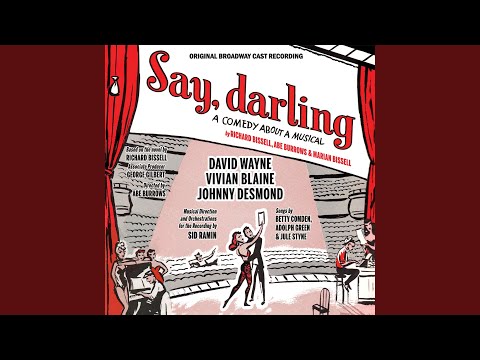
Musical’s script was created by A. Burrows, M. Bissell & R. Bissell. Music composed by J. Styne. Lyrics written by A. Green & B. Comden. Broadway premiere took place in early April 1958, in ANTA Washington Square Theatre. In early December, the musical moved to the Martin Beck Theatre, where the spectacular was shown till the middle of January 1959. It has survived for 332 exhibitions. Production was carried out by director Abe Burrows and choreographer Matt Mattox. The cast involved D. Wayne, V. Blaine, T. Snow, J. Desmond, J. Cowan, H. McMahon, C. Ford, E. Albert, E. Gould, V. Martin, R. Morse & K. Leigh. At the end of February 1959, off-Broadway production took place in NYC Center Theatre. Unfortunately, it was holding only for 16 performances. The show had such cast: R. Morse & O. Bean as main actors.
In July 1959, staging was shown in the Grand Theatre, Sullivan, Illinois. The director was S. Eden, choreographer – J. Schnee. The musical included this cast: J. Kelso, S. Thayer, S. Eden, J. Frosher, J. Shea, A. Austin, M. Ems, R. Gwaltney, N. Bacon, J. Little, T. Lawrie, D. Lamb, B. Fahey, E. McCarty & J. Runyon. From May to June 1996, new off-Broadway productions were held in West End with only 16 performances. Production was directed by R. Armin and had such cast: B. Tatum, S. Gibbons, D. Vogel, L. Bowman & P. Amodeo. In March 2013, reborn production took place in NYC’s MTC Creative Center under the direction of Ben West. In the musical were involved R. H. Blake, J. Cassidy, A. Hohn, M. Saldivar, B. Sears & P. S. Smith. In 1958, the musical won Theatre World Award. Also, the show was nominated for the Tony Award. In 1958, a record of album with Broadway actors has been made.
Release date of the musical: 1958
"Say, Darling" – The Musical Guide & Song Meanings
Review
Can a Broadway show be a backstage satire, a romantic comedy, and a demo tape, all at once, without choosing a lane? That is the gamble of “Say, Darling” (1958), a three-act comedy about turning a Midwestern writer’s material into a Broadway musical, while letting us hear the would-be score as auditions and rehearsal tryouts. The structural trick is also the lyrical point: every song is “for the show,” which means the lyrics do double duty as character weapons. A tune can flatter a star, corner a producer, or soft-launch a rewrite.
The lyricists are Betty Comden and Adolph Green, the specialists in people talking too fast because they are thinking too fast. Here they are in meta mode: writing intentionally corny “in-show” numbers and then letting the surrounding dialogue tell you whether that corn is useful, humiliating, or both. Jule Styne’s job is to make the satire sing without turning it into pure parody. He does. The score hops between pop-leaning torchiness (“Try to Love Me,” “Say, Darling”), faux-wholesome Americana (“The Husking Bee”), and a waltz that sounds like it wandered in from a more sincere musical (“Dance Only with Me”). The result is weirdly modern: a show about development notes, with songs that behave like pitch decks.
Listening tip: the cast album can mislead you into expecting a full book musical. In the theatre, much of the music is deliberately “work-in-progress” material performed inside the story. That tension, between polished album and scrappy context, is the real theme.
How It Was Made
“Say, Darling” is adaptation squared: it is based on Richard Bissell’s novel about the making of a musical, itself inspired by his experience with the musical version of his earlier novel “7 1/2 Cents” (“The Pajama Game”). The show-within-the-show is called “The Girl from Indiana,” and the songs are presented diegetically as audition pieces and rehearsal numbers.
One production detail matters for how the lyrics land. Onstage, the “score” was spare, played with minimal accompaniment (the point is the process, not the finish). The cast album flips that. RCA Victor recorded the songs with full orchestral treatment under arranger-conductor Sid Ramin, turning intentionally provisional numbers into something lush and commercial. That contrast is not a footnote; it changes how you hear Comden and Green’s joke-writing. A so-so audition song becomes a showpiece the moment the strings arrive.
A small origin-story shard, also revealing: composer Jule Styne later recalled watching Robert Morse audition for the young producer Ted Snow, broke and looking “ratty and seedy,” and being turned down flat by director Abe Burrows. The role, and Morse’s eventual success in it, became one of the show’s lasting legacies.
Key Tracks & Scenes
"Try to Love Me Just as I Am" (Irene)
- The Scene:
- In the producer’s office, fluorescent daylight and hard chairs. Irene, a brassy Hollywood import with Broadway ambitions, uses a pop ballad as a résumé. It plays like a private audition performed at full volume.
- Lyrical Meaning:
- The lyric is a demand disguised as vulnerability: accept me on my terms, and quickly. Inside the plot, it is also a warning shot. The show is telling you its star will negotiate affection the way she negotiates billing.
"It’s Doom" (Rudy)
- The Scene:
- Same office, different temperature. Composer Rudy “demonstrates” a new number as if certainty can substitute for quality. Think piano, cigarette energy, and a creative team smiling through pain.
- Lyrical Meaning:
- Comden and Green write deliberately overconfident gloom: a song that sells melodrama as sophistication. The joke is that Rudy’s ego hears art where everyone else hears a problem.
"The Husking Bee" (Company, introduced by Rudy)
- The Scene:
- A producer asks for a wholesome opening number, against the writer’s wishes, and Rudy improvises one. The room becomes a fake cornfield under rehearsal lights, with performers marking steps and trying to look enthusiastic.
- Lyrical Meaning:
- It is Americana as a commercial strategy. The lyric treats “local color” like set dressing, which is exactly how Broadway can treat it when the backers want something “friendly.”
"It’s the Second Time You Meet That Matters" (Rudy)
- The Scene:
- At auditions, the number is presented as a selling-point: catchy, glib, and designed to win the room fast. The casting table writes notes while the song insists it knows romance better than the humans in it.
- Lyrical Meaning:
- The hook is also an aesthetic thesis: surfaces matter, repeat encounters matter more, and the first impression is marketing. It is a songwriter’s worldview colliding with an author’s desire for meaning.
"Let the Lower Lights Be Burning" (Jack and Hackett)
- The Scene:
- On a Broadway stage, the writer Jack is momentarily alone with the space. The noise of commerce drops out. He sings a Methodist hymn he remembers from a church choir, the most sincere sound in a room built for pretense.
- Lyrical Meaning:
- This is the show admitting what it is afraid to be: earnest. The hymn is not satire; it is a grounding wire. It also sets up the central conflict: integrity is quieter than Broadway, and therefore easier to ignore.
"Chief of Love" (Irene)
- The Scene:
- Irene swallows pride and auditions properly, using Rudy’s current pop hit. The lighting turns flattering, as if the room itself wants her to succeed. The performance reads as both submission and flex.
- Lyrical Meaning:
- The lyric crowns romance like a corporate title. In context, it is Irene accepting the rules of the game, but also showing she can win it better than anyone else.
"Say, Darling" (Rudy)
- The Scene:
- In rehearsal, Rudy unveils a big ballad as if unveiling himself. It is meant to stop the room. People listen, not because they trust him, but because big ballads are hard to argue with in the moment.
- Lyrical Meaning:
- The title phrase is intimacy turned into a button. The lyric sells softness, but the subtext is control: Rudy wants the show, and the people in it, to respond on cue.
"Dance Only with Me" (Irene and Rex)
- The Scene:
- Late in the process, as the tryout strain shows, a new waltz arrives. The stage picture simplifies: a couple in a pool of light, everyone else fading into the wings. Suddenly the show remembers it has a heart.
- Lyrical Meaning:
- Unlike the deliberately “in-show” material, this lyric feels like a character confession sneaking past the concept. The waltz form itself is the metaphor: order, agreement, a breath taken together.
"Something’s Always Happening on the River" (Jack and Company)
- The Scene:
- During the New Haven tryout crisis, the writer finally understands what the fictional musical should be about and helps reshape the second act. The number plays like a fix: pragmatic, energetic, built to move plot and mood at once.
- Lyrical Meaning:
- The river becomes the show’s argument for change. Theatre folk panic. The river keeps flowing. It is a tidy metaphor for revisions, ego injuries, and the fact that the audience does not care about your process unless it lands.
Live Updates
Information current as of February 1, 2026.
Is “Say, Darling” touring in 2025 or 2026? Not in any widely tracked commercial way. Concord Theatricals lists the title for licensing, but its “Now Playing” section is empty, which usually means no productions have been reported through their platform at the moment. If you want to stage it, rights are the realistic path forward.
The soundtrack story is more active than the staging story. A notable modern release is Stage Door Records’ 2CD “Deluxe Edition,” released June 30, 2023, expanding the album with pop covers and instrumentals that prove the score had a longer life in the marketplace than in repertory. Streaming availability also helps: the original cast recording appears on major services, which keeps the material audible even when the show is not visible.
Small trust note: “Say, Darling” is also a band name in other contexts. If you are searching event calendars, add “Abe Burrows” or “Jule Styne” to stay on the theatre track.
Notes & Trivia
- The Broadway run began April 3, 1958 at the ANTA Playhouse and ultimately totaled 332 performances before transferring late in the run.
- The songs are presented inside the story as auditions and rehearsals for the fictional musical “The Girl from Indiana.”
- On Broadway, the show’s music was performed with minimal accompaniment; the cast album used full orchestration under Sid Ramin.
- Robert Morse won a Theatre World Award for playing young producer Ted Snow and received a Tony nomination for Featured Actor in a Play.
- A key plot beat is the New Haven tryout going badly, prompting rewrites and song swaps; the show is unusually frank about how blunt that process can be.
- Stage Door Records’ 2023 “Deluxe Edition” was issued as a limited run and added a full bonus disc of pop covers (including Peggy Lee and Blossom Dearie).
- Myth-check: many listeners assume “Say, Darling” is a conventional musical because of the cast album. In performance, it is closer to a straight play with music, and the diegetic framing is the whole mechanism.
Reception
In 1958, the critical split was less about talent than about format. Some writers liked the inside-baseball comedy and the bright performances; others bristled at a show that advertises famous songwriters and then keeps the songs in quotation marks, as “material,” not emotion. That debate has aged well, because modern audiences are used to meta theatre and process narratives.
“Say, Darling seems to me an exceptionally cheerful entertainment.”
“The form, however, is ingenious.”
Walter Kerr called it “a smart, sassy and wonderfully funny romp.”
Quick Facts
- Title: Say, Darling
- Year: 1958
- Type: Three-act comedy / play with music (diegetic songs)
- Book: Abe Burrows, Richard Bissell, Marian Bissell
- Music: Jule Styne
- Lyrics: Betty Comden, Adolph Green
- Show-within-show: “The Girl from Indiana”
- Notable original cast: David Wayne (Jack), Vivian Blaine (Irene), Johnny Desmond (Rudy), Robert Morse (Ted)
- Original Broadway theatre: ANTA Playhouse (later Virginia Theatre)
- Cast recording label: RCA Victor (original); later reissues include DRG (2008) and Stage Door Records (Deluxe Edition, 2023)
- Album availability: Major streaming platforms list the Original Broadway Cast Recording
- Selected placements: “Try to Love Me” (producer’s office), “It’s the Second Time You Meet That Matters” (auditions), “Say, Darling” (rehearsals), “Something’s Always Happening on the River” (tryout rewrite moment)
Frequently Asked Questions
- Is “Say, Darling” a full musical?
- Not in the traditional sense. It is a play with music: songs appear as audition and rehearsal material inside the plot, rather than as characters’ inner monologues.
- Why does the cast album sound like a conventional Broadway score?
- The original album was orchestrated for a full studio ensemble, even though the stage presentation used minimal accompaniment. The recording sells the songs as finished product.
- Who wrote the lyrics and why do they feel “meta”?
- Betty Comden and Adolph Green wrote the lyrics. The show is about making a musical, so the lyrics are written to function as “samples” of what the fictional musical could become.
- What is the show-within-the-show called?
- “The Girl from Indiana.” Many songs are presented as numbers being tried out for that fictional production.
- Is the show being produced in 2025 or 2026?
- No major commercial production is broadly listed right now. The clearest current route is licensing for regional, academic, or specialty companies.
- Where should I start if I only want one song?
- Start with “Dance Only with Me” for melody and sincerity, or “Something’s Always Happening on the River” for the show’s rewrite-and-survive ethos.
Key Contributors
| Name | Role | Contribution |
|---|---|---|
| Jule Styne | Composer | Music that toggles between pop polish and deliberately “in-show” pastiche. |
| Betty Comden | Lyricist | Fast, character-driven lyric writing used here as satire of Broadway development culture. |
| Adolph Green | Lyricist | Co-authored lyrics that weaponize charm and banter inside rehearsal-room politics. |
| Abe Burrows | Co-writer / Director | Shaped the backstage-comedy engine and directed the original Broadway production. |
| Richard Bissell | Co-writer / Source novelist | Provided the autobiographical backbone and the recursive adaptation premise. |
| Marian Bissell | Co-writer | Co-authored the book structure and backstage portraiture. |
| Sid Ramin | Arranger / Conductor (cast album) | Orchestrated and conducted the recording that reframes the “workshop” songs as finished Broadway product. |
| Vivian Blaine | Original cast | Gives Irene’s numbers star wattage, especially “Try to Love Me” and “Chief of Love.” |
| Johnny Desmond | Original cast | Anchors Rudy’s songwriter vanity with bright vocal attack. |
| David Wayne | Original cast | Plays the author as moral center; the hymn moment is the show’s sincerity valve. |
| Robert Morse | Original cast | As Ted Snow, a young producer type who became the production’s standout legacy. |
Sources: The New Yorker, IBDB, Concord Theatricals, Stage Door Records, Masterworks Broadway, Broadway.com, Apple Music, Spotify, Playbill.