
Rock Of Ages Lyrics: Song List
- Act 1
- Introduction
- Just Like Paradise / Nothin' But A Good Time
- Sister Christian
- We Built This City / Too Much Time On My Hands
- I Wanna Rock
- We're Not Gonna Take It
- Heaven / More Than Words / To Be With You
- Waiting For A Girl Like You
- Wanted Dead Or Alive
- I Want To Know What Love Is
- Cum On Feel The Noize / We're Not Gonna Take It (Reprise)
- Harden My Heart / Shadows Of The Night
- Here I Go Again
- Act 2
- The Final Countdown
- Any Way You Want It / I Wanna Rock - Reprise
- High Enough
- I Hate Myself For Loving You / Heat Of The Moment
- Hit Me With Your Best Shot
- Can't Fight This Feeling
- Every Rose Has Its Thorn
- Oh Sherrie
- The Search Is Over
- Don't Stop Believin'
About the "Rock Of Ages" Stage Show
Preliminary show took place in 2005 in LA of USA. At the beginning of 2006, the histrionics geographically shifted to Hollywood’s club Vanguard. After the fantastic launch, the play rearranged into Ren-Mar Studio, collecting full houses more than once.
Previews started on Broadway in 2009. A group of musicians was dressed in ordinary attires, which live bands were wearing playing heavy rock. Drummer was playing in the cage with the inscription: ‘Please do not feed the guy on drums!’. One of the 1st guitarists, J. Hoekstra, was a Night Ranger’s member & currently – of Whitesnake. Other guy, T. Kessler, was playing in Blondie.
After more than 2,000 exhibitions on Broadway, theatrical was closed & it was a success. In the UK, previews began in 2011 of the revised version. A. Pemberton was depicting Sherrie, but got sick & was forced to leave the histrionics. The main female role was played by her understudy N. Andreou.
In 2013, the show moved to the Garrick Theatre & in 2014, it held the first tour in the UK & Ireland. From 2010 to 2015, the musical has traveled to many countries (Canada, Australia, the Philippines, Norway, Mexico & Malta). In May 2011, Warner Bros. & New Line Cinema have started filming the movie named Rock of Ages.
Release date of the musical: 2008
"Rock of Ages" – The Musical Guide & Song Meanings
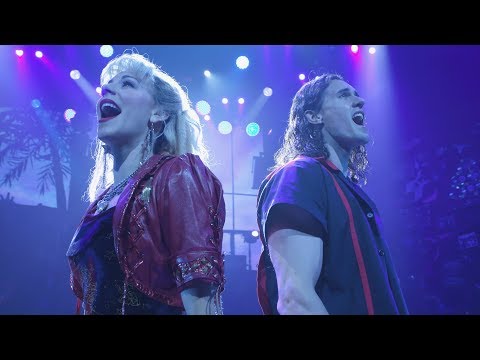
Review: what the lyrics are really doing
Here’s the paradox at the heart of “Rock of Ages”: it’s a jukebox musical that keeps daring you to treat its borrowed lyrics as dialogue, not karaoke. The plot is featherweight on purpose, but the writing strategy is surprisingly muscular. It frames 1987 Sunset Strip romance as a sequence of lyrical “positions” you already know: swagger, yearning, shame, relapse, regroup. The show succeeds when the lyric becomes a decision, not a reference. It stumbles when a song lands as a punchline first and a character beat second.
The lyric engine runs on contrast. Hair-metal braggadocio gets reassigned to people who cannot fully live up to it. Power-ballad sincerity gets handed to characters who are performing sincerity because their lives are already theatrical. That tension is the show’s real subject: aspiration as costume. In production terms, the arrangements lean into the era’s hard edges while keeping theatre diction intelligible, which matters because the story is often carried by what a singer emphasizes, clips, or spits out. The result feels like a mixtape with stage directions baked into the vowels.
Musically, this is not a museum piece. The onstage band sound matters because it makes the lyrics feel “present tense.” That is the only way a familiar chorus can function as plot. When the band is hot and the actors treat each refrain like an argument, the show turns its biggest liability (everyone knows the words) into its sharpest weapon (everyone knows the stakes).
How it was made
“Rock of Ages” began as an L.A. club-born idea before it learned Broadway rules, and you can still feel that origin in how it courts the audience. Its creator has described the music as personal memory, not research, and that matters: the show is structured like someone reliving a decade through choruses that hit at specific life moments. The developmental path ran from Hollywood venues to Las Vegas, then Off-Broadway (2008), then Broadway (2009). Along the way, the production team built a format where narration and fourth-wall nudges could coexist with full-throttle rock performance.
The other key piece is craft, not nostalgia: the arrangements and orchestrations adapt arena-rock phrasing to theatre storytelling. That means tightening intros, clarifying lyric pickup lines, and designing transitions so a scene can pivot without stopping the musical pulse. If you ever wondered why a pop hit suddenly feels like it was “written for” a character, that is the arranger’s job. Here, it’s less about rewriting lyrics and more about reassigning intention.
Key tracks and scenes
"Just Like Paradise / Nothin’ but a Good Time" (Lonny, Dennis, Drew, Company)
- The Scene:
- Sunset Strip, neon and grit. The Bourbon Room is introduced like a holy site for people who worship volume. The lighting snaps between club wash and spotlight punctures as the narrator “hosts” the audience into the world.
- Lyrical Meaning:
- This opener isn’t about paradise. It’s about permission. The lyrics become a social contract: you can be ridiculous here, and the show will protect you from consequences until it decides to stop.
"Sister Christian" (Sherrie, Drew, Ensemble)
- The Scene:
- A fresh arrival meets a city that eats optimism for breakfast. The staging often plays like a pop montage turned anxious: bright front light for hope, then harsher angles as the Strip asserts itself.
- Lyrical Meaning:
- The lyric becomes a warning disguised as a sing-along. It frames innocence as something the city will negotiate away, one chorus at a time.
"Wanted Dead or Alive" (Stacee, Sherrie, Ensemble)
- The Scene:
- Backstage swagger and predatory charm, staged with that specific mix of concert machismo and theatrical clarity. The room narrows, the band sits forward in the mix, and the power dynamic turns physical.
- Lyrical Meaning:
- In context, the lyric reads like a pickup line with plausible deniability. It’s romance language used as camouflage, and the show wants you to hear the menace inside the melody.
"Here I Go Again" (Company)
- The Scene:
- Act I lands on parallel loneliness. Characters occupy separate pools of light as if the Strip has split into private confession booths. The tempo drives forward even as the people onstage feel stuck.
- Lyrical Meaning:
- The repeated vow is the point: everyone is choosing the same mistake for different reasons. The lyric’s circularity becomes dramaturgy.
"The Final Countdown" (Hertz, Franz, Dennis, Lonny, Regina, Ensemble)
- The Scene:
- Act II opens with a fight for real estate and identity. The staging tends to widen, with banners, marching shapes, and lights that mimic civic spectacle rather than club heat.
- Lyrical Meaning:
- What reads as apocalyptic hype in a stadium becomes deadline pressure onstage. The lyric turns into a ticking clock for the Bourbon Room and for everyone’s self-image.
"I Hate Myself for Loving You / Heat of the Moment" (Sherrie, Stacee, Drew, Ensemble)
- The Scene:
- The Venus Club sequence flips shame into fury. It’s often staged with aggressive, exposed lighting that refuses soft focus. Comedy is present, but the beat is revenge.
- Lyrical Meaning:
- This is where pop-lyric confession becomes weaponized. The words are not therapy. They’re a blade, and each refrain sharpens the character’s spine.
"Oh Sherrie / The Search Is Over" (Drew, Sherrie)
- The Scene:
- A late-night chase to stop a departure. The staging usually strips away the club clutter. Cooler light, fewer bodies, more air. The story briefly asks for sincerity without winking.
- Lyrical Meaning:
- The lyrics do the heavy lifting of apology and commitment. The key is that the words are specific enough to feel like a vow, even though they were never written as one.
"Don’t Stop Believin’" (Company)
- The Scene:
- Epilogue energy. The band drives, the company floods the stage, and the production leans into communal release. It plays as a curtain-call anthem that is still, technically, plot.
- Lyrical Meaning:
- This finale works because it reframes belief as survival, not optimism. In this story, “believin’” means you keep walking back into the noise anyway.
Live updates (2025-2026)
As of 2025-2026, “Rock of Ages” is living less as a single flagship production and more as a widely programmed title across regional, international, and licensed stages. A notable 2025 booking placed the show in Puerto Rico as part of a San Juan Broadway season engagement. Meanwhile, theatre listings and ticket marketplaces show a steady drumbeat of 2026 engagements at regional venues, which tracks with how the title now circulates: short runs, high recognition, strong bar sales.
One wrinkle worth catching: there is also a concert act branded around the show’s Broadway band. That is not the musical, but it borrows the same muscle memory and can confuse buyers scanning listings fast. If you are tracking the musical specifically, start with licensing and venue season announcements, then verify against the presenter’s own page before buying.
Notes and trivia
- The show opened Off-Broadway in 2008 and later opened on Broadway in 2009, running until 2015.
- The Broadway run totaled 2,328 performances.
- The cast recording rolled out first as a digital release, then as a physical release in summer 2009.
- The score is “various artists,” but the show’s identity is shaped by its consistent arrangements and orchestrations, not by rewriting lyrics.
- Many productions place the band visibly onstage, reinforcing the concert grammar that makes the lyrics land as dialogue.
- The show originated in Los Angeles club venues before its New York life.
- Some later productions incorporate “Rock of Ages” by Def Leppard, even though it was not part of the original Broadway incarnation.
Reception: critics then vs. now
Critical response has always split along a predictable fault line: how much “seriousness” you require from a show that is loudly advertising its own trashy grin. Early Broadway reviews often praised the staging craft while questioning the thinness of the book, which the production frequently answers by refusing to linger between songs. Over time, the reception has mellowed in the way nostalgia often does: audiences increasingly treat the show as a communal event, and critics have become more attentive to the skill involved in making familiar lyrics feel newly motivated.
“Director Kristin Hanggi knows better than to loiter long between songs.”
“It’s frequently more fun than it has any right to be.”
“A moderately amusing jukebox musical.”
Quick facts for nerds
- Title: Rock of Ages
- Year (NY launch): 2008 Off-Broadway; 2009 Broadway
- Type: Jukebox musical (1980s rock)
- Book: Chris D’Arienzo
- Music and lyrics: Various artists (songs by multiple bands and writers)
- Direction and choreography (original Broadway): Kristin Hanggi (director); Kelly Devine (choreography)
- Music supervision, arrangements, orchestrations: Ethan Popp
- Selected notable placements: “Here I Go Again” as Act I closer; “The Final Countdown” as Act II opener
- Original Broadway cast recording: released digitally June 2009; physical release July 2009
- Label and availability: issued through New Line Records and distributed widely on major streaming stores
Frequently asked questions
- Is “Rock of Ages” an original-score musical?
- No. It is a jukebox musical built from existing 1980s rock songs, with a new book that motivates those lyrics as story beats.
- Who wrote the lyrics?
- The lyrics come from the original songwriters of each track. The show’s authorship is primarily in the book and in the arrangements that shape how the words function in scenes.
- Is there a movie version?
- Yes. A film adaptation was released in 2012, using a related but not identical song lineup and story emphasis.
- Why does the narrator keep talking to the audience?
- Because the show is selling a party and a plot at the same time. The narration gives the production permission to shift tone quickly without pretending it is “realistic.”
- Is “Rock of Ages” by Def Leppard in the stage show?
- Not in the original Broadway version. Some later productions add it, so your exact song list can vary by edition and rights package.
Key contributors
| Name | Role | Contribution |
|---|---|---|
| Chris D’Arienzo | Book | Built the narrative frame that reassigns familiar lyrics as character choices. |
| Kristin Hanggi | Director | Shaped the pacing-forward staging style that keeps scenes snapping into songs. |
| Kelly Devine | Choreographer | Mapped hair-metal physical vocabulary into readable stage storytelling. |
| Ethan Popp | Music supervision, arrangements, orchestrations | Adapted rock phrasing for theatre clarity while keeping the band’s bite. |
| Beowulf Boritt | Scenic design (original Broadway) | Created a flexible environment that supports both club grit and story turns. |
| Jason Lyons | Lighting design (original Broadway) | Used aggressive concert-style lighting to keep the show’s energy honest. |
| Peter Hylenski | Sound design (original Broadway) | Balanced rock volume with lyric intelligibility, a non-negotiable for plot. |
Sources: Playbill, IBDB, Concord Theatricals, Los Angeles Times, Entertainment Weekly, Variety, The Wall Street Journal, Apple Music, CM Performing Arts Center digital playbill, Discover Puerto Rico, SeatGeek.