
On the Record Lyrics: Song List
- Disc 1
- Prologue. A Dream Is a Wish Your Heart Makes
- Prologue. Whistle While You Work / Give a Little Whistle
- Can You Feel the Love Tonight / I Won't Say I (I'm in Love) / Let's Get Together
- Someday My Prince Will Come / Once Upon a Dream
- The Walrus and the Carpenter / I Wan'na Be Like You
- Prince Ali
- I Just Can't Wait to Be King / Lavender Blue
- When She Loved Me
- Minnie's Yoo-Hoo
- Heigh-Ho
- The Work Song
- I'm Wishing / One Song
- You Can Fly! You Can Fly! You Can Fly!
- So This is Love
- A Whole New World
- The Second Star to the Right
- Under the Sea
- Part of Your World
- Poor Unfortunate Souls
- Kiss the Girl
- Reflection
- Bella Notte / Les Poissons
- Ev'rybody Wants to Be a Cat / The Siamese Cat Song / The Tiki Tiki Tiki Room
- He's a Tramp
- Higitus Figitus/Bibbidi-Bobbidi-Boo/Supercalifragilisticexpialidocious/Hi-Diddle-Dee-Dee/Following The Leader/Zip-A-Dee-Doo-Dah/The Dwarf's Yodel Song (The Silly Song)/Hakuna Matata/Mickey Mouse March
- Disc 2
- Let's Go Fly a Kite
- I Will Go Sailing No More / Just Around the Riverbend / Strangers Like Me
- Colors of the Wind
- When I See an Elephant Fly
- Look Out for Mr. Stork
- Pink Elephants on Parade
- Baby Mine
- The Bells of Notre Dame
- Out There
- Something There / Beauty and the Beast
- A Change in Me
- Be Our Guest
- Will the Sun Ever Shine Again
- You've Got A Friend in Me
- If I Never Knew You
- You'll Be in My Heart
- When You Wish Upon a Star
- A Dream Is a Wish Your Heart Makes (reprise)
- The Bare Necessities / A Spoonful of Sugar / It's a Small World
- Mickey Mouse March / Colonel Hathi's March / Cruella De Vil/A Spoonful Of Sugar / Winnie The Pooh / I've Got No Strings
About the "On the Record" Stage Show
The idea of creating a show belongs to T. Schumacher & R. Longbottom. Screenwriter – C. Beguelin. Arrangements done by D. Chase. Songwriters: S. Burke, F. Churchill, E. Daniel, W. Disney, S. Fain, R. Gilbert, L. Harline, B. Hillard, F. Huddleston, J. Lawrence, J. Livingston, L. Morey, A. Rinker, T. Sears, R. B. Sherman, G. Slater, T. Rice, N. Washington, A. Wrubel, H. Ashman, S. Cahn, P. Collins, M. David, J. Dodd, T. Gilkyson, W. Hibler, A. Hoffman, E. John, P. Lee, A. Menken, R. Newman, S. Schwartz, R. M. Sherman, C. Stalling, O. Wallace, M. Wilder & D. Zippel.
The play was developed specifically for the US national tour. The first show of the musical took place in November 2004 on the stage of Palace Theater Cleveland in the state of Ohio. The last performance was in July 2005 in Colorado Denver Center. The tour went through the cities Tampa, Boston, Indianapolis, Atlanta, Dallas & Houston among others. The director and choreographer was R. Longbottom. In the play acted: B. Sutherland, E. Skinner, A. Brown, A. Samonsky, K. Nurullah, A. Karl, M. Inglesby, J. Franklin, T. Maynard, L. A. Larkin, L. Philistine & K. Mochizuki. In January 2005, the role of Diane began to perform K. Hopkins.
In April 2009, in San Jose at the Children's Musical Theatre scene was shown the new version of the revue. In this musical, the main ones became three children – the heroes who have fallen into the magic world of Disney. In adaptation of scenario was involved Kevin Hauge. From 20 to 29 of June 2014, it was held on the stage of White Plains theatre, directed by F. Portanova. Musical director was L. Frare and S. Ferri. The revue had cast: J. Bellino, C. Alfredo, A. Francsico, G. Noto, D. Lewis, T. O'Callagahan, E. Pagan & P. Oliva.
Release date of the musical: 2004
"On the Record" – The Musical Guide & Song Meanings
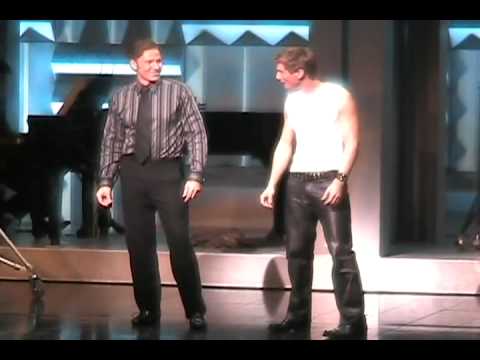
Review
Can a jukebox musical made of universally known songs still feel like a discovery? “On the Record” tries by giving Disney’s catalog a frame: four vocalists in a studio, cutting a greatest-hits album while their romantic geometry tilts from track to track. That premise is smart, because studio work is already theatrical: spotlight, headphones, the lonely glare of a mic stand. The risk is just as obvious. Studio realism and fairy-tale lyrics are allergic to each other, and the show spends much of its running time negotiating that rash.
The lyrical engine is borrowed, not written. That is the point, and also the problem. Each character “speaks” through pre-existing lines, so the book (credited to scenarist Chad Beguelin) functions like an editor’s room: pick the right couplet, cut before the song demands a context you cannot supply, and let the audience’s memory do the connective tissue. When it works, the familiar words become subtext. When it does not, you can feel the splice.
Musically, the score is a curated argument about Disney’s range. It jumps from Tin Pan Alley sweetness to Menken-era Broadway density, and then into pop balladry and anthem-writing. The arranging task (David Chase, with Danny Troob’s orchestrations) is less about polish than about continuity: keep the sound world coherent while the source material spans decades and styles. That continuity is why the cast album plays better than you might expect, even for skeptics who can smell “brand extension” from the lobby.
How It Was Made
The show’s origin story is less “miracle workshop” and more “strategic inventory.” In the early 2000s, Disney Theatrical had already proven it could convert films into full-scale musicals, but the songbook itself was the larger asset. A proposed revue titled “When You Wish” circulated first, then the concept shifted into a touring-specific vehicle: a “very simple story” designed to let songs do the talking without leaning on a movie screen. That intent shows up repeatedly in the public record: press notes, feature coverage, and even album reviewers describing the plot as a light graft over a catalog play.
What is genuinely clever is the structural device: the songs are organized into themed “sessions,” like a real recording day broken into moods and medleys. That does two things. First, it gives the audience an intuitive map (“this is the love set,” “this is the nonsense-words set”). Second, it gives the performers a rhythm of reset and reinvention, which matters in a revue that asks the same singers to embody wildly different lyric personas in rapid succession.
Myth-checking, because it refuses to die: people still talk about “On the Record” as if it were a Broadway title that vanished. It was built for the road, and multiple contemporaneous accounts treat Broadway as a non-goal rather than a missed stop. The tour model also explains the production’s design language: portable, clean, and built around lighting and music rather than scenic complexity.
Key Tracks & Scenes
"A Dream Is a Wish Your Heart Makes" (Kristen)
- The Scene:
- Prologue. A studio wakes up: stands, cables, a hush that feels like a held breath. The young singer claims the room the way an audition claims a life, with the mic as both invitation and threat.
- Lyrical Meaning:
- As an opening statement, it frames the entire evening as aspiration in a fluorescent workspace. The lyric’s gentleness is the misdirection; in a studio setting, “wish” reads like ambition with a smile.
"Can You Feel the Love Tonight / I Won't Say (I'm in Love)" (Company)
- The Scene:
- Session 1. A love-medley becomes a four-way relay race. Voices overlap like takes in a control room, flirting and dodging the red light.
- Lyrical Meaning:
- This is the show’s thesis in miniature: take lyrics written for specific characters and repurpose them as emotional confessionals for new ones. The denial in “I Won’t Say” is especially useful when your book cannot afford long dialogue.
"When She Loved Me" (Diane)
- The Scene:
- Session 2. The energy drops. The diva stops playing “diva” and lets the room hear the cost of being adored and discarded. The studio becomes a private booth.
- Lyrical Meaning:
- In a plot this light, a song like this supplies backstory by force. The lyric is already a complete dramatic arc, so it functions like a flashback the show never has to stage.
"Under the Sea / Part of Your World / Poor Unfortunate Souls" (Company, featured voices)
- The Scene:
- Session 5. The studio turns aquatic without changing locations: rhythmic claps, vocal colors, and the sense of a “mini show” inside the show. It is the revue’s closest move to a full production number.
- Lyrical Meaning:
- These lyrics are about desire, bargaining, and the fantasy of transformation. In the studio frame, they double as show-business metaphors: wanting the part, paying the price, selling the act.
"Reflection" (Kristen)
- The Scene:
- Session 6. A solo take. The newcomer is suddenly alone with a song that refuses irony. The spotlight tightens; the band listens.
- Lyrical Meaning:
- “Reflection” is an identity statement, and it gives the ingénue something sturdier than flirtation. In a revue, that matters: it turns a “type” into a person.
"Be Our Guest" (Company)
- The Scene:
- Mid-show variety set. The session becomes a linguistic game, with different singers pivoting between languages like a studio stunt meant to impress the producer in the booth.
- Lyrical Meaning:
- The lyric’s hospitality becomes performance itself: the cast selling the evening, selling Disney, selling the very idea that one studio can contain a century of voices.
"Strangers Like Me / Colors of the Wind" (Company, featured voices)
- The Scene:
- Session 9. The songs land like an ethics unit in a pop set list. The mood turns searching, and the studio frame briefly feels too small for the questions being asked.
- Lyrical Meaning:
- These lyrics widen the show’s emotional bandwidth. They argue that curiosity and empathy are also “Disney,” not just romance or comic patter.
"The Bells of Notre Dame" (Company)
- The Scene:
- Session 11. Choral writing fills the room. The revue suddenly remembers it has a Broadway-weight songbook in its pocket, and it uses it.
- Lyrical Meaning:
- This is where the evening’s concept is most exposed: sacred-scale lyrics in a secular studio. The tension is productive, because it reminds you how cinematic some of this material is even without a screen.
Notes & Trivia
- The show is often advertised as “64 songs,” but published breakdowns list more (with medleys and reprises), organized into themed recording “sessions.”
- The tour model shaped everything: production notes and coverage repeatedly describe it as a touring venture rather than a Broadway pipeline.
- The cast recording (Walt Disney Records) captures most of the show because the onstage piece uses minimal dialogue.
- The album’s release date is documented as March 15, 2005, and the runtime is notably long for a cast album (a two-disc presentation).
- At least one session focuses on multilingual variations of “Be Our Guest,” explicitly treating lyric translation as entertainment.
- The show’s framing device is a “recording session that changed the lives” of a young unknown, a pop diva, and a matinee idol, with a “new kid” as romantic and professional disruption.
- A later regional revival context exists in the historical record (for example, the 2014 White Plains run documented in theatre coverage), reinforcing that the piece survives mainly as a flexible revue concept rather than a fixed canonical production.
Reception
Critically, “On the Record” lived in a familiar jukebox dilemma: audiences can love the tunes while critics ask why the tunes need a plot at all. Some reviews basically diagnose the same tension from different angles: the songs are strong, the connective tissue is the weak link, and the evening’s best moments arrive when the show stops pretending it is anything other than a high-gloss catalog concert.
“Yes, it’s a bad show. But the real surprise here is the grating dullness.”
“Take a collection of pre-existing songs, graft on a semblance of a plot, and presto...”
“So the recording doesn't really amount to much more than an attractive collection of songs.”
The more sympathetic read is that the show is not trying to outwrite Alan Menken or Howard Ashman. It is trying to turn recognition into momentum, with arrangement and performance doing the dramatic heavy lifting. On disc, that bargain is easier to accept, because you are not watching the storyline strain to justify itself in real time.
Live Updates
Information current as of January 29, 2026. “On the Record” is best understood as a historical touring property with occasional regional reappearances, not a continuously running franchise. The original run launched in Cleveland in November 2004 and closed in Denver in July 2005, with the cast album released March 15, 2005. Later documentation confirms at least a notable regional production in 2014 (White Plains Performing Arts Center), and the show’s songs remain broadly available via the cast recording and digital platforms.
What you will not find, at least in widely circulated official channels, is a clear 2025 or 2026 touring announcement under the “On the Record” banner. If you see the title popping up recently, it is usually in performer bios or retrospective playlist coverage rather than in current booking calendars. Practically speaking, this means the album is the primary way most listeners encounter the piece today. For listeners: treat the cast album like a “radio edit” of a full evening. Sample in session-sized bursts rather than trying to consume it as a single 100-minute block.
Quick Facts
- Title: Disney’s On the Record (often billed as “On the Record”)
- Year: 2004 (tour premiere); Cast recording released March 15, 2005
- Type: Jukebox musical revue (Disney songbook)
- Book / Scenarist: Chad Beguelin
- Music & Lyrics: Various Disney composers and lyricists; adapted/supervised/arranged by David Chase
- Orchestrations: Danny Troob
- Direction / Choreography / Co-conception: Robert Longbottom
- Notable structure: Songs divided into themed recording “sessions,” often performed as medleys
- Album label: Walt Disney Records (2-disc original cast recording)
- Availability: Cast recording widely distributed on major music platforms
Frequently Asked Questions
- Is “On the Record” a Broadway musical?
- It was produced as a touring venture and is best known for its 2004 to 2005 national tour and its cast recording, rather than a Broadway run.
- What is the plot, in plain English?
- Four singers record a Disney greatest-hits album in a studio while two potential couples form and wobble. The story is intentionally light so the songs can carry the emotion.
- Why are so many songs shortened?
- The show is built around medleys and rapid thematic “sessions,” so songs are often excerpted to keep the night moving and to fit a studio-session conceit.
- Which track best represents the show’s concept?
- The love-medley early on (“Can You Feel the Love Tonight / I Won’t Say (I’m in Love)”) shows how the piece repurposes character-specific lyrics as new dialogue between its studio performers.
- Is the cast album basically the whole show?
- Nearly. Because the stage piece uses minimal spoken dialogue, the two-disc album functions as an audio version of the evening’s structure.
- Did the cast change for the recording?
- Yes. Coverage of the album release notes Kaitlin Hopkins in the diva role (replacing Emily Skinner) alongside the other principal and ensemble performers.
Key Contributors
| Name | Role | Contribution |
|---|---|---|
| Robert Longbottom | Director / Choreographer / Co-conceiver | Shaped the touring-ready studio concept and staging language. |
| David Chase | Music adapter / Supervisor / Arranger | Created continuity across decades of source material; built session-based medleys. |
| Chad Beguelin | Scenarist | Provided the minimal narrative frame that lets lyrics function as dialogue. |
| Danny Troob | Orchestrator | Orchestral glue for a catalog-spanning revue. |
| Natasha Katz | Lighting Designer | Helped turn “recording session” into theatrical spectacle with portable design. |
| Robert Brill | Scenic Designer | Studio environment built for travel and clarity. |
| Gregg Barnes | Costume Designer | Quick character shifts without literal character costumes. |
| ACME Sound Partners | Sound Design | Essential in a show where “studio” is both setting and metaphor. |
Sources: Playbill, Broadway.com, LaughingPlace, Newcity Stage, BroadwayWorld, AllMusic, Spotify, IBDB, Pittsburgh Post-Gazette