Notre Dame de Paris Lyrics – All Songs from the Musical
Notre Dame de Paris Lyrics: Song List
- Act 1
- Ouverture
- Age of the Cathedrals
- Refugees
- Frollo's Intervention
- Bohemienne Song
- Esmeralda You See
- So Look No More For Love
- The Feast Of Fools
- The King Of Fools
- The Sorceress
- The Foundling
- The Doors Of Paris
- Kidnap Attempt
- The Court of the Miracles
- The Word Phoebus
- Shining Like The Sun
- Torn Apart
- Anarchy
- Water please
- Belle (Is the Only Word)
- Home In The Sky
- Pagan Ave Maria
- If You Can See Inside Of Me
- Your Love Will Kill Me
- The Shadow
- At Val d'Amour
- The Voluptuary / Destiny
- Act 2
- Talk To Me Of Florence
- The Bells (opening part)
- The Bells
- Where Is She?
- The Birds They Put in Cages
- Cast Away
- The Trial
- The Torture
- I'm a Priest
- Phoebus If You Can Hear Me
- To Get Back To You
- My Heart If You Will Swear
- Frollo's Visit To Esmeralda
- On Bright Morning You Danced
- Free Today
- Moon
- This Small Whistle I Leave You
- God You Made the World All Wrong
- Live for the One I Love
- Attack of Notre-Dame
- By Royal Law
- Master And Saviour
- Give Her To Me
- Dance My Esmeralda
About the "Notre Dame de Paris" Stage Show
The musical "Notre-Dame de Paris," based on Victor Hugo's novel, has captivated audiences worldwide since its 1998 debut. Its compelling narrative and memorable music have led to numerous productions and recordings.The original histrionics made such stage works popular in France. In order to benefit the 1st night of the play, upfront the premiere in France’s capital were published 3 songs from it, one of which – Belle – became ?1 song in Europe & was even nominated for the best century’s song position. This single became wildly popular in whole world & in Asia singers performed even their own versions of this piece.
Since the opening nite, the histrionics was staged in many countries (Switzerland, Canada, the USA, Belgium, China, and UK amongst others) & its translation was performed onto 6 languages (Spanish, English & Flemish are amongst them). A cutted variant of the performance has been exhibited in the 1st year of XXI century in the USA’s Vegas city. Separate singles from this piece became popular in countries, supporting French as one of the main ones. C. Dion performed one of the songs, despite the fact she didn’t take part in this spectacular.
During 4 years from 2010, it has been presented in such progressive capitals of the world as Kiev, Paris & Beirut. At the beginning of 2016 paparazzi were outspoken to reveal that the spectacular would be reborn again in November in Paris in Le Palais des Congrès de Paris & after that the troupe would travel in France in a national tour. According to the Guinness Book of Records, the first year of production of this show was the most successful in the history of world musicals. The original French concept album with all the songs from the musical was recorded 7 times. Part of Esmeralda sang Israeli singer Achinoam Nini (a.k.a. Noa).
In 2023, the original venue, Palais des Congrès in Paris, hosted the 25th-anniversary performances from November 15 to December 3. This series featured the return of Angelo Del Vecchio as Quasimodo and Daniel Lavoie reprising his role as Frollo.
The musical's international appeal continued with a tour in China starting on August 25, 2024. Additionally, a Korean tour was scheduled to return to South Korea in 2024, featuring performances in the Korean language.
"Notre-Dame de Paris" has been performed in over 23 countries and translated into nine languages, selling more than 13 million tickets globally. Its enduring popularity is a testament to its universal themes and captivating music.
The musical's influence extends beyond the stage. Notably, Lebanese singer Hiba Tawaji, known for her role as Esmeralda, was selected to perform at the reopening of Paris's Notre Dame Cathedral on December 7, 2024, following its restoration after the 2019 fire.
"Notre-Dame de Paris" continues to enchant audiences worldwide, solidifying its status as a monumental work in musical theater.
Release date: 1998
"Notre-Dame de Paris" – The Musical Guide & Song Meanings
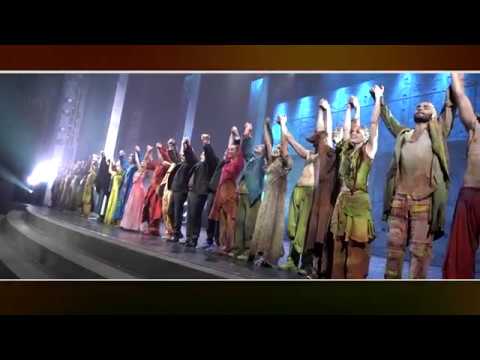
Review: a megahit that treats love like a public hazard
Notre-Dame de Paris is often sold as Victor Hugo with radio hooks. That is true, and incomplete. The show’s real engine is accusation. Everyone wants Esmeralda, but the lyrics rarely romanticize that want. They name it, repeat it, corner it. This is a sung-through score where the characters do not “break into song” so much as confess on a loop, like witnesses who cannot stop talking.
Luc Plamondon’s lyric worldview is blunt in the best way. He writes in slogans, yes, but those slogans work like street graffiti on sacred stone: simple lines that stick because the situation is not simple. The text circles four obsessions: the city as spectacle, the body as currency, the Church as power, and outsiders as permanent suspects. Even the famous love triangle is less triangle than traffic pile-up: Quasimodo’s devotion, Frollo’s self-hatred, Phoebus’ appetite. Three desires, three alibis.
Musically, Riccardo Cocciante leans into pop-rock propulsion and anthem structure. That choice reshapes Hugo into something closer to a concert with choreography and plot. When the show lands, it is because the form is honest: the story is not subtle, so the music does not pretend it is. When it misses, it is usually on repetition that feels like padding rather than pressure.
Viewer tip for first-timers: do not chase plot details on the album alone. Use the opening number and the “hits” as signposts, then let the staging do the connective tissue. This production language is physical, climbing, falling, bodies used like punctuation. You will understand more in a seat with a clean, centered sightline than in a tight side angle, because the wall, projections, and group movement are doing narrative work.
How it was made
The show debuted in Paris in 1998 at the Palais des Congrès, with lyrics by Plamondon and music by Cocciante, staged by director Gilles Maheu with choreography by Martino Müller. Its creation story has one unusually technical twist: Cocciante has said the music came first, with Plamondon writing lyrics afterward, reversing the usual musical-theatre workflow. That matters to how the words behave. The lyric lines often sit on top of completed musical architecture, snapping into rhythm like captions to an already-moving camera.
Development took years, and the team locked the stage language early: not pretty realism, but a symbolic cathedral wall that performers can climb, with moving towers, apertures, and projections. Reviewers repeatedly describe a minimalistic stone facade with handholds, plus gargoyle-topped elements gliding across the stage. The design is not décor. It is the show’s argument that Paris is a machine, grinding bodies into spectacle.
The marketing was as modern as the music. Multiple songs were released as singles ahead of the Paris opening, turning the score into a public soundtrack before audiences saw the staging. It is easy to forget how radical that was for a French-language stage property: the album and the radio did part of the producing.
Key tracks & scenes
"Le Temps des cathédrales" (Gringoire)
- The Scene:
- Act I ignition. A bare stage becomes Paris through a looming wall and shifting stone blocks. Gringoire steps forward like a narrator who pretends to be neutral. Lighting is cool and architectural, the kind that makes people look like silhouettes against history.
- Lyrical Meaning:
- The lyric frames the whole show as a civilization diagnosis, not just a romance. It treats cathedrals as proof of human ambition and human delusion, which quietly prepares you for a story where “faith” and “ownership” get confused on purpose.
"Les Sans-papiers" (Clopin, Chorus)
- The Scene:
- Early Act I, the city’s underclass floods the stage. Movement is urgent, clustered, defensive. The wall reads as barrier more than monument, and the ensemble becomes a living petition, pushing toward space that will not make room for them.
- Lyrical Meaning:
- This is Plamondon’s thesis in plain language: Paris is built on exclusion. The lyric refuses quaint “gypsy color” and instead makes marginalization the musical’s moral baseline.
"La Fête des fous" / "Le Pape des fous" (Company, Quasimodo)
- The Scene:
- Mid-Act I, public cruelty staged as entertainment. Lights sharpen, the tempo accelerates, and the chorus moves like a crowd that has found a target. Quasimodo is elevated, mocked, crowned. It looks like celebration until it looks like sentencing.
- Lyrical Meaning:
- The lyrics weaponize laughter. The “festival” language makes the violence feel permissible. Quasimodo’s later devotion carries extra weight because the show first defines him as an object, not a person.
"Belle" (Quasimodo, Frollo, Phoebus)
- The Scene:
- Late Act I, the score stops pretending this is a community story and locks into obsession. Staging often isolates the three men in separate light zones, as if desire is a private cell. The wall becomes a confessional backdrop: stone watching flesh.
- Lyrical Meaning:
- Three perspectives, one fixation. The lyric’s genius is its shared vocabulary. Each man thinks he is unique, and the text proves they are repeating the same appetite with different costumes. It is a love song that behaves like evidence.
"Ave Maria païen" (Esmeralda)
- The Scene:
- Act I into Act II hinge, when the production often cools the color palette and narrows focus. Esmeralda is alone against the architecture, a small body in a big city. The lighting frequently reads like candle glow built from modern spots.
- Lyrical Meaning:
- The lyric is prayer without institutional permission. Esmeralda asks for mercy in a language that the Church does not recognize, exposing the show’s central cruelty: sanctity is controlled by gatekeepers.
"Être prêtre et aimer une femme" (Frollo)
- The Scene:
- Act II confession. Frollo is staged in stark, vertical light, frequently framed by the wall’s openings like a man trapped inside his own doctrine. Movement is minimal, tension is maximal.
- Lyrical Meaning:
- The lyric turns theology into self-interrogation. Frollo names desire as contamination, then pursues it anyway. Plamondon does not let him hide behind religion; the words are too explicit for that.
"Vivre" (Esmeralda)
- The Scene:
- Act II, after the story tightens its grip. The stage is quieter, the ensemble held back, and the set’s hard edges contrast with a vocal line that wants softness. Often sung under a single dominant spotlight.
- Lyrical Meaning:
- It is a survival anthem that knows it might be too late. The lyric insists life is still worth choosing, even as the plot demonstrates how little choice she is being given.
"Danse, mon Esmeralda" (Quasimodo)
- The Scene:
- Final sequence. The wall and towers feel less like scenery and more like a tomb. Quasimodo claims space with grief, not strength. Lighting drops into deep shadow, with faces picked out like icons.
- Lyrical Meaning:
- This is love stripped of fantasy. Quasimodo’s words do not bargain with fate. They accept loss and still insist on tenderness, which is the show’s harshest moral contrast to everyone else’s consuming want.
Live updates (2025–2026)
Current as of January 29, 2026. The show returned to Paris for a holiday run at the Palais des Congrès from December 19, 2025 through January 4, 2026, promoted as an anniversary homecoming in the venue where the 1998 phenomenon began. Official materials also list a touring cast that includes Angelo Del Vecchio (Quasimodo), Elhaida Dani (Esmeralda), Daniel Lavoie (Frollo), and Gian Marco Schiaretti (Gringoire).
In early 2026, the production has visible momentum across Europe. Listings and local press note performances in Budapest (January 8 to 11, 2026) and Bucharest (January 15 to 20, 2026). Italy is gearing up for a major 2026 tour launch, with Milan’s Teatro degli Arcimboldi presenting the show from late February into March 2026, supported by large-scale ticketing and presenter infrastructure.
Practical ticketing note: this production plays “big,” but it is not only big. The wall’s apertures, projected details, and vertical choreography reward full-stage visibility. If you are choosing between “closer” and “center,” center usually wins.
Notes & trivia
- The piece is sung-through, with no spoken dialogue, a choice that some critics describe as closer to opera than a conventional musical.
- Cocciante has said he composed the music first, with Plamondon writing lyrics afterward, which helps explain the lyric’s caption-like snap on top of finished melodic structure.
- Several songs were released as singles before the Paris opening, making the score familiar to the public ahead of the staging.
- Many modern reviews emphasize the staging’s signature architecture: a stone wall with climbing handholds, moving towers, and projections that shift the sense of place without realistic scenery.
- The official production site claims album sales in the tens of millions, positioning the cast recording as a core part of the brand, not a souvenir.
- The show has been produced internationally in multiple languages, but recent high-profile engagements have also stressed performances in the original French with supertitles.
- “Belle” became the breakout hit and one of the show’s lasting cultural exports, still functioning as a gateway track for listeners who have never seen the stage version.
Reception: then vs. now
In France, Notre-Dame de Paris is often treated as a turning-point blockbuster that helped normalize big musical storytelling in a culture that once treated the form as suspect. Internationally, critical response has been more divided, with admiration for scale and skepticism about lyrical repetition and rock-concert volume.
What has changed in the 2020s is the framing. New York engagements and anniversary tours have made the production’s aesthetic legible to audiences raised on arena-scale pop staging. Even detractors tend to grant that the show knows what it is: a cathedral-shaped concert where the plot is carried by vocal declarations and physical images, not book scenes.
“Nothing is spoken, everything is sung from beginning to end.”
“The music and lyrics of most numbers were extraordinarily repetitive and unsophisticated.”
“The turning point came in 1998 with Notre-Dame de Paris.”
Quick facts
- Title: Notre-Dame de Paris
- Year: 1998 (Paris premiere)
- Type: Sung-through French musical; pop-rock “spectacle” format
- Based on: Victor Hugo’s novel Notre-Dame de Paris (1831)
- Composer: Riccardo Cocciante
- Lyricist: Luc Plamondon
- Director: Gilles Maheu
- Choreography: Martino Müller
- Original venue: Palais des Congrès de Paris
- Selected notable placements: “Le Temps des cathédrales” (Act I opening); “Les Sans-papiers” (early Act I social thesis); “La Fête des fous / Le Pape des fous” (Act I public humiliation); “Belle” (late Act I obsession trio); “Vivre” (Act II survival vow); “Danse, mon Esmeralda” (final lament)
- Album: Complete French version cast recording (widely available on streaming; long tracklist)
- 2025–2026 status: Paris holiday run (Dec 19, 2025 to Jan 4, 2026) plus touring dates across Europe, with a major Italy run beginning Feb 2026 in Milan
Frequently asked questions
- Who wrote the lyrics for Notre-Dame de Paris?
- Luc Plamondon wrote the lyrics, with music composed by Riccardo Cocciante.
- Is the show sung-through?
- Yes. There is no spoken dialogue in the standard staging, which shapes the lyric style into continuous declarations rather than scene-by-scene banter.
- What is “Belle” doing in the story?
- It is the score’s central diagnostic: three men describing the same obsession in different moral languages, revealing that desire can sound noble while acting predatory.
- Why does “Le Temps des cathédrales” matter so much?
- It frames the narrative as history judging a city. The lyric makes Notre-Dame a symbol of what people build, and what they excuse.
- Is the show performing in 2025–2026?
- Yes. It returned to Paris from December 19, 2025 through January 4, 2026, and listings show multiple European tour stops in early 2026, including Budapest and Bucharest, with a major Milan engagement starting late February 2026.
- Which recording should I start with?
- Start with the complete French cast recording so you hear the full sung-through structure, then revisit the “hit” numbers after you know their dramatic function.
Key contributors
| Name | Role | Contribution |
|---|---|---|
| Luc Plamondon | Lyricist | Wrote the French lyrics that drive character confession and social commentary. |
| Riccardo Cocciante | Composer | Composed the pop-rock score, built for anthem structure and continuous momentum. |
| Gilles Maheu | Director | Shaped the spectacle staging language: wall architecture, physical storytelling, and concert-scale flow. |
| Martino Müller | Choreographer | Created movement that reads like crowd psychology, with climbing and ensemble-driven tension. |
| Christian Rätz | Set designer (credited in multiple reviews) | Associated with the iconic stone wall concept and moving architectural elements. |
| Angelo Del Vecchio | Performer | Listed in official 2025–2026 materials as Quasimodo on tour. |
| Elhaida Dani | Performer | Listed in official 2025–2026 materials as Esmeralda on tour. |
| Daniel Lavoie | Performer | Listed in official 2025–2026 materials as Frollo on tour. |
Sources: Official “Notre-Dame de Paris” site; The Guardian; LondonTheatre; Le Monde; Wikipedia (EN/FR); TheaterMania-style and venue listings; Theatre in Paris; Teatro degli Arcimboldi; Vivo Concerti; Budapest/Bucharest listings; Slashfilm; Lincoln Center NYC reviews.