Miss Liberty Lyrics – All Songs from the Musical
Miss Liberty Lyrics: Song List
- What Do I Have to Do to Get My Picture Took?
- Most Expensive Statue in the World
- Little Fish in a Big Pond
- Let's Take an Old Fashioned Walk
- Homework
- Paris Wakes up and Smiles
- Only for Americans
- (Just One Way to Say) I Love You
- You Can Have Him
- Policemen's Ball
- Falling Out of Love Can Be Fun
- Give Me Your Tired, Your Poor
About the "Miss Liberty" Stage Show
The first Off-Broadway show took place in Philadelphia in June 1949. Despite many negative reviews from critics, a four-week rental of musical brought creators 170,000 dollars. This was the signal for the transfer of the project on Broadway. It started there in July 1949. As the venue, Imperial Theatre was chosen. Official closure took place in April 1950. During this period, the audience saw 308 productions.It was directed by Moss Hart. Under his leadership, a number of well-known actors has appeared, including E. Albert, A. McLerie, M. McCarty & C. Dingle. Choreographic component was performed by J. Robbins, costumes and sets – designed by O. Smith. In 1950, the musical won a Tony Award for the best techniques (J. Lynn). Critics took the show very coldly. Brooks Atkinson of The New York Times called it a total disappointment. Even further went W. Morehouse of The Journal, which said that the musical was an acute disaster. However, the presence of such critics did not prevent a variety of songs from the production to become real hits. Weekly income from the sale of albums on that time was from 5000 to 9000 dollars.
Release date: 1949
“Miss Liberty” – The Musical Guide & Song Meanings
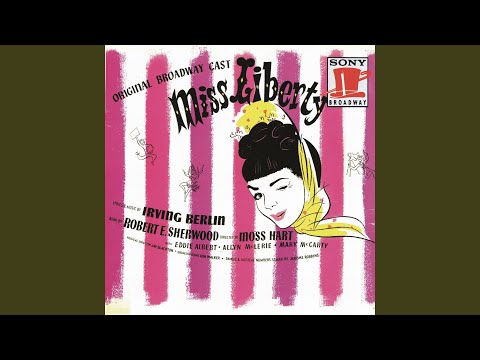
Review
What happens when you build a whole musical around a national symbol and then make the plot about a publicity mistake? “Miss Liberty” (1949) answers with a grin, a wince, and a score that keeps trying to rescue a book that wants to talk its way to the finish line. Irving Berlin’s lyrics are at their sharpest when they’re treating “America” as a headline, not a hymn. Cameras click. Papers compete. Romance is negotiated like circulation. The show’s central joke is also its thesis: the country falls in love with an image before it asks whether the image is true.
That idea lands because the lyric writing understands showbiz and journalism as cousins. “What Do I Have to Do to Get My Picture Took?” treats attention as currency, and it is funny because it is recognizably transactional. “Homework,” meanwhile, flips from charm to ache: Maisie’s “assignment” is self-erasure dressed as advice, a comic song with real bruises underneath. By Act II, Berlin goes riskier. “You Can Have Him” is not a catfight. It is a detente, two women choosing clarity over chaos. Then the finale swings hard into civic poetry with “Give Me Your Tired, Your Poor,” a setting of Emma Lazarus that turns the Statue into an argument, not just a backdrop.
Musically, “Miss Liberty” is classic Broadway with a big orchestra footprint and dance demands that telegraph Jerome Robbins even when the libretto is busy explaining itself. The sound is polished, period-aware, and built for motion: street energy in the newsboy material, Paris color in “Paris Wakes Up and Smiles,” and a public-pageant thrust that makes the dedication finale feel earned even if the mistaken-identity mechanics can feel fussy.
How it was made
The authorship is unusually heavyweight for a show that never quite decides whether it wants to be satire or valentine. The book is by Robert E. Sherwood, the score is Berlin’s, and the original production was directed by Moss Hart with choreography by Robbins. The result is a show that looks expensive, sounds expensive, and sometimes behaves like it expects you to applaud the résumé.
The best behind-the-scenes detail is that the show’s own premise comes with an embedded myth-check. The plot sends Horace to Paris to find the “model” for the Statue of Liberty, and he returns with the wrong woman. Historically, Bartholdi’s mother is commonly cited as the facial inspiration, which makes the musical’s mistake feel like a wink at our appetite for a prettier story. The show is honest about that appetite: it stages a lie, watches America buy it, then asks what love looks like once the headline collapses.
In modern times, the musical’s afterlife has been driven by scholars and specialty producers more than commercial appetites. A notable example: a rare 2015 U.K. revival announced it would restore songs cut in tryouts, unearthed from Berlin archives by musicologists. That is the kind of “Miss Liberty” news that tracks: the piece survives as a trove, a research object, and an occasion for rediscovery.
Key tracks & scenes
“What Do I Have to Do to Get My Picture Took?” (Maisie, Horace)
- The Scene:
- At the Statue ceremonies in New York, cameras and egos jockey for position. Bright, public lighting. A crowd that wants proof it was there, even before it knows what “there” means.
- Lyrical Meaning:
- Berlin turns celebrity into labor. Maisie’s punchlines are instructions for survival in a media economy. The song sets the show’s rule: attention is earned, bought, stolen, and staged.
“A Little Fish in a Big Pond” (Horace, Maisie)
- The Scene:
- After Horace botches his assignment and gets fired, the mood drops. Lighting narrows. Maisie pushes him toward Paris, turning humiliation into strategy.
- Lyrical Meaning:
- Ambition is framed as a kind of self-defense. The lyric plays like pep talk, but the subtext is sharper: in this world, you either swim or you become tomorrow’s discarded copy.
“Let’s Take an Old-Fashioned Walk” (Horace, Monique)
- The Scene:
- Paris. A cheap tour that feels like romance because it is. Warm, street-level light, movement through space instead of speeches. Two people talking themselves into tenderness.
- Lyrical Meaning:
- The lyric is Berlin at his simplest and most effective. It sells time together as the luxury. In a show about images, the song’s power is that it asks you to watch people, not symbols.
“Homework” (Maisie)
- The Scene:
- Back in New York, Maisie is offered professional advancement and turns it down because her focus is Horace. Solo spot. A confident façade that keeps slipping.
- Lyrical Meaning:
- It is a comedy number that smuggles in a portrait of emotional unpaid labor. The lyric is full of “helpful” advice that sounds like love until you hear what it costs her.
“Just One Way to Say I Love You” (Horace, Monique)
- The Scene:
- End of Act I. Paris to promise, the stage closing in around a private confession. Softer palette, fewer bodies, higher stakes.
- Lyrical Meaning:
- Berlin tightens the language to sincerity. After all the media noise, the song tries to speak plainly, which becomes its dramatic point.
“You Can Have Him” (Maisie, Monique)
- The Scene:
- Act II, a hotel room conversation that could have been a showdown. Low, intimate lighting. Two women measuring each other, then disarming each other.
- Lyrical Meaning:
- It is a joint renunciation that reads like mutual respect. The lyric refuses melodrama and makes a case for self-possession in a plot built on misunderstanding.
“The Policeman’s Ball” (Maisie, Ensemble)
- The Scene:
- Walhalla Hall. Festive lights and kinetic choreography. Horace and Monique duck into a public party while the private crisis escalates.
- Lyrical Meaning:
- Berlin writes civic festivity as cover. The number underlines how easily a crowd’s joy becomes camouflage for panic.
“Give Me Your Tired, Your Poor” (Monique, Ensemble)
- The Scene:
- Near the end, at Castle Garden as deportation looms. The stage clears, the light cools, and Monique sings toward the idea of America rather than its newspapers.
- Lyrical Meaning:
- A literal poem setting that could have felt like pageant, but it lands because the show has already exposed the machinery behind “welcome.” After the spectacle, the lyric argues for the moral claim beneath it.
Live updates (2025/2026)
Information current as of January 2026. “Miss Liberty” is not a touring title in the modern commercial sense, and there is no active Broadway run to track. Its footprint today is licensing and curation. Concord Theatricals continues to license the full-length show, and the materials list signals a production that plays best with serious musical resources: large ensemble, big orchestra needs, and dance difficulty that can stress smaller companies.
On the listening side, the original cast recording remains easy to find through modern platforms and label reissues. Masterworks Broadway maintains an album page with a detailed synopsis and production context, including the recording’s early release timeline. If you are coming to the show through the album first, start with “Let’s Take an Old-Fashioned Walk” for the romance, then jump to “You Can Have Him” for the emotional geometry, then finish with “Give Me Your Tired, Your Poor” to hear Berlin aiming for something larger than a love plot.
Recent visibility spikes tend to come from “rare revival” events, like the 2015 U.K. performances that reinstated cut material from archives. That pattern is your clue for the next one: watch universities, concert-series presenters, and Berlin estate-friendly research projects rather than a standard commercial pipeline.
Practical viewing tip for staged revivals: sit far enough back to read the full crowd pictures in the newspaper and ceremony scenes, but close enough to catch the choreography’s footwork when the party numbers explode. Middle orchestra is the sweet spot in most houses.
Notes & trivia
- The original Broadway run opened July 15, 1949 at the Imperial Theatre and closed April 8, 1950 after 308 performances.
- The original creative lineup is unusually loaded: Berlin and Sherwood producing alongside Moss Hart, with choreography by Jerome Robbins.
- Myth-check baked into the plot: the show’s “found model” is wrong, and sources commonly cite Bartholdi’s mother as the real-life inspiration for the statue’s face.
- “Give Me Your Tired, Your Poor” sets Emma Lazarus’s “The New Colossus,” tying a Broadway finale directly to U.S. immigration symbolism.
- A 2015 U.K. revival announced it would restore four songs cut during tryouts, located in Berlin archives by musicologists with estate permission for a one-off performance.
- Concord’s listing tags the show as period and history-forward, and flags an extra-large orchestra plus difficult dance requirements.
- The Master Propertyman Joe Lynn won the 1950 Tony Award for Stage Technician for the original production.
Reception
Critically, “Miss Liberty” arrived with famous names and got treated like a famous-name project: expectations first, then irritation when the evening didn’t justify the banner. Wolcott Gibbs, writing in The New Yorker, skewered the show’s sense of necessity, arguing it felt made out of habit rather than urgency. That critique still maps onto the book today. When “Miss Liberty” slows down, it does not slow into psychological depth. It slows into logistics.
“A sense of arbitrary creation, of production through force of habit.”
Yet the score has aged better than the narrative scaffolding. Modern advocates tend to pitch it as a “pleasant” Berlin album with a handful of genuine keepers. Peter Filichia, writing for TheaterMania around the York Theatre’s concert-style presentation, put it plainly: the cast album is the persuasive exhibit.
“The cast album documents a most pleasant score that includes one of my favorite songs, ‘You Can Have Him.’”
Even the label-side editorial framing is blunt about the gap between ambition and outcome, while still pointing to the duet that refuses to die. Masterworks Broadway calls the show a letdown after “Annie Get Your Gun,” then immediately concedes the staying power of “Let’s Take an Old-Fashioned Walk.” That’s the “Miss Liberty” deal in three sentences: the book is contrived, the melodies are real, and one duet keeps walking out of the theatre into the wider culture.
“There was no way Irving Berlin could have topped himself after Annie Get Your Gun, but his next effort…seemed a serious letdown.”
Quick facts
- Title: Miss Liberty
- Year: 1949
- Type: Full-length musical comedy (period/history setting)
- Music & Lyrics: Irving Berlin
- Book: Robert E. Sherwood
- Original director / choreographer: Moss Hart / Jerome Robbins
- Original Broadway theatre: Imperial Theatre (308 performances)
- Music supervision (original): Jay Blackton (musical director), Don Walker (orchestrations)
- Selected notable placements: Statue ceremony opener; Paris studio and streets; Act II arrival in New York; Policemen’s Ball; Castle Garden finale
- Album: “Miss Liberty – Original Broadway Cast 1949” (Masterworks Broadway album page includes synopsis and credits)
- Release context: Original LP release noted as August 5, 1949 on the Masterworks Broadway album page
- Availability: Licensing available via Concord Theatricals; cast recording available via modern streaming/reissues
Frequently asked questions
- Is “Miss Liberty” about the Statue of Liberty’s creation or its dedication?
- Both, but through a tabloid lens. The plot is set around the 1880s ceremonies and a press hunt for the statue’s “model,” which turns into a public deception and private romance.
- Who wrote the lyrics?
- Irving Berlin wrote both music and lyrics. The book is by Robert E. Sherwood.
- Was Monique DuPont the real model for the Statue of Liberty?
- No. The musical makes the mistake the engine of its plot. The show itself notes the “found” model is wrong, and common historical accounts cite Bartholdi’s mother as the facial inspiration.
- What is the best-known song from the show?
- “Let’s Take an Old-Fashioned Walk” is the breakout standard. “You Can Have Him” is a deep-cut favorite, and “Give Me Your Tired, Your Poor” is the show’s big civic statement.
- Has the show been revived recently?
- It appears more often as a rarity than a repertory staple. A notable 2015 U.K. revival restored songs cut during tryouts, and New York visibility in the 2000s included concert-style presentations.
Key contributors
| Name | Role | Contribution |
|---|---|---|
| Irving Berlin | Composer, lyricist, producer | Wrote the score and lyrics; produced the original Broadway production |
| Robert E. Sherwood | Book writer, producer | Wrote the libretto shaping the press-war plot around the Statue of Liberty |
| Moss Hart | Director, producer | Staged the original Broadway production |
| Jerome Robbins | Choreographer | Created the dances; the show’s big ensemble moments depend on his style |
| Jay Blackton | Musical director | Led the original music direction and vocal arrangements |
| Don Walker | Orchestrator | Orchestrated the original score for a large pit |
| Oliver Smith | Scenic & lighting design | Designed the original physical and lighting world |
| Motley | Costume design | Created period costumes supporting Paris and New York contrasts |
| Dominic McHugh | Musicologist | Helped uncover Berlin archive material used to restore cut songs in 2015 |
Sources: IBDB, Concord Theatricals, Masterworks Broadway, Playbill, The New Yorker, TheaterMania, Wikipedia (plot overview and song list cross-check).