For Good Lyrics — Wicked
For Good Lyrics
– Kristin Chenoweth & Idina Menzel[ELPHABA]
I'm limited:
Just look at me - I'm limited
And just look at you -
You can do all I couldn't do, Glinda
So now it's up to you
(spoken) For both of us
(sung) Now it's up to you:
[GLINDA]
I've heard it said
That people come into our lives for a reason
Bringing something we must learn
And we are led
To those who help us most to grow
If we let them
And we help them in return
Well, I don't know if I believe that's true
But I know I'm who I am today
Because I knew you:
Like a comet pulled from orbit
As it passes a sun
Like a stream that meets a boulder
Halfway through the wood
Who can say if I've been changed for the better?
But because I knew you
I have been changed for good
ELPHABA
It well may be
That we will never meet again
In this lifetime
So let me say before we part
So much of me
Is made of what I learned from you
You'll be with me
Like a handprint on my heart
And now whatever way our stories end
I know you have re-written mine
By being my friend:
Like a ship blown from its mooring
By a wind off the sea
Like a seed dropped by a skybird
In a distant wood
Who can say if I've been changed for the better?
But because I knew you:
GLINDA
Because I knew you:
BOTHI have been changed for good
ELPHABA
And just to clear the air
I ask forgiveness
For the things I've done you blame me for
GLINDA
But then, I guess we know
There's blame to share
BOTH
And none of it seems to matter anymore
GLINDA ELPHABA
Like a comet pulled Like a ship blown
From orbit as it Off it's mooring
Passes a sun, like By a wind off the
A stream that meets Sea, like a seed
A boulder, half-way Dropped by a
Through the wood Bird in the wood
BOTH
Who can say if I've been changed for the better?
I do believe I have been changed for the better?
GLINDA
And because I knew you:
ELPHABA
Because I knew you:
BOTH
Because I knew you:
I have been changed for good.
For Good (Movie Version) Lyrics
Complete Movie Lyrics: Wicked: For Good (2025)
Song Overview
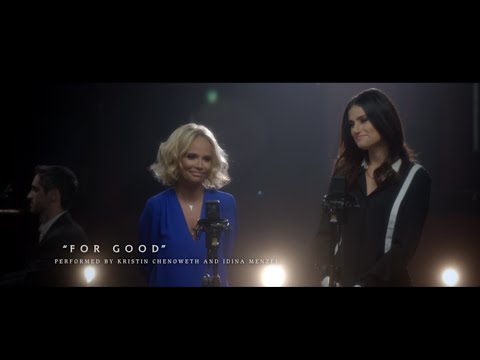
Review and Highlights
Quick summary
- For Good is the farewell duet between Elphaba and Glinda near the end of Wicked, capturing the final turn in their friendship and the cost of their choices.
- The number was written by Stephen Schwartz for the original 2003 Broadway production and recorded by Idina Menzel and Kristin Chenoweth for the cast album released on December 16, 2003.
- Structurally it is a slow-building ballad for two voices, trading solo verses before locking into close harmony that mirrors the characters’ hard-won understanding.
- The title hinges on a double meaning: the friends are changed permanently, and they have changed one another for the sake of something better.
- In the 2025 film sequel Wicked: For Good, Cynthia Erivo and Ariana Grande perform a new screen version that keeps the core structure but re-orchestrates the song for cinema and surround sound.
Screen & media placements
Wicked: For Good (2025) - feature film - diegetic. The duet appears in the final stretch of the movie, sung by Elphaba and Glinda as they part ways in the ruins of their friendship, in the last reel of the story. The sequence pulls the camera in close, largely abandoning spectacle so that the song plays almost like a chamber scene: two women, one conversation, the future of Oz hanging off every line. The number works as the film’s quiet emotional landing after battles, propaganda, and political turmoil, underlining that the core of this saga is a relationship rather than a revolution.
Television & tributes - non-diegetic. Excerpts of the original Broadway recording have been used over montage segments, including a tribute on the game show Wheel of Fortune for late director Mark Corwin, where the piece scored a series of farewell clips. The song has also become a staple at memorials and celebrations of life; Kristin Chenoweth’s performance at John Spencer’s funeral is often cited by fans as one of the most affecting public uses of the piece.
Series & covers - diegetic within other shows. The number appears in Glee as a farewell duet for Rachel and Kurt in the episode “New York,” transplanting the Oz friendship into the world of McKinley High. That performance helped introduce the song to viewers who had never seen Wicked onstage and further cemented it as a go-to soundtrack for graduations and goodbyes.
Review: how the song works on stage and record
On the original cast recording, For Good arrives after a long stretch of narrative turmoil. By the time the piano figure opens and Glinda begins, the audience has watched these two women move from rivals to uneasy allies to estranged counterparts. Schwartz leans into that backstory with a deceptively simple melody: the opening phrase feels conversational, almost like someone testing out a farewell speech before they dare to say it out loud.
Idina Menzel and Kristin Chenoweth meet the material with restraint. Their first verses sit in a conversational mid-range, prioritizing diction and character over vocal fireworks. The orchestration gradually folds in strings and woodwinds, but the arrangement always leaves room for breath and silence. Only in the final build - when the pair sing different lines in counterpoint, then finally join on the closing phrase - does the song open up into the kind of big, sustained harmony Broadway fans wait for. Even then, it never turns into a belting contest; the drama lives in how carefully they listen to one another.
What stands out most is the balance between sentiment and craft. The lyric is full of plainspoken images - “handprint on my heart”, “a stream pulled by a boulder” - that a lesser score might overload with ornament. Here they are allowed to land cleanly, framed by transparent harmony writing. Critics sometimes tease For Good for leaning toward schmaltz, but, as one Vulture ranking pointed out, the show earns this moment by spending two acts building the relationship behind it. When the duet finally arrives, the sentiment feels paid for rather than handed out for free.
Key takeaways
- The duet is less about grand romance and more about the kind of friendship that changes a person’s moral compass and sense of self.
- Its musical design mirrors that journey: individual lines that slowly braid into a shared statement, then separate again when the characters choose different paths.
- It has become a modern standard for farewells - adopted for graduations, funerals, and last nights of long-running productions - precisely because it avoids saying “for the better”, leaving room for mixed feelings.
- The 2025 film adaptation keeps the thematic skeleton but adds a subtly different dramatic frame: the camera supplies close-ups and tiny facial shifts that stage audiences could only imagine, while the vocal approach tilts more toward intimate film acting than Broadway projection.
Creation history
Stephen Schwartz has often described For Good as one of the most personal numbers in the Wicked score. The initial spark came from a conversation not with a collaborator, but with his daughter: he asked her what she would say if she knew she would never see her best friend again. Her plain reply became the seed for the opening lines, anchoring the piece in the language of real people rather than ornate musical-theatre phrasing.
The title itself emerged in a brainstorming session with book writer Winnie Holzman. According to Schwartz, Holzman floated the phrase “for good” to describe how the two witches affect each other’s lives, and he immediately heard the potential: the idiom means “forever” and “for the sake of the good” at once. That layered meaning became the organizing principle of the entire lyric.
For Good also carries a structural link to other parts of the score. The short “I’m limited” introduction, sung by Elphaba, reprises the “unlimited” theme associated with her early optimism in the show. Schwartz later explained that he moved a planned reprise of that material out of No Good Deed and into this duet, so that the motif would land where Elphaba recognises that her dreams have narrowed even as her inner life has deepened. It is a subtle but telling shift: the earlier anthem Defying Gravity shouts her independence to the rafters; this song quietly measures what that independence has cost.
On record, producer Stephen Schwartz keeps the arrangement simple: piano-led, with orchestral textures that swell rather than dominate. Later live and studio versions - from the Out of Oz series to cast reunions and special events - often preserve that transparent palette, even when the singers bring new colours or riffs. By the time the 2025 film adaptation was in post-production, director Jon M. Chu reportedly re-shot the ending of the movie to pull the camera closer for this number, deciding that the song worked best when everything else stepped out of its way.
Song Meaning and Annotations
Plot
Within the story of Wicked, For Good arrives near the end of Act II. Oz has turned against Elphaba, the green-skinned woman who tried and failed to reform the Wizard’s regime. Propaganda has branded her “wicked”, and Glinda - once her roommate and unlikely friend - has been elevated as the acceptable, photogenic face of “good”.
Before the siege on Kiamo Ko, the two women steal a last private meeting. Glinda begins awkwardly; she admits she is not sure whether the comforting platitude that people come into our lives for a reason is even true, but she knows that meeting Elphaba has shaped who she is. Elphaba responds in kind, owning the ways Glinda has rewritten her story, even as the world outside the room is prepared to paint her as a villain forever.
The conversation moves through apology. Elphaba asks for forgiveness for the harm she has caused, directly or indirectly. Glinda, in a rare moment of honest humility, replies that “there’s blame to share”, and that none of their grievances quite matter in the face of what they are about to lose. The pair acknowledge that they may never meet again in this lifetime, and choose to leave each other with gratitude rather than accusation. When they part, they do so as friends, even though almost nobody in Oz will ever know it.
Song meaning
The heart of the song is not just “goodbye”, but “you made me into the person who can survive this goodbye”. Rather than revisit every plot point, the lyric zooms out to the ways long relationships alter personality: how someone else’s courage can rub off; how proximity to another worldview can crack open your own. Glinda, once obsessed with status and surface, admits that she would not be the leader she is without the prickly friend who challenged her vanity. Elphaba, who has spent much of the show armoured against hurt, concedes that Glinda taught her to risk connection at all.
There is also a tougher edge under the tenderness. “For good” avoids saying “for the better”. That small omission matters. Both women know that their time together has carried pain as well as joy: betrayal, jealousy, political fallout. The song refuses to frame their story as uncomplicated uplift. Instead it suggests that sometimes the people who grow us the most are the ones who complicate our lives, who pull us out of our comfort narratives and into messier, truer versions of ourselves.
Layered onto that personal reading is a wider social metaphor. Elphaba’s treatment in Oz - judged first by her appearance, constantly misunderstood, scapegoated when power needs a monster - has long been read as a commentary on prejudice. Against that backdrop, For Good becomes a quiet proposal that real allyship changes both parties. Glinda’s status has insulated her from the worst of Oz’s cruelty; her friendship with Elphaba forces her to confront how that privilege operates, and how “goodness” can be weaponised as branding rather than ethics.
Annotations
Several details in and around the song deepen that reading when you look closer.
“I’ve heard it said that people come into our lives for a reason”
This opening line came directly from Schwartz’s real-life question to his daughter, which is why it feels so much like something you might hear in an ordinary conversation. That grounded tone keeps the duet from floating off into fantasy; it is two people trying to articulate something big without the vocabulary to match, so they reach for the phrases they know.
Earlier in the show, Elphaba’s solo The Wizard and I brimmed with unshaken optimism. Her future felt “unlimited”; she believed talent and hard work would override bias. By the time she reaches For Good, the word “unlimited” has been reshaped into “I’m limited” - the small prelude that leads into the duet. The world has not changed in the way she hoped; instead, she has had to change in order to face that truth. The hope for uncomplicated belonging has been taken from her, and the song gently acknowledges that loss.
The contrast with Glinda’s arc is crucial. Glinda has been the public favourite for most of the story, the one anointed as “good” by institutions that prefer her polished image. Numbers like Thank Goodness show her wrapped in applause and ceremony. In the duet, all that drops away. Titles and tiaras do not matter; these are two women in a room, admitting that their public roles have cost them private honesty. The scene allows Glinda to strip off the brand of “Glinda the Good” and simply be a flawed person saying sorry.
“Because I knew you, I have been changed for good”
On the surface this line reads like a soft, Hallmark-style sentiment, and that is part of its power. Hidden inside is the double meaning that has fascinated fans and scholars alike: “for good” as “forever” and “for the sake of good”. The line never specifies whether the change was entirely positive, which leaves room for the complicated mix of guilt, gratitude, and grief actively playing across the characters’ faces in most stagings.
Musically, there is a clever trick late in the song that many listeners only notice subconsciously. Through most of Wicked, Elphaba usually takes the lower line while Glinda sings the sparkling top parts. Here, for sections of the climax, they switch, with Elphaba floating up into the higher harmony and Glinda anchoring the lower notes. That inversion is a neat metaphor for how they have altered each other’s internal balance: Elphaba has learned to let herself soar; Glinda has learned to steady herself on the ground.
“It well may be that we will never meet again in this lifetime”
This line is brutal in its clarity. The pair share a secret the rest of Oz will never fully understand: Elphaba is not dead, and Fiyero is alive with her. Glinda knows she must maintain the public lie to protect them, and that doing so will isolate her politically and spiritually. The farewell is not just between two friends; it is between two possible futures for an entire land. The lyric captures that sense of a door closing on something bigger than either woman.
Rhythm, harmony, and the feeling of “good”
From a craft perspective, For Good sits at an interesting intersection of styles. The basic harmony language is classic Broadway ballad: diatonic, gently shifting through related keys. But the phrasing often breaks away from strict four-bar symmetry. Lines stretch or contract around the characters’ thoughts, particularly in the verses, which helps the song feel like speech that happens to be sung.
The piano accompaniment works in arpeggiated patterns that echo both hymn-like simplicity and 1990s pop ballad textures. That blend underlines how the show positions “goodness”. Is it church-sanctioned morality, as the Wizard’s regime would have it, or something messier and more human? When the two voices finally overlap - Glinda and Elphaba literally singing different lines at the same time - the harmony becomes a sonic metaphor for competing truths coexisting.
Lyrically, Schwartz leans on modest metaphors rather than baroque poetry. Comparisons to comets and streams, seeds and boulders, create just enough visual imagery to imply motion and weight. None of them are obscure; you could explain every one to a child. That accessibility is part of why the song has travelled so widely outside theatre circles, becoming a staple at school ceremonies and amateur cabarets. It is the kind of writing that appears simple until you try to imitate it.
Historical and cultural context
When Wicked opened in 2003, its central relationship between two women - played by Idina Menzel and Kristin Chenoweth - already felt like a quiet rebuke to a Broadway landscape still dominated by male romantic leads. Over the following two decades, For Good turned into something more: an anthem for female friendship that allowed for conflict, disagreement, and eventual grace.
As productions mounted around the world and the cast recording climbed the charts year after year, the duet found a second life offstage. Choir arrangements proliferated. It slipped into graduation playlists, death announcements, and social-media tribute videos. Articles about popular graduation songs in the 2010s frequently list it alongside radio hits, while funeral-music guides mention it as a growing favourite for services where family members want something reflective but not overtly religious.
The piece is now entering yet another phase with the film sequel Wicked: For Good. Early coverage of the movie has heavily teased the new screen version of the duet, with director Jon M. Chu and outlets like NME magazine talking up how the scene focuses on the intimacy between Cynthia Erivo and Ariana Grande rather than digital spectacle. Rolling Stone’s recent look at the sequel underscores the same point: the franchise can add new songs and bigger sets, but this farewell remains the emotional spine that everything else bends around.
Key Facts
- Artist: Idina Menzel & Kristin Chenoweth (original Broadway cast recording)
- Featured: Duet between Elphaba (Idina Menzel) and Glinda (Kristin Chenoweth)
- Composer: Stephen Schwartz
- Producer: Stephen Schwartz (original cast album)
- Release Date: December 16, 2003
- Genre: Musical theatre, pop-influenced show tune
- Instruments: Piano, strings, woodwinds, orchestral percussion
- Label: Decca Broadway / Verve (Universal Music)
- Mood: Reflective, grateful, bittersweet, quietly resolute
- Length: 5:07 (original Broadway cast recording)
- Track #: 18 on Wicked (Original Broadway Cast Recording)
- Language: English
- Album: Wicked (Original Broadway Cast Recording); included on later anniversary editions
- Music style: Duet ballad for two female voices with contrapuntal climax; Broadway orchestration with pop ballad pacing
- Poetic meter: Primarily iambic lines with conversational deviations and occasional anapestic figures
Canonical Entities & Relations
- Stephen Schwartz - wrote music and words for the song and produced the original cast recording.
- Idina Menzel - originated the role of Elphaba on Broadway and sings one half of the duet on the album.
- Kristin Chenoweth - originated the role of Glinda and sings the other half of the duet on the album.
- Winnie Holzman - wrote the book of Wicked and helped shape the dramatic placement and title of the duet.
- Decca Broadway - issued the original cast album that includes the track.
- Universal Pictures - produced the two-part film adaptation, including the 2025 sequel titled Wicked: For Good.
- Cynthia Erivo - portrays Elphaba in the films and performs the duet on the soundtrack for the second movie.
- Ariana Grande - portrays Glinda in the films and joins the duet in the 2025 screen version.
- Gershwin Theatre - original Broadway home of Wicked, where the song has been performed thousands of times.
- Wicked (Original Broadway Cast Recording) - the album that first preserved the duet for audio release.
Questions and Answers
- Why is For Good placed so late in Wicked?
- By holding the duet until near the end of Act II, the creators allow the audience to see Elphaba and Glinda through rivalry, camaraderie, betrayal, and political fracture before they try to say goodbye. The song relies on that history; without it, the platitudes about changing each other “for good” would feel weightless.
- What makes the title phrase “for good” so important?
- It compresses several ideas into two short words. The friendship has altered both women permanently, and it has nudged each of them toward a deeper understanding of what “goodness” might mean beyond public labels. The phrase hints at both consequences and moral aspiration without spelling either out.
- Is the duet meant to be comforting or sad?
- Both. The music leans toward consolation, with warm harmonies and a sense of closure. The story context is much harsher: one woman is about to disappear into myth as a so-called villain; the other is about to preside over a regime built on that lie. The song lets them carve out one protected moment of honesty inside that bleak reality.
- How does the song comment on prejudice in Oz?
- Elphaba’s experience of being judged by her green skin and outsider status reflects forms of bias in the real world. In the duet she does not get justice or vindication; what she gets is a friend who finally recognises how deeply the system has wronged her. The piece quietly suggests that genuine friendship across divides can change how someone uses their power.
- Why do so many schools and choirs choose this piece for graduations?
- The lyric speaks directly about being changed by knowing someone, without tying that change to a romantic relationship. That makes it easy to adapt to a class, a team, or a community. The melody is singable for amateur voices, and the text leaves enough space for listeners to project their own stories.
- How does the 2025 film version with Cynthia Erivo and Ariana Grande differ from the Broadway recording?
- The film version is shaped for the camera. Tempi and dynamics lean into close-up acting rather than projecting to the back row, and the orchestration makes fuller use of modern film-scoring resources. According to pre-release coverage, director Jon M. Chu ultimately chose a restrained visual approach for the scene, letting the performances carry the weight instead of cutting away to sweeping shots of Oz.
- Did Stephen Schwartz plan the “unlimited / I’m limited” callback from the start?
- The “unlimited” motif appears throughout the score, tied to Elphaba’s early belief in her boundless potential. Schwartz has explained that he shifted a reprise of the idea from No Good Deed into the prelude of this song so that Elphaba’s recognition of her limits would land in conversation with Glinda. It is a deliberate structural choice rather than a coincidence.
- Why do many listeners mention the swapped vocal lines in the final chorus?
- Because the women trade their usual ranges for a moment, the ear hears a subtle shift in who is supporting whom. It is as if Glinda lends Elphaba her lightness while Elphaba lends Glinda her grounding. That detail is never announced in the script, but it reinforces the idea that they have reshaped each other from the inside out.
- How does the duet relate to earlier songs like “The Wizard and I” and “Popular”?
- The earlier pieces show the two women in their youthful extremes: Elphaba dreaming of institutional approval; Glinda basking in surface-level popularity. For Good looks back at those earlier selves with more clarity and regret. Musically, it quotes Elphaba’s “unlimited” theme and echoes some of Glinda’s brighter harmonic language, now slowed down and shaded.
- Is there a religious or spiritual layer to the number?
- While the song does not reference any specific faith, the language of purpose and transformation has led some listeners to hear echoes of hymns or blessing rituals. The repeated “because I knew you” functions almost like a litany of gratitude. At the same time, the show’s broader satire of institutions keeps the piece grounded in human, not divine, responsibility.
- How do notable cover versions change the feel of the song?
- Pop duets, such as the LeAnn Rimes and Delta Goodrem recording, smooth out some of the stage-dialogue edges and lean more into crossover ballad territory. Solo covers by artists like Heather Headley and Rachel Bay Jones introduce different vocal colours and sometimes alter the narrative frame, turning the lyric into a more general reflection on life-altering relationships rather than a specific Oz farewell.
Awards and Chart Positions
While For Good was not released as a stand-alone single in the way a pop track might be, its home album has enjoyed a remarkable life in the charts and in the recording industry’s honours lists.
- Grammy Awards: Wicked (Original Broadway Cast Recording), which includes For Good, won the Grammy for Best Musical Show Album at the 2005 ceremony.
- Billboard 200: The album first appeared modestly in 2003, then climbed over the years, ultimately reaching a new peak at number 33 on the Billboard 200 in 2024 as interest surged around the first film adaptation.
- Cast Albums chart: The recording has repeatedly topped the Billboard Cast Albums chart and has appeared at or near the summit of various year-end lists for cast recordings across the late 2000s and 2010s.
- RIAA certifications: The original Broadway cast album has progressed from platinum to double and triple platinum, and in July 2025 it was certified 4x Platinum in the United States, with global sales reported at over five million copies.
- Streaming & online presence: Official uploads of the Broadway track and associated live versions on platforms such as YouTube and streaming services have accumulated tens of millions of plays, helping the duet reach listeners who have never set foot inside a theatre.
- Film-era accolades: The 2024 and 2025 Wicked soundtracks, which preserve new screen performances of the score including the closing duet, have generated their own chart successes and award nominations, particularly at film-music ceremonies and critics’ organisations.
| Release | Format | Key Milestone | Relevance to For Good |
|---|---|---|---|
| Wicked (Original Broadway Cast Recording) | Cast album | Grammy Award, multi-platinum sales, Billboard 200 peak at #33 (2024) | First and still definitive audio document of the duet with Menzel and Chenoweth. |
| Wicked: The Soundtrack (2024) | Film soundtrack (Part 1) | Historic chart debut for a stage-to-screen musical album | Builds momentum for renewed interest in the score, priming audiences for the sequel that will feature the duet. |
| Wicked: For Good – The Soundtrack (2025) | Film soundtrack (Part 2) | Pre-release buzz, major label campaign, awards attention for new songs | Introduces the Erivo/Grande screen version, placing the duet inside a modern cinematic sound world. |
How to Sing For Good
Because this duet has become such a go-to choice for recitals, graduations, and auditions, it helps to approach it with the same care the original cast and later interpreters have brought to it.
- Key: Db major (concert key of the original Broadway vocal score).
- Approximate tempo: around 70–80 BPM, a gentle ballad pace that leaves space for breath and text.
- Vocal range (original female keys): roughly G?3 to D?5 for both lines, with Glinda edging slightly higher in certain arrangements and Elphaba anchoring more of the middle register.
- Primary style markers: musical-theatre legit with contemporary ballad inflections, strong emphasis on legato, straight-tone on entries, and tasteful vibrato at phrase ends.
Step-by-step guide
-
Start with tempo and pulse
Before worrying about high notes, sit at a piano (or use a reliable backing track) and clap through the song at a steady tempo. Count in four, but feel the phrases over eight or sixteen beats; this keeps the long lines from breaking into choppy segments. Pay attention to bars where the lyric stretches past the barline - those little extensions are where the emotion tends to sit. -
Map out the text and diction
Speak the entire lyric in rhythm as if it were a monologue. Aim for clear consonants on words like “changed”, “rewritten”, “reason”, and “forgiveness”. Because the text is so simple, sloppy diction can make it sound vague; crisp consonants and clean vowels keep it grounded. Avoid over-pressing the rhymes - this is conversation that happens to rhyme, not a cabaret patter song. -
Plan breathing like a string player
Mark breaths where you can inhale silently and deeply without chopping important phrases in half. For example, try to sing “I know I’m who I am today because I knew you” in one breath if possible, so the thought lands as a single unit. Practise slow inhalations through a relaxed mouth, expanding ribs and back rather than lifting the shoulders. A good exercise: hiss out on a slow count of twenty, inhale on a count of four, repeat, then add the actual melody. -
Shape the flow and phrasing
Think of each verse as a single emotional arc rather than a chain of small peaks. Build the volume slightly toward the middle of each section (“like a ship blown from its mooring”) and release toward the end of the thought, rather than hammering every high note. Listen to how the original cast and later interpreters like Heather Headley lift individual words without turning the piece into a belt showcase; the power comes from long arcs, not isolated climaxes. -
Work the accents and subtext
Decide which words your character would lean on in a real conversation. Glinda might emphasise “I don’t know if I believe that’s true”, revealing her doubt about comforting clichés. Elphaba might dig into “I ask forgiveness” with a small change in colour. Mark those words and experiment with dynamic micro-choices rather than big volume jumps: a slight swell, a change of tone, a softened consonant. -
Rehearse ensemble blend and balance
When you add the second singer, start by speaking the text together, then hum the harmonies on a neutral vowel. Aim for matched vowels, unified cut-offs, and a shared sense of where the phrase is going. Decide who leads in each section: when one singer carries the melody and the other sings harmony, the supporting voice should be fractionally softer and a touch warmer in tone. Trade roles consciously when the lines cross. -
Think about mic technique and acoustics
In a theatre, the piece is usually amplified but treated as a quiet chamber scene. If you perform it on microphones, keep the capsule at a steady distance (roughly a hand span) and resist the urge to “eat” the mic on big phrases, which can make the sound harsh. In an unamplified space, prioritise spinning legato and clear vowels over raw volume, especially in the final harmonies. -
Watch for common pitfalls
Singers often rush the conversational opening, flatten out the dynamic shape, or over-belt the last chorus. Another trap is letting vibrato wobble widen on sustained notes, which can pull the two voices out of tune. Practise the final phrases softly and in straight tone first, then add a narrow vibrato only where it serves the story. -
Build practice materials that support storytelling
Create two rehearsal tracks if possible: one with both lines, one with only your partner’s line. Use the second to practise listening and reacting while you sing your part from memory. It is also worth recording run-throughs on your phone and listening back for blend issues and rushed phrases. Focus on whether the narrative reads clearly even if the listener does not know the show.
Additional Info
Over two decades, For Good has gathered a web of stories around it that extend far beyond its original place in Wicked.
On the album side, anniversary editions of the cast recording have paired the track with bonus material and new covers, including the LeAnn Rimes and Delta Goodrem pop version on a special release. Theatre-focused outlets like Playbill have highlighted the duet in lists of Stephen Schwartz’s most significant songs, often praising how it captures the way relationships can foster growth rather than just providing a showy vocal showcase. At the same time, more sceptical rankings, such as one widely circulated feature that grouped it among Wicked’s more sentimental numbers, usually acknowledge that the show’s storytelling earns its sincerity.
Culturally, the song has become almost inescapable at occasions of transition. Education and music blogs regularly list it among the most-used graduation tracks, while funeral-planning guides and personal essays recount how it has soundtracked services for teachers, friends, and public figures. One such story, about students singing the duet at their vocal coach’s memorial, captures something essential about why the piece travels so well: it gives people a script for talking about being changed by someone’s presence even when words are hard to find.
The actors most closely associated with it have also carried it into other contexts. Kristin Chenoweth’s performance at John Spencer’s memorial service, connecting her West Wing colleague to her Wicked character’s farewell, is still discussed in interviews and fan forums. Idina Menzel and Chenoweth have reunited for charity performances and special events where fans pay substantial sums for the chance to share the stage with them, a detail that underlines just how deeply the duet has lodged in public imagination.
As the franchise shifts into its film era, critics and fans are watching closely to see how the new screen version with Cynthia Erivo and Ariana Grande will sit alongside the Broadway original. Previews suggest the movie leans into the song’s intimacy, framing it as the emotional fulcrum of the second film. NME magazine’s coverage of the trailers, and Rolling Stone’s recent conversations with Schwartz about new material written for the sequel, both treat the duet as a kind of touchstone: change what you like elsewhere, but get this scene right or the story’s heart goes missing.
In short, the piece sits at a rare crossroads of theatre lore, chart success, and everyday ritual. It belongs to Broadway history and to pop culture, but also to countless private moments where someone presses play, thinks of a person who altered their life, and quietly mouths along: “Because I knew you, I have been changed for good.”
Sources: Playbill, BroadwayWorld, Universal Music and Decca Broadway press releases, Billboard, People, Rolling Stone, NME, official Wicked and Universal Pictures materials
Music video
Wicked Lyrics: Song List
- Act 1
- No One Mourns the Wicked
- Dear Old Shiz
- The Wizard and I
- What Is This Feeling?
- Something Bad
- Dancing Through Life
- Popular
- I'm Not That Girl
- One Short Day
- A Sentimental Man
- Defying Gravity
- Act 2
- Thank Goodness
- The Wicked Witch of the East
- Wonderful
- I'm Not That Girl (Reprise)
- As Long as You're Mine
- No Good Deed
- March of the Witch Hunters
- For Good
- Finale