The Funnies Lyrics — As Thousands Cheer
The Funnies Lyrics
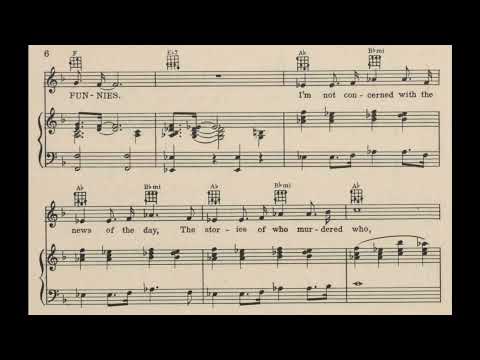
Sunday is Sunday to my family
But Sunday is not simply Sunday for me
For Sunday's the one day when I love to see the funnies
Breakfast is nothing of which you can boast
But breakfast to me isn't coffee and toast
It's coffee and toast and what I love the most, the funnies
[REFRAIN:]
Oh, I love the funnies
I couldn't go without the funnies
A cup o' coffee to my lips and in between the sips
The papers with the capers that are in the comic strips
Which means I'm simply mad about
I mean I couldn't do without the funnies
Oh, in my pajamas
I love to read the "Katzenjammers"
A little coffee in a cup and "Bringing Father Up"
I'm dippy over "Skippy" and his little yellow pup
Which means I'm simply mad about
I mean I couldn't do without the funnies
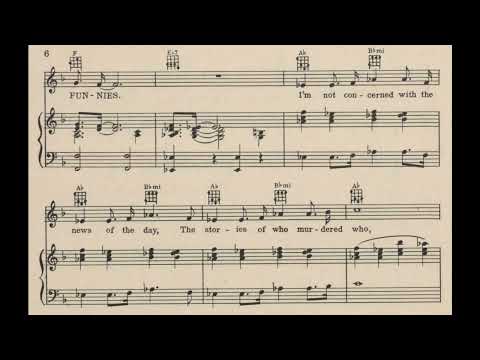
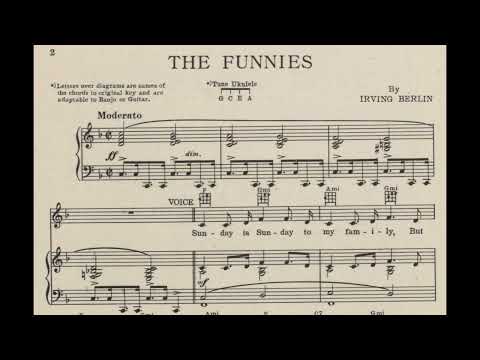
I'm not concerned with the news of the day
The stories of who murdered who
And for the columns what they have to say
I have no need of
I don't want to read of
The guys and all their honeys
The wealthy daughters or the sonnies
The news about the lovely trips that people take in ships
I'd rather read about the people in the comic strips
Which means I'm simply mad about
I mean I couldn't do without the funnies
[alternate lines:]
And as for what Mister Hearst has to say
The Dempseys or the Tunneys
Song Overview
Review and Highlights
Quick summary
- Work: As Thousands Cheer (1933), a Broadway newspaper revue with sketches by Moss Hart and songs by Irving Berlin.
- Original staging note: Listed in Act I and associated with Marilyn Miller in the 1933 production.
- Modern cast-recording anchor: The 1998 New York revival assigns it to "Man" and features B. D. Wong on the album track list.
- Stage idea: A human performer turns into a living strip panel, with chorus and visuals doing the punch line work.
As Thousands Cheer (1933) - stage revue - non-diegetic. This number feels like the paper has been folded to the comics page, then shaken until the ink starts dancing. Berlin writes it as a quick-turn showcase: a stream of jokes, images, and character snaps that land best when the singer stays crisp and slightly deadpan. The melody is friendly, almost chatty, but the rhythm keeps nudging you forward, like you are scanning panels before the next gag pops.
What makes it work is how the material invites stagecraft. You can hear the setups in the rests and you can feel where a costume reveal is supposed to happen. As stated in IBDB production credits, the original Broadway staging involved masks and headdresses specifically tied to this sequence, which is a pretty loud hint that the number was designed as much for the eye as for the ear.
- Key takeaways:
- Play it like comedy written for timing, not for volume.
- Keep diction clean so the jokes read like captions, not mush.
- It is a scene song that thrives on choreography and costume logic.
Creation History
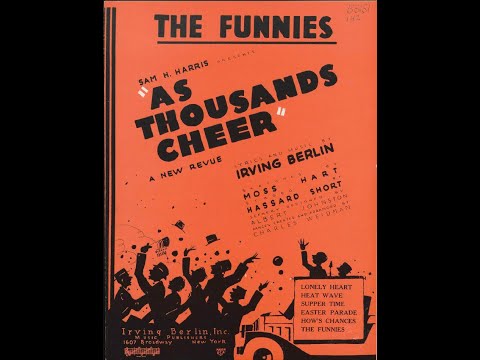
As Thousands Cheer opened at the Music Box Theatre on September 30, 1933, using newspaper headlines to launch each scene. "The Funnies" arrived as the moment when the revue admits, with a grin, that news is not just politics and scandal - it is also the everyday habit of turning pages for a quick laugh. Archival listings show the song preserved in the Irving Berlin Collection with multiple formats (manuscript piano scores, sketches, printed piano-vocal score, and a lyric sheet), which suggests it had a clear production life beyond a throwaway gag.
Song Meaning and Annotations
Plot
A speaker guides the audience through a comic-strip world, with the stage turning into a page that comes alive. The action is a parade of bits: the singer points, reacts, and shifts personas while the ensemble fills in the atmosphere, like background art that suddenly starts talking back.
Song Meaning
The meaning is simple and sharp: comics are relief, and relief is part of survival. In a show built on headlines, this number quietly argues that public life is not just what scares you, it is also what distracts you. It treats laughter as a daily ritual, something people reach for between the hard stories. Berlin keeps the tone light, but there is an edge to the idea: even comfort can be curated and sold, one panel at a time.
Annotations
"The funnies - BOX-FOLDER 72/6 ... Printed piano-vocal score ... Typescript lyric sheet"
Library of Congress finding aid
That catalog detail is more useful than it looks. It confirms the song was kept in multiple working forms, which usually means it was staged with real care: music drafts, production sketches, and a formal vocal score ready for performers.
"Masks and headdresses in the Funnies by Remo Buffano"
IBDB production credits
This tells you the scene was built to read visually from far away. When a number gets its own specialty design credit, it is rarely just a singer at a stand. The comedy likely depended on silhouettes, faces, and quick transformations.
"The Funnies - Man"
Concord Theatricals role list
The modern licensing label is blunt on purpose. It treats the performer as a flexible narrator, not a fixed character, which matches how comic-strip scenes tend to function: one body, many quick identities.
Style, rhythm, and cultural touchpoints
The writing sits in that sweet spot where theatre patter meets popular-song ease. It is not trying to be a grand ballad. It is built for motion, for reaction shots, for a performer who knows how to sell a line like a caption. The cultural hook is the newspaper itself: in the early 1930s, comic strips were mass entertainment, and the revue treats them as part of the same public conversation as politics and celebrity.
Key phrases and stage metaphor
Even without quoting full lines, you can hear the structure: setup, turn, button. It plays like panels: each unit lands, then the next one flips into view. That panel logic is also the meaning. Life is overwhelming, so you break it into frames you can handle.
Technical Information (Quick Facts)
- Song: The Funnies
- Artist: As Thousands Cheer cast (1998 New York revival cast recording features B. D. Wong)
- Featured: "Man" (licensing role label); chorus and visual ensemble as staged
- Composer: Irving Berlin
- Producer: Bruce Kimmel (1998 cast recording production credit in catalog metadata)
- Release Date: September 30, 1933 (Broadway opening context); January 1, 1998 (1998 cast album metadata date on major platforms)
- Genre: Musical theatre, comic scene song
- Instruments: Theatre orchestra (arrangements vary by production and edition)
- Label: Concord Theatricals (1998 cast album distribution metadata)
- Mood: Playful, fast, caption-like wit
- Length: About 2:13 (1998 cast recording track listing)
- Track #: 7 (1998 cast album listing on Apple Music)
- Language: English
- Album (if any): As Thousands Cheer (1998 Off-Broadway Cast Recording)
- Music style: Visual-forward comedy number with quick character pivots
- Poetic meter: Accentual, speech-led phrasing tuned for punch lines
Frequently Asked Questions
- Who wrote the song?
- Irving Berlin wrote the music and words for the number as part of the As Thousands Cheer score.
- Who performed it in the original 1933 Broadway production?
- Show documentation lists Marilyn Miller with the Act I number in the original staging.
- Who performs it on the 1998 cast recording?
- The 1998 New York revival album track list credits B. D. Wong for the recording.
- What is the scene concept?
- The number treats the comics page as theatre, with a narrator-like performer guiding quick bits that can be supported by chorus and visual reveals.
- Why do masks and headdresses matter here?
- IBDB credits indicate specialty design work for this sequence, implying the comedy relies on visual transformation as much as lyric timing.
- Is it considered a pop standard like some other Berlin songs from the show?
- It is better known as a theatrical scene number than as a standalone standard. Its reputation is tied to staging, revivals, and cast recordings.
- Was it kept in Berlin's archives?
- Yes. The Library of Congress finding aid lists multiple formats for the song, including manuscript materials and a printed piano-vocal score.
- Are there notable modern performances outside full productions?
- A documented example is the Feinstein's 54 Below concert presentation where performers tackled selections from the revue, including this number.
Additional Info
Two paper trails help pin the number down. The Morgan Library catalog describes a first-edition vocal score published by Irving Berlin Inc. in 1933, and the University of Maine Digital Commons record also lists a 1933 sheet-music item for the song. Those entries are useful because they confirm the piece existed in the commercial sheet-music world, not only inside the theatre script.
Then there is the performance footprint. The revue itself is still treated as a landmark by theatre historians, and the 1998 off-Broadway revival kept obscure numbers like this in circulation for a new audience. According to Variety's 1998 review coverage of the revival, the show placed this song among the highlighted musical selections, which is a good reminder that the comics-page bit was not treated as filler.
Key Contributors
| Entity | Type | Relationship (S - V - O) |
|---|---|---|
| Irving Berlin | Person | Berlin wrote the music and lyrics for the number. |
| Moss Hart | Person | Hart wrote the revue sketches framed by newspaper headlines. |
| Marilyn Miller | Person | Miller is listed with the Act I number in the original Broadway production. |
| B. D. Wong | Person | Wong recorded the song for the 1998 New York revival cast album. |
| Remo Buffano | Person | Buffano created masks and headdresses for the original staging credit. |
| Concord Theatricals | Organization | Concord publishes role lists and distributes the 1998 cast recording metadata. |
| Library of Congress | Organization | The library holds archival materials for the song within the Irving Berlin Collection. |
| Music Box Theatre | Venue | The theatre hosted the Broadway opening of As Thousands Cheer in 1933. |
Sources
Sources: Library of Congress Irving Berlin Collection finding aid, IBDB production page for As Thousands Cheer, Concord Theatricals show page and role list, Apple Music album listing for the 1998 cast recording, Spotify track listing for B. D. Wong, The Morgan Library music catalog record for the 1933 vocal score, University of Maine Digital Commons sheet-music record, Variety review of the 1998 revival, Cabaret Scenes review of the Feinstein's 54 Below concert, YouTube upload for "The Funnies" (1933).