
Jungle Book Lyrics: Song List
- Overture - Jungle Book
- Baby
- Colonel Hathi's March (The Elephant Song)
- The Bare Necessities
- I Wan'na Be Like You (The Monkey Song)
- Monkey Chase
- Tell Him
- Colonel Hathi's March (Reprise)
- Jungle Beat
- Trust In Me (The Python's Song)
- What'cha Wanna Do
- That's What Friends Are For (The Vulture Song)
- Tiger Fight
- Poor Bear
- My Own Home (The Jungle Book Theme)
- The Bare Necessities (Reprise)
- Bonus Tracs
-
Interview With The Sherman Brothers

- Baloo's Blues
- It's A Kick
- Brothers All
- The Song Of The Seeonee
About the "Jungle Book" Stage Show
The premiere of the cartoon took place in the world in October 1967. Box offices have surpassed all expectations, and still this musical is registered in the history in the number of leaders of box offices. Lyrics were written mostly by famous Sherman brothers, who have not read the book before and did not attempt to adjust the lyrics under the gloomy mood of Kipling, together with Terry Gilkison. Instrumental music was made by George Bruns.
Cartoon itself was the last work of Walt Disney, which he produced from start to finish. Because of the stubbornness of Disney, one of the screenwriters, Bill Peet, left the team, not wanting to accept the lighter and carefree version of Kipling's work. The following writers, who have received the script in hands, were ordered by Walt Disney not to read the book.
From the capital changes in the plot, in addition to the removal of many main characters on the background, is the change in the remaining protagonist characters. For example, harsh and strict Bear Baloo turns into a reckless gouging, which only teaches Mowgli live with today, scratching the back of the palm trees and never mind the problems. But a wise old python Kaa that was instructing Mowgli, becomes an angry snake, who kidnapped the boy for the purpose of eating. It should be noted that the Monkey King Louis is absent in the book, because the monkeys couldn’t choose a leader.
Cartoon appeared on DVD in 2008. The premiere of this event was held on December, 2008. In 1943, the cartoon received Oscar for the best song, was nominated for another four categories, but did not take any more.
Release date of the musical: 1967
"The Jungle Book" – The Musical Guide & Song Meanings
Review
Why does a film about predators and exile sound like a Saturday-night combo set? Because “The Jungle Book” (1967) is built on a lyrical strategy: smile first, then slip the threat in through the side door. Walt Disney’s team wanted lightness, and the songs oblige, even when the scenes are quietly brutal. The result is oddly sophisticated. The lyrics don’t just decorate. They negotiate, distract, seduce, recruit. The jungle isn’t a location. It’s a chorus of persuasive voices.
The score’s big idea is character as genre. Baloo’s advice arrives as easygoing jazz. King Louie sells ambition as swing-showmanship. Kaa weaponizes a lullaby. The vultures make loneliness sound like barbershop fellowship, which is funny until you notice what they’re actually saying. Even the brief “My Own Home” moment works like a magnet: plain melody, simple words, one human voice, and Mowgli’s whole identity tilts. The lyrics are often conversational, sometimes slyly double-edged, and almost always plotted. They pull the story forward by tempting Mowgli toward a version of belonging that is never fully safe.
How it was made
The famous behind-the-scenes twist is that the film’s songs were effectively rebooted midstream. Terry Gilkyson was first hired and delivered material closer to Kipling’s tone, but Disney felt it played too dark for the movie he wanted. One Gilkyson song survived the purge: “The Bare Necessities.” Then the Sherman Brothers were brought in to rewrite the songbook, with Disney pushing them toward songs that could live inside scary situations without turning the film heavy.
That mandate explains the lyric craft. The Shermans keep the lines plain enough for kids to quote, but structured enough to steer scenes. “Trust in Me” even repurposes DNA from an unused “Mary Poppins” idea, which is a very Disney way of saying: nothing is thrown away, it’s merely waiting for the correct snake. Another nearly-happened pivot: the vultures’ number was first conceived as a more contemporary rock idea, complete with Beatles-inspired styling, then reshaped into barbershop once Disney worried the sound would date the film. In other words, the soundtrack we know is less “pure inspiration” than a series of practical aesthetic bets that happened to age well.
Key tracks & scenes
"Colonel Hathi’s March (The Elephant Song)" (Colonel Hathi & Chorus)
- The Scene:
- Morning breaks with military certainty. A parade of elephants files through the jungle like they own the place. The light is bright, the humor is stiff-shouldered, and every step feels too loud for a forest that prefers secrecy.
- Lyrical Meaning:
- The lyrics are pomp with a wink. They turn discipline into a joke, and the joke into a warning: order is comforting, but it is also blind. Mowgli is learning how groups enforce belonging by marching over whatever is in the way.
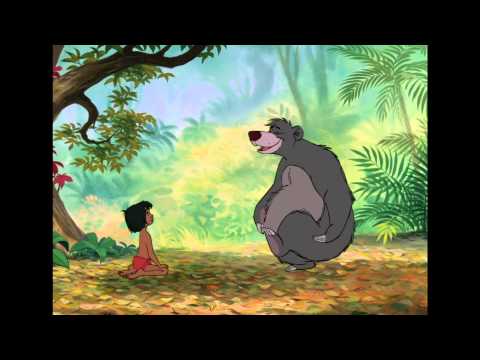
"The Bare Necessities" (Baloo, with Mowgli)
- The Scene:
- Baloo meets Mowgli and offers an alternative curriculum: relax, snack, scratch your back on a tree. The jungle becomes a sunny promenade, almost a dance floor. The threat of Shere Khan is pushed to the edge of the frame, on purpose.
- Lyrical Meaning:
- It’s a philosophy pitch disguised as friendly riffing. The lyric sells a life without ambition, without fear, without tomorrow. The trick is that it sounds like freedom while also keeping Mowgli exactly where the jungle wants him: present-tense, unplanned, easy to lose.
"I Wan’na Be Like You (The Monkey Song)" (King Louie)
- The Scene:
- Ruins, shadows, and a showman’s entrance. King Louie turns a kidnapping into an audition. The lighting feels like nightclub jungle: torch-glow, stone, and swinging bodies everywhere.
- Lyrical Meaning:
- Louie’s lyric is ambition with a grin: teach me fire, make me human, upgrade my status. It’s comedy, but it’s also the film’s sharpest take on envy. Everyone wants what they are not. Mowgli is the only one who can’t stop being what he is.
"Trust in Me (The Python’s Song)" (Kaa)
- The Scene:
- A tree becomes a trap. Kaa’s voice slides in soft circles, and the world narrows to eyes and breath. The motion is slow, hypnotic, almost tender, which is exactly why it’s alarming.
- Lyrical Meaning:
- The lyric is persuasion as predation. The words promise safety while the scene demonstrates the opposite. It’s one of Disney’s cleanest examples of a villain using intimacy as a weapon: the comfort is the hook, the hook is the point.
"That’s What Friends Are For (The Vulture Song)" (The Vultures)
- The Scene:
- Wasteland. Flat light. A teenage boy tries loneliness on for size. Then a quartet shows up and offers companionship with tight harmonies and suspicious enthusiasm.
- Lyrical Meaning:
- The lyric stages friendship as a transaction. It’s playful, but it keeps circling the idea of what vultures do for a living. The song reframes danger as community, which is exactly the kind of bargain Mowgli keeps being offered.
"My Own Home (Jungle Book Theme)" (The Girl)
- The Scene:
- Water at the river. Human life at a distance. One girl sings as if she’s alone, and Mowgli hears a future he didn’t know had a melody. The palette softens. The jungle finally loses the argument.
- Lyrical Meaning:
- These lyrics don’t debate. They simply state. That plainness is the power. After an entire film of animals trying to recruit Mowgli into their worldview, a human voice suggests home as something quiet and inevitable.
"The Bare Necessities (Reprise)" (Baloo & Bagheera)
- The Scene:
- After the chaos, the film exhales. Familiar words return like a final shrug, shared between characters who disagree on almost everything except affection for the kid they just lost.
- Lyrical Meaning:
- The reprise turns a personal motto into a goodbye. In reprise form, “necessities” reads less like a lifestyle brand and more like a coping skill. The lyric’s optimism survives, but it now carries a bruise.
Live updates (2025/2026)
On the “where can I watch it?” front, Disney still positions the 1967 film as a core library title and streams it on Disney+. That matters because the songs remain culturally active: kids meet them through the film first, then find them again through covers and clips.
On the “is it touring?” front, the more current live-performance footprint is educational licensing. Disney’s “The Jungle Book KIDS” continues to be licensed for youth and school productions through MTI and Disney Theatrical Licensing, keeping “Bare Necessities” and “I Wan’na Be Like You” in circulation as stage material rather than nostalgia content. If you’re tracking the songs as living repertoire, that youth pipeline is the real heartbeat right now.
On the “album” front, the widely available modern digital versions typically reflect later reissues that include more of George Bruns’ score and bonus material beyond the core six songs. If you want the cleanest “songs only” listen, you may prefer editions that reduce narration and dialogue. If you want the film’s musical architecture, the expanded reissue approach makes the motifs easier to hear.
Notes & trivia
- Only one song by the original songwriter Terry Gilkyson survived the rewrite: “The Bare Necessities.”
- The film’s song list is small by design: six originals in the film’s core identity, then expanded in later soundtrack editions.
- “We’re Your Friends” was once imagined as a more contemporary rock idea for the vulture quartet, with Beatles-inspired styling, then changed to barbershop.
- “Trust in Me” is rooted in an unused Sherman Brothers idea written for “Mary Poppins,” repurposed into Kaa’s lullaby trap.
- Van Dyke Parks arranged the film version of “The Bare Necessities,” a deep-cut credit that explains some of its sly musical polish.
- Child actress Darlene Carr was noticed singing at the studio and ended up tied to “My Own Home,” a rare “right place, right voice” origin story.
- The soundtrack’s production history includes three major versions: a “storyteller” narration-heavy release, a more adult-leaning release, and later reissues adding score and bonuses.
Reception
Critics have tended to agree on one point across decades: the songs are the film’s social glue. Even when reviewers side-eye the episodic plotting, the music gives each episode a persuasive engine. Older reviews praised the “clutch of tunes” as part of the film’s relaxed intelligence; later takes highlight how a single number can define a character’s entire worldview.
“His jazzy rendition of ‘The Bare Necessities’… ranks among the funniest sequences in Disney animation.”
“Phil Harris’ vocals… are soothing, and Mowgli learns an… valuable lesson along the way.”
“Baloo’s laid-back mantra… helped grab… its only Academy Award nomination.”
Quick facts
- Title: The Jungle Book
- Year: 1967
- Type: Animated film soundtrack album (multiple release configurations)
- Songwriters: Sherman Brothers; Terry Gilkyson
- Score composer: George Bruns
- Producer (soundtrack album): Larry Blakely
- Recording window (album metadata): February 1964 to June 1967
- Original label: Disneyland (Walt Disney)
- Selected notable placements: “The Bare Necessities” (Baloo’s philosophy pitch), “Trust in Me” (Kaa’s hypnosis), “I Wan’na Be Like You” (Louie’s fire bargain), “That’s What Friends Are For” (vultures’ recruitment), “My Own Home” (human village pull)
- Where listeners find it now: major digital services (expanded editions often include more score cues)
Frequently asked questions
- Who wrote the lyrics for “The Jungle Book” (1967)?
- Most of the film’s signature songs were written by the Sherman Brothers, with “The Bare Necessities” written by Terry Gilkyson.
- How many original songs are in the film’s core score?
- The film is identified with six original songs: five by the Sherman Brothers and one by Gilkyson, with later album editions expanding the listening experience with score cues and bonus material.
- Why does “Trust in Me” sound sweet when the scene is dangerous?
- That’s the point. The lyric offers comfort as misdirection, turning a lullaby into a hunting strategy. It’s one of the film’s cleanest examples of menace delivered in soft consonants.
- Was “That’s What Friends Are For” always barbershop?
- No. During development it was conceived in a more contemporary rock direction for the vulture quartet, then reshaped into barbershop to avoid sounding era-locked.
- Is there a stage version people can perform?
- Yes. “The Jungle Book KIDS” is licensed for youth productions through MTI and Disney Theatrical Licensing, keeping several songs active in live settings.
- Where can I watch the 1967 film today?
- Disney lists it as streaming on Disney+ in many regions, with availability varying by country.
Key contributors
| Name | Role | Contribution |
|---|---|---|
| Richard M. Sherman & Robert B. Sherman | Songwriters | Wrote five core songs; shaped character through genre-coded lyric voices. |
| Terry Gilkyson | Songwriter | Wrote “The Bare Necessities,” the key song retained from an earlier approach. |
| George Bruns | Composer | Composed the score; later editions foreground motifs and action material. |
| Larry Blakely | Soundtrack producer | Credited producer on key soundtrack releases. |
| Van Dyke Parks | Arranger | Arranged the film version of “The Bare Necessities.” |
| Wolfgang Reitherman | Director | Directed the film; performance-forward approach supports the conversational lyric style. |
Sources: Disney Movies (official), Disney+, Wikipedia (film and soundtrack entries), Los Angeles Times, TIME, The A.V. Club, IMDb (soundtrack page), MTI Shows, Disney Theatrical Licensing, Apple Music.