
Groundhog Day Lyrics: Song List
- Act 1
- There Will Be Sun
- Small Town, U.S.A. (Day 1)
- Punxsutawney Phil
- February 2nd / There Will Be Sun
- Small Town, U.S.A. (Day 2)
- Punxsutawney Phil
- Small Town, U.S.A. (Day 3)
- Stuck
- Nobody Cares
- Philandering
- One Day
- Act 2
- Playing Nancy
- Hope
- Everything About You
- If I Had My Time Again
- Everything About You (Reprise)
- Philosopher
- Night Will Come
- Philanthropy
- Punxsutawney Rock
- Seeing You
- Dawn
About the "Groundhog Day" Stage Show
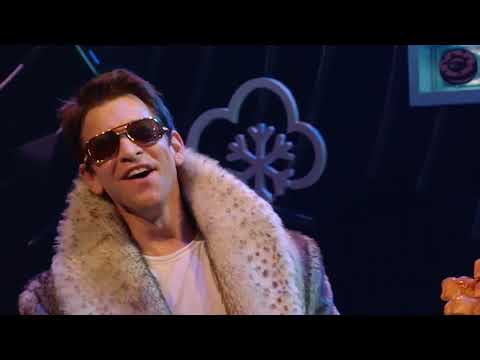
Groundhog Day is a musical comedy with music and lyrics by Tim Minchin, and a book by Danny Rubin. Based on the 1993 film of the same name written by Rubin and Harold Ramis, the musical made its world premiere try-out at The Old Vic in London in summer 2016 and opened at the August Wilson Theatre on Broadway on 17 April 2017. The plot centres around Phil Connors, an arrogant Pittsburgh TV weatherman who, during an assignment covering the annual Groundhog Day event in Punxsutawney, Pennsylvania, finds himself in a time loop, repeating the same day again and again.
Release date of the musical: 2017
"Groundhog Day" – The Musical Guide & Song Meanings
Review: what the lyrics are really doing
How do you write fresh lyrics for a story that repeats itself? Groundhog Day solves it by making repetition the subject, the structure, and the joke. Tim Minchin’s writing keeps asking the same emotional question from different angles: if tomorrow never arrives, what’s left of ambition, romance, shame, or even basic decency?
The show’s lyric engine is contrast. Punxsutawney speaks in plain, folksy slogans, while Phil Connors begins in dense, fast, self-protective language. That mismatch is plot. His lines rarely rest; he treats conversation like a competitive sport. Then the loop traps him, and the text starts stripping him down. By Act II, the best lines are the ones that stop trying to win. The musical’s big emotional turn is not a confession of love; it is an admission of not knowing.
Style matters here because Minchin uses genre as character psychology. When Phil is in control, the writing gets clever, busy, and brittle. When he loses control, the score leans into synthetic, circular patterns that feel like a bad waiting room you cannot leave. Later, as he starts acting with care, the language softens and the music lands closer to rootsy Americana. The plot stays on February 2. The lyrics do not.
How it was made
This stage version comes from a tight creative handshake: Danny Rubin adapting his own screenplay into a book musical, with Minchin writing music and lyrics, and Matthew Warchus directing. The key craft problem was always the same: how to stage “again” without boring an audience. The solution is musical architecture. Motifs return, harmonic cycles keep folding back on themselves, and the lyric perspective shifts even when the action is technically identical. The writing treats the loop like a microscope, not a gimmick.
Minchin later explained the score’s internal logic in unusually technical terms, pointing to circular harmonic motion and recurring thematic material that links the show’s opening and its final resolution. If you want a creator’s-eye view of the lyrics, it is one of the rare cases where the composer lays out the intent almost like a set of engineer’s notes, including why certain songs change genre as Phil changes emotional temperature.
One practical “how it was made” detail became part of the show’s history: the 2023 Old Vic return streamlined elements of the design and choreography compared with the earlier staging, a reminder that this piece has always been a collaboration between lyric craft and stage mechanics. When the production scales, the writing has to keep carrying the loop.
Key tracks and scenes
"There Will Be Sun" (Company)
- The Scene:
- Pre-dawn. A town preparing itself like it has practiced the morning a thousand times. Warm lights on miniature Americana, a calm that feels earned, not naive.
- Lyrical Meaning:
- It sounds simple on purpose. The lyric is a thesis disguised as a greeting card: you cannot “will” life into cooperating, but you can wait, work, and keep going. The irony is that Phil hears it before he is capable of understanding it.
"Stuck" (Phil and the Healers)
- The Scene:
- A carousel of quacks, therapists, and pseudo-fixes. The rhythm feels mechanized, like being held on the same bar of music while the room keeps changing.
- Lyrical Meaning:
- The joke is the horror. Phil tries to solve the loop as a technical problem, so the lyric floods him with false certainty and packaged wisdom. The number’s true punchline is that explanation is not salvation.
"One Day" (Rita)
- The Scene:
- Rita writes herself a life on the road out of town. Softer light, a private corner of the story where Phil is not the only person with an inner life.
- Lyrical Meaning:
- It is hope with a bruise under it. The lyric flirts with fairy-tale optimism, then admits a more adult logic: wanting better does not guarantee you will chase it in the right direction.
"Hope" (Phil and Company)
- The Scene:
- Top of Act II. Phil hits the wall, then kicks it, then laughs at it. Teen-angst rock energy, stage pictures that lean into danger and impulse.
- Lyrical Meaning:
- The word “hope” becomes a weapon he turns on himself. The lyric mocks uplift while secretly measuring how badly he still wants it. This is not inspiration; it is a tantrum with a pulse.
"Everything About You" (Phil)
- The Scene:
- After the self-destruction. Snow. Stillness. A man finally too tired to perform. The stage feels wider because his ego stops filling it.
- Lyrical Meaning:
- This is where the lyric stops being an act. Phil says the truth without bargaining for a reward. The language is plain, and that plainness is the point: sincerity is the new virtuosity.
"If I Had My Time Again" (Rita, Phil and Company)
- The Scene:
- Rita pulls him up, not with therapy-speak, but with an easy pop lift that invites the room back into color. The ensemble enters like a community deciding to try again.
- Lyrical Meaning:
- The lyric is a philosophical trap in a cheerful package: what would you redo if you could? For Phil, the song becomes an accusation and an invitation at the same time. He cannot hide behind irony here because the premise is literally his life.
"Night Will Come" (Ned)
- The Scene:
- After Phil learns he cannot save everyone. Ned, once comic annoyance, steps forward with the calm of someone who has already paid for his wisdom.
- Lyrical Meaning:
- The lyric insists on mortality without melodrama. It is the show’s grown-up voice: if you want to love life, you have to accept its ending. That makes Phil’s future kindness feel less like a tactic and more like a choice.
"Seeing You" (Phil, Rita and Company)
- The Scene:
- End of Act II. A release valve. The loop does not just break; it loosens. The staging makes room for silence, and the song lets the audience sit inside it.
- Lyrical Meaning:
- This is the lyrical payoff: the shift from “I know everything” to “I know nothing.” It reframes the whole story as an education in perception. Change the way you see the day, and you change the day.
Live updates (2025/2026)
Information current as of January 27, 2026.
Commercially, the most recent major professional run was the Australian production in Melbourne, which has officially ended its season at the Princess Theatre. In London, the Old Vic revival played in 2023 and became a headline example of how this title can be re-mounted with a streamlined design while keeping the same musical spine.
The big practical shift for 2025 and 2026 is licensing. Music Theatre International is accepting license requests for Groundhog Day, with territory restrictions noted by MTI. In real terms, that means the show’s “current life” is increasingly regional and community-led, with new casts discovering how hard these lyrics are to land cleanly and how satisfying they are when they do.
If you are tracking where it is being performed right now, your best source is MTI plus local venue calendars. One visible example: YES Theatre (Sudbury, Ontario) listed performances in February to March 2025, signaling the first wave of post-licensing momentum.
Listening tip for first-timers: start with “There Will Be Sun,” then jump to “Stuck,” then “Everything About You” and “Seeing You.” It is the fastest way to hear the show’s full emotional arc without getting lost in plot mechanics.
Notes and trivia
- The 2017 Original Broadway Cast Recording had a digital release in April 2017, with a later physical release date listed by the label.
- Tim Minchin has publicly described deliberate “circularity” in the score and how recurring harmonic ideas mirror the loop.
- “Stuck” is designed to feel musically trapped, matching the scene’s parade of useless fixes.
- The Old Vic’s 2023 return credited Lizzi Gee for choreography and included a streamlined design approach compared with earlier staging.
- Bill Murray attended the Broadway musical on consecutive nights in 2017, echoing the story’s premise offstage.
- Andy Karl performed at Broadway opening with a highly publicized knee injury, a real-world endurance story that oddly fits Phil’s repeated-day stamina.
- For legal lyrics and notation, the officially published songbook (Hal Leonard) is the cleanest route for performers and lyric-focused listeners.
Reception and critic quotes
Critically, Groundhog Day has tended to earn praise for invention and craft, with debates focusing on whether its emotional temperature matches its technical intelligence. That split is part of the show’s identity: it is about a man learning empathy inside a structure that can feel like a clock.
“Repetition is an art of infinite variety.”
“Technically, the production is a mini-wonder.”
“Kinetic and sometimes witty but ultimately wearying antics.”
Quick facts
- Title: Groundhog Day
- Year: 2017 (Original Broadway Cast Recording release year)
- Type: Stage musical (book musical)
- Book: Danny Rubin
- Music and Lyrics: Tim Minchin
- Director (key productions): Matthew Warchus
- Orchestrations / Musical Supervision (credited): Christopher Nightingale
- Original Broadway Cast Recording label context: Broadway Records / Masterworks, billed as a Center Stage Records release
- Selected notable placements: “Seeing You” at the end of Act II; “Stuck” during Phil’s early search for answers; “Night Will Come” after Phil confronts limits to what he can fix
- Availability: Widely available on major streaming platforms; physical editions released after the digital launch
- Licensing: Available via MTI (territory restrictions apply)
Frequently asked questions
- Can you post the full 2017 Groundhog Day lyrics?
- No. Full lyrics are copyrighted text. For legal, complete lyrics and notation, use the officially published songbook and licensed materials.
- Is there an official cast recording?
- Yes. The Original Broadway Cast Recording was released in 2017, with label-listed digital and physical release dates.
- Where does “Seeing You” happen in the show?
- It is positioned at the end of Act II, after Phil’s perspective shifts and the town becomes visible to him in a new way.
- Why do the lyrics feel like they change genre so often?
- Because the score treats musical style as character psychology. The loop stays the same; Phil’s internal state does not.
- Is Groundhog Day touring in 2025 or 2026?
- There is no single official global tour schedule. The show’s most active “current” pathway is licensing, which produces many regional runs that appear on local calendars.
- Did the production change in later revivals?
- Yes. The Old Vic’s 2023 return was reported to streamline aspects of the design, and it credited a different choreographer than the earlier staging.
Key contributors
| Name | Role | Contribution |
|---|---|---|
| Tim Minchin | Composer and lyricist | Wrote music and lyrics; articulated the score’s recurring motifs and genre shifts. |
| Danny Rubin | Book writer | Adapted his film screenplay into a stage book with musical structure. |
| Matthew Warchus | Director | Staged the loop with theatrical mechanics and pacing that supports repetition. |
| Christopher Nightingale | Orchestrations / Musical supervision | Helped build the score’s sonic identity across styles and recurring themes. |
| Rob Howell | Set and costume design | Designed the visual language of Punxsutawney, balancing whimsy and precision. |
| Lizzi Gee | Choreography (Old Vic 2023) | Credited choreographer for the 2023 revival’s movement approach. |
| Paul Kieve | Illusions | Created theatrical “time-loop” tricks that support the story’s repeated beats. |
| Andy Karl | Original leading performer (Phil Connors) | Central performance in London, Broadway, and later major productions; anchored the show’s comedic and emotional turn. |
Sources: TimMinchin.com, Music Theatre International (MTI), Playbill, The Old Vic, The Guardian, Entertainment Weekly, Vulture, The Hollywood Reporter, Broadway Records, Vanity Fair, Vogue, YES Theatre.