
Flower Drum Song Lyrics: Song List
About the "Flower Drum Song" Stage Show
Initially production was opened in 1958 under the leadership of creative duo made of Rodgers and Hammerstein in St. James Theatre. Advance purchases of tickets were normal and regular sales were also strong, despite the unrest of the novel's author C. Y. Lee. Receiving 6 Tony nominations, among which there was only one award, musical confidently lasted for 600 exhibitions and it was more than another other show, comprised of Asian actors. Closing took place in May 1960, after lowering the threshold of ticket sales to the level of 70%. This histrionics brought a profit of 35% of ROI on initial investment. This show served for Rodgers as his salvation from depression.
After that, the opening in London wasn’t waiting too long & in 1960 it has already begun, giving 464 hits. There were fewer Asian actors than on Broadway and there were: Y. S. Tung, K. Scott, G. Minami, Y. Saki, T. Herbert, I. Shepley. The director was Jerome Whyte.
The national tour followed in 1960, starting with Detroit, then the prosperous city, shortly before the death of Hammerstein in 1960. Marketing support in San Francisco was in streets decoration with Chinese lanterns, and Asian girls were hired to play on musical instruments. Closing of the tour was in 1961.
Screen version of the film took place in 1961 too and received a terrible financial failure – the only one among adaptations of this creative duo that failed at the box office. Following resurrection of the same version performed in 1961 in San Diego, 1961 at St. Louis, 1963 and 1964 in San Francisco, in 1965 at St. Louis again. It's hard to count numerous amateur performances, which began because of the popularity of this musical. It is only known that they began in the 1960s. In the second half of the 60s, musical popularity has declined because this musical was weaker than the rest of the work Rodgers & Hammerstein, and racial tolerance in the United States increased in general.
Release date of the musical: 1958
“Flower Drum Song” – The Musical Guide & Song Meanings
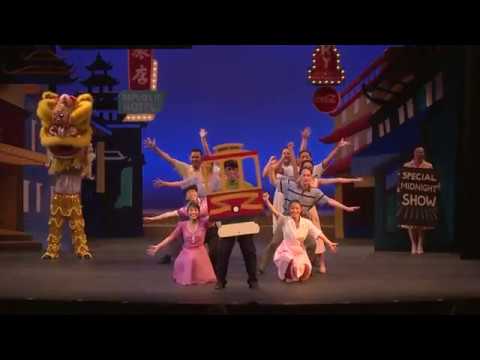
Review: a Rodgers & Hammerstein score that smiles, while the book flinches
“Flower Drum Song” sells brightness. That is the trick, and also the tension. The music moves with Broadway confidence, and the lyrics often sound as if they are trying to charm the audience into trust before the story asks harder questions. Assimilation is never abstract here. It lives in clothing, names, jobs, and who gets to be seen as “modern.”
Hammerstein’s writing keeps returning to translation. Not just language, but social translation. Mei Li arrives with a private inner life that the world keeps misreading. Linda Low performs an American self so fluently it becomes a mask she can’t take off without losing power. The show’s most durable songs land because they are character arguments, not just set pieces. “Love, Look Away” is not a torch song for atmosphere. It is a boundary drawn in pencil, then erased, then redrawn. “I Enjoy Being a Girl” is funny, and still revealing, because it makes gender feel like a role you can learn to play, then start believing.
Rodgers, meanwhile, builds a score with a recurring rhythmic fingerprint. “A Hundred Million Miracles” plants a drum idea that keeps returning like a pulse. It is a musical reminder that the characters can change outfits and addresses, but the old beat stays under their feet. That motif makes the soundtrack album feel unusually coherent for a mid-century comedy. You can hear the whole town in it, not just the leads.
How it was made
The musical is based on C.Y. Lee’s 1957 novel, set in San Francisco’s Chinatown. It opened on Broadway at the St. James Theatre on December 1, 1958, and ran 600 performances through May 7, 1960. It became a landmark for representation in casting, even as later decades questioned the story’s stereotypes and its tourist-postcard gaze.
Behind the scenes, the writing process reads like a late-career sprint. During rehearsals, Hammerstein was still recovering from surgery, and the creative team kept revising. Songs shifted or disappeared. “She Is Beautiful” was reshaped into “You Are Beautiful,” and “Don’t Marry Me” was reportedly written in a few hours to solve a story problem on the spot. That kind of speed matters when you listen to the album. The cast recording catches the show as a living draft, polished enough to sell, but still carrying the nervous energy of a piece trying to find its final shape.
There is also a technical lyric footnote that turns out to be emotional. Hammerstein wrote “I Am Going to Like It Here” using a pantoum structure, where lines repeat and re-enter. On stage, it gives Mei Li a mind that circles. She is not just describing a new place. She is teaching herself how to stay calm inside it.
Key tracks & scenes
“A Hundred Million Miracles” (Mei Li, Dr. Li, Company)
- The Scene:
- The first sound is ritual and motion. A drum pattern under low light, then the stage opens into travel, uprooting, and arrival. In the revised Hwang framing, the number can feel like an origin myth, with the drum as luggage and inheritance.
- Lyrical Meaning:
- The lyric treats survival as a chain of unlikely outcomes. “Miracles” is not spiritual comfort. It is math. If enough improbable things happened to get you here, you start believing the next one might happen too.
“I Am Going to Like It Here” (Mei Li)
- The Scene:
- Mei Li stands at the edge of a new city. Lighting often isolates her, because the crowd is the point. America is loud. Her promise is whispered anyway.
- Lyrical Meaning:
- This is self-instruction. The repeating-line structure makes optimism sound practiced, not naive. Mei Li is translating fear into a sentence she can live with.
“I Enjoy Being a Girl” (Linda Low)
- The Scene:
- In the 1958 version, Linda is a nightclub performer, and this lands as a bright, flirtatious showpiece. In later stagings, directors often push it toward a knowing performance, with mirror lights, costume changes, and the sense that Linda is steering the gaze.
- Lyrical Meaning:
- On the page, it can read dated. In context, it becomes a portrait of strategy. Linda understands what gets rewarded. The lyric is her user manual for attention.
“Don’t Marry Me” (Mei Li, Sammy Fong)
- The Scene:
- A comedic negotiation with real stakes. The staging is usually tight and practical, with the blocking doing what the characters can’t: tell the truth cleanly.
- Lyrical Meaning:
- The song is about consent disguised as banter. It lets Mei Li be firm without being punished for it, and it forces Sammy to say the quiet part out loud.
“Grant Avenue” (Linda, Madame Liang, Ensemble)
- The Scene:
- Neon, foot traffic, and an advertised version of Chinatown. The number plays best when it feels like choreography built from salesmanship, with smiles that snap into place like signage.
- Lyrical Meaning:
- The lyric sells spectacle, and that is the critique. It describes a neighborhood as a product, which turns identity into something you can rent by the hour. Later revisions lean into that irony, making the tourist-trap energy the point.
“Love, Look Away” (Helen Chao)
- The Scene:
- A still pocket inside a busy show. Helen is often staged downstage with the world behind her continuing, dimly, like life refusing to pause for heartbreak.
- Lyrical Meaning:
- It is the score’s most honest refusal. Helen does not argue for love. She argues against it, because she knows what it costs her. The lyric’s restraint is the wound.
“Sunday” (Linda, Sammy, Ensemble)
- The Scene:
- A nightclub shimmer that tries to pass as romance. Lighting warms, the groove relaxes, and the couple’s chemistry is tested in public.
- Lyrical Meaning:
- “Sunday” is time as fantasy. It promises a day off from consequences. The lyric is sweet, but it is also avoidance, a deal to postpone decisions one more week.
“Wedding Parade” (Mei Li, Company)
- The Scene:
- Procession, color, ceremonial movement, and the complicated feeling of an ending that wants to be joyous while the story’s questions are still alive.
- Lyrical Meaning:
- The lyric is tradition in motion. It does not solve assimilation. It stages it, insisting that belonging can be built, even if it looks improvised.
Live updates (2025/2026)
The big current headline is not a tour. It is a revision. David Henry Hwang is revising “Flower Drum Song” again for East West Players in Los Angeles, as part of the company’s anniversary programming, with Lily Tung Crystal directing. Playbill’s 2024 announcement cited a late-spring 2026 run window, and East West Players later published updated dates and full creative leadership details on its production page, including music direction and choreography.
For listeners, the album story has also kept moving. Craft Recordings and Concord Theatricals reissued the 1958 Original Broadway Cast Recording as a 2-LP set in 2020, alongside a high-resolution digital release, which matters if you care about how the percussion and orchestration register in modern playback.
Notes & trivia
- Original Broadway run: December 1, 1958 to May 7, 1960 at the St. James Theatre, 600 performances.
- The Concord licensing breakdown places “You Are Beautiful” and “A Hundred Million Miracles” early in Act I, with “Love, Look Away” later in Act I and “Sunday” in Act II.
- Hammerstein wrote “I Am Going to Like It Here” using a pantoum form, built around repeating lines that loop forward.
- “A Hundred Million Miracles” carries a drum idea that functions as a recurring musical signature across the score.
- The 1958 cast album was recorded at Columbia’s 30th Street Studio about a week after opening night, under musical direction of Salvatore Dell’Isola.
- Salvatore Dell’Isola won the Tony Award for Best Conductor and Musical Director for “Flower Drum Song.”
- The 2002 Broadway revival’s cast album earned a Grammy nomination and featured orchestrations by Don Sebesky, adapted by musical director David Chase.
Reception: then vs. now
In 1958, reviewers could admire the professionalism and still complain that the piece felt safe. That mixed reaction has become part of the musical’s identity. The score stayed popular. The book became the battleground. By the 2000s, criticism often split into two arguments happening at once: how to honor the chance the show created for Asian and Asian American performers, and how to confront the show’s simplifications.
Now the conversation is more openly about authorship and stewardship. The “right” version depends on what a production wants to interrogate. The original can read like a Broadway Chinatown fantasy. Hwang’s approach reframes the story around art-making and cultural self-definition, then invites the audience to watch the mechanisms of stereotype as something characters recognize, not something they sleepwalk through.
“Flower Drum Song is passably pleasant in its way, but its way is strictly routine.”
“Sure, the 1958 original had problems. Its once-landmark status as a treatment of Asian American issues had long become an embarrassment of subconscious racial stereotypes…”
“The original has its share of flaws and stereotypes, but it nonetheless holds a special place in my heart.”
Quick facts
- Title: Flower Drum Song
- Year: 1958 (Broadway premiere)
- Type: Musical comedy with romance and intergenerational conflict
- Music: Richard Rodgers
- Lyrics: Oscar Hammerstein II
- Original book: Oscar Hammerstein II and Joseph Fields
- Revised book: David Henry Hwang (notably 2002, with further revisions announced for 2026)
- Setting: San Francisco’s Chinatown (mid-century, depending on version)
- Broadway run: 600 performances at the St. James Theatre (Dec 1958 to May 1960)
- Notable song placements: “Love, Look Away” (Act I); “Sunday” (Act II); “Wedding Parade” (late Act II)
- 1958 cast recording: Recorded at Columbia’s 30th Street Studio; musical direction by Salvatore Dell’Isola
- 2002 cast recording: Grammy-nominated; orchestrations by Don Sebesky, adapted by David Chase
- Catalog status: 1958 album reissued on vinyl and high-resolution digital in 2020
- Licensing: Concord Theatricals (multiple versions available)
Frequently asked questions
- What is “Flower Drum Song” really about, beyond the love story?
- It is about identity under pressure. The characters keep negotiating how Chinese, how American, and how performative they need to be in order to survive, get loved, and get paid.
- Is “I Enjoy Being a Girl” meant to be taken straight?
- On the page, it reads like a 1950s gender fantasy. On stage, it depends on the performer and the production. It can be played as sincere comedy, or as Linda using glamour as leverage.
- Where does “Love, Look Away” sit in the story?
- It arrives in Act I as Helen’s private reckoning, a pause that lets the show admit real pain inside a glossy social world.
- What changed in the David Henry Hwang version?
- The setting and many names remain, but the framing shifts toward Chinese opera, nightclub culture, and cultural storytelling itself. Songs are repositioned, and the show’s point of view becomes more self-aware about stereotype and display.
- Is there a movie adaptation?
- Yes. A 1961 film adaptation helped keep the score visible to mainstream audiences, even as conversations about representation evolved.
- What is the most important musical motif in the score?
- “A Hundred Million Miracles” introduces a drum pattern that functions as a recurring signature across the score, giving the album a unifying pulse.
Key contributors
| Name | Role | Contribution |
|---|---|---|
| Richard Rodgers | Composer | Wrote a classic Broadway score with a recurring rhythmic identity tied to “A Hundred Million Miracles.” |
| Oscar Hammerstein II | Lyricist, original book | Shaped the lyric voice of Mei Li and Helen, including formal craft choices such as the pantoum structure in “I Am Going to Like It Here.” |
| Joseph Fields | Original book | Co-wrote the original Broadway libretto and its farce-driven romantic mechanics. |
| C.Y. Lee | Novelist | Wrote the 1957 source novel that inspired the musical’s Chinatown family world. |
| Salvatore Dell’Isola | Musical director | Led the original production musically and directed the 1958 cast recording sessions. |
| David Henry Hwang | Revised book | Reimagined the show for 2002 Broadway and is revising again for East West Players’ 2026 staging. |
| Don Sebesky | Orchestrator (2002) | Provided fresh orchestrations for the revival’s Grammy-nominated cast album. |
| David Chase | Musical direction (2002) | Adapted revival orchestrations and guided the updated musical sound world. |
| Lily Tung Crystal | Director (2026) | Directs East West Players’ next iteration, positioned as a community-facing reclamation project. |
| Marc Macalintal | Music director (2026) | Leads musical direction for the East West Players staging. |
| Lainie Sakakura | Choreographer (2026) | Shapes movement language for the 2026 staging, bridging classic musical form with contemporary sensibilities. |
Sources: IBDB, Concord Theatricals, Rodgers & Hammerstein Official Site, Playbill, East West Players, TIME, SFGate, BroadwayWorld, The Second Disc.