Caroline, or Change Lyrics – All Songs from the Musical
Caroline, or Change Lyrics: Song List
- Disc 1:
- 16 Feet Beneath the Sea
- The Radio
- Laundry Quintet
- Noah Down The Stairs
- The Cigarette
- Laundry Finish
- The Dryer
- I Got Four Kids
- Caroline, There's Extra Food
- There Is No God, Noah
- Rose Stopnick Can Cook
- Long Distance
- Dotty and Caroline
- Moon Change
- Moon Trio
- The Bus
- That Can't Be
- Noah And Rose
- Inside/Outside
- JFK
- Duets: No One Waitin'
- Duets: 'Night Mamma
- Duets: Gonna Pass Me A Law
- Duets: Noah Go To Sleep
- Noah Has A Problem
- Stuart And Noah
- Quarter In The Bleach Cup
- Caroline Take My Money Home
- Roosevelt Petrucius Coleslaw
- Disc 2:
- Santa Comin' Caroline
- Little Reward
- 1943
- Mr. Gellman's Shirt
- Ooh Child
- Rose Recovers
- I Saw Three Ships
- The Chanukah Party
- Dotty And Emmie
- I Don't Want My Child To Hear That
- Mr. Stopnick And Emmie
- Kitchen Fight
- A Twenty Dollar Bill And Why
- I Hate the Bus
- Moon, Emmie And Stuart Trio
- The Twenty Dollar Bill
- Caroline And Noah Fight
- Aftermath
- Sunday Morning
- Lot's Wife
- Salty Teardrops
- Why Does Our House Have A Basement?
- Underwater
- Epilogue
About the "Caroline, or Change" Stage Show
For the first time the opening of the musical was performed in a workshop in 2003 in New York. Its duration was only equal to one season, until 2004, after which it has moved to Broadway and was completed in May of 2004. The popularity of this musical under the direction of George C. Wolfe was below average – only 136 performances and 22 previews. The actors were as follows: H. Chad, C. Wilson, T. Pinkins, V. Cox & A. N. Rose. Hope Clarke was responsible for the choreography, R. Hernandez did the scenic design, P. Tazewell was a costume designer, and P. Eisenhauer was a lighter. Despite the very short duration, the musical was nominated for Tony 6 times, and one of the nominations were for the Best Musical. It didn’t win, unfortunately.London saw the show in 2006, with the same director, continued until early 2007. However, its production has been done elsewhere, not in the West End, but that did not stop the musical was rewarded with Olivier (the British equivalent of Tony). Actors in London were such: P. Millward, C. Rowe, T. Pinkins, G. Bernstein, P. Bennett–Warner, J. Weldon, H. McRae & A. Francolini.
In California musical was in 2004, first in L.A., and then in San Francisco. Chicago took the show in 2008, where it earned 4 Jeff Awards, and in 2011 it staged in CT. In 2008, the musical has been brought to Maryland, in 2009 in Minnesota, in 2010 in New York. In Ohio it was in 2011 and again in the state of N.Y. in 2012, in the city of Syracuse.
International production was opened in 2012 in Toronto.
Release date: 2004
"Caroline, or Change" – The Musical Guide & Song Meanings
Review: the lyrics that refuse comfort
What if the most honest character in a musical is a machine. “Caroline, or Change” makes that argument with a straight face. Tony Kushner’s lyrics behave like overheard thought. They are blunt, then suddenly lyrical, then blunt again. He keeps cutting away the pretty option. Caroline wants to stay still, because staying still is how you survive. The words do not let her.
The score is a street map of American sound. Jeanine Tesori jumps from Motown shimmer to synagogue memory to something like chamber opera. It is not a sampler platter. It is pressure. Each style is a social class in motion. Each motif is a different person knocking at the basement door. The lyrics ride those shifts instead of smoothing them out, so scenes can pivot from household comedy to political dread without warning.
The show’s key lyrical obsession is money. Not money as metaphor. Money as lint, as shame, as a child’s test, as a parent’s trap. “Change” is the pocket clink you can hear from the audience. The language keeps returning to what is owed, what is stolen, what is offered with a smile that still hurts.
How it was made: Kushner’s memory play, Tesori’s genre engine
Kushner has described the piece as rooted in childhood memories from Lake Charles, Louisiana, and in one incident that stayed with him for years. That autobiographical charge matters because the writing never treats Caroline as an emblem. She is a person who is tired, angry, funny, and cornered. Tesori’s job is to make the corner audible. She does it by assigning Caroline company that cannot talk back in real life: the washer, the dryer, the radio, the bus, the moon.
The licensing synopsis preserves a crucial origin detail that explains the show’s unusual musical density: it was first written with an opera path in mind, and when that plan fell through, the Public Theater and George C. Wolfe helped reshape it for the stage musical ecosystem. That history shows in the through-sung architecture. Dialogue is rare. Music is the air.
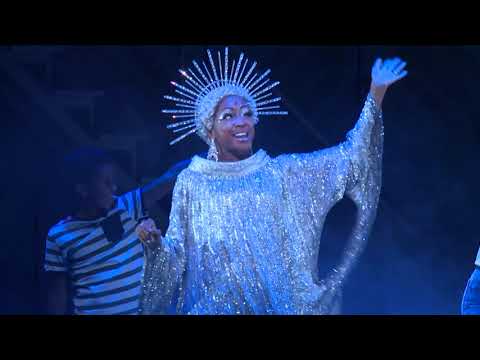
One more craft choice has become the calling card: the radio as a trio, built like a 1960s girl group. It is a canny lyric delivery system. News becomes harmony. Desire becomes commercial jingle. The country’s pain becomes a hook you cannot stop humming.
Key tracks & scenes: 8 lyrical pressure points
"16 Feet Beneath the Sea" (Caroline, Washing Machine)
- The Scene:
- 1963. Heat aboveground, damp below. Caroline works in the basement while the washer sings like a bright new conscience. Light feels fluorescent, workmanlike, unromantic.
- Lyrical Meaning:
- The lyric is Caroline’s private geography. “Underwater” is not poetic decoration. It is her status. Hidden labor. Hidden grief. Hidden rage.
"The Radio / Laundry Quintet" (Radio Trio, Caroline, Washing Machine)
- The Scene:
- The radio girls glide in like a commercial that became human. Their sound fills the basement corners Caroline cannot. The staging often treats them as both chorus and hallucination.
- Lyrical Meaning:
- Kushner uses pop structure to frame private life as public product. Caroline’s interior voice has to compete with the nation’s soundtrack. That is the point.
"The Cigarette" (Noah, Caroline)
- The Scene:
- Noah sneaks into the basement with a match. Small light. A ritual. A child trying to buy closeness with a grown-up secret.
- Lyrical Meaning:
- The lyric turns a tiny act into a contract. Affection becomes transaction. That pattern will later explode when the money gets bigger.
"The Dryer / I Got Four Kids" (Dryer, Caroline, Radio)
- The Scene:
- The dryer moans and needles. Caroline keeps folding while the sound of her own life becomes unbearable. The basement feels tighter, like the ceiling lowered.
- Lyrical Meaning:
- This is a lullaby that refuses to soothe. The lyric lists children and years and wages with the flatness of someone recounting weather. Tesori lets the harmony carry what Caroline will not say out loud.
"Moon Change / Moon Trio" (Moon, Dotty, Caroline)
- The Scene:
- At the bus stop. Night air. Streetlight. The moon arrives as a calm witness while two maids argue about school, choices, and what “better” even means.
- Lyrical Meaning:
- The lyric is about time more than politics. Change is not a slogan here. It is a threat, because it might demand courage Caroline cannot afford.
"The Bus / That Can't Be" (Bus, Company)
- The Scene:
- The bus pulls in with the news of Kennedy’s assassination. The world tilts. Lighting often snaps colder. People freeze mid-task, like the whole town got unplugged.
- Lyrical Meaning:
- The lyric captures collective disbelief as rhythm. It is community shock, sung. It also underlines the show’s grim thesis: history arrives whether you are ready or not.
"A Twenty Dollar Bill and Why / I Hate the Bus" (Mr. Stopnick, Emmie)
- The Scene:
- A holiday gathering upstairs, then back to the bus stop outside. Stopnick’s lesson speech is noisy, self-satisfied. Emmie’s number is kinetic, restless, future-facing.
- Lyrical Meaning:
- The lyric contrast is generational and racial. Stopnick moralizes from safety. Emmie dreams from constraint. Her words are an “I want” song that sounds like a plan and a dare.
"The Twenty Dollar Bill / Caroline and Noah Fight" (Caroline, Noah)
- The Scene:
- Noah runs down to the basement too late. Caroline has found the bill and claims it. The fight is intimate and ugly, like family arguments are. The space becomes a cage.
- Lyrical Meaning:
- This is the show’s moral crack in the wall. The lyric turns pocket change into racial weaponry. Both characters say unforgivable things because the system has already said them first.
"Lot's Wife / Salty Teardrops / Why Does Our House Have a Basement? / Underwater" (Caroline, Radio, Noah)
- The Scene:
- Sunday morning, then later: Caroline can’t return to work, then finally does. The radio sings heartbreak. Noah speaks from above while Caroline listens from below. The staging often emphasizes distance: floors, stairs, doorframes.
- Lyrical Meaning:
- “Lot’s Wife” is prayer as self-erasure. Caroline begs to want nothing, because wanting makes you vulnerable. The late “Underwater” material shifts the show toward uneasy acceptance, not healing. That is braver.
Notes & trivia
- The Broadway setting is explicitly Lake Charles, Louisiana, November to December 1963.
- The show’s synopsis and song list underline how often it moves between basement labor and the bus stop, making “inside/outside” a structural idea, not just a lyric.
- In study materials, the radio is described as a Motown-style girl group, a design choice that turns public life into musical commentary.
- Licensing history materials note the piece was first conceived for an opera route before the Public Theater shepherded it forward.
- The 2021 Broadway revival cast album was recorded in mid-November 2021 and released digitally in December, with a physical double-CD release following in January 2022.
- The original Broadway cast recording was issued as a two-disc set on Hollywood Records in June 2004 and preserves the show’s unusually complete musical fabric.
- MTI’s UK-facing materials have listed the title as “currently restricted,” which can affect how quickly new amateur and semi-pro productions can be scheduled.
Reception: early raves, later vindication
In 2003 and 2004, critics tended to describe the show as a rare musical with adult moral weight, even when they admitted it might never become a mass-market hit. That gap is part of its legacy: a score and lyric book admired with the same intensity that kept it niche. The later wave of major revivals reframed it as a contemporary essential, not a worthy outlier. When a show about labor still sounds current twenty years later, that is not nostalgia. That is diagnosis.
“A Jewish boy and his family's black maid are at the heart of this witty, pulsing musical.”
“Caroline is, in fact, a tragic character.”
“Caroline, or Change succeeds… by managing to be both unsentimental and immensely moving.”
Live updates 2025/2026: productions, licensing, and what’s next
In 2025, the title leaned into its new-life pattern: strong regional and community productions rather than a single commercial center. Cain Park mounted the show in Cleveland Heights in August 2025, with local coverage emphasizing the work’s scale and emotional force. In Arizona, Black Theatre Troupe scheduled a run at Tempe Center for the Arts from October 17 to November 2, 2025, keeping the piece in active conversation during an election-season year that makes its themes hard to ignore.
Looking ahead, Invictus Theatre Company in Chicago has announced “Caroline, or Change” for May 26 to July 10, 2026, with a listed press opening on June 1. That is the profile the musical thrives in: a company willing to treat through-sung storytelling like a feature, not a risk.
One practical note for 2025 and 2026 planners: MTI’s UK materials have flagged the title as “currently restricted.” That does not erase the show from stages, but it can shape availability and lead time.
Quick facts: album, credits, and where the music lives
- Title: Caroline, or Change
- Broadway year: 2004
- Type: Through-sung musical drama
- Book & lyrics: Tony Kushner
- Music: Jeanine Tesori
- Original Broadway director: George C. Wolfe
- Setting: Lake Charles, Louisiana, November to December 1963
- Signature musical devices: Singing washer, dryer, radio trio, bus, and moon
- Original Broadway cast recording: Two-disc album released June 29, 2004 (Hollywood Records)
- Broadway revival cast recording: Released December 17, 2021 (Broadway Records / Roundabout Records imprint), with physical release January 14, 2022
- Selected notable placements inside the story: Bus-stop “Moon Change” sequence; Kennedy assassination as “The Bus”; the $20 bill conflict culminating in “Caroline and Noah Fight”
- Licensing: Music Theatre International (availability can vary by territory and season)
Frequently asked questions
- Who wrote the lyrics in “Caroline, or Change”?
- Tony Kushner wrote the book and lyrics. Jeanine Tesori composed the music.
- Where does “The Bus” happen, and why does it matter?
- It lands at the bus stop at night, delivering the Kennedy assassination news into the characters’ daily routine. It turns national tragedy into private rupture.
- Why do the washer, dryer, and radio sing?
- They externalize Caroline’s inner life and the world pressing in. The lyric book treats objects as witnesses, gossips, and tormentors because Caroline has no safe listener.
- Which cast album should I start with?
- If you want the original 2004 Broadway sound world, start there. If you want the newer revival’s vocal approach and updated recording clarity, choose the 2021 Broadway revival album.
- Is the show connected to Tony Kushner’s life?
- Yes. Kushner has described it as grounded in childhood memories from Lake Charles and an incident that stayed with him for years, shaped into fiction.
- Is “Caroline, or Change” being staged in 2025 and 2026?
- Yes. Several regional productions have been scheduled and announced, including runs in 2025 and a Chicago production in 2026.
Key contributors
| Name | Role | Contribution |
|---|---|---|
| Tony Kushner | Book, lyrics | Built a lyric architecture where politics enters the home as sound, money, and speech. |
| Jeanine Tesori | Composer | Wove Motown, blues, spirituals, and Jewish musical idioms into one dramatic engine. |
| George C. Wolfe | Director (original) | Shaped the original staging language that treats the basement as both real room and psychic landscape. |
| Michael Longhurst | Director (major revival path) | Helmed the revival staging that traveled from the UK to Broadway, renewing the show’s profile. |
| Sharon D. Clarke | Lead performer (revival) | Anchored the UK and Broadway revival era in a performance that critics treated as definitive. |
| Linda Twine | Musical director (original Broadway) | Managed the show’s through-sung complexity and ensemble precision. |
| Nigel Lilley | Music supervisor (Broadway revival) | Oversaw the revival’s music system and consistency across a demanding score. |
Sources: MTI (US & MTI Europe pages), IBDB, Playbill, Roundabout Theatre Company, The Guardian, Variety, Observer, Court Theatre study guide PDF, Musical Stage Company study guide PDF, Black Theatre Troupe, Tempe Tourism, Cain Park coverage (CoolCleveland, Cleveland Scene), Invictus Theatre Company, Apple Music, Discogs, Spotify, Broadway.com.