Bajour Lyrics – All Songs from the Musical
Bajour Lyrics: Song List
- Act 1
- Move Over, New York
- Where Is The Tribe For Me?
-
The Haggle
- Love-Line
- Words, Words, Words
-
Mean
- Bajour
- Must It Be Love?
- Act 2
- Soon
- I Can
- Living Simply
-
Honest Man
- Guarantees
- Love Is A Chance
- The Sew-Up
- Finale: Move Over, America
About the "Bajour" Stage Show
The original musical was previewed in the Shubert Theatre, which is located in Boston. On Broadway, the musical was released in 1964, in the theater with the same name. After its move to the Lunt-Fontanne, the total number of plays was a little more than 230, indicating that the show is not successful at all. Lawrence Kasha previously participated as a director in other musicals, and they also did not shine with duration. Peter Gennaro is choreographer.Actors are as follows: N. Dussault, H. Bernardi, C. Rivera, G. Trikonis, H. Edelman, M. Questel, Paul Sorvino (father of Hollywood actress Mira Sorvino. However, he himself played in Hollywood films too), H. Goz, M. Bennett & L. Palmer.
The musical won a Tony Award nomination and it is no different with anything more, except of one more nomination for choreography. The soundtrack was recorded in 1964. In 2007, the musical was resurrected for a short while in order to be delivered to Broadway.
Critics gave polar assessments. Some say that the musical is disgusting and too long, on the stage almost nothing happens, except for dancing and singing. Some say that it is – skullduggery. But there are those who say that it was generally good. However, no one was very pleased with a musical visit to gypsies. Probably, it is still hard-hitting topics, especially for the stage.
Release date: 1964
"Bajour" – The Musical Guide & Song Meanings
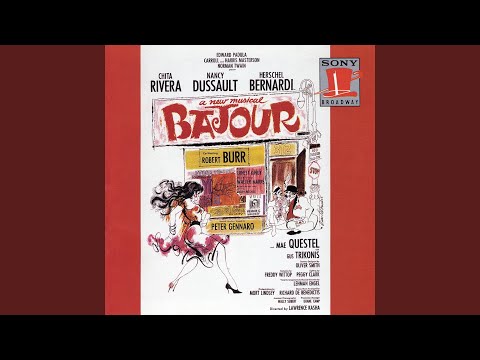
Review
What do you call a love story that begins as a confidence game? Bajour answers with a grin that never quite relaxes. Walter Marks writes lyrics that move fast, like a hustler changing the subject mid-sentence. The score keeps its footing in Broadway swing and character-comedy, but it is always orbiting the same moral problem: charm as a tool, charm as a weapon, charm as a mask.
The plot is built like a set of nested pitches. Johnny Dembo sells his tribe as “color” to New York. Anyanka sells destiny, romance, and fear to Mrs. Kirsten. Even Emily, the NYU anthropologist, sells herself a story about safe observation. The lyrics do the work that dialogue usually does. They explain the con’s mechanics while also revealing who is lonely enough to believe it.
Marks’ best lyrical idea is linguistic friction. “Gajo” and “bajour” enter the show as vocabulary lessons, but they also become a social border: insiders naming outsiders. When Emily sings “Where Is the Tribe for Me?,” it sounds like an academic joke until the rhyme scheme starts behaving like yearning. The musical style matters here. These are bright, accessible songs, and that accessibility mirrors the seduction of the swindle itself.
How It Was Made
Bajour arrived on Broadway in 1964 with a book by Ernest Kinoy and music and lyrics by Walter Marks, adapted from Joseph Mitchell’s New Yorker stories about Manhattan gypsies. It opened at the Shubert Theatre and later transferred to the Lunt-Fontanne, finishing a 232-performance run. The creative team was classic mid-century Broadway muscle: Lawrence Kasha directing, Peter Gennaro staging the numbers, Lehman Engel as musical director with vocal arrangements, and Mort Lindsey orchestrating.
The origin detail that sticks is the title itself. “Bajour” is defined in contemporary materials as a swindle, specifically a confidence game aimed at “lonely and unhappy women” with savings. It is blunt. It is not metaphor. That bluntness shaped the lyric writing. Marks doesn’t romanticize the con. He musicalizes the steps: establish trust, offer destiny, isolate the mark, and keep everyone smiling while the money changes hands.
The afterlife story is just as telling. In a 1998 Playbill column, director and critic Peter Filichia described how a community-theatre producer struggled to locate materials, then discovered the show at Dramatic Publishing, and even had to solve missing orchestrations by having a musician re-score the music. That’s a hidden history of many “lost” Broadway titles: the work exists, but the infrastructure around it thins out.
Key Tracks & Scenes
"Move Over, New York" (Johnny & the Dembeschti)
- The Scene:
- A deserted, dilapidated storefront in a Manhattan slum becomes a pop-up kingdom. The tribe unloads from a converted hearse. Lights shift from gray streetlight to warmer, carnival interior as fabrics, shawls, and charts appear.
- Lyrical Meaning:
- The lyric is a takeover notice. It frames the city as a marketplace, and the tribe as entrepreneurs. The cheer is real, and so is the warning.
"Where Is the Tribe for Me?" (Emily)
- The Scene:
- Emily, an NYU anthropology Ph.D. candidate, tries to make research sound like romance. She is bright, eager, and underlit, as if the city’s neon is already rewriting her thesis.
- Lyrical Meaning:
- A “want” song that slips into self-deception. The lyric positions “tribe” as a solution to modern loneliness. That makes her vulnerable before the plot even touches her.
"The Haggle" (Johnny, Newark, Men)
- The Scene:
- Two tribes square off, each trying to outdo the other in feats of agility. Bright, competitive lighting. Movement like a street fight choreographed into dance.
- Lyrical Meaning:
- The lyric treats marriage as commerce. Every insult is also a price negotiation. It is funny, but it clarifies the show’s ethic: bodies can be traded, and everyone pretends it is normal.
"Love-Line" (Anyanka)
- The Scene:
- The fortune-teller parlor, now fully alive with beaded curtains and charts. Anyanka reads palms with a predator’s patience. A tight spotlight isolates hands, wrists, jewelry.
- Lyrical Meaning:
- The lyric is seduction disguised as prophecy. Anyanka plants “love” in Emily and Lou’s minds, and the song makes manipulation sound like fate.
"Words, Words, Words" (Emily & Johnny)
- The Scene:
- Emily tries a word-association test on Johnny Dembo. It begins as research. It ends as flirtation and role reversal. Lighting loosens, like the room itself is listening.
- Lyrical Meaning:
- A song about language as control. Emily wants to define Johnny. Johnny turns the test back on her, and the lyric reveals how easily intellect becomes intimacy.
"Mean" (Anyanka & the Dembeschti Women)
- The Scene:
- Anyanka rallies the women. The stage picture tightens into a line, a chorus of appraisal. She claims the right to lead by naming what the job requires.
- Lyrical Meaning:
- “Mean” is self-mythology. Anyanka insists cruelty is competence. The lyric is a resume written in vice.
"Living Simply" (Lou, Emily & the Patrolmen)
- The Scene:
- At the police station, Lou warns Emily she could be criminally involved if the con lands. Cold institutional light. A rhythm section feel under uniforms and paperwork.
- Lyrical Meaning:
- The lyric is a reality check that sounds like a moral lecture and a love warning at once. It is also the show’s nod to the audience: you cannot watch neutrally forever.
"Guarantees" (Momma)
- The Scene:
- Mrs. Kirsten, widowed and lonely, is courted by attention that feels like rescue. The lighting softens into an “elegant” glow that is meant to look safe. It isn’t.
- Lyrical Meaning:
- A song about the lies we buy for comfort. The lyric’s tenderness is the trap. It shows how the con succeeds without shouting.
"Move Over, America" (Johnny & the Dembeschti)
- The Scene:
- The swindle collapses into a different victory. Newark is furious. The Dembeschti leave for New Jersey with a new bankroll and a new legend. Lights widen into road-show optimism.
- Lyrical Meaning:
- A finale that refuses punishment. The lyric argues that survival is its own moral category. The audience must decide whether to applaud or flinch.
Live Updates
Bajour is not part of any major 2025 or 2026 commercial touring conversation. Its “current status” is quieter and more practical: it exists as a licensable title, and it survives through collectors, cast-album listeners, and occasional semi-staged revivals.
The most visible modern revival point remains the York Theatre Company’s Musicals in Mufti presentation in 2007, with Playbill documenting casting and the show’s premise for that run. In licensing terms, a commonly cited rights index lists Bajour with Dramatic Publishing. That matters because it means the show is not locked away. It can be produced, and it can be reinterpreted, even if the Broadway ecosystem has moved on.
If there is a 2025–2026 “trend” to watch, it is the slow return of forgotten mid-century scores through concert formats and archival-minded companies. Bajour fits that pattern perfectly. The cast album is still accessible, and the material has clear theatrical problems to solve: how to stage seduction without glamorizing exploitation, and how to handle ethnic representation with contemporary care.
Notes & Trivia
- The Broadway run opened November 23, 1964 at the Shubert Theatre, transferred to the Lunt-Fontanne, and finished after 232 performances in June 1965.
- IBDB credits include Lawrence Kasha (director), Peter Gennaro (staging), Lehman Engel (musical director and vocal arrangements), Mort Lindsey (orchestrations), and Richard De Benedictis (dance arrangements).
- Playbill’s program listing (as reproduced in Playbill Vault imagery) shows the score’s Act I / Act II structure, including “Move Over, New York,” “Words, Words, Words,” “Guarantees,” and “Move Over, America.”
- Mae Questel, who played Mrs. Kirsten, is widely known for voicing Betty Boop; a Masterworks Broadway retrospective calls attention to that casting history while discussing “Guarantees.”
- Ovrtur’s recording entry lists “Guarantees” as a Momma solo and provides role-attribution across the album’s track list.
- The original cast recording was made at Columbia’s 30th Street studio on November 29, 1964, according to retailer discographic notes and Discogs release data.
- In a 1998 Playbill column, Peter Filichia described a community-theatre producer’s struggle to locate orchestrations and the eventual re-scoring effort after locating the show through Dramatic Publishing.
Reception
Reviews landed in a familiar split: affection for energy, skepticism about substance. What’s striking is how often critics isolate the score and lyrics as the show’s strongest argument, even when they doubt the book’s shape.
“flamboyant, footloose, frolicsome, fervid … and fairly funny.”
“The score by Walter Marks is pleasant, too, although the only song I can remember is ‘You Can’t Cheat an Honest Man.’”
“ ‘Bajour,’ a Gypsy word meaning swindle, doesn’t come off.”
Today, the album helps the show’s reputation. You can hear why performers liked it: crisp story-song writing, character hooks that land quickly, and a lead role for Anyanka that begs for a dancer-actor with bite.
Technical Info
- Title: Bajour
- Year: 1964 (Broadway premiere and original cast album)
- Type: Broadway book musical
- Book: Ernest Kinoy
- Music & lyrics: Walter Marks
- Source material: Joseph Mitchell’s New Yorker stories (including “The Gypsy Women” and “The King of the Gypsies”)
- Director: Lawrence Kasha
- Staging / choreography credit: Peter Gennaro (musical numbers staged)
- Musical direction & vocal arrangements: Lehman Engel
- Orchestrations: Mort Lindsey
- Dance arrangements: Richard De Benedictis
- Broadway run: Shubert Theatre (Nov 23, 1964 to May 8, 1965), then Lunt-Fontanne (May 10 to Jun 12, 1965)
- Selected notable placements (story cues): storefront arrival (“Move Over, New York”); Emily’s research hunger (“Where Is the Tribe for Me?”); tribe negotiation (“The Haggle”); palm-reading seduction (“Love-Line”); word-association role reversal (“Words, Words, Words”); police-station warning (“Living Simply”); con closing and exit (“Move Over, America”).
- Album: Original Broadway Cast Recording, issued by Columbia Masterworks (later reissued through Masterworks Broadway channels)
- Recording date / studio: November 29, 1964 at Columbia Records 30th Street Studio (New York)
- Track list notes: Common discographies list 15 tracks, with role attributions for each number.
- Availability: Digital reissues and user-uploaded distributor streams keep the album accessible on major platforms.
FAQ
- Who wrote the lyrics for Bajour?
- Walter Marks wrote both the music and the lyrics, with a book by Ernest Kinoy.
- What does “bajour” mean in the show?
- In contemporary descriptions of the musical, it is defined as a swindle, a confidence game aimed at separating a lonely target from her savings.
- Which song best explains the con itself?
- “Love-Line” and “Words, Words, Words” are the cleanest demonstrations: seduction as “fate,” then psychology as flirtation, both steering the mark.
- Is there a cast recording?
- Yes. The original Broadway cast album was recorded in November 1964 and has been reissued digitally through Masterworks Broadway channels and other distributors.
- Can theatres license Bajour today?
- Yes. Rights indexes commonly list the title as available through Dramatic Publishing, and the show has a documented modern concert revival history (including York Theatre Company’s 2007 Mufti presentation).
Key Contributors
| Name | Role | Contribution |
|---|---|---|
| Walter Marks | Composer & lyricist | Writes fast, character-forward lyrics that make persuasion sound like entertainment. |
| Ernest Kinoy | Book writer | Builds the plot’s nested cons: tribe vs. city, Anyanka vs. Mrs. Kirsten, romance vs. transaction. |
| Joseph Mitchell | Source author | Provides the Manhattan “gypsy” reportage that the musical transforms into a Broadway fable. |
| Lawrence Kasha | Director | Shapes the show’s tone, keeping comedy adjacent to cynicism. |
| Peter Gennaro | Staging / choreography credit | Turns negotiation and rivalry into kinetic stage language (“The Haggle” as athletic bargaining). |
| Lehman Engel | Musical director; vocal arrangements | Anchors the score in crisp ensemble diction and classic Broadway pacing. |
| Mort Lindsey | Orchestrator | Gives the score its mid-’60s Broadway polish; later stories note the difficulty of tracking his parts down for revivals. |
| Chita Rivera | Original Anyanka | Makes Anyanka a physical and vocal force: allure with an edge. |
| Nancy Dussault | Original Emily Kirsten | Centers the show’s “outsider” lens, singing curiosity that turns into real emotional stakes. |
| Herschel Bernardi | Original Johnny Dembo | Plays the salesman-king who can charm a room while also running the game. |
| Mae Questel | Original Mrs. Helene Kirsten | Supplies the show’s most vulnerable target, vital for making the con feel personal, not abstract. |
Sources: Masterworks Broadway, IBDB, Ovrtur, Playbill, The New Yorker, Billboard (via World Radio History), CastAlbums.org, Dramatic Publishing (rights context), Broadway Musical Home, Discogs.