Z, the Masked Musical of Zorro Lyrics – All Songs from the Musical
Z, the Masked Musical of Zorro Lyrics: Song List
- Tears of Sorrow
- What Makes a Hero
- Glorious Glutinous Greed
- Ivory Towers
- Zoro Rides
- Sweet Siesta
- Just Close Your Eyes
- Dance of Love
- I've Never Seen His Faces
- Play the Fool
- Fiesta Armor
- Everything But Love
- Deep in the Night
- Twists and Turns
- Devil On My Back
- Now That I Have You
- Wedding Finale
- BONUS TRACKS:
- We Do What We Must Do
- Send Me a Hero
- Now That I Have You 2
About the "Z, the Masked Musical of Zorro" Stage Show
Musical was composed by R. W. Cabell. In March 1997, New York's Producers' Club Theatre hosted the trial of the play. Staging was directed by R. Sordelet. Choreography did M. E. Gardens. The cast was the following: R. Baker, R. Burton, T. Sherwood, L. Halverson, A. Hallbrook, L. Gans, R. Korthaze, E. Perry, M. Schilke, G. R. Ramsey, T. Enriquez, D. Conroy, R. Sharpe, R. Stephens & J. D. Brimmer. The reading of future stage production was from April to May 1997 in The Lambs Theatre, directed by N. Corley. The fighting scenes development was on T. Enriquez. The cast was: S. McDermott, L. Halverson, J. Langel, T. Enriquez, G. Ramsey, W. Linton, D. Conroy, R. Sharpe, R. Stephens, M. Hudgins, W. Ryall, R. Barclay, M. DeVries, J. Winter, R. Korthaze, K. Taylor, T. Jones & B. Nayhas.In 1998, a concept album with songs from the musical was recorded. Songs performed: R. Blades, P. Newman, D. Gibson, R. Gomez, C. Noll, R. Evan & T. Enriquez amongst others. From February to March 2000, in Oregon’s Ace Theater was world premiere of the show. German production was going from June to July 2013 during Clingenburg Festival of fashion. Adaptation and translation was done by M. Krohn. The choreography developed by S. Anders and M. Mai. The cast involved Philip Georgopoulos, Karl Grunewald, Judith Peres, Hannes Seebauer, Daniel Coninx, Daniel Pabst, Christian Theodoridis, Karl Straub, Sonja Tièschky, Maria Altmann, Noémi Schröder, Frank Kirschgens, Nadine Eisenhardt, Michael Marwitz, David Fengler, Tobias Brown, Catherin Joos & Maria Altmann.
Release date: 1999
"Z, the Masked Musical of Zorro" – The Musical Guide & Song Meanings
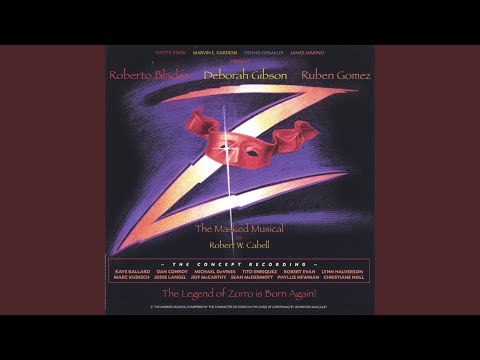
Review
Can a Zorro musical survive when its hero is legally famous, dramatically familiar, and musically expected to arrive on horseback to a predictable chord? This one tries anyway, and its boldest move is structural: the story is told as a performance, by traveling storytellers, so the lyrics have to do double duty as narration and character psychology. The best writing lands when it stops selling “legend” and starts showing the cost of playing two roles at once: Diego the polite cipher, Zorro the weaponized rumor.
Lyrically, the engine is contradiction. The score keeps returning to masks, bargains, and public virtue versus private desire. When the text is sharp, it uses simple verbs and direct stakes: who gets hurt, who profits, who is seen. When it softens into slogan, the show feels like it is pitching a logo instead of a person. Still, the concept-album format gives the writers permission to swing between pop immediacy and theatre exposition, which is handy in a plot that has to introduce Spain, California, corruption, romance, and revolt at speed.
Musically, the piece telegraphs “Latin-infused” in more than one dialect: flamenco-adjacent fire, ballroom pulse, and pop power-ballad phrasing. That mix matters because it mirrors the hero’s split identity. The romantic numbers want clean, radio-friendly sincerity; the ensemble numbers want pageant and momentum. The friction is the point. If you like your swashbucklers with a melodic hook and a moral argument, you will find both here.
How It Was Made
“Z” is the rare musical whose origin story includes both show-business hustle and federal court filings. The author-composer-lyricist created the piece in the mid-1990s, explicitly drawing from early Zorro source material that had entered (or was argued to have entered) the public domain. The concept recording arrived first, then readings and productions followed, with plans repeatedly complicated by rights disputes around the Zorro brand. That offstage tension bleeds into the work’s onstage obsession: who owns a symbol, who gets to wear it, and what happens when the crowd believes the symbol more than the man.
Artistically, the “celebrity concept album” approach is not a gimmick so much as a strategy: use pop voices and Broadway ringers to sell a big, exportable legend before a commercial production exists. In practice, that pushes the lyric writing toward clarity. You cannot hide story beats behind staging when the staging is only in the listener’s head. The album has to paint location, power dynamics, and emotional temperature with nouns, rhythms, and the occasional well-timed admission.
Key Tracks & Scenes
"Gypsy Story Tellers" (Ensemble)
- The Scene:
- A troupe steps into view as if they have been here all along. Lantern light, clapping patterns, a promise: tonight’s entertainment is also tonight’s warning.
- Lyrical Meaning:
- This is the thesis statement in song. The words establish that “Zorro” is a tale being sold, traded, and reshaped in real time. It primes you to listen for repetition and reframing.
"Illusions of Life" (Company)
- The Scene:
- Diego’s education and refinement are framed as preparation, but also as camouflage. Bright salon lighting; the music smiles while the lyric squints.
- Lyrical Meaning:
- The lyric treats polish as both privilege and prison. “Illusion” is not a magic trick here; it is an identity policy.
"Tears of Sorrow" (Company)
- The Scene:
- The community counts losses. The stage picture narrows, faces forward, and the sound turns communal rather than romantic.
- Lyrical Meaning:
- Grief becomes a political resource. The lyric’s job is to convert sadness into motive without turning it into propaganda.
"What Makes a Hero" (Carlotta & Company)
- The Scene:
- Carlotta is surrounded by talk of Zorro before she can separate gossip from truth. Spotlight on her, movement behind her, like a rumor gaining mass.
- Lyrical Meaning:
- This is where the show argues with itself. The lyric asks whether heroism is action, image, or sacrifice, then quietly admits it may be all three.
"Ivory Tower" (Diego & Company)
- The Scene:
- Power speaks in comfort. High balcony energy, controlled breathing, a villain’s sense of safety that the audience knows is temporary.
- Lyrical Meaning:
- The metaphor is blunt on purpose. The lyric weaponizes entitlement as a rhyme scheme: neat, closed, and proud of its locks.
"Zorro Rides" (Ensemble)
- The Scene:
- Action montage. Percussive footwork, a streak of black, bodies shifting like doors opening in a hallway chase.
- Lyrical Meaning:
- The lyric is less about plot than velocity. It teaches the audience how to cheer: not for violence, but for disruption.
"Just Close Your Eyes" (Diego & Carlotta)
- The Scene:
- A private corner in a public world. The lighting warms, the tempo settles, and the threat of discovery hovers at the edge of the duet.
- Lyrical Meaning:
- Romance becomes complicity. The lyric flirts with denial, then uses that denial as a test: what are you willing not to see to keep what you want?
"Devil on My Back" (Trio)
- The Scene:
- Three voices, one crisis. The stage goes spare; it feels like an interrogation room that the character carries inside himself.
- Lyrical Meaning:
- Temptation is staged as argument, not seduction. The lyric frames heroism as a daily negotiation with fear, ego, and retaliation.
Live Updates
Info current as of February 2026. The most visible “Z” footprint remains its recordings and printed materials rather than a long-running commercial production. The concept album’s tracklist and cast lineup were documented at release, and a later “Original Score” release (2013) appears on major digital music platforms. A 2014 piano-vocal publication also circulates through booksellers, keeping the show playable for performers even when it is not widely produced.
Online, the album has been re-uploaded and organized into platform playlists (with at least one major platform playlist showing a 2025 update timestamp), which has quietly improved its discoverability for new listeners. Separately, the Zorro-rights landscape that once discouraged producers has been repeatedly litigated and reported, and that history still shapes how often “Z” gets mounted and where.
Notes & Trivia
- The concept recording was announced for a December 1998 release and marketed as a full book/music/lyrics vehicle for its creator.
- The concept album split (or shared) the Diego/Zorro vocal identity across multiple singers, reinforcing the story’s double-life theme at the casting level.
- The Playbill-reported track list includes bonus versions of key songs, a common concept-album tactic: test different lead voices without rewriting the show.
- A later English-language recording tied to a 2013 German premiere score is referenced in promotional/packaging material alongside detailed music-direction credits.
- The framing device of traveling storytellers is baked into the show’s pitch, which is why so many lyrics function as narration, not just confession.
- The title lives in multiple naming conventions across releases (“Z,” “Z - The Masked Musical,” and “Z - The Musical of Zorro”), so searches work best when you try more than one.
- Legal disputes around Zorro trademarks and copyrights became part of the musical’s public narrative, affecting how easily it could be produced.
Reception
Because “Z” circulated first as a recording, much of its documented reception reads like industry curiosity: a Zorro moment in late-1990s pop culture, plus theatre people tracking whether the album could translate into a stage life.
“1998 has been quite a year for Zorro.”
“Oh, how I wanted to like” this recording.
Copyright law can protect “original expression” added to public-domain material.
Read together, those reactions sketch the show’s paradox. The hook is instantly marketable. The execution divides listeners who want either purist Broadway craft or pure pop pleasure. And the business reality is that a famous character brings both attention and headaches.
Awards
- No major awards are consistently documented across the show’s limited-production history; its most verifiable milestones are recordings, readings, and regional stagings.
Quick Facts
- Title: Z (also circulated as “Z - The Masked Musical of Zorro”)
- Primary release era: Concept recording marketed in late 1998 with 1999 distribution listings
- Type: Latin-inflected musical theatre with pop vocal writing and ensemble storytelling
- Book / Music / Lyrics: Robert W. Cabell
- Story basis: Early Zorro source material (notably “The Curse of Capistrano” and the 1920 film legacy)
- Recording approach: Celebrity-forward concept album, plus later “Original Score” digital release
- Notable placements (in-show): “Gypsy Story Tellers” frames the tale; “What Makes a Hero” tests the legend; “Zorro Rides” functions as the action signature
- Label context: The concept CD was sold as a specialty cast recording; later releases appear under Warrington Publications branding on digital platforms
- Availability: Digital streaming and video-upload ecosystem; printed piano-vocal publication for performance use
Frequently Asked Questions
- Is this the same show as the Gypsy Kings “Zorro” musical?
- No. This “Z” is a separate work with its own score and a concept-album origin. Confusion is common because multiple stage projects have used the Zorro mythos.
- Who wrote the lyrics?
- Robert W. Cabell is credited as book, music, and lyric author for the project as marketed with the concept recording.
- Is there a full cast recording or just a concept album?
- The best-known entry point is the concept recording. A later “Original Score” release (2013) also circulates digitally, and piano-vocal material exists for performers.
- Where do I start if I want to understand the plot quickly?
- Listen in order to “Gypsy Story Tellers,” “Tears of Sorrow,” “What Makes a Hero,” and “Zorro Rides.” Those four establish the frame, the stakes, the central question, and the show’s action language.
- Why does the lyric writing feel so direct in places?
- Concept albums cannot lean on staging to clarify story. The text often has to identify who has power, what changed, and what it costs, fast.
- Is there a movie version?
- Not for this musical. The character has many film adaptations, but this specific score is primarily experienced through recordings and occasional productions.
Key Contributors
| Name | Role | Contribution |
|---|---|---|
| Robert W. Cabell | Book / Music / Lyrics | Creator of the stage work and the concept-album architecture. |
| Deborah Gibson | Performer | Featured vocalist as Carlotta on the concept recording. |
| Ruben Gomez | Performer | Featured vocalist as Diego/Zorro on the concept recording. |
| Roberto Blades | Performer | Performer associated with the Diego/Zorro vocal identity in concept-album materials. |
| Christiane Noll | Performer | Performer listed on the concept recording lineup. |
| Marc Kudisch | Performer | Performer on key ensemble and featured tracks. |
| Kaye Ballard | Performer | Performer on “Dance of Love” in the published track list. |
| Phyllis Newman | Performer | Performer on “Dance of Love” in the published track list. |
References & Verification: Playbill release coverage and track list; piano-vocal/packaging materials (sheet music and CD art PDF); Cabell-related production notes reported by BroadwayWorld; public reporting and legal analysis from Courthouse News and The Hollywood Reporter; label and release metadata from Apple Music listings; general show pitch text from major bookseller listings.