Zanna, Don't Lyrics – All Songs from the Musical
Zanna, Don't Lyrics: Song List
- Who's Got Extra Love?
- I Think We Got Love
- I Ain't Got Time
- Ride 'Em
- Zanna's Song
- Be A Man
- Don't Ask, Don't Tell
- Fast
- I Could Write Books
- Don't You Wish We Could Be In Love?
- Whatcha Got?
- Do You Know What It's Like?
- 'Tis A Far, Far Better Thing I Do
- Blow Winds
- Straight To Heaven
- Someday You Might Love Me
- Straight To Heaven (Reprise)
- Sometime, Do You Think We Could Fall In Love
- Finale
About the "Zanna, Don't" Stage Show
Libretto and the lyrics were written by Tim Acito and Alexander Dinelaris. Music composed by T. Acito. The first show was held on the stage of Rodney Kirk Theatre from October to November 2002, directed and choreographed by Devanand N. Janki. In the show were involved: G. Treco, R. Sapp, S. Thomas, A. Larsen, A. R. Paige & D. Nichols. In March 2003, tryouts began as off-Broadway productions. The musical took place in the John Houseman Theatre from mid-March to June 2003, with 17 preliminaries and 119 regular exhibitions. Production involved D. N. Janki as director. The performance had cast: J. Rodriguez, R. Sapp, A. Larsen, S. Thomas, J. Zeus & D. Nichols. In 2008, a student musical performance was shown on the Edinburgh Fringe Festival in George Square Theatre.In May 2009, during the London’s ‘Enterprise 09 Festival’, show was held at The Space. Then, from June to July, the performance was hosted by the Upstairs at the Gatehouse. The play was developed by the director Joseph C. Walsh and choreographed by Philip Scutt. The cast included: M. Shearer, K. Malyon, M. Cotton, M. Stacey, N. Crowe, B. Hurst & L. Orr. In April 2013, Gryphon Theatre hosted the New Zealand’s version. It was produced by director Stuart James and had the following cast: J. Pallesen, S. James, J. Finn, J. Pollock & K. Evans. In March 2014, the play was shown in New Orleans Old Marquer Theatre, developed by the director Christopher Bentivegna and choreographer Lindsey Romig, with such actors: K. Russell, L. Johnson & J. W. Brewer. In June 2014, Landor Theatre hosted another London production, directed by Drew Baker and choreographed by Holly Hughes. The main parts were played by D. Ribi and J. Dudley.
Release date: 2003
"Zanna, Don’t!" – The Musical Guide & Song Meanings
Review
“Zanna, Don’t!” poses a mischievous question and then refuses to let you answer it politely: if your world flipped its default settings, would you still call your own desires “normal,” or would you start policing them? The show’s hook is clean satire, but the lyric writing has a tougher assignment. It has to be funny about social rules while still letting four teenagers bleed in public. When it works, it is because the songs treat identity as something you do, not something you announce.
The score’s signature move is tonal agility. A cheer can become an aria. A political argument can show up disguised as a school musical rehearsal. That flexibility keeps the show airborne in a short runtime, and it helps the text avoid sermonizing. The recurring lyrical motifs are the ones you would expect from a fairy-tale comedy with real stakes: matching, masking, wishing, and the uneasy idea that “fixing” the world might be another form of control. That last one is the show’s best trick, because it turns a feel-good premise into a moral boomerang.
Listener tip, straight from the trenches of cast-album culture: track the show by locations, not by romances. Heartsville High is the public stage where rules are enforced. The diner is where defenses drop. The “corral” scenes are where fear gets comic packaging. The prom is where consequences arrive wearing sequins.
Version note for 2024–2026 readers: the original 2003 piece and the later “Reboot” conversations share DNA, but they aim at different targets. The original leans on pop immediacy and a classic fairy-tale arc. The later revision efforts openly chase deeper character work and newer political questions. If you are licensing or watching a regional run, ask which text you are actually getting.
How It Was Made
Tim Acito wrote the book, music, and lyrics, with additional book and lyrics by Alexander Dinelaris. The show developed Off-Broadway in 2002 and then opened its main Off-Broadway run in spring 2003. The premise was a sharp inversion comedy for a moment when mainstream culture was still negotiating what “acceptance” even sounded like in public. The score answered with radio-ready structure: quick intros, sticky choruses, and character voices that land fast.
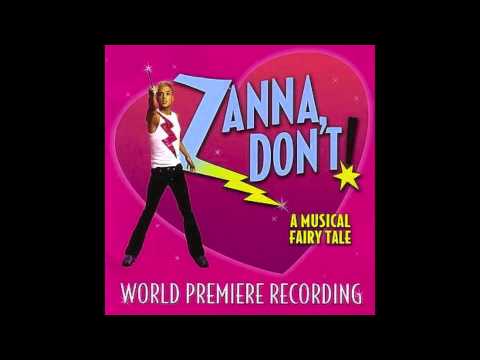
The title has a tidy origin story. Acito reportedly took inspiration from “Xanadu,” partly because an early conception imagined the title character on roller skates. That detail matters, because it explains the show’s vibe. “Zanna, Don’t!” wants to feel like glitter with a pulse, even when the plot turns bruising.
After Off-Broadway, producers talked seriously about Broadway and even floated a simplified title. That plan did not materialize, but the show’s afterlife became its own kind of proof. A cast recording arrived the same year, and licensing has kept the musical in circulation, especially as audiences have grown more fluent in queer storytelling and more skeptical of tidy “love solves everything” messaging.
Key Tracks & Scenes
"Who’s Got Extra Love?" (Zanna & Company)
- The Scene:
- First day energy at Heartsville High. Bright, pop-concert lighting. The ensemble moves like a hallway stampede with choreography that doubles as social sorting.
- Lyrical Meaning:
- The lyric sells the town’s core currency: affection as status. It also introduces Zanna’s philosophy as cheerful logistics. Love is a resource, and he thinks he can allocate it without a bill coming due.
"I Ain’t Got Time" (Roberta)
- The Scene:
- A diner shift that feels like a pressure cooker. Practical lighting, clattering rhythms, customers as a Greek chorus with opinions.
- Lyrical Meaning:
- Roberta’s comedy is armor. The lyric turns busyness into refusal, then betrays the truth underneath: she is afraid that wanting love makes her look foolish.
"Ride ’Em" (Roberta, Kate & Company)
- The Scene:
- The mechanical bull-riding team moment, staged as a pep rally with flirtation. Hot colors, fast counts, bodies forming challenges and dares.
- Lyrical Meaning:
- It is a brag song that becomes a courtship ritual. The lyric frames desire as sport, which gives Kate permission to feel something without calling it “need.”
"Be a Man" (Zanna & Company)
- The Scene:
- Rehearsal for the students’ controversial in-school show about straight people in the military. The staging often reads like a low-budget pageant that accidentally tells the truth.
- Lyrical Meaning:
- The lyric weaponizes “role model” rhetoric by aiming it at history and masculinity. It is funny, and it is also a reminder that identity is always being cast by somebody.
"Don’t Ask, Don’t Tell" (Kate & Steve)
- The Scene:
- A deliberately overwrought ballad inside the school musical, then a reprise energy that starts to feel uncomfortably personal. Spotlight logic: performers lit, audience in shadow, shame hovering.
- Lyrical Meaning:
- The lyric begins as parody and ends as prophecy. It shows how easy it is to laugh at oppression until you realize the joke has your name on it.
"Fast" (Bronco, Tex, Loretta)
- The Scene:
- The “I’m Okay, You’re Okay Corral” hangout. Warm bar lighting, a little hoedown swagger, adults dispensing advice like it is medicine.
- Lyrical Meaning:
- This is the show’s critique of romantic momentum. The lyric sells speed as safety, which is exactly what frightened characters want to believe.
"Whatcha Got?" (Roberta & Company)
- The Scene:
- State chess finals turned into a roaring cheer sequence. Tight white light on the board, then a stadium surge as the ensemble becomes crowd noise.
- Lyrical Meaning:
- The lyric is encouragement as pressure. It pushes Mike forward while also exposing how public love can feel like performance, even when it is sincere.
"Someday You Might Love Me" (Zanna)
- The Scene:
- After Zanna’s spell flips the world, he becomes the odd one out. The stage empties. The lighting cools. The fairy-tale palette drains.
- Lyrical Meaning:
- Zanna finally speaks without selling. The lyric is a quiet audit of the show’s central fantasy: if you can rewrite society, you can also erase people.
Live Updates
Info current as of February 2026. “Zanna, Don’t!” is alive in the way cult musicals tend to be alive: licensing, periodic revivals, and a cast album that keeps recruiting new fans at 2 a.m. Theatrical Rights Worldwide continues to license the title, with a listed 90-minute runtime and a small-band orchestration that makes the show practical for companies that want pop energy without a pit the size of an aircraft carrier.
In the UK, the Old Joint Stock Theatre mounted a December 2024 revival that generated a fresh wave of reviews praising the show’s punchy numbers and contemporary resonance. That matters for SEO because it signals ongoing critical conversation, not just nostalgia. The piece reads differently in the mid-2020s than it did in 2003. Audiences now bring sharper expectations about who gets to be “the lesson” and who gets to be “the joke,” and productions are adjusting tone accordingly.
On the community and regional circuit, the musical remains a frequent pick. One clear datapoint: Loveland Stage Company lists a January 2026 run in its season, and their materials frame the story in explicitly modern acceptance language. In other words, the show has become a flexible mirror. Some productions sell it as candy-colored satire. Others lean into the tenderness and the ache of social exile.
Reboot watch: revised versions have been publicly discussed and presented in limited formats in the late 2010s, and documentation suggests substantial rewriting in dialogue and score. If you are researching lyrics, always confirm whether a production is using the original Off-Broadway text or a revision, because “song meanings” can shift when a show changes what it thinks it is arguing.
Notes & Trivia
- The Off-Broadway run began March 20, 2003 at the John Houseman Theater and closed after 17 previews and 119 performances.
- The cast album was released October 7, 2003 by PS Classics and became a strong seller for the label, according to contemporary reporting.
- Acito has cited “Xanadu” as an inspiration for the title and an early idea of Zanna on roller skates.
- The show’s in-story “Don’t Ask, Don’t Tell” school musical is the plot catalyst that turns parody into personal crisis.
- Licensing materials list a compact orchestration and a short runtime, which helps explain why the show travels well through schools and smaller companies.
- “Fast” is a structural hinge: it reframes romantic urgency as social pressure at the exact moment the central couple needs patience.
- The piece won recognition at the 14th Annual GLAAD Media Awards in 2003 in the New York theatre category, per Playbill’s winners coverage.
Reception
Critics have generally agreed on the product and argued about the dosage. The score is catchy. The premise is sweetly aggressive. The question is how much sugar you can take before you start craving salt. When the show is staged with speed and discipline, the pop surface keeps the satire buoyant. When it is played as pure feel-good, the moral complications can blur.
“Few shows have the appeal of Zanna, Don't! It would take a hard heart to resist Tim Acito's candy-flavored melodies that have theatregoers lining up in the lobby after the show to sign a mailing list for the CD. He has turned out a number of top-40-worthy hits.”
“Tuneful, peppy and full of heartfelt goodness, Acito's ebullient score is a knockout.”
“The winning score has both variety and a contemporary feel, perhaps permitting it to find a cross-generational appeal.”
Awards
- 14th Annual GLAAD Media Awards (2003): listed in Playbill winners coverage for Outstanding New York Theater (Off-Off-Broadway category listing includes the title).
- Lucille Lortel Awards (2003 season): Best Choreography win for Devanand Janki; additional nominations documented in multiple theatre databases.
- Drama Desk Awards (2003 season): multiple nominations including musical, music, book, and lyrics reported in aggregated awards listings.
- Outer Critics Circle: nomination for Outstanding Off-Broadway Musical reported in awards listings.
Quick Facts
- Title: Zanna, Don’t! (A Musical Fairy Tale)
- Year: 2003 (main Off-Broadway run)
- Book / Music / Lyrics: Tim Acito
- Additional book and lyrics: Alexander Dinelaris
- Off-Broadway venue: John Houseman Theater (Theatre Row)
- Original director/choreographer: Devanand Janki
- Musical supervision (original production reporting): Edward G. Robinson
- Cast album: PS Classics, released October 7, 2003
- Runtime (licensing listing): 90 minutes
- Orchestration (licensing listing): 4 musicians (piano/conductor, guitar, bass, percussion)
- Selected notable placements: “Don’t Ask, Don’t Tell” appears as an in-story school musical; “Whatcha Got?” is framed as the chess finals cheer; “Someday You Might Love Me” lands after the spell’s social cost
Frequently Asked Questions
- Who wrote the lyrics for “Zanna, Don’t!”?
- Tim Acito wrote the book, music, and lyrics, with additional book and lyrics credited to Alexander Dinelaris in licensing and production documentation.
- Is the cast recording the same as a soundtrack?
- In theatre terms, it is a cast recording: studio-style documentation of the score performed by the production cast, released by PS Classics in 2003.
- Where does “Don’t Ask, Don’t Tell” happen in the story?
- It is performed as part of the students’ in-school musical about straight people in the military, and it becomes the catalyst for the central straight couple’s awakening and the town’s backlash.
- What song should I play first if I want the show’s whole argument in miniature?
- Try “Don’t You Wish We Could Be in Love?” It begins playful, then widens into the show’s real emotional geometry as multiple characters admit what the social order will not allow.
- Is there an updated version with different songs?
- Revisions have been discussed and presented in limited formats in the late 2010s, with reporting and summaries indicating substantial rewriting. Always confirm which version a given production is licensing or performing.
- Is “Zanna, Don’t!” appropriate for schools?
- Many schools do produce it, and licensing materials emphasize its small-band practicality. Content suitability depends on community standards and how a production handles the show’s sexual humor and themes of discrimination.
Key Contributors
| Name | Role | Contribution |
|---|---|---|
| Tim Acito | Book / Music / Lyrics | Architect of the pop-satire voice; writes character wants in radio-shaped songs. |
| Alexander Dinelaris | Additional Book and Lyrics | Supplemental text and lyric support credited in licensing and production documentation. |
| Devanand Janki | Director / Choreographer | Original staging engine; Lortel-recognized choreography that translates pop into storytelling. |
| Edward G. Robinson | Orchestrations / Arrangements / Musical Supervision | Original production sound world; helps the score shift styles without losing momentum. |
| Jai Rodriguez | Original Off-Broadway Zanna | Anchors the cast recording with a bright, talk-to-the-room delivery. |
| Anika Larsen | Original Off-Broadway Roberta | Comic bite plus vulnerability; key voice for the show’s “bravado as defense” lyric mode. |
| PS Classics | Record Label | Released the 2003 world premiere recording and kept the show discoverable via album circulation. |
| Theatrical Rights Worldwide | Licensing | Current licensing home; publishes runtime and orchestration details used by producing companies. |
References & Verification: PS Classics release page and critic pull-quotes; Playbill reporting on the Off-Broadway opening, the cast album release, Broadway transfer plans, and GLAAD winners coverage; Theatrical Rights Worldwide licensing listing for runtime/orchestration and synopsis; CurtainUp review excerpt; 2024 UK revival reviews (All That Dazzles, The Reviews Hub, Musical Theatre Review); 2026 production scheduling (Loveland Stage Company season listing and ticketing “about” page); general plot and song placement cross-check via encyclopedia summary.