Year with Frog and Toad, A Lyrics – All Songs from the Musical
Year with Frog and Toad, A Lyrics: Song List
- Act 1
- Opening
- A Year With Frog And Toad
- Spring
- Seeds
- The Letter
- Getta Loada Toad
- Underwater Ballet
- Alone
- The Letter (Reprise)
- Cookies
- Act 2
- The Kite
- A Year With Frog And Toad (Reprise)
- He'll Never Know
- Shivers
- Snow Ballet
- The Letter (Reprise 2)
- Down The Hill
- I'm Coming Out Of My Shell
- Toad To The Rescue
- Merry Almost Christmas
- Finale
About the "Year with Frog and Toad, A" Stage Show
Libretto and lyrics were written by W. Reale. The music composed by his brother R. Reale. Tryouts were in Powerhouse Theater in 2000. Production realized director D. Petrarca. Starring: M. Linn-Baker and R. Sella. Premiere hosted by Minneapolis Children's Theatre. The show took place there from August to November 2002, then it moved to New Victory Theatre, where it was shown from mid-November to early December 2002. It was directed by D. Petrarca & choreographed by D. Pelzig. The actors were: J. Goede, M. Linn-Baker, D. Ferland, K. Reinders & F. Vlastnik. Tryouts were on Broadway in April 2003. The play hosted by Cort Theatre from April to June 2003, having 15 preliminaries and 73 regular performances. Production was prepared by D. Petrarca and D. Pelzig. Actor’s list was: M. Linn-Baker, J. Goede, D. Ferland & J. Gambatese.From January to March 2006, the theatrical was exhibited in Goodman Theatre, developed by director H. Godinez, having such actors: B. Mott, J. Foronda, L. S. Banks & O. Jones. From October to November 2013, performance took place in the Ruth Page Arts Center, prepared by H. Godinez and choreographed by T. Rapley with these actors: M. D. Kaplan, K. Hamilton & C. Bunuan. From October to November 2014, the histrionics was held in ZACH Theatre, directed by N. Miller and choreographed by J. Y. Mahlstedt. The spectacular involved: C. Brewer, C. Harris, K. Henry & N. Kier. In December 2014, it was represented in the Salt Lake Acting Company, directed by P. Caywood. The cast involved J. Bowen, A. R. Moore, T. L. McGriff & L. Tarantino. Production was nominated for 2 awards.
Release date: 2002
"A Year with Frog and Toad" (2002) – The Musical Guide & Song Meanings
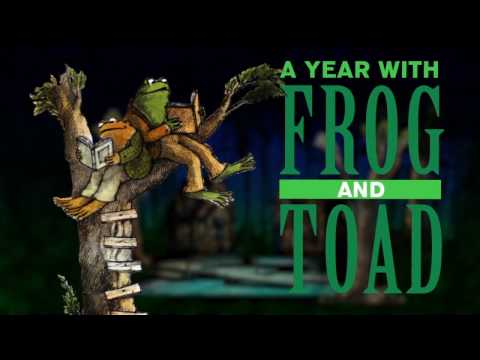
Review: small show, sharp lyric engine
Here’s the trick “A Year with Frog and Toad” tries to pull off: turn tiny, self-contained storylets into a full musical without inflating them into mush. Mostly, it succeeds by writing lyrics that behave like stage directions you can sing. The words keep nudging the show forward, then quietly reveal character in the nudge itself.
Willie Reale’s lyric strategy is repetition with purpose. The show is built for kids, yes, but the smartest children’s theatre does not baby-talk. When a phrase comes back again and again, it lands as a game for younger ears and as an anxiety loop for older ones. That is the heart of the piece: Frog’s breezy social confidence meeting Toad’s catastrophizing inner monologue. The rhyme schemes are tidy, the jokes are clean, and the punchlines are often emotional rather than comedic. You laugh, then you realize you’re watching a friendship negotiate shame.
Musically, Robert Reale’s score lives in a jazzy, early-20th-century palette: vaudeville bounce, radio-era warmth, dance-band pep. That style matters because it keeps the sentiment from curdling. In a more contemporary pop idiom, the show might beg for applause after every moral. Here, the “lesson” sneaks in under syncopation. The result is a family musical that has a surprisingly adult respect for timing: set up, repeat, vary, release.
How it was made
The show exists because of a family handoff. Scenic designer and producer Adrianne Lobel, daughter of author-illustrator Arnold Lobel, commissioned an adaptation and helped steer the tone. The Reale brothers were initially wary: the original stories are short vignettes, not a ready-made plot. Their solution was structural, not sentimental. They found “runners” to stitch the episodes together, most famously the slow-motion “snail mail” device that turns waiting into a running joke and, finally, a payoff.
The score’s stylistic “click” also came from memory, not branding. Accounts from the creators describe an early pass that did not fit; the breakthrough was leaning into an old-school dance-band sensibility tied to Arnold Lobel’s home listening. That choice is more than cute trivia. It explains why the lyrics can stay plainspoken. The music supplies the polish, so the text can stay human.
Production timeline matters if you are tracking the show’s identity: it was workshopped in 2000, premiered at Children’s Theatre Company in Minneapolis in 2002, moved to New York’s New Victory Theater later that year, then transferred to Broadway’s Cort Theatre in April 2003. The cast album followed afterward, in 2004, and it preserves the show’s compact “five-actor” storytelling without needing the visuals to sell the joke.
Key tracks & scenes
"A Year with Frog and Toad" (Birds, Frog, Toad)
- The Scene:
- End of winter. Birds peer in on two hibernating friends. Soft light, bedtime silhouettes, a world holding its breath.
- Lyrical Meaning:
- This is the thesis statement: friendship as a calendar, not a mood. The lyric frames the show as a promise you renew, even when you are asleep.
"It’s Spring" (Frog, Toad, Birds)
- The Scene:
- Frog drags spring into the room. Toad resists with the dignity of someone who wants another month of denial. The comedy is physical, the subtext is tender.
- Lyrical Meaning:
- The lyric is basically a persuasion tactic set to music. Frog does not shame Toad; he reframes time so Toad can rejoin life without losing face.
"Seeds" (Toad)
- The Scene:
- Garden plot, bright daylight, the big dream of being instantly good at something. Toad plants, then stares at dirt like it owes him an answer.
- Lyrical Meaning:
- Toad’s impatience becomes poetry. The lyric turns effort into a negotiation: if I do the work, will the world please respond on my schedule?
"The Letter" (Snail)
- The Scene:
- A tiny messenger commits to a long journey. The stage picture often plays comically small against a big, open space.
- Lyrical Meaning:
- The lyric sanctifies slowness. In a show about seasons, “later” is not failure; it is the tempo of care.
"Getta Loada Toad" (Ensemble feature)
- The Scene:
- Summer pond. A bit of gossip turns into a chorus. The lighting brightens, movement gets splashy, and the ensemble becomes a town square.
- Lyrical Meaning:
- It’s a prank-song with a sting: public embarrassment as community sport. The lyric sets up Toad’s core wound, so later forgiveness has weight.
"Cookies" (Frog, Toad, Birds)
- The Scene:
- A kitchen tornado. Cookies appear, disappear, reappear. The rhythm accelerates until self-control becomes a farce.
- Lyrical Meaning:
- Repetition becomes compulsion. The lyric makes willpower sound like a children’s chant, which is exactly why it reads as truthful.
"He’ll Never Know" (Frog, Toad)
- The Scene:
- Quiet evening. Frog has done something kind without announcing it. The staging typically pulls focus down to two bodies and a small pool of light.
- Lyrical Meaning:
- One of the show’s cleanest emotional pivots: love expressed as secrecy. The lyric respects pride while still delivering the gift.
"Merry Almost Christmas" (Frog, Toad, Moles)
- The Scene:
- Winter arrives. The moles bustle like a backstage crew inside the story. The vibe is cozy, not holy.
- Lyrical Meaning:
- The lyric treats celebration as improvisation. It’s not about perfect timing; it’s about showing up for the person next to you.
Live updates (2024–2026)
Information current as of February 2, 2026.
The show’s “life” now is less about one definitive production and more about its reliability as a family title that theatres can mount with modest resources. Recent professional and regional stagings have kept it visible: Children’s Theatre Company in Minneapolis brought it back in spring 2024, explicitly framing the piece as a return to its 2002 home base. In summer 2025, Asolo Repertory Theatre mounted it in Sarasota. Late 2025 brought more evidence of its seasonal usefulness as a warm, holiday-adjacent option for family audiences.
The Broadway run in 2003 is also part of the show’s cautionary tale: critics could be kind while economics stayed brutal. Contemporary reporting and commentary point to high top ticket prices for a children’s title and a difficulty converting good notices into consistent grosses. That history is why the piece arguably works better now in regional houses and children’s theatre ecosystems, where the business model matches the material.
Listening habits have also shifted in the show’s favor. The original cast recording is widely available on major streaming services, which makes it easier for parents, educators, and younger performers to learn the score before seeing it live. For SEO purposes, that matters: discovery now often starts with “Cookies” in a classroom, not a billboard in Times Square.
Notes & trivia
- The musical was workshopped in 2000, premiered in Minneapolis in 2002, and opened on Broadway April 13, 2003, at the Cort Theatre.
- The Reales’ solution to the source material’s vignette structure was to add “runners,” including the snail-delivery throughline that turns waiting into plot glue.
- Creator interviews and study materials describe the score’s stylistic anchor as an old-fashioned, dance-band and vaudeville sound connected to Arnold Lobel’s listening habits at home.
- The original cast recording was released April 6, 2004 by P.S. Classics, and runs about 55 minutes across 21 tracks.
- Broadway credits include director David Petrarca, choreographer Daniel Pelzig, and scenic design by Adrianne Lobel.
- The show earned three Tony nominations in 2003: Best Musical, Best Book of a Musical, and Best Original Score.
- Some dance-orchestra moments exist primarily as staging texture; they help explain why the album feels brisker than the full stage evening.
Reception: critics then vs now
In 2003, reviewers often treated the show as an unusually tasteful crossover: real musical theatre craft, scaled to younger attention spans. The praise tended to land on the same trio of virtues: melodic clarity, lyric wit, and emotional decency. At the same time, industry coverage was blunt about the financial challenge of selling premium-priced Broadway seats for a title aimed at kids.
“Anyone who cherishes musical theater and can beg or borrow a child from 4 up...”
That line is frequently repeated because it captures the show’s odd Broadway positioning: adults were invited to treat it as a “real” musical, but the buying decision still depended on family logistics.
“There is a fine line between theatre and children’s theatre.”
Two decades later, the critical conversation feels calmer. The show is less a Broadway event and more a repertory staple. That shift has helped the lyrics: without the pressure of hype, their modesty reads as a feature, not a limitation.
“Lively and appealingly old-fashioned musical numbers...”
Awards
- Tony Awards (2003): Nominated for Best Musical, Best Book of a Musical, Best Original Score.
- Drama League Awards (2003): Distinguished Production of a Musical, nominee.
Quick facts
- Title: A Year with Frog and Toad
- World premiere: August 23, 2002 (Children’s Theatre Company, Minneapolis)
- Creators: Music by Robert Reale; Book and Lyrics by Willie Reale
- Based on: The “Frog and Toad” books by Arnold Lobel
- Developed by / scenic design: Adrianne Lobel
- Broadway opening: April 13, 2003 (Cort Theatre)
- Orchestration (Broadway credit): Irwin Fisch
- Original cast recording: Released April 6, 2004 (P.S. Classics)
- Availability: Streaming on Apple Music and Spotify; physical CD via multiple retailers
- Selected notable “placements” (story moments): hibernation-to-spring wake-up; garden patience; snail-delivered letter; pond-side embarrassment; cookie self-control spiral; winter “almost Christmas” camaraderie
Frequently asked questions
- Is this a 2002 musical or a 2003 Broadway musical?
- Both. It premiered in Minneapolis in 2002, then transferred to Broadway in April 2003.
- Who wrote the lyrics?
- Willie Reale wrote the book and lyrics; Robert Reale composed the music.
- Where can I listen to the cast album?
- The original cast recording (released April 6, 2004) is available on major streaming services, including Apple Music and Spotify.
- Why does the score sound “old-fashioned”?
- Creator accounts tie the musical language to vaudeville and early dance-band styles, linked to memories of Arnold Lobel’s listening habits while he worked.
- Is there an official movie version?
- There is no widely recognized feature-film adaptation as of February 2, 2026. The most common video entry point is theatre-produced trailers and clips.
- How can theatres perform it legally?
- In many territories, performance rights are administered through Music Theatre International (MTI). Always license before staging.
Key contributors
| Name | Role | Contribution |
|---|---|---|
| Willie Reale | Book & lyrics | Turns vignette storytelling into song-driven scenes; lyric wit built on purposeful repetition. |
| Robert Reale | Composer | Jazzy, vaudeville-leaning score that keeps the tone buoyant while the feelings get real. |
| Arnold Lobel | Source author-illustrator | Created the characters and the emotional DNA: gentle humor, quiet longing, clean morals. |
| Adrianne Lobel | Developer / scenic designer | Commissioned and shaped the adaptation’s tone; Broadway scenic design credit. |
| David Petrarca | Director (Broadway) | Helped scale the show for Broadway while keeping the intimacy of children’s theatre. |
| Daniel Pelzig | Choreographer (Broadway) | Movement vocabulary that reads for kids while still landing jokes for adults. |
| P.S. Classics | Label | Released the original cast recording in 2004. |
| Music Theatre International (MTI) | Licensing | Common rights administrator for productions; also publishes a production history summary. |
References & Verification: IBDB production record; MTI show page and licensing notes; Playbill reporting and production statistics; creator interview and 2024 revival coverage via YourClassical (American Public Media); educational study guides (Wheelock Family Theatre and others); streaming metadata via Apple Music, Spotify, and AllMusic; recent regional listings via BroadwayWorld and theatre sites; industry coverage via Variety.