Where's Charley? Lyrics – All Songs from the Musical
Where's Charley? Lyrics: Song List
- Act 1
-
Overture
-
Better Get Out Of Here
- The New Ashmolean Marching Society And Students' Conservatory Band
- My Darling, My Darling
-
Serenade With Asides
-
Make A Miracle
-
Lovelier Than Ever
- The Woman In His Room
-
Pernambuco
- Act 2
-
Where's Charley?
- Once In Love With Amy
-
The Gossips
-
At The Red Rose Cotillion
- Finale
About the "Where's Charley?" Stage Show
Where's Charley? is a musical with music and lyrics by Frank Loesser and book by George Abbott. The story was based on the 1892 play Charley's Aunt by Brandon Thomas. The musical debuted on Broadway in 1948 and was revived on Broadway and in the West End. Ray Bolger starred, and sang the popular song "Once In Love With Amy".Release date: 1948
"Where's Charley?" – The Musical Guide & Song Meanings
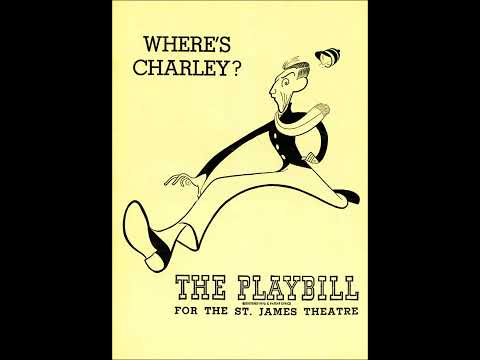
Review
Why does “Where’s Charley?” still work, even when the premise reads like a dare? Because Frank Loesser writes jokes that scan. He also writes feelings that sneak in while you’re laughing at the mechanics. The show is a farce adaptation of “Charley’s Aunt,” and it never pretends otherwise. Doors swing, identities wobble, authority figures chase money and hormones. Yet the score keeps insisting on a small human truth: everyone wants permission to love who they love, and this society keeps demanding paperwork.
Loesser’s lyric technique here is efficiency with a grin. He likes clean stresses, clear rhymes, and conversational setups that can pivot into a punchline without changing tempo. The characters sing the way they think: the students blur bravado and panic, the lovers lean sincere, and Mr. Spettigue sings in officious knots. The musical style is old-school variety: marches, waltzes, patter-ish comedy, and a few ballads that are better than the plot deserves. That mismatch is part of the charm. The show’s best numbers do not advance the story so much as they weaponize it, turning a situation into a public performance that the audience is invited to join.
How It Was Made
Broadway, 1948. Producers Cy Feuer and Ernest H. Martin (with Gwen Rickard) mount a musical version of Brandon Thomas’s farce, with George Abbott writing the book and Loesser supplying both music and lyrics. They cast Ray Bolger as Charley Wykeham, which is the kind of choice that sounds wrong until you remember Bolger’s whole skill set is elastic dignity. He can be embarrassed without shrinking, and that is the show’s engine.
Here’s the practical tragedy in the show’s audio history: the original Broadway production never got a proper cast recording, largely because a recording ban and labor conditions at the time made it impossible. That absence shaped the show’s afterlife. Instead of living as an album everyone owned, it lived as a performance story people told, mainly about one song in Act II that turned spectators into participants.
That song is “Once in Love with Amy.” It is written as a sing-along, and Bolger’s performance reportedly triggered repeated audience involvement, with people demanding an encore and joining in. The score, in other words, created a behavioral habit in the house. That is a rare kind of hit: a number that changes what the room thinks musical theatre is allowed to do.
Key Tracks & Scenes
"The Years Before Us" (Male Chorus)
- The Scene:
- Oxford seniors on the edge of graduation. Warm, nostalgic lighting, caps and gowns, the sort of pageantry that makes young men feel older than they are.
- Lyrical Meaning:
- The lyric sells time as a souvenir. It sets up the show’s tone: fondness first, foolishness second, and a quiet fear underneath that adulthood is arriving whether you consent or not.
"Better Get Out of Here" (Charley, Jack, Kitty, Amy)
- The Scene:
- A room that was meant for polite visiting, now a crisis zone. The women arrive early, the chaperone is missing, and the social rules tighten like a noose. The light feels suddenly brighter, less forgiving.
- Lyrical Meaning:
- This is morality as choreography: the lyric is all motion, all exit signs. It dramatizes how “decency” can be used as a weapon, even in a comedy that wants you to relax.
"My Darling, My Darling" (Jack, Kitty)
- The Scene:
- Romance squeezed into the margins of chaos. Softer pools of light, the couple claiming a private corner while the farce keeps rattling the furniture.
- Lyrical Meaning:
- Loesser writes affection without irony here. The lyric’s simplicity is strategic: it makes the surrounding deception feel louder by contrast.
"Make a Miracle" (Charley, Amy)
- The Scene:
- Mid-Act I scheming with a smile. Charley tries to talk his way into a solution that will keep Amy close and keep the scandal away. The staging often plays it with quick footwork and “I can’t believe I’m saying this” energy.
- Lyrical Meaning:
- The lyric frames lying as optimism. It is a polite form of desperation, and the joke is that everyone recognizes it as desperation except the people choosing to believe.
"Serenade with Asides" (Mr. Spettigue)
- The Scene:
- Public courtship, private commentary. A spotlight that flatters him while his asides puncture his own sincerity. He is performing romance the way a bureaucrat performs kindness.
- Lyrical Meaning:
- This is Loesser’s skill with character hypocrisy. The lyric lets Spettigue sound noble and grubby in the same stanza, which is exactly the joke.
"The Woman in His Room" (Amy)
- The Scene:
- A young woman alone with a thought she’s not sure she’s allowed to have. The stage clears. The light tightens. Comedy pauses long enough for real suspicion to enter.
- Lyrical Meaning:
- The lyric is emotional logic: Amy tries to solve a social puzzle with feelings as evidence. It gives the farce stakes without turning it into a sermon.
"Where’s Charley?" (Company)
- The Scene:
- Act II opens with a class photo setup. Everyone is assembled, ceremonial and impatient, and Charley is missing until the last possible second. It plays like a ticking clock with mortarboards.
- Lyrical Meaning:
- The lyric turns absence into suspense. It also underlines the show’s comic thesis: Charley is always needed somewhere else, usually in the least convenient outfit.
"Once in Love with Amy" (Charley)
- The Scene:
- Often performed downstage, sometimes in front of a closed curtain, with Charley essentially conducting the house. The lighting is bright and direct, like a performer breaking the fourth wall because he can.
- Lyrical Meaning:
- The lyric is a love song that doubles as crowd control. It is sincere about Amy, but it is also a survival tactic: if Charley can keep everyone singing, maybe he can keep everyone from thinking.
Live Updates
Information current as of 2 February 2026. “Where’s Charley?” is not in a commercial Broadway revival cycle right now, and there is no major tour bannered for 2025 or 2026. Its life is mainly through licensing, where it remains an attractive choice for companies that want a classic comedy built around a star vehicle role. Music Theatre International continues to license the title and position it as a medium-sized cast show with a male lead at the center.
Recent signals of activity are real, just not centralized. A Japanese production was announced for Tokyo and Osaka in 2024, and the show continues to surface in conservatory and regional contexts where performers can actually benefit from its craft: clean comic structure, vocal variety, and one famous audience-facing number that teaches you how to command a room.
If you are listening in 2026 and wondering which album to start with, begin with the 1958 London cast recording. It is the easiest way to hear how the score is meant to sit in sequence, especially the Act I run into “Pernambuco” and the Act II pairing of “Where’s Charley?” with “Once in Love with Amy.”
Notes & Trivia
- The original Broadway production opened October 11, 1948 at the St. James Theatre and ran 792 performances.
- Ray Bolger won the Tony Award for Best Actor in a Musical for his performance as Charley Wykeham.
- The original Broadway production did not receive an original cast recording, commonly linked to a recording ban/strike at the time.
- “Once in Love with Amy” is widely cited as an early example of planned audience participation in a Broadway musical, with sing-along behavior becoming part of the performance tradition.
- Billboard listings from 1949 document commercial recordings of “Once in Love with Amy,” including Ray Bolger’s Decca release.
- Scene-level Playbill materials from 1949 show “My Darling, My Darling,” “Make a Miracle,” “Serenade with Asides,” “Lovelier Than Ever,” and “The Woman in His Room” grouped in the same mid-Act I sequence, followed by “Pernambuco” shortly after.
- The show has had notable later visibility through a Broadway revival (1974, starring Raúl Juliá) and a New York City Center Encores! semi-staged run (2011).
Reception
“Where’s Charley?” has always had a slightly odd critical profile. Reviewers tend to acknowledge the plot as engineered silliness, then get pulled toward Loesser’s professionalism and the star turn. That split still defines it today: the piece is less a “serious” musical than a well-built machine for comic performance, and audiences forgive the gears because the music is so agreeable.
Modern response often focuses on the show’s polish and its surprising sweetness, especially in revivals that treat the material as a period dessert instead of apologizing for it. The other recurring point is that the score blooms when staged by people who respect timing. This isn’t about winking at old jokes. It’s about landing them.
“The sweet, silly, thoroughly enchanting revival of the 1948 musical ‘Where’s Charley?’ ... the score blooms onstage.”
“An ear-tickling array of ballads, marches and waltzes.”
“Happily, there’s just such a moment in the second act.”
Quick Facts
- Title: Where’s Charley?
- Year: 1948
- Type: Musical comedy
- Based on: “Charley’s Aunt” by Brandon Thomas
- Book: George Abbott
- Music: Frank Loesser
- Lyrics: Frank Loesser
- Original Broadway opening: October 11, 1948 (St. James Theatre)
- Original Broadway run: 792 performances
- Selected notable placements: Act II opens with “Where’s Charley?” at the class photo; “Once in Love with Amy” follows as Charley’s audience-facing showstopper; “Pernambuco” appears late Act I as an ensemble release valve
- Album / recording status: No original Broadway cast recording; widely circulated recordings include the 1958 London cast album (later reissued) and period single releases of key songs
- Licensing: Available through Music Theatre International (MTI)
- Streaming availability note: The 1958 London cast recording is available on major music platforms; the 1952 film has intermittent streaming listings depending on territory
Frequently Asked Questions
- Who wrote the lyrics for “Where’s Charley?”
- Frank Loesser wrote both the music and the lyrics, with a book by George Abbott.
- Is “Where’s Charley?” based on a play?
- Yes. It adapts Brandon Thomas’s farce “Charley’s Aunt,” keeping the identity-swap premise and building musical set pieces around it.
- Why is “Once in Love with Amy” so famous?
- Because it turns the audience into part of the number. It’s written for sing-along participation, and performance tradition made that participation a feature, not a gimmick.
- Is there an original Broadway cast album?
- No. The 1948 Broadway production did not get a full cast recording. The most accessible “complete-ish” listening experience is the 1958 London cast recording.
- Is the show being produced in 2025 or 2026?
- It appears mainly via licensing rather than commercial tours. MTI continues to make it available, and it surfaces periodically in regional, conservatory, and international productions.
Key Contributors
| Name | Role | Contribution |
|---|---|---|
| Frank Loesser | Composer; lyricist | Wrote a score built for comic timing: marches, waltzes, and singable refrains that land jokes cleanly. |
| George Abbott | Book writer; director (original production) | Adapted the farce mechanics for musical pacing and kept the story moving like a well-run backstage callboard. |
| Ray Bolger | Original star (Charley Wykeham) | Made the central disguise premise playable through physical comedy and direct audience rapport. |
| Cy Feuer | Producer | Co-produced the original Broadway production and helped launch the show’s commercial life. |
| Ernest H. Martin | Producer | Co-produced the original Broadway production alongside Feuer (and Gwen Rickard). |
| George Balanchine | Dance director (original production) | Oversaw dance elements that give the farce momentum and musical punctuation. |
| Ted Royal | Orchestrator (credited) | Helped translate Loesser’s writing into pit textures that support quick scene shifts. |
| Hans Spialek | Orchestrator (credited) | Contributed orchestral craft that keeps comedy buoyant without thinning the sound. |
| Phil Lang | Orchestrator (credited) | Supported instrumental color and pacing across the show’s variety-style numbers. |
Sources: IBDB, Playbill, MTI (Music Theatre International), FrankLoesser.com library, Ovrtur, Variety, Billboard (World Radio History archive), TheaterMania, SPICE (eplus.jp, Japan production news).