Taboo Lyrics – All Songs from the Musical
Taboo Lyrics: Song List
- Act 1
- Ode to Attention Seekers
- Stranger in This World
- Safe in the City
- Shelter
- Genocide Peroxide
- I'll Have You All
- Touched By The Hand Of Cool
- Pretty Lies
- Guttersnipe
- Love Is A Question Mark
- Do You Really Want To Hurt Me
- Church of the Poison Mind
- Act 2
- Everything Taboo
- Talk Amongst Yourselves
- Independent Woman
- I See Through You
- Ich Bin Kunst
- Petrified
- Out Of Fashion
- Il Adore
- Pie In The Sky
About the "Taboo" Stage Show
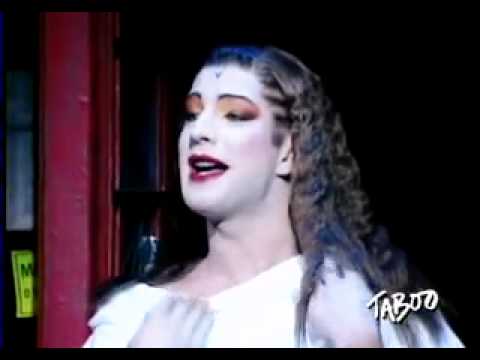
The musical includes more than 20 songs. The premiere of the spectacular was held in London's West End in January 2002. Christopher Renshaw became director. The actors were – Boy George, L. Evans, R. E. Esparza, E. Douglas, G. Morton, D. L. Pilkington, S. U. Berry, J. Carlson & B. Elliot. American actress & comedian R. O'Donnell liked the play so much, so she decided to finance the staging of the musical on Broadway. After 16 previews, the show starts in November 2003 in the Plymouth Theatre. The American public reacted to the setting pretty chilly. After 100 displays, the theatrical was closed because of the negative reviews. The investments have not recouped.The histrionics revived only in 2012 in south London in Brixton. The director has made some changes in the plot by introducing new characters. B. George & K. Frost wrote two new songs for this production. The show had a greater success – 213 performances have been shown. The play closed at the end of March 2013.
Release date: 2003
"Taboo" – The Musical Guide & Song Meanings
Information current as of February 2, 2026.
Review
"Taboo" (the Broadway version that opened in 2003) is a musical about identity that keeps picking fights with storytelling. On its best nights, the score lands like gossip you can dance to: punchy, bratty, strangely tender. On its worst nights, the show behaves like it is still inside a club, daring you to complain about the mess. That dare is half the point.
The lyric engine is attention. Who gets it, who performs for it, who survives without it. Songs keep returning to the language of pose, image, “truth,” and the trapdoor between persona and person. The characters speak in barbs and slogans because the scene itself was built on barbs and slogans, and because Boy George knows how to write a hook that sounds like a diary entry you would never admit is yours.
Musically, "Taboo" sits in pop and new wave idioms, then borrows theatrical muscle when it needs to sell regret. That collision matters: the club sound is how the characters stay upright; the theatre sound is what leaks out when they cannot. The result is a score that can feel more coherent than the book, which is a compliment and also a warning label.
Listening tip: try the cast album in two passes. First, let it play as pop theatre. Second, replay only the ballads and notice how often “fame” is treated like a drug with stage lighting.
How It Was Made
"Taboo" began life in London and then got heavily rebuilt for Broadway, including a new book credited to Charles Busch. The Broadway run opened November 13, 2003 at the Plymouth Theatre and closed February 8, 2004 after 100 performances, a tidy statistic for a show that never felt tidy onstage.
Boy George wrote lyrics and contributed to the score with key collaborators including Kevan Frost, John Themis, and Richie Stevens. What reads like a single voice is more like a writers’ room in eyeliner: collaborative craft, tight pop instincts, and a shared sense that the club scene is both a party and a pressure cooker.
One reason the material still attracts producers is that its subject is not just nostalgia. It is the mechanics of self-invention, and those mechanics are evergreen. A new reimagining has been actively developed in London in 2025/2026, with a newly commissioned book by Jack Holden and Boy George and Michael Longhurst attached to direct, suggesting the piece is being treated less as a period postcard and more as a living draft.
Key Tracks & Scenes
"Freak / Ode to Attention Seekers" (Philip)
- The Scene:
- The evening detonates with a ringmaster introduction. The space reads as a warehouse-club hybrid: bodies packed in, faces angled toward light, everyone auditioning for the right kind of stare.
- Lyrical Meaning:
- This is the show’s thesis in glitter. The lyric frames attention as currency and as hunger. It also sets up the moral problem: if everyone is performing, who is telling the truth, and does it matter?
"Stranger in This World" (George)
- The Scene:
- A quieter pocket inside the noise. George steps out of the group dynamic and lets the mask slip, usually under a tighter, more focused light that isolates him from the crowd.
- Lyrical Meaning:
- The song turns alienation into melody. It argues that difference is not a pose, it is the baseline, and that fame will not solve the loneliness that existed before the first photograph.
"Sexual Confusion" (Marcus, George, Big Sue, Philip)
- The Scene:
- A social pinball machine: flirtation, panic, status games. The choreography tends to treat bodies like punctuation marks, snapping the scene forward.
- Lyrical Meaning:
- The lyric refuses a tidy coming-out narrative. Confusion is not presented as failure; it is presented as the cost of honesty in a room where everyone wants certainty and nobody wants consequences.
"Pretty Lies" (George)
- The Scene:
- A reflective moment that plays like a confession overheard. The staging often pulls the character away from the club’s bustle, letting stillness do the work.
- Lyrical Meaning:
- The show finally names its favorite tool: fabrication. The lyric is interested in the comfort of pretending and the damage it does when it becomes a lifestyle instead of a survival tactic.
"Ich Bin Kunst" (Leigh)
- The Scene:
- Performance art as confrontation. Leigh treats the room like a gallery that cannot look away, often with aggressive, presentational staging that dares the audience to keep up.
- Lyrical Meaning:
- “I am art” is both manifesto and defense mechanism. The lyric makes provocation feel like a shield: if you cannot be loved safely, be admired loudly.
"Everything Taboo" (Company)
- The Scene:
- The club is fully declared, a communal swell of sound where the ensemble moves like a single organism. If the show is going to convince you it is a nightlife epic, it does it here.
- Lyrical Meaning:
- The lyric celebrates transgression while quietly admitting it is a brand. It is joy with a price tag, and that tension is what keeps the number from being pure party.
"Out of Fashion" (Ensemble)
- The Scene:
- The hangover number. The room feels bigger because fewer people fill it, and the mood turns elegiac.
- Lyrical Meaning:
- This is the score’s sharpest meditation on time. The lyric treats trend as mortality practice: if you can be “out” overnight, you can be gone overnight too.
"Come On In From the Outside" (Company)
- The Scene:
- A late-show appeal that tries to stitch community back together. The staging typically shifts toward a more open, inclusive tableau.
- Lyrical Meaning:
- After so much posturing, the lyric attempts something risky: sincerity. It asks whether belonging can exist without the constant need to be the most interesting person in the room.
Live Updates (2025/2026)
A new version of "Taboo" has been actively in development in London with workshops planned across 2025/2026. Producer Thomas Hopkins Productions has announced a reimagining that builds on the original Mark Davies Markham book, with a newly commissioned book by Jack Holden and Boy George and Michael Longhurst attached to direct. As of February 2, 2026, this has been positioned as development activity (workshops) rather than a public commercial run with tickets.
Why it matters for the lyrics: if Longhurst and the new book team are doing their job, expect fewer “and then” scenes and more songs that land as decisions, not decorations. "Taboo" already has a score people defend. The next iteration will live or die on whether the book learns to serve the lyric point of view.
The original Broadway-era ticketing context is also telling: Playbill reported Broadway tickets in the $80–$100 range in late 2003, a sign the producers were aiming squarely at mainstream Broadway economics, not cult-club scarcity.
Notes & Trivia
- The original Broadway production opened November 13, 2003 and closed February 8, 2004 after 100 performances and 16 previews.
- The Broadway production played the Plymouth Theatre (now the Gerald Schoenfeld Theatre).
- The "Taboo (Original Broadway Cast Recording)" was released May 25, 2004 on DRG Records.
- TIME singled out Boy George’s music and lyrics as the production’s strongest element, even while criticizing the book and staging.
- Playbill reported that Tony voters received advance copies of the cast recording in 2004, underscoring the producers’ awards-season strategy.
- Boy George’s wider discography also intersects with "Taboo" material, including songs connected to the show that appear in other releases and versions.
- In 2025, major theatre press reported a fresh reimagining in development, including a newly commissioned book and a high-profile director joining the project.
Reception
"Taboo" has always had a split personality in criticism: admiration for the score, suspicion about the book. That split has softened over time, partly because musical theatre has caught up to the idea that pop language can carry real character weight, and partly because the culture now reads the show’s identity politics with more fluency than some 2003 reviews managed.
“The real triumph of Taboo, however, is O’Dowd’s music and lyrics, among the best I’ve heard on Broadway in the past few seasons.”
“The pleasure of this show is in the savage wit displayed by George and mates Marilyn, Philip Sallon and Leigh Bowery.”
“Taboo juxtaposes the speedy rise and precipitous fall of the front man for Culture Club with the sad story of a fellow club fixture.”
Quick Facts
- Title: Taboo
- Broadway year: 2003 (opened November 13, 2003)
- Type: Pop-driven book musical with biographical elements
- Lyrics: Boy George
- Music: Boy George with Kevan Frost, John Themis, and Richie Stevens
- Book: Mark Davies Markham (original); Charles Busch (Broadway rewrite)
- Director (notable productions): Christopher Renshaw
- Broadway theatre: Plymouth Theatre (now Gerald Schoenfeld Theatre)
- Run: 16 previews; 100 performances
- Cast album (Broadway): “Taboo (Original Broadway Cast Recording)”
- Label: DRG Records
- Album release date: May 25, 2004
- Selected notable placements: Opening number “Freak / Ode to Attention Seekers”; club-set ensemble peak “Everything Taboo”
- 2025/2026 status: Reimagined version in development in London (workshops announced)
Frequently Asked Questions
- Is “Taboo” a jukebox musical?
- No. The score is largely original, with a small number of familiar Boy George or Culture Club-associated songs used in certain versions and recordings.
- Why do people argue about the Broadway version?
- Because the Broadway rewrite put heavier emphasis on Boy George’s arc, and critics often felt the book could not keep pace with the music’s clarity.
- What is the most important lyrical theme?
- Attention as survival. Characters treat visibility like oxygen, then discover it can also become an addiction.
- Is there a current revival or tour?
- As of February 2, 2026, the most concrete public reporting points to workshops in London for a reimagined version, rather than an announced ticketed run.
- Which songs should I start with if I’m new to the show?
- Try “Freak / Ode to Attention Seekers,” “Stranger in This World,” “Everything Taboo,” and “Out of Fashion.” They outline the show’s emotional map without requiring plot homework.
Key Contributors
| Name | Role | Contribution |
|---|---|---|
| Boy George (George O’Dowd) | Lyricist / Composer | Primary lyrical voice; co-wrote music and shaped the score’s pop-theatre identity. |
| Kevan Frost | Composer / Collaborator | Key music collaborator across versions; helped translate club sonics into theatre structure. |
| John Themis | Composer / Collaborator | Co-wrote music; part of the collaborative core behind the score. |
| Richie Stevens | Composer / Collaborator | Co-wrote music; contributed to the show’s stylistic range. |
| Mark Davies Markham | Book | Original book that established the show’s character world and scene framework. |
| Charles Busch | Book (Broadway rewrite) | Rebuilt the London book for Broadway, shifting emphasis and structure. |
| Christopher Renshaw | Director | Directed notable productions; helped set the show’s visual grammar. |
| Rosie O’Donnell | Producer (Broadway) | Backed the Broadway transfer and its scale-up economics. |
| DRG Records | Label | Released the Original Broadway Cast Recording (May 25, 2004). |
| Jack Holden | Book (reimagining, 2025/2026) | Commissioned to co-write a new book with Boy George for the current development version. |
| Michael Longhurst | Director (reimagining, 2025/2026) | Attached to direct the new development iteration, signaling a contemporary reframe. |
Sources: IBDB, Playbill, TIME, The Guardian, WhatsOnStage, Thomas Hopkins Productions, Apple Music, YouTube.
Author: David Gordon, theatre journalist and technical SEO editor. Focus: lyric function, production history signals, and what revivals tend to fix first.