Summer of '42 Lyrics: Song List
- Prelude
- The Summer You'll Always Remember
- The Terrible Trio
- Here and Now
- Will That Ever Happen To Me?
- Winchell report #1
- You're Gonna Miss Me
- Little Did I Dream
- Mr. Sanders #1
- The Walk
- Unfinished Business
- Make You Mine
- Mr. Sanders #2 / Here and Now (Reprise)
- The Drugstore
- The Jitterbug
- The Marshmallow Roast
- The Campfire
- Hermie And Dorothy
- Promise of the Morning
About the "Summer of '42" Stage Show
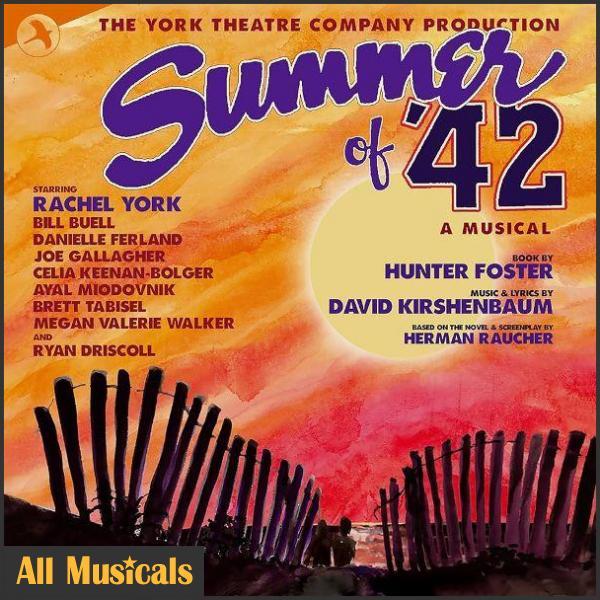
The songs written by D. Kirshenbaum. Libretto prepared by H. Foster. The premiere was in Chester’s Norma Terris Theatre from August to September 2000. Histrionics was directed and choreographed by G. Barre. The staging had this cast: I. Menzel, R. Driscoll, B. Tabisel, J. Marcus, M. Farnsworth & J. Goodman. In October 2000, a musical was shown in Dayton Victoria Theatre. In July 2001, the show took place in California MVCPA. The cast has changed a little – in the show entered K. J. Grant & E. Webley. Off-Broadway production was shown from December 2001 to January 2002 in the Variety Arts Theatre, directed by G. Barre. In the spectacular were involved: R. Driscoll, K. J. Grant, C. Keenan-Bolger, J. Marcus, G. Stone, B. Tabisel, M. V. Walker & E. Webley.
In October 2003, the play was in Texas’ Casa Manana Theatre. The director of the show was G. Barre. Stars: R. York & J. Gallagher. In May 2005, the Theatre at St. Peter's Church hosted a concert after this musical. Production was prepared by G. Barre. The cast involved: R. York, R. Driscoll, C. Keenan-Bolger, M. V. Walker, D. Ferland, B. Tabisel, J. Gallagher, A. Miodovnik & B. Buell. From June to July 2007 it was exhibited in Round House Theatre, directed by M. McDonough. The main cast was: N. Snow & R. Nealy. From July to August 2013, this piece was in Philadelphia Bucks County Playhouse, prepared by director H. Foster & choreographer L. Latarro. The musical included actors: B. Buntain, J. Dippel, A. Gagarin, F. M. Haynie, B. Hogg & B. Mayne. In 2007, the recording of an album has been produced. In 2001, production was nominated for Outer Critics Circle, but didn’t win.
Release date of the musical: 2007
"Summer of '42" – The Musical Guide & Song Meanings
Review: what the lyrics are really doing
How do you musicalize a story where the most important moment is almost silent? Hunter Foster’s book and David Kirshenbaum’s score solve it by giving language to the things the characters cannot say in 1942: sex, grief, and the uneasy gap between “crush” and “consequence.” The lyrics don’t just decorate the plot. They create a moral weather system. The boys’ jokes and swagger rhyme with radio-era snap, while Dorothy’s lines stretch out, careful and adult, as if she has learned to ration verbs the way the country rations sugar.
Kirshenbaum writes in a period-fluent musical theatre idiom, with swing and pop-inflected structures that let the show slide between teen comedy and war-bride sorrow without sounding like two different scores. Listen for the way the radio voice of Walter Winchell functions as a recurring lyrical device. Those “Winchell Report” tracks are not filler; they are the show’s public language, always trying to tidy up a messy private story. Against that, “Here and Now” keeps insisting on immediacy. The title itself is basically the boys’ philosophy, until the narrative forces them to learn what “now” can cost.
Experience tip (for listeners): play the cast recording straight through once, without skipping the scene tracks. This is a fully scripted album. The pacing tells you where the writers want discomfort, where they want oxygen, and where they want you to laugh so you will feel worse later.
How it was made
The musical is based on Herman Raucher’s novel and screenplay, and it moved through a long development path before its Off-Broadway run. It had early readings and productions in the early 2000s, then a complete concert presentation at The York Theatre Company in May 2005, followed immediately by the studio session that became the two-disc cast album. That time lag matters. The score sounds like a show that has been tested, argued over, and tightened in rooms full of actor-musicians trying to make adolescent humor land without turning Dorothy into a plot device.
One piece of behind-the-scenes honesty that helps decode the writing: in a 2001 interview around the Off-Broadway opening, cast members and creatives talked about the project’s youthfulness and how the story’s wartime context felt newly immediate in the wake of national trauma. That context is baked into the lyric choices. The boys talk big because they are scared. Dorothy speaks carefully because she is already living in the aftermath.
Key tracks & scenes
"The Summer You’ll Always Remember" (Company)
- The Scene:
- A seaside summer postcard comes to life. Bright, open lighting. The boys narrate their own legend before the world has a chance to correct it.
- Lyrical Meaning:
- The lyric is memory writing itself in real time. It is not nostalgia yet. It is bravado. That difference matters, because the show’s last pages will force the audience to hear this opening promise as a setup.
"Here and Now" (Hermie, Oscy, Benjie)
- The Scene:
- The “Terrible Trio” declares its summer mission with the conviction of boys who think a slogan counts as a plan. Tight focus lighting, quick dialogue rhythms.
- Lyrical Meaning:
- This is the show’s thesis in miniature: adolescence treats urgency as virtue. The phrase returns later with a different weight, when “now” stops being funny.
"The Walk" (Dorothy, Hermie)
- The Scene:
- On a path near Dorothy’s house, the stage narrows. The boys’ world falls away. Dorothy and Hermie move in parallel like two people in different decades.
- Lyrical Meaning:
- Foster’s lyric strategy often turns on social permission. A “walk” is safe, polite, explainable. Underneath, the song is about a boy rehearsing adulthood and a woman borrowing normality.
"The Movies" (Boys, Girls)
- The Scene:
- A movie house: darkness, flashing screen light, hands that do not know where to go. Comedy is played as choreography, not punchline.
- Lyrical Meaning:
- The lyric treats cinema as both education and misinformation. The boys are learning from shadows. The show is quietly accusing American romance culture of teaching technique without teaching empathy.
"The Drugstore" (Hermie, Mr. Sanders)
- The Scene:
- Bright soda-fountain lighting. A grown man (Mr. Sanders) controls the situation with cheerfully merciless small talk while Hermie tries to buy condoms without saying the word.
- Lyrical Meaning:
- One of the score’s best examples of lyrical engineering: euphemism as comedy, and comedy as a pressure valve. It also underlines the show’s moral framework. Adults know what’s going on. They choose when to intervene.
"Someone to Dance With Me" (Dorothy)
- The Scene:
- Late evening at Dorothy’s house. The lighting warms, then cools. The room feels too big. Music arrives like a memory of parties that no longer make sense.
- Lyrical Meaning:
- Dorothy’s lyric vocabulary is built around absence: a husband offstage, a future postponed, a body present but unclaimed. The desire is simple, but the implications are not. The song frames intimacy as a human need, not a twist.
"Promise of the Morning" (Dorothy, Hermie)
- The Scene:
- After the telegram, the stage goes spare. Dorothy’s grief is not acted outward; it is contained. A single pool of light, like dawn refusing to arrive on schedule.
- Lyrical Meaning:
- This is the score’s emotional hinge. The lyric makes a commitment without pretending it is a cure. “Morning” is not optimism here; it is survival, and the language is deliberately plain because anything pretty would feel dishonest.
"Losing Track of Time" (Dorothy)
- The Scene:
- Bonus track from the cast album: Dorothy in reflection, outside the show’s strict chronology. The accompaniment is less period, more confessional.
- Lyrical Meaning:
- The lyric reframes the story as adulthood looking back, a mirror to Hermie’s future narration. It suggests the show’s real subject is not sex. It is how memory edits pain so life can continue.
Live updates (2025/2026)
Information current as of February 2026. “Summer of ’42” lives primarily as a licensed title rather than a standing commercial property. The rights are handled through a licensing house (and the cast album remains the most reliable way to experience the full narrative at home). If you are tracking productions, your best indicators tend to be regional-theatre season announcements, conservatory programming, and community-theatre calendars rather than Broadway touring grids.
On recordings: the two-disc Original Cast Recording is widely available on major streaming platforms, and its structure matters for SEO and for listeners. This is not a highlights album. It is essentially a “complete narrative” audio document, including dialogue tracks, which makes it unusually useful for understanding where each song lands in the story.
Notes & trivia
- The Original Cast Recording is a two-disc set with 41 tracks, and it includes scripted material in addition to songs.
- The York Theatre Company hosted a full concert presentation of the complete show in May 2005; the cast went into the studio the next day to record the album.
- Development included early performances/readings connected to Goodspeed’s Norma Terris Theatre in Connecticut before the Off-Broadway run.
- A 2013 staging at Bucks County Playhouse positioned the piece in direct dialogue with military service, honoring veterans at performances.
- Walter Winchell’s presence as recurring “report” tracks turns period journalism into a structural motif: public narrative interrupting private crisis.
- The Outer Critics Circle cited the show in its 2002 season nominations for Outstanding Off-Broadway Musical.
- Myth-check: many people confuse this musical with the 1971 film’s famous instrumental theme by Michel Legrand. The stage musical’s score is an original by David Kirshenbaum, not an adaptation of Legrand’s film score.
Reception: then vs. now
Critical response in 2001 often circled the same friction point: the material’s restraint is either its integrity or its limitation. Some reviewers wanted sharper theatrical teeth. Others responded to its gentleness as the point, especially in a post-9/11 climate where wartime stories landed differently.
“So one might conclude after a visit to ‘Summer of ’42,’ a personality-free new musical …”
“Unlike Urinetown … Summer of ’42 has no sharp edges …”
“Much of Summer of ’42 takes place on the beach, which may explain why it seems so waterlogged.”
What has aged best is the show’s lyric architecture around permission, silence, and hindsight. The dialogue-plus-score recording also changed the afterlife: listeners can “stage” it internally, which has helped the material travel through regional and educational contexts even without a constant commercial footprint.
Quick facts
- Title: Summer of ’42
- Year (cast album release): 2007
- Type: Stage musical (adapted from novel and film)
- Book: Hunter Foster
- Music and lyrics: David Kirshenbaum
- Based on: Herman Raucher’s novel and screenplay
- Original Cast Recording: 2 CDs, 41 tracks (dialogue and score)
- Label: JAY Records
- Musical director (recording): Lynne Shankel
- Selected notable placements (album track markers): “The Movies” (movie house sequence), “The Drugstore” (condom purchase), “Promise of the Morning” (post-telegram emotional centerpiece)
- Release context: Recorded after a May 2005 York Theatre concert presentation; released as a two-disc set in 2007
Frequently asked questions
- Is “Summer of ’42” the same story as the 1971 film?
- Yes, it is a stage adaptation of the same core narrative: three teen boys on a New England island during WWII, and one boy’s complicated bond with a war bride named Dorothy.
- Who wrote the lyrics?
- David Kirshenbaum wrote the music and lyrics, with a book by Hunter Foster.
- Where do I start if I only listen to a few tracks?
- Start with “The Summer You’ll Always Remember,” then “Here and Now,” then jump to “The Drugstore” for comedic tone, and finish with “Promise of the Morning” for the emotional thesis.
- What are the “Winchell Report” tracks doing on the album?
- They function like period news bulletins and time stamps. Dramatically, they keep pulling the story back to the public world of war and headlines, which makes the private plot feel less safe.
- Is the cast recording a highlights album or the full show?
- It is closer to a full narrative document: two discs, 41 tracks, including dialogue tracks and scene transitions.
Key contributors
| Name | Role | Contribution |
|---|---|---|
| David Kirshenbaum | Composer, lyricist | Wrote the score and lyrics; builds recurring motifs like “Here and Now” and the Winchell interludes. |
| Hunter Foster | Book writer | Shapes the dialogue rhythm and the show’s tonal pivots between teen comedy and Dorothy’s grief. |
| Herman Raucher | Source author | Wrote the novel and screenplay that the musical adapts. |
| Lynne Shankel | Musical director (recording) | Leads the album’s musical continuity; also appears on instrumentals and transitions. |
| Gabriel Barre | Director | Directed the Off-Broadway production and is credited on the cast album materials. |
| John Yap | Producer (recording) | JAY Records producer credited on bonus material connected to the recording. |
| Rachel York | Original cast recording performer | Portrays Dorothy on the recording, anchoring the score’s adult emotional center. |
| Ryan Driscoll | Original cast recording performer | Portrays Hermie; carries the story’s narration and the coming-of-age lens. |
Sources: JAY Records, Playbill, TheaterMania, CurtainUp, Variety, Apple Music, BroadwayWorld, ovrtur, Concord Theatricals.