Spamalot Lyrics – All Songs from the Musical
Spamalot Lyrics: Song List
- Act 1
- Overture / Historian's Introduction to Act One
- Finland / Fisch Schlapping Dance
- Monks' Chant/ He Is Not Dead Yet
- King Arthur's Song
- He Is Not Dead Yet
- Come With Me
- Laker Girls Cheer
- The Song that Goes Like This
- All For One
- Knights of the Round Table
- Find Your Grail
- Run Away!
- Act 2
- Historian's Introduction to Act Two / Always Look On The Bright Side of Life
- Brave Sir Robin
- You Won't Succeed On Broadway
- Diva's Lament (Whatever Happened to My Part?)
- Where Are You?
- His Name Is Lancelot
- I'm All Alone
- Twice In Every Show
- Act II Finale
- Always Look On the Bright Side of Life (Reprise)
About the "Spamalot" Stage Show
This musical is of comedian genre and is considered to be kind of parody of all famous legends about Arthur. It is an adaptation of movie, created in 1975. This production is different from film though. Original Broadway version was created in 2005. The previews were at NY Shubert Theatre. Official opening was in March. Author and director of the musical was M. Nichols. C. Nicholaw became a choreographer, John Du Prez, Neil Innes and Eric Idle became the composers. The latest also wrote lyrics. There were more than 30 tryouts and 1500 performances. Displays were closed in 2009. The initial cast included T. Curry, M. McGrath, D. H. Pierce, H. Azaria, C. Sieber and S. Ramirez. There were several replacements during displays.The staging became successful from the very beginning, winning Tony Awards as Best Musical. The spectacle was nominated for plenty of other Tonies as well. In 2006, appeared West End production. Its opening took place at Palace Theatre. Displays lasted for two years. Then there was also a tour in the UK. In 2010, it started at New Wimbledon Theatre. Phill Jupitus and Todd Carty were selected for the leading roles. Other performers were Simon Lipkin, David Lingham, Samuel Holmes, Graham McDuff and Robin Armstrong. In 2011, the musical officially opened in Italy. In 2012, this production got a revival in West End. Displays happened at Harold Pinter Theatre. The majority of actors were the same as for the UK tour. The tour in the USA began in 2006. Michael Siberry, David Turner, Rick and Bradley Dean & Jeff Dumas were among the cast. This tour obtained two Broadway Awards, which also included one for Best Musical. Displays ended in 2009 after visiting Chicago, San Francisco, LA, San Diego and other places.
Release date: 2005
"Spamalot" – The Musical Guide & Song Meanings
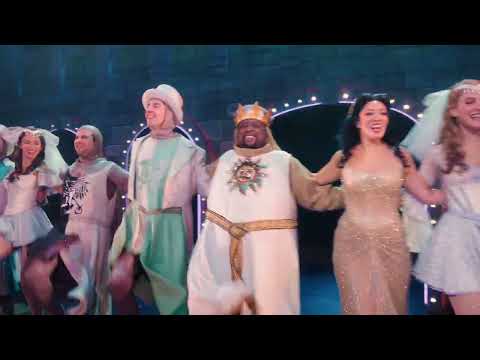
Review
“Spamalot” is the rare musical that mocks the form while depending on it. That sounds like a contradiction. Onstage, it is the whole business model. Eric Idle’s lyrics are built as fake sincerity, then real sincerity, then fake again, sometimes inside a single rhyme. The show wants the audience to recognize the gag and also to enjoy the craft enough to applaud the gag’s target.
Most parody scores stop at reference. This one writes like a diagnosis. “The Song That Goes Like This” is not just a joke about power ballads, it is a practical manual for how Broadway telegraphs emotion with key changes, swelling orchestration, and rhymed inevitability. “Diva’s Lament” is not just a star turn, it is an argument about structural neglect: when the show sidelines the Lady of the Lake, the lyric tells you exactly how the machine treats women as accessories. Even the pep-rally material (“Find Your Grail”) is a spoof with a point. It lands because it is genuinely singable.
And yes, the production keeps evolving. The 2023 Broadway revival and the 2025–2026 tour lean into topical punchlines and more inclusive comedy choices, including turning an old “rescue the bride” beat into a celebratory same-sex wedding sequence. That is less about being “current” and more about making the satire aim upward instead of sideways. You still get the flying cow. You also get a show that understands its own punchlines are artifacts that need maintenance.
Experience tip: “Spamalot” is noisy, visual, and full of blink-and-miss props. If you are choosing seats, prioritize sightlines over distance. You want to read faces and catch the fast physical jokes.
How it was made
The show began as a pre-Broadway Chicago engagement in late 2004, then hit Broadway in March 2005 at the Shubert Theatre, directed by Mike Nichols with choreography by Casey Nicholaw. That creative pairing matters. Nichols treated the comedy like a straight play that occasionally bursts into musical absurdity, which is why the lyric jokes land as character choices instead of sketch leftovers.
Idle later opened the backstage door wider with “The Spamalot Diaries,” a compilation drawn from his diaries and emails during development and the Broadway run-up. The throughline is not “we were wacky.” It is the grind: rewrites, structural debates, and the oddly delicate task of turning cult comedy into eight-shows-a-week timing. AP reporting also credits Idle with a practical spark for the adaptation: the idea clicked while he was working on a CD-ROM game based on “Holy Grail.”
And then there is the cut-song mythology, which is unusually well documented. Chicago had at least two Act I numbers that did not survive to Broadway, including “The Cow Song.” The joke here is that even in a show about silliness, the writers still made hard editorial decisions. In 2025, the 20th anniversary release finally made “The Cow Song” part of the official audio record.
Key tracks & scenes
"The Song That Goes Like This" (Galahad, Lady of the Lake)
- The Scene:
- Act I, after the Lady of the Lake transforms Dennis into Sir Galahad. The stage shifts into glossy romance mode on purpose: spotlit faces, slow movement, and a “we are now doing a serious musical” posture that cannot stay serious.
- Lyrical Meaning:
- It is a parody blueprint, but it is also affectionate. The lyric points at modulation, rhyme logic, and melodramatic escalation, then proves it can execute all of it cleanly.
"Knights of the Round Table" (Company)
- The Scene:
- Act I, the arrival at Camelot, staged as Las Vegas pageantry with armor. Think bright, brassy, deliberately tacky glam. The choreography is a joke and also real choreography.
- Lyrical Meaning:
- This is the show announcing its core trick: medieval legend filtered through Broadway bravado. The lyric’s cheerfulness is the satire. Camelot is “a silly place,” but the number is engineered like a true showstopper.
"Find Your Grail" (Lady of the Lake, Company)
- The Scene:
- End of Act I, God assigns the quest. The Lady reframes it as a motivational anthem, often staged with a strong front-light wash and a chorus that suddenly looks like an army of backup singers.
- Lyrical Meaning:
- Self-help language as comedy, but also as propulsion. The lyric turns a plot requirement into a collective pep talk, then dares you to whistle it afterward.
"You Won’t Succeed on Broadway" (Robin, Ensemble)
- The Scene:
- Act II, after the Knights Who Say Ni demand a musical. Robin becomes the accidental producer, selling “commerciality” as destiny. Lighting often shifts into flashy, cabaret-style punchiness.
- Lyrical Meaning:
- A roast of Broadway economics and taste. The lyric is broad, but the underlying joke is technical: it understands how producers talk when they pretend cynicism is artistry.
"Diva’s Lament (What Ever Happened to My Part?)" (Lady of the Lake)
- The Scene:
- Act II, the Lady stops the show to file a complaint. Staging usually isolates her in a hot spotlight, with the orchestra acting like it has been waiting all night to go big.
- Lyrical Meaning:
- Meta, yes, but pointed. The lyric is a structural critique disguised as comedy: when the story sidelines her, the show admits it out loud and turns neglect into virtuosity.
"His Name Is Lancelot" (Lancelot, Herbert, Men)
- The Scene:
- Act II, the revelation and celebration of Lancelot’s identity. In newer stagings, the scene leans toward joyful spectacle rather than snickering punchlines.
- Lyrical Meaning:
- One of the clearest examples of revision over time. The lyric and staging choices can tilt it toward cheap laughs or toward community affirmation. Recent productions have favored the latter.
"Always Look on the Bright Side of Life" (Patsy, Arthur, Men)
- The Scene:
- Act II opener, after chaos and separation. The number often plays with a warm, audience-facing brightness, like a wink that says, “Yes, we know what happened. Sing anyway.”
- Lyrical Meaning:
- Borrowed from “Life of Brian,” but repurposed as a theatrical reset button. The lyric is gallows cheer, which makes it perfect for a show that keeps getting interrupted by its own stupidity.
Song-to-plot placement above follows the licensed synopsis and widely circulated production summaries, with scene framing aligned to the 2023–2026 staging style described in major reviews.
Live updates (2025/2026)
Information current as of 2 February 2026. The “Spamalot” North American tour launched December 1, 2025 in Cleveland and is scheduled on IBDB through late August 2026. The tour routing includes major markets across the U.S., framed in press materials as a 30-plus-city first-year run.
The tour cast is led by Major Attaway as King Arthur, with Sean Bell as Sir Robin, Chris Collins-Pisano as Sir Lancelot, Ellis C. Dawson III as Sir Bedevere, Leo Roberts as Sir Galahad, Amanda Robles as the Lady of the Lake, Blake Segal as Patsy, and Steven Telsey as the Historian and Prince Herbert. The official tour site maintains a current “company” roster, and multiple venue press releases mirror the same principal lineup.
Context if you are tracking the title’s momentum: the 2023 Broadway revival closed April 7, 2024, but it functioned as a launchpad. The tour is the long tail, where a comedy like this makes its real money and tests what jokes survive contact with 2026.
Audio-side, 2025 brought a 20th anniversary edition of the Original Broadway Cast Recording on vinyl, marketed with a booklet of lyrics and the restored “Cow Song.” That is both collector bait and a quiet archival moment: it formalizes a piece of the score that had lived as trivia.
Notes & trivia
- Chicago previews began Dec 21, 2004, and the Chicago opening was Jan 9, 2005 before the show transferred to Broadway.
- Broadway previews began Feb 14, 2005; official Broadway opening was Mar 17, 2005 at the Shubert Theatre.
- The original Broadway run played 1,575 performances (plus 34 previews) and closed Jan 11, 2009.
- The 2023 Broadway revival announced its closing for April 7, 2024, and industry coverage positioned a fall 2025 tour launch as the next step.
- The Original Broadway Cast Recording won the Grammy Award for Best Musical Show Album (awarded in 2006).
- Chicago had songs that were later cut, including “The Cow Song,” which was restored to the official recorded release as a 20th anniversary bonus in 2025.
- The 2025–2026 tour is listed on IBDB as running from Dec 1, 2025 through Aug 26, 2026.
Reception
Critics tend to agree on the central fact: “Spamalot” is more Broadway parody than Arthurian parody, and it lives or dies on execution. The 2023 revival reviews praised the production for going big on spectacle while acknowledging that “jokebox” familiarity is a risk. Tour reviews in early 2026 describe a show that plays best when it stops trying to be “updated” and instead commits to its own ridiculous mechanics.
“It is essentially an ongoing parody of itself.”
“A welcome dose of both hilarious deconstruction and old-fashioned razzle-dazzle.”
“A stuffed spectacle threatening to burst under the weight of its sheer stupidity.”
Quick facts
- Title: Monty Python’s Spamalot (commonly billed as Spamalot)
- Year: 2005 (Broadway premiere)
- Type: Musical comedy
- Book & lyrics: Eric Idle
- Music: John Du Prez and Eric Idle
- Original Broadway director: Mike Nichols
- Original Broadway choreographer: Casey Nicholaw
- Broadway opening: Mar 17, 2005 (previews began Feb 14)
- Broadway run: 1,575 performances; closed Jan 11, 2009
- Recent Broadway run: 2023 revival closed Apr 7, 2024
- Cast album: Original Broadway Cast Recording (Decca Broadway), recorded Feb 7, 2005; released May 3, 2005
- Awards (album): Grammy Award for Best Musical Show Album (awarded 2006)
- 2025 audio update: 20th Anniversary Edition vinyl with “The Cow Song” and a lyrics booklet
- 2025/2026 live status: North American tour launched Dec 1, 2025; listed on IBDB through Aug 26, 2026
- Selected notable placements: “The Song That Goes Like This” after Galahad’s knighting; “Find Your Grail” at Act I climax; “Diva’s Lament” mid-Act II as a structural protest song
Frequently asked questions
- Who actually wrote the lyrics of “Spamalot”?
- Eric Idle wrote the book and lyrics, collaborating with John Du Prez on the music. Several musical ideas are adapted from the broader Monty Python universe, but the lyric voice is overwhelmingly Idle’s.
- Is “Spamalot” just “Holy Grail” with songs?
- Not quite. It borrows famous scenes, but its main target is musical theatre convention: it treats Broadway structure as the true legend it is allowed to mock.
- What is the best recording to start with?
- The 2005 Original Broadway Cast Recording is the baseline document, and the 2025 20th Anniversary Edition adds a notable cut number and expanded packaging.
- Is “Always Look on the Bright Side of Life” originally from “Spamalot”?
- No. It predates the musical and was repurposed as the Act II opener because its cheerful fatalism fits the show’s tone like a glove.
- Is there a current U.S. tour in 2026?
- Yes. The North American tour launched in December 2025 and is scheduled into summer 2026, with principal casting announced by multiple industry and venue sources.
Key contributors
| Name | Role | Contribution |
|---|---|---|
| Eric Idle | Book & lyricist; co-composer | Built a lyric voice that parodies Broadway form while still delivering clean hooks and narrative propulsion. |
| John Du Prez | Composer | Co-wrote the score’s musical language, balancing pastiche with genuine musical-theatre architecture. |
| Mike Nichols | Director (original Broadway) | Anchored the comedy in disciplined storytelling, making the jokes land as choices instead of sketches. |
| Casey Nicholaw | Choreographer (original Broadway) | Delivered choreography that works simultaneously as satire and real Broadway spectacle. |
| Josh Rhodes | Director & choreographer (2023 revival; tour staging) | Steered the revival toward topical refreshes and high-energy staging that feeds the touring version’s scale. |
| Tim Curry | Original Broadway cast | Originated King Arthur on Broadway, establishing the “straight man under siege” performance template. |
| Sara Ramirez | Original Broadway cast | Originated the Lady of the Lake, shaping the show’s signature diva meta-comedy and vocal fireworks. |
| Major Attaway | Tour lead (2025–2026) | Leads the national tour as King Arthur, central to translating the revival’s comedic pacing to large houses. |
| Amanda Robles | Tour lead (2025–2026) | Plays the Lady of the Lake on tour, carrying the show’s biggest vocal and meta-theatrical material. |
Sources: Spamalot official site, IBDB, Playbill, AP News, Time Out, Entertainment Weekly, The Times Union, Decca (20th anniversary release page), Deutsche Grammophon store listing, SecondHandSongs.