Seven Brides For Seven Brothers Lyrics – All Songs from the Musical
Seven Brides For Seven Brothers Lyrics: Song List
- Act 1
- Bless Your Beautiful Hide
- Wonderful, Wonderful Day
- One Man
- Goin' Courtin'
- Social Dance
- Love Never Goes Away
- Sobbin' Women
- Act 2
- Townsfolk's Lament
- Woman Ought to Know Her Place
- We Gotta Make It Through the Winter
- We Gotta Make It Through the Winter (Reprise)
- Spring, Spring, Spring (Spring Dance)
- Woman Ought to Know Her Place (Reprise)
- Glad That You Were Born
- Love Never Goes Away (Reprise)
- Wedding Dance
- Finale: Wonderful Day (Reprise)
About the "Seven Brides For Seven Brothers" Stage Show
The scenario to the considered histrionics was written by famous authors L. Kasha & D. Landay. Music part has been produced by G. de Paul, A. Kasha & J. Hirschhorn, lyrics – by the same team + J. Mercer. The project did not remain unnoticed. In many ways, staging is rooted in the eponymous film of 1954 by S. Donen, which was an adaptation of a short story by S. V. Benet ‘The Sobbing Women’.After a highly vivid tour in the USA, production gradually moved to the Broadway. The venue of its demonstration was chosen Alvin Theatre. The 1st show took place in July 1982. Prior to it, the beholders, producers the critics could see 18 previews. Director's chair of a project took L. Kasha, as choreography was made by J. Jackson. The cast included D. Boone, D. Carroll, L. Teeter, C. Peralta & N. Fox. Despite all expectations, musical failed miserably at the box office. Its story ended just after 5 performances.
In July 2 1985, a reborn histrionics was premiered in the West End. It was crowned with much greater success than it was 3 years ago on Broadway, but not too much more vivid, only 41 of plays were staged. All the performances took place in the Old Vic theater. The main roles performed R. Page, S. Devereaux & M. Strachan. London production hasn’t been noted warmly by critics and it neither received awards or honors.
Release date: 1985
"Seven Brides for Seven Brothers" – The Musical Guide & Song Meanings
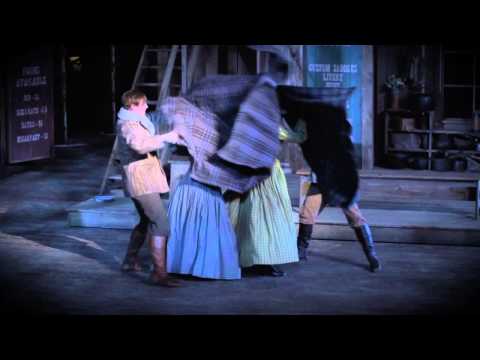
Review: what the show is trying to pull off
The job of “Seven Brides for Seven Brothers” is simple to describe and tricky to justify: it wants you to cheer a romance that starts with a shopping trip for a wife, then swerves into a mass abduction, then begs to be forgiven by spring. That sounds like a dare, and modern productions treat it that way, leaning hard on comedy, speed, and a score that keeps refusing to sit still. When it works, the lyrics serve as the show’s moral thermostat, rising when the men mythologize their own behavior and dropping when Milly forces the story back into the real world.
Johnny Mercer’s best lines in the borrowed film material have that familiar snap: plain words, bright rhythm, and a sneaky wink on the rhyme. The stage additions by Al Kasha and Joel Hirschhorn do a different kind of labor. Their songs plug narrative leaks, especially once the blizzard isolates everyone and the plot needs emotional arguments, not just athletic dance breaks. The lyric writing tends to say the quiet part out loud, which is exactly what this particular story requires if you want the audience to stay with it.
Musically, the show lives in mid-century Americana, buoyant major keys, square-dance propulsion, and choruses built for big open vowels. That style matters because it frames the brothers’ world as energetic and childish rather than sinister. It also gives Milly a satisfying dramatic contrast: she’s the one character whose songs consistently translate charm into terms and conditions.
How it was made: from MGM gloss to stage pragmatism
The property begins as the 1954 MGM film, directed by Stanley Donen with choreography by Michael Kidd, and songs by Gene de Paul and Johnny Mercer. Under the hood, the story reaches back further: Stephen Vincent Benét’s short story “The Sobbin’ Women,” itself riffing on the Sabine women legend. The stage musical had to make all of that playable in a room with living actors and a visible orchestra pit, which is why the adaptation history reads like a long series of revisions and re-revisions.
By the late 1970s, the show was adapted for the stage with a book by Lawrence Kasha and David Landay and additional songs by Kasha and Hirschhorn. It reached Broadway briefly in 1982, then found a more durable life in touring and regional contexts where dance-heavy classics have space to breathe.
Your “1985” marker is especially telling. That year, a West End run landed at the Old Vic beginning 2 July 1985, with Roni Page as Milly and Steve Devereaux as Adam. The same production travelled, including a Toronto engagement at the Royal Alexandra Theatre from 9 September through 19 October 1985. The following year, the Original London Cast Recording was released on First Night Records, effectively freezing a specific vintage of the score: the film standards plus story-filling stage songs that explain what the characters are thinking when the plot refuses to slow down.
Key tracks & scenes: the lyrical turning points
"Bless Your Beautiful Hide" (Adam)
- The Scene:
- Town, daytime. Adam is in public, doing private math. He circles the locals like a man who has mistaken “courtship” for “procurement,” and the number lands on Milly.
- Lyrical Meaning:
- This is Adam’s self-mythologizing in real time. The lyric is full of big open praise, but it’s also a sales pitch he’s delivering to himself: he’s not impulsive, he’s “decisive.” The song plants the show’s central tension: charm can be a mask for entitlement.
"Wonderful, Wonderful Day" (Milly, Town Women)
- The Scene:
- Outside the restaurant, bright and bustling. The town women try to warn Milly, and Milly refuses to take the note. Light stays sunny because she’s decided the story is sunny.
- Lyrical Meaning:
- Milly sings optimism as a defense mechanism. The lyric’s cheer becomes character information: she’s capable of hope that borders on stubbornness, which later becomes her superpower when she has to civilize seven men at once.
"Goin' Courtin'" (Milly, Adam, Brothers)
- The Scene:
- The Pontipee house, morning into montage. Milly turns the cabin into a finishing school. The staging usually makes it kinetic: comic drills, shaving, posture, and the brothers learning that clean shirts do not cause injury.
- Lyrical Meaning:
- The song is a thesis statement for the “battle of the sexes” framing. Milly is rewriting the brothers’ vocabulary. The lyric’s real punch is practical: romance requires behavior, not just desire.
"Sobbin' Women" (Adam, Brothers)
- The Scene:
- After the social fight, late-night plotting. Adam gives the brothers a history lesson with disastrous confidence. The staging often tightens the light and narrows the space, as if the room itself is trying to stop him from finishing the idea.
- Lyrical Meaning:
- The lyric is clever, and that’s the problem. It weaponizes wit to rationalize wrongdoing. Dramatically, it’s the hinge: the show stops being a courtship comedy and becomes a redemption problem that the score will spend Act Two trying to solve.
"The Townsfolk's Lament" (Suitors, Town)
- The Scene:
- Town square chaos, then prayer. The brides are gone, the men are panicked, and the ensemble gets to voice the moral outrage the plot needs onstage.
- Lyrical Meaning:
- This is the community’s verdict, sung. The lyric reframes the story away from the brothers’ “romance” and toward the brides’ autonomy. It’s also a structural reset: the show reminds you that consequences exist.
"We Gotta Make It Through the Winter" (Brothers, then Women)
- The Scene:
- The farm, snowed-in Act Two. The men are exiled to the barn while the women set the rules inside. It plays best with visible weather and a sense of time dragging, lantern light, cold breath, and chores that never end.
- Lyrical Meaning:
- The lyric turns yearning into penance. For the brothers, love becomes patience for the first time. For the women, the reprise often reads like a negotiation with reality: they can be angry and still admit attachment.
"Love Never Goes Away" (Milly, Adam, ensemble variants)
- The Scene:
- Two emotional angles, usually staged in parallel. Milly holds the romantic center while the brothers confess their own first loves, and the show finally lets longing look vulnerable instead of boastful.
- Lyrical Meaning:
- This song is the show’s argument for forgiveness. The lyric insists that love has endurance, not just spark. In a story with rough edges, that insistence is not decoration, it’s the bridge back to a happy ending.
"Glad That You Were Born" (Milly, Company)
- The Scene:
- The cabin, warm interior light. A newborn arrives, everyone gathers, and the show briefly becomes what it has always wanted to be: a community musical about chosen family.
- Lyrical Meaning:
- The lyric is lullaby-simple on purpose. It’s Milly’s values put into melody: tenderness as leadership. It also sets up Adam’s last major test, because the song makes clear what he risks losing if he stays proud.
Live updates (2025/2026): where it’s showing up now
In 2026, “Seven Brides” is thriving less as a single headline production and more as a reliable repertory title, the kind that sells because audiences know the big dances and theatres know the crowd likes leaving in a good mood. Licensing-wise, MTI continues to circulate a “Revised Version (2007),” which is the practical reality for many companies mounting it today.
Recent evidence of that pattern: LifeHouse Theater has announced the show for its 2026 season (scheduled 11 April through 17 May 2026). That’s the contemporary footprint now, regional organizations and musical societies choosing it as a dance-forward crowd-pleaser rather than a prestige revival.
If you want a more recent “major” London reference point than 1985, the Regent’s Park Open Air Theatre production (summer 2015) remains a useful benchmark for how directors handle the show’s tone now: keep the energy high, clarify the women’s agency, and let choreography do the seduction that the plot should not be doing.
Notes & trivia
- The 1985 Old Vic production began on 2 July 1985 and featured Roni Page (Milly) and Steve Devereaux (Adam).
- That same production played Toronto’s Royal Alexandra Theatre from 9 September to 19 October 1985.
- The Original London Cast Recording was released on 13 June 1986, on First Night Records, and runs about 51 minutes across 17 tracks.
- The score is a hybrid: classic film numbers (de Paul/Mercer) plus additional stage songs credited to Al Kasha and Joel Hirschhorn.
- Act Two’s blizzard is not just scenery. Structurally, it forces the men to stop moving and start thinking, which is why the stage-added songs matter most there.
- Modern revivals often rely on staging choices to address the story’s sexual politics, especially around “Sobbin’ Women,” which plays as a warning sign rather than a lark when directed with any sense.
Reception: critics then vs. now
Critics tend to agree on one point across decades: the dancing is the show’s best argument. Reviews also show a split between admiration for the score’s punch and discomfort with the plot’s premise, with modern productions earning credit when they clarify that the women are not passive prizes.
“In the end it’s the choreography… that makes this a musical worth reviving.”
“A rollicking and tuneful revival…”
“A spunkier… Milly… [and] the deep baritone voice… we have come to expect…”
Quick facts (album + show metadata)
- Title: Seven Brides for Seven Brothers
- Year (your reference): 1985 (Old Vic West End run)
- Type: Stage musical adapted from the 1954 MGM film
- Book: Lawrence Kasha, David Landay
- Core music: Gene de Paul
- Core lyrics: Johnny Mercer
- Additional stage songs: Al Kasha, Joel Hirschhorn
- 1985 London venue: The Old Vic (London)
- 1985 Toronto engagement: Royal Alexandra Theatre (9 Sep 1985 to 19 Oct 1985)
- Soundtrack album to know: Original London Cast Recording (First Night Records, released 13 Jun 1986, 17 tracks)
- Current licensing status: MTI lists a “Revised Version (2007)” in circulation
Frequently asked questions
- Is there an “official” cast album for the 1985 production?
- Yes. The Original London Cast Recording was released in 1986 on First Night Records and documents the Old Vic-era lineup of songs and performers.
- Who wrote the lyrics, and why do some songs sound different from the film?
- The film-originated songs use lyrics by Johnny Mercer. The stage version adds material by Al Kasha and Joel Hirschhorn, mainly to carry Act Two’s emotional and narrative load.
- What is the show’s central lyrical theme?
- Agency. The men sing in slogans early on, and the women force the language to change into promises, rules, and apologies. The score’s arc is basically a vocabulary lesson.
- Which song best explains why the show still gets produced?
- “Goin’ Courtin’,” because it turns a problematic setup into a comic engine: Milly reframes the men’s world through behavior. It also gives choreographers a playground.
- Do modern productions change the story?
- Most do not rewrite the premise, but many adjust tone, staging, and character emphasis to make the women’s choices clearer and the men’s actions less celebrated.
Key contributors
| Name | Role | Contribution |
|---|---|---|
| Johnny Mercer | Lyricist | Lyrics for the core film-originated songs used in the stage score |
| Gene de Paul | Composer | Music for the core score, including signature numbers |
| Lawrence Kasha | Book writer | Stage book adaptation shaping pacing, tone, and character arcs |
| David Landay | Book writer | Co-wrote the stage book adaptation |
| Al Kasha | Composer/Lyricist (additional songs) | Wrote stage-added songs to deepen Act Two and clarify motivations |
| Joel Hirschhorn | Composer/Lyricist (additional songs) | Co-wrote the additional stage songs alongside Al Kasha |
| Michael Winter | Director (1985 Old Vic production) | Directed the 1985 Old Vic run |
| Roni Page | Performer | Played Milly in the 1985 Old Vic production and on the Original London Cast Recording |
| Steve Devereaux | Performer | Played Adam in the 1985 Old Vic production and on the Original London Cast Recording |
Sources: Music Theatre International (MTI), Theatricalia, Mirvish Show Archives, Presto Music, The Guardian, Variety, TheaterMania, Regent’s Park Open Air Theatre, JAY Records.