Saturday Night Fever Lyrics – All Songs from the Musical
Saturday Night Fever Lyrics: Song List
About the "Saturday Night Fever" Stage Show
Musical’s script was written by N. Knighton, supported by A. Phillips, P. Nicholas & R. Stigwood. The show used the ‘Bee Gees’ group’s songs. Try-outs began in April 1998 in the London’s Palladium. In May, it hosted the play’s premiere. Production finished at the end of February 2000. Director and choreographer of the show was A. Philips. The cast involved: A. Garcia, A. L. Combe, T. Wilkinson, S. Greiff, A. Sarple, S. Torkia, M. Rouse, R. Calkin, J. Avery & S. Fay. At the end of September 1999, the try-outs began for Broadway. Staging was hosted by Minskoff Theatre in mid-October 1999 to end of December 2000 with 27 preliminaries and 501 regular performances. Histrionics was directed by A. Philips. The musical had such cast: J. Carpinello, P. Price, P. Castree, S. Palmer, A. Blankenbuehler, R. H. Blake & B. Batt.In 2000 and in 2003, it was a national UK tour. At the beginning of July 2004, production returned to the West End. Musical was shown in the Apollo Victoria Theatre until mid-February 2006, under the direction and choreography of A. Philips with such actors: S. Anelli, Z. Ebsworth, K. Marsh, R. Dent, A. Jessop & S. Williamson. In 2005 and 2014, there were organized the next British tours under the direction of R. McBryde. The performance this time had such cast: D. Bayne, R. Phelan, N. Slights, B. Linsdell, E. A. Lowe, A. Lodge & J. Vetch. In March 2015, the musical was in Australian Radcliffe Musical Theatre. Director was M. Johns, choreographer – J. Robert. The cast: A. Goodall, M. Murenec, C. Niebling, R. Lyons, S. Chamberlain & A. Kuchmenko. Staging took place in 20 countries around the world. It has received three nominations for Laurence Olivier. The Broadway version was nominated twice for the Outer Critics’ Circle Award.
Release date: 1998
"Saturday Night Fever" – The Musical Guide & Song Meanings
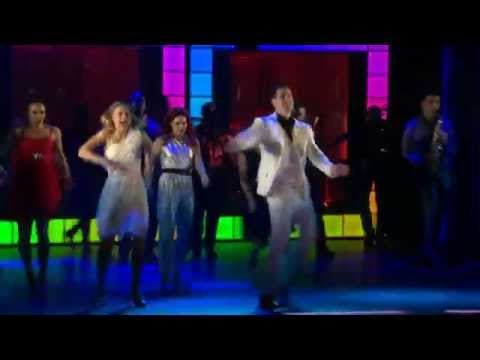
The hook of Saturday Night Fever (stage version, first premiered in 1998) is also its recurring problem: these are pop lyrics built to loop, not to turn a scene. When the production lets the songs behave like the characters’ private weather, it clicks. When it treats them as a greatest-hits playlist with dialogue breaks, you can feel the seams. The best stagings admit that tension and lean into it, using choreography, light, and speed to turn repetition into obsession.
Can disco lyrics carry a plot that keeps turning darker?
The musical wants to do two things at once. First, it wants the communal dopamine hit of a dance floor that never stops offering a reset. Second, it wants to keep the original story’s bruises visible: class frustration, macho posturing, the stale air of a family home where everyone is losing. Those ambitions fight each other, and that fight is the evening.
Lyrically, the Bee Gees’ best writing here is not narrative, it is diagnosis. “Stayin’ Alive” does not explain Tony, it frames him: swagger as self-defense, motion as survival. “Night Fever” is not romance, it is pre-game ritual, a mirror pep-talk with a pulse. Because these songs were written for records, they repeat, and repetition becomes character when the staging treats it as compulsion: the beat returns because Tony keeps needing it.
Musically, this is disco as engine, not nostalgia. The “four on the floor” drive matters because it keeps pulling Tony forward even when his life does not. The smart productions use that contrast: the club is bright and synchronized; the neighborhood scenes are cramped, blunt, and rhythmically less forgiving. If the show ever flattens those worlds into the same glossy tone, the drama leaks out.
How it was made
The stage version premiered in London in 1998 with a book by Nan Knighton, developed in collaboration with Arlene Phillips, Paul Nicholas, and producer Robert Stigwood. Phillips directed and choreographed the original, and the show’s identity has always been tied to her physical storytelling: it is a dance musical that happens to be full of famous songs.
The deeper origin story sits behind the brand name. Stigwood’s “Saturday Night Fever” was always a machine built across mediums: magazine story to film to soundtrack to stage, with the music carrying cultural memory faster than the plot ever could. In interviews around the film’s soundtrack, Stigwood’s mandate was clear: he wanted the Bee Gees to write something you could not stop moving to. That “can’t stop” energy is the franchise DNA, and the stage version inherits it whether it wants to or not.
The stage musical also made a crucial, slightly risky choice: it did not rely only on the best-known tracks. Contemporary accounts of the original West End production note that new Bee Gees songs written for the stage version were among what worked best, a tacit admission that a jukebox show sometimes needs bespoke material to land emotional turns cleanly.
Key tracks & scenes
Below are the 8 lyrical moments that do the most narrative heavy lifting. Scene locations follow the show’s standard Brooklyn-to-club geography, with the bridge functioning as a recurring symbol of “somewhere else.”
"Stayin’ Alive" (Tony, Company)
- The Scene:
- Bay Ridge, Brooklyn. Tony moves through the neighborhood like he’s performing for invisible judges. Street-level bustle, a hard forward walk, and the sense that the spotlight is earned by momentum.
- Lyrical Meaning:
- The lyric is a résumé written in bravado. It tells you Tony’s main skill is endurance, and that charm is how he sells it. The confidence reads as real until you notice how urgently he needs to say it.
"Night Fever" (Tony, Company)
- The Scene:
- Saturday night prep. The vibe is ritual: clothes, hair, mirror, the beat as a metronome for self-invention. Many productions stage this as a private ceremony before the public club.
- Lyrical Meaning:
- “Night fever” is not love, it’s permission. The lyric keeps circling the same promise because the promise is fragile: tonight I get to be the person I can’t afford to be all week.
"More Than a Woman" (Tony, Stephanie)
- The Scene:
- Inside the club, the pairing becomes visible. Their dance reads as negotiation: attraction, status, and the fantasy of Manhattan polish. Lighting often shifts toward glamour here because Tony is trying on a future.
- Lyrical Meaning:
- The lyric sounds like compliment, but it is also a projection screen. Tony is asking Stephanie to be proof that he can cross the bridge emotionally and socially, not just geographically.
"If I Can’t Have You" (Annette)
- The Scene:
- A neighborhood girl watching the guy who treats the dance floor like a throne. Annette’s isolation is the point, even if she is surrounded by bodies.
- Lyrical Meaning:
- It’s a love song with a trap door: devotion phrased as necessity. The lyric makes desire sound like a medical condition, which is why the number can feel painfully modern when played without irony.
"Jive Talkin’" (Tony, Annette, The Faces, Company)
- The Scene:
- Group dynamics tighten. Friends egg each other on, insults land as sport, and the vibe turns from party to peer pressure. The band-like groove can read as fun until the scene reveals who is getting cornered.
- Lyrical Meaning:
- The lyric is about mistrust and noise. In-story, it becomes a way to avoid responsibility: if everything is “talk,” nobody has to own harm.
"What Kind of Fool" (Stephanie)
- The Scene:
- Stephanie tries to define her terms. She is often staged apart from the club crowd, or lit more cleanly, as if she wants a life without the haze.
- Lyrical Meaning:
- The song is boundaries disguised as heartbreak. The lyric asks a question that is really a refusal: don’t confuse my ambition with availability.
"Tragedy" / "First and Last" (Bobby C)
- The Scene:
- The show’s emotional temperature drops. Many productions slow “Tragedy” down to make it a warning flare rather than a banger, placing Bobby’s pain in the foreground while the others keep pretending it is Saturday forever.
- Lyrical Meaning:
- “Tragedy” becomes literal, which is both effective and awkward: a pop chorus suddenly asked to carry consequences. When it works, it is because the performance treats repetition as panic, not as hook.
"How Deep Is Your Love" (Tony, Stephanie)
- The Scene:
- After damage has been done, the show reaches for tenderness. The staging tends to simplify here: less spectacle, more direct address, an attempt to speak without the disco mask.
- Lyrical Meaning:
- The lyric is a test. Tony is asking for steadiness because the rest of his life is unstable. The key question is whether the production earns the vulnerability, or drops it in like a slow song at last call.
Live updates (2025-2026)
Information current as of February 2026.
Australia (Melbourne): A “reimagined” production played the Athenaeum Theatre in January 2026 (8-25 Jan). Critical response in the Australian press leaned skeptical, praising the nostalgia value while arguing the staging struggled to replace the film’s kinetic magnetism. One notable modern adjustment in that production: harsher language was softened and a violent scene was moved offstage, a choice that changes how the show’s darkness lands in the room.
UK (regional listings): The title continues to appear in venue calendars, including an early May 2026 run in Wolverhampton (listed as an amateur production) with entry-level pricing advertised from £15, which tells you something about how the show now circulates: less as a singular event, more as a dependable crowd-pleaser with a known soundtrack.
Licensing and availability: In North and South America, licensing has been handled by Broadway Licensing since 2022, an industry-side shift that matters for schools, community theatres, and regional companies weighing rights availability and materials.
Notes & trivia
- The stage musical’s original West End run opened 5 May 1998 at the London Palladium and closed 26 February 2000.
- The show’s core geography is structural: Bay Ridge versus the club, with the Verrazzano-Narrows Bridge treated as a recurring emblem of escape and “the other side.”
- Contemporary West End coverage singled out two Bee Gees songs written specifically for the stage version, “Immortality” and “First and Last,” as standout material.
- The musical numbers list is unusually candid about form: several entries are framed as dance numbers rather than traditional “I sing my feelings” theatre writing.
- Musical supervision and arrangements are tightly associated with Phil Edwards across major productions, with orchestrations credited to Nigel Wright in production documentation.
- For the 2026 Melbourne staging, reviewers noted family-friendly sanitizing choices (toned-down profanity; a violent scene shifted offstage), which materially changes audience alignment with Tony.
- The original London cast recording has circulated under Polydor branding in the UK and Decca Broadway branding in the US, reflecting imprint differences rather than a different album.
Reception: then vs now
The initial critical line was blunt: reviewers clocked the commercial intent and asked whether the show had anything beyond the soundtrack’s halo. Later responses, especially around touring revivals, have been more practical than ideological: does the staging generate heat, or does it look like a tribute night with better costumes?
“Mounted with one purpose in mind: to cash in on ’70s retro chic.”
“Liberal tampering with musical arrangements and disturbingly normal voices.”
“Pop songs rarely work in the way musicals require.”
My read: the most persuasive versions do not pretend the pop catalogue is secretly a book musical score. They treat it as a pressure system. Disco is the drug, and the lyrics are the side effects. That framing makes the darker plot points feel like the morning after rather than an abrupt genre change.
Quick facts
- Title: Saturday Night Fever
- Year (stage premiere): 1998 (West End)
- Type: Jukebox musical (disco-pop catalogue anchored by the Bee Gees)
- Book: Nan Knighton (in collaboration with Arlene Phillips, Paul Nicholas, Robert Stigwood)
- Original West End director/choreographer: Arlene Phillips
- Musical supervision / arrangements (major productions): Phil Edwards
- Orchestrations (documented): Nigel Wright
- Selected notable placements: “Stayin’ Alive” as the swaggering opener; “Night Fever” as the Saturday-night primp ritual; dance-competition suite as late-show spectacle
- Cast album: Original London Cast Recording (commercial release documented June 1; credited to the London cast, featuring Adam Garcia)
- Label / imprint: Polydor (UK releases); Decca Broadway (US listings)
- Availability: Widely streamed (album listings appear on major digital platforms)
Frequently asked questions
- Is the stage musical the same story as the 1977 film?
- It tracks the same core arc: Tony’s week is survival, Saturday night is identity. Stage versions vary in how much grit they keep visible, especially in revivals and “family-friendly” adjustments.
- Who wrote the lyrics in the musical?
- Most songs are by the Bee Gees (and other credited writers for select disco standards), with the stage book credited to Nan Knighton in collaboration with the original creative partners.
- Which recording should I start with if I want the stage context?
- The Original London Cast Recording is the most direct bridge to the stage show’s structure and selections, and it is concise enough to map onto the musical numbers list without fatigue.
- Why does “Tragedy” land differently in the musical than on the radio?
- Because productions often slow it down and place it on Bobby’s breaking point. The hook becomes a warning, and repetition reads as spiraling rather than celebratory.
- Is there a cleaned-up version for younger audiences?
- Some recent productions have softened profanity and shifted a violent scene offstage, but the underlying story is still about adult choices and consequences. Always check the specific production’s advisories.
- Where is it playing in 2026?
- Listings in early 2026 included a January run in Melbourne and a May engagement in Wolverhampton (venue calendar listing). The title also remains active in licensing pipelines for regional and amateur companies.
Key contributors
| Name | Role | Contribution |
|---|---|---|
| The Bee Gees | Music & lyrics (primary catalogue) | Core songbook that defines Tony’s inner life through repetition, pulse, and emotional shorthand. |
| Nan Knighton | Book | Stage structure and dialogue framework; adapts the film’s scenes into stage pacing. |
| Arlene Phillips | Director / Choreographer (original West End) | Physical language of the show; turns disco vocabulary into narrative action. |
| Robert Stigwood | Producer / collaborator | Cross-medium stewardship of the property; guides the franchise logic from film to stage. |
| Phil Edwards | Musical supervisor / arrangements | Aligns pop material with theatre needs: transitions, dance breaks, and vocal architecture. |
| Nigel Wright | Orchestrations | Turns studio-era textures into playable theatre scoring without losing drive. |
| Robin Wagner | Set design (documented for original production) | Builds the Brooklyn-to-club world, including signature scale gestures noted in early reviews. |
| Andy Edwards | Costume design (documented for original production) | Period silhouette and status signaling: Tony’s armor is fabric before it is attitude. |
| Andrew Bridge | Lighting design (documented) | Disco as architecture: light sells the dream, then exposes its limits in the book scenes. |
| Drew Anthony | Director (Melbourne 2026 listing) | Modern “reimagined” framing in Australian staging, emphasizing spectacle and accessibility choices. |
Sources: The Guardian; Whatsonstage; Variety; Playbill; IBDB; Ovrtur; StageAgent; English Theatre Frankfurt (Teacher Support Pack PDF); Athenaeum Theatre (Melbourne) listing; Wolverhampton Grand Theatre listing; Billboard; MusicRadar.