Rodgers and Hammerstein's South Pacific Lyrics – All Songs from the Musical
Rodgers and Hammerstein's South Pacific Lyrics: Song List
- Dites-Moi
- A Cockeyed Optimist
- Twin Soliloquies
- Some Enchanted Evening
- Bloody Mary
- There Is Nothin' Like a Dame
- Bali Ha'i
- My Girl Back Home
- I'm Gonna Wash That Man Right Outa My Hair
- Reprise: Some Enchanted Evening
- Wonderful Guy
- Reprise: Bali Ha'i
- Younger Than Springtime
- Reprise: A Wonderful Guy
- This Is How It Feels
- Finale Act I
- Happy Talk
- Reprise: Younger than Springtime
- Honey Bun
- You've Got To Be Carefully Taught
- This Nearly Was Mine
- Reprise: Some Enchanted Evening
- Reprise: Honey Bun
- Finale Ultimo
About the "Rodgers and Hammerstein's South Pacific" Stage Show
The script for the musical was written by O. Hammerstein & J. Logan, music belongs to the composer R. Rodgers. These are honorable theater-makers, thanks to the work of which the world has seen a lot of interesting performances, including the legendary ‘Oklahoma!’. Regarding this project particularly, it was partly based on the book by Pulitzer laureate James A. Michener, titled ‘Tales of the South Pacific’. Creation raises a number of topical issues. In particular, the plot pays a lot of attention to racial discrimination, which is one of the main problems of modern society.The first Broadway’s musical appearance dated April 1949. As the venue was chosen Majestic Theatre. The performance immediately gained a lot of fans and had strong support from critics. For several years, the audience has seen 1925 productions. At that time, it was the second result of running duration (first place belonged to the already mentioned ‘Oklahoma!’). The main role in the production performed M. Martin & E. Pinza. Having learned that the performers have agreed to participate in the project, the composer especially for them created a few songs, which all have been recognized classics, and to this day with pleasure listened by many people.
After nearly 60 years, creation returned to Broadway (in April 2008). All 996 performances were shown to viewers in Vivian Beaumont Theatre. Directing the performance was entrusted to B. Sherr. The team also included: choreographer C. Gattelli, bandleader R. R. Bennett, set designer M. Yeargan, costume designer C. Zuber & lighting designer D. Holder. The new project fully met the expectations of the audience and critics. It managed to get closer to the success of original histrionics that for many years thought to be impossible task. In 2008, the production was able to win at once 7 figurines of Tony. These included the main theatre award – for Best Musical. In addition to the above-mentioned two appearances on Broadway, creations twice staged in the West End (1951 and 2001). In 1958, was released the same-named film with R. Brazzi in the title role.
Release date: 2008
Rodgers and Hammerstein's South Pacific – The Musical Guide & Song Meanings
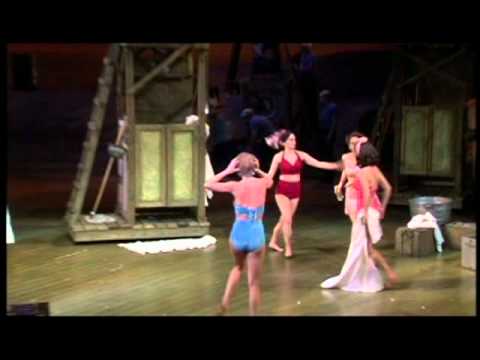
Review
Why does a “Golden Age” musical still manage to feel like a news alert? Because South Pacific hides its sharpest lyric inside its prettiest melody, then makes you hum it on the way home. The 2008 Broadway revival (Bartlett Sher at Lincoln Center) leaned into that contradiction: lush romance up front, social rot underneath, both sung with terrifying ease.
Oscar Hammerstein II writes with the plainspoken confidence of someone trying to talk a decent person out of a bad idea. “A Cockeyed Optimist” turns a sunny worldview into character exposition, not decoration. “Some Enchanted Evening” sells destiny so hard it feels like a trap. Then the show flips the lights: Nellie’s “Wash That Man” is comic self-hypnosis, and “You’ve Got to Be Carefully Taught” is a moral thesis that refuses to dress up as poetry. Richard Rodgers meets him note for note, switching styles like a director changes camera lenses: Emile’s music is expansive and almost operatic in its phrasing, while Nellie’s “Honey Bun” and “Wash That Man” mimic wartime pop with a wink that still bites.
The recurring “Bali Ha’i” idea matters here: it is a musical beacon, seductive and slightly ominous. The island is promise, fog, and warning at once. The score keeps asking whether desire is freedom or conditioning, and Hammerstein keeps answering: both, and you are responsible for the difference.
How It Was Made
South Pacific started as an adaptation problem. James A. Michener’s Tales of the South Pacific is episodic, reportorial, and full of harsh edges. Rodgers and Hammerstein chose to stitch two love stories together, not to soften the material but to make the prejudice impossible to dodge: one romance collapses under it, the other survives only after it stares the thing down.
Several origin stories are unusually concrete. The “Bali Ha’i” lyric is tied to a visual: Hammerstein was reportedly sparked by a misty detail in the island backdrop, and the song’s famous opening motif became a three-note signature that haunts the show like a siren. “Happy Talk” is often cited as a speed-written number, an almost casual burst that disguises how strategically it sits beside the darker plot machinery. And the political spine of Act II, “You’ve Got to Be Carefully Taught,” wasn’t an accident or an add-on: the creators defended it against pressure to cut it, insisting the show’s point was incomplete without it.
The 2008 cast album is also a statement of craft. It was conducted by Ted Sperling and recorded with Robert Russell Bennett’s original orchestrations, restoring the score’s full muscle rather than sanding it down for contemporary “relevance.” That choice is the album’s quiet flex: the material does not need modernizing; it needs playing well.
Key Tracks & Scenes
"A Cockeyed Optimist" (Nellie Forbush)
- The Scene:
- Early Act I. A young Navy nurse looks out at the ocean and talks herself into certainty. The light feels open, bright, almost naive by design.
- Lyrical Meaning:
- It is not just “optimism.” It is a defense mechanism. Hammerstein gives Nellie a creed before he tests it, so we can measure every later crack.
"Some Enchanted Evening" (Emile de Becque)
- The Scene:
- Act I, on Emile’s ground. The atmosphere turns intimate, the orchestra widens, and the lyric speaks like a memory being rewritten in real time.
- Lyrical Meaning:
- It is destiny phrased as advice. Emile is persuading himself as much as Nellie, and Rodgers lets the melody do the seducing so the words can stay direct.
"There Is Nothin' Like a Dame" (Seabees, Sailors, Marines)
- The Scene:
- Mid-Act I. The men turn boredom into bravado, building a rowdy chorus out of loneliness. The staging usually keeps it communal and kinetic, a pressure valve.
- Lyrical Meaning:
- It is comic on purpose, but it also draws the show’s gender politics in thick lines: longing becomes entitlement if nobody checks it.
"Bali Ha'i" (Bloody Mary)
- The Scene:
- Act I, with Bloody Mary selling an island like a spell. Many productions isolate her in a pool of light, making the invitation feel both intimate and transactional.
- Lyrical Meaning:
- “Come” is the operative word. The lyric is hospitality and manipulation at once. The island becomes a metaphor for the choices Americans want to treat as consequence-free.
"I'm Gonna Wash That Man Right Outa My Hair" (Nellie and Nurses)
- The Scene:
- Late Act I. Nellie performs a breakup as if it is a hygiene routine. The mood is funny, brisk, and slightly frantic, often staged with literal washing imagery.
- Lyrical Meaning:
- It is the classic Hammerstein trick: a catchy comic surface hiding a serious refusal. Nellie is trying to scrub away what she cannot yet name as bias.
"Happy Talk" (Bloody Mary, Liat, Cable)
- The Scene:
- Act II’s deceptively sweet pocket. The sound relaxes, the stakes pretend to shrink, and the lyric offers a fantasy of domestic simplicity.
- Lyrical Meaning:
- It is a lullaby that doubles as sales pitch. The song frames love as a life you can step into, while the plot is busy proving that society still blocks the door.
"You've Got to Be Carefully Taught" (Lt. Joseph Cable)
- The Scene:
- Act II, after the romantic storyline hits its hardest wall. The moment often lands under stark, unpretty lighting, like a lecture delivered against the orchestra’s will.
- Lyrical Meaning:
- Hammerstein writes a diagnosis in rhyme: hate is learned, rehearsed, and rewarded. The lyric refuses metaphor because metaphor would let the listener escape.
"This Nearly Was Mine" (Emile de Becque)
- The Scene:
- Act II, at Emile’s lowest point. The stage typically narrows around him, and the orchestration gives him room to feel the loss before the plot moves again.
- Lyrical Meaning:
- The title does the damage. “Nearly” is the tragedy, and the lyric makes heartbreak sound like an adult consequence, not a teenage tantrum.
Live Updates
As of February 1, 2026 (Europe/Athens), South Pacific is not running on Broadway, but it is very much in circulation. The show’s footprint in 2024 to 2026 has looked less like a single blockbuster revival and more like a steady chain of concert versions, regional productions, and benefit events, which is often the real indicator of a canon title’s health.
In December 2024, Lincoln Center Theater marked the 75th anniversary of the musical and honored the 2008 staging with a gala concert that reunited key artists from that production. That kind of institutional spotlight matters: it keeps the Sher revival, and its interpretive choices, in the active conversation rather than the scrapbook.
For the 2025 to 2026 season cycle, multiple organizations have publicly announced South Pacific on their calendars, including a semi-staged concert format in January 2026 with the Alabama Symphony Orchestra, and a January 2026 run for Performance Now. This is also a period where licensing remains explicitly version-sensitive. Concord Theatricals emphasizes that multiple versions exist, and producers need to choose carefully before renting materials. Translation: you can still mount South Pacific, but the paperwork is trying to prevent a lazy one.
Notes & Trivia
- The “Bali Ha’i” opening is built around a short motif that functions like a sonic lighthouse. It is the score’s most effective piece of propaganda.
- The show’s most controversial number is correctly titled “You’ve Got to Be Carefully Taught,” a detail that matters because the lyric is about precision, not vibes.
- Michener later recalled pushback during tryouts over the bluntness of the anti-racist message; the creative team kept the song anyway.
- One famous piece of lore ties “Bali Ha’i” to a scenic inspiration: Hammerstein’s lyric was reportedly triggered by the way the island was painted with mist.
- The 2008 Broadway revival opened April 3, 2008 and ran through August 22, 2010 at the Vivian Beaumont Theater, winning major awards along the way.
- The 2008 cast recording was recorded in April 2008 and released the following month, conducted by Ted Sperling using Robert Russell Bennett’s original orchestrations.
- The Bartlett Sher production was broadcast by PBS as “Live from Lincoln Center” on August 18, 2010, effectively giving the revival an afterlife beyond the room.
Reception
South Pacific has always had the rare ability to collect praise from opposite directions: romantics hear a love story, realists hear an argument. The 2008 revival revived more than a title; it revived a style of sincerity that modern musical theater sometimes treats as suspicious. Critics in 2008 largely responded to how the production trusted the writing and refused to add a layer of snark to “protect” it.
“The happy news is that its brilliance hasn’t faded.”
“It’s a perfectly decent revival … but with little of the pizzazz we expect.”
“I can’t find one serious flaw in this production.”
That split is also the show’s ongoing risk: if a production sells only the romance, it can feel like a museum piece; if it sells only the message, it can feel like homework. The best stagings, including the 2008 revival’s sound world and pacing, make you sit in the discomfort while the melodies keep smiling.
Quick Facts
- Title: Rodgers and Hammerstein’s South Pacific
- Year (focus of this guide): 2008 Broadway revival and cast recording
- Type: Musical
- Music: Richard Rodgers
- Lyrics: Oscar Hammerstein II
- Book: Oscar Hammerstein II and Joshua Logan
- Based on: Tales of the South Pacific by James A. Michener
- 2008 revival venue: Vivian Beaumont Theater, Lincoln Center (opened April 3, 2008; closed August 22, 2010)
- 2008 revival director: Bartlett Sher
- 2008 cast recording: Conducted by Ted Sperling; original orchestrations by Robert Russell Bennett
- Label / release context: Released as a new Broadway cast recording in 2008; widely available on major streaming platforms
- Notable screen capture of the revival: PBS “Live from Lincoln Center” broadcast (August 18, 2010)
Frequently Asked Questions
- Who wrote the lyrics for South Pacific?
- Oscar Hammerstein II wrote the lyrics (and co-wrote the book). Richard Rodgers composed the music, and Joshua Logan is credited as co-book writer for the stage version.
- Is “You’ve Got to Be Taught” the correct title?
- The score’s title is “You’ve Got to Be Carefully Taught.” People shorten it, but the full title reflects the song’s argument: prejudice is learned with method.
- Is there a filmed version of the 2008 revival?
- Yes. The Bartlett Sher production was broadcast by PBS as “Live from Lincoln Center” on August 18, 2010.
- Is there a movie of South Pacific?
- Yes. The most famous is the 1958 film adaptation. There is also a 2001 television film version.
- Where should I start on the 2008 cast album if I’m new?
- Try this sequence: “A Cockeyed Optimist” (character thesis), “Some Enchanted Evening” (romance at full voltage), “Bali Ha’i” (temptation), then jump to “You’ve Got to Be Carefully Taught” (the show’s moral core).
- Why does the show have two love stories?
- The structure forces comparison. One romance reveals how prejudice ruins people who think they’re “nice.” The other reveals how prejudice can still win even when love is real.
Key Contributors
| Name | Role | Contribution |
|---|---|---|
| Richard Rodgers | Composer | Wrote the score; built recurring motifs including the signature “Bali Ha’i” musical idea. |
| Oscar Hammerstein II | Lyricist / Book | Lyrics with blunt moral clarity; co-wrote the book; fought to keep the show’s anti-racist argument intact. |
| Joshua Logan | Book / Original staging lineage | Co-wrote the book and shaped the stage storytelling tradition productions inherit. |
| Bartlett Sher | Director (2008 revival) | Staged the Lincoln Center Broadway revival that defined the 2008 recording’s performance style. |
| Ted Sperling | Conductor (2008 cast recording) | Conducted the 2008 cast recording; helped restore a full-scale orchestral sound. |
| Robert Russell Bennett | Orchestrator | Original orchestrations used for the 2008 cast recording. |
| Kelli O’Hara | Performer | Led the 2008 revival as Nellie Forbush; central vocal personality of the recording. |
| Paulo Szot | Performer | Played Emile de Becque in the 2008 revival; anchored the album’s dramatic baritone repertoire. |
Sources: Rodgers & Hammerstein Official Site, IBDB, Playbill, TIME, The Guardian, PBS (Live from Lincoln Center), Wikipedia, Concord Theatricals, Alabama Symphony Orchestra, Performance Now, Vogue, TheaterMania, Oxford Academic.