Roar Of The Greasepaint, The - The Smell Of The Crowd Lyrics – All Songs from the Musical
Roar Of The Greasepaint, The - The Smell Of The Crowd Lyrics: Song List
- Act 1
- Overture
- The Beautiful Land
- A Wonderful Day Like Today
- It Isn't Enough
- Things To Remember
- Put It In The Book
- With All Due Respect
- This Dream
- Where Would You Be Without Me?
- My First Love Song
- Look at That Face
- The Joker
- Who Can I Turn To (When Nobody Needs Me)
- Act 2
- That's What It Is To Be Young
- What A Man!
- Feeling Good
- Nothing Can Stop Me Now!
- Things to Remember (reprise)
- My Way
- Who Can I Turn To (Reprise)
- Sweet Beginning / The Beautiful Land (Reprise)
About the "Roar Of The Greasepaint, The - The Smell Of The Crowd" Stage Show
Musical was created by A. Newley & L. Bricusse. The premiere of the show took place in early August 1964 in Theatre Royal. Nottingham was the first city of the British tour. Tour ended in Manchester Palace Theatre, where the play was shown from September to October 1964, under the direction of A. Newley. Musical arrangement was made by G. Lynne. Such actors participated in the show: N. Wisdom, W. Goddard, S. Smith, D. Watling, C. Grant, R. Hutchinson, B. Wells, S. White, J. Goodman & G. Hoyle.American producer D. Merrick transferred the histrionics in the USA, where in 1965 was a national tour. On Broadway, performance was in May 1965. Preliminaries began in Shubert Theatre in May of the same year, and after 5 days, it was a premiere. The last performance was at the beginning of December 1965 and there were 7 preliminaries and 231 regular performances. Staging was exercised by A. Newley. Choreography was ruled by G. Lynne. The list of actors was the following: A. Newley, C. Ritchard, S. Smith, J. Jillson, G. Price, M. Tannenbaum, R. Bates & L. Browne.
In 1988, a musical was staged in the West End. In 1990, the show was presented in Milburn, state NJ. In December 2002, production took place in NY Sol Goldman’s 14th Street YMHA. The director and choreographer of the musical was T. Mills. The show involved: D. Andrew, D. Edwards, A. Epstein, L. A. Hendricks, G. S. Irving, L. Lebowitz, M. Parris, A. Pisoni, J. Rivers & S. Rosa. At the end of February 1965, the album with the participation of the American tour of performers was recorded. In March 1965, it went on sale. Also in 1965, the recording was made with the cast of the Broadway show. The musical received 2 nominations at the Theatre World Award, winning 1. Also, it was 6 times nominated for Tony.
Release date: 1965
"The Roar of the Greasepaint - The Smell of the Crowd" (1965) - The Musical Guide & Song Meanings
Here’s the trick of Roar: the book keeps trying to be a serious parable about class, but the score keeps slipping out the side door to become pop history. Leslie Bricusse and Anthony Newley wrote songs that behave like character studies, even when the characters are basically chess pieces named Sir and Cocky. That imbalance is the show’s flaw onstage and its superpower on an album.
Review
Can a musical be a hit if the audience only loves the songs? Roar is practically a lab experiment designed to answer that. It stages “The Game” as a rigged contest between Sir (power, polish, rules) and Cocky (hunger, humiliation, stubborn hope). The score does the emotional labor the book sometimes dodges: each number is a pressure release, a pivot, or a trapdoor.
Lyrically, Bricusse and Newley write in clean, audience-friendly sentences that land like signage. That sounds like an insult until you notice how often the text functions as propaganda inside the story. “Things to Remember” is not advice, it’s conditioning. “Look at That Face” is not romance, it’s branding. And “Who Can I Turn To?” arrives as the evening’s least metaphorical moment, which is why it hits.
Musically, it’s British music hall with pop instincts and a cynical grin. The melodies are built to travel: from stage to radio to lounge act to movie needle-drop. You can hear why the score escaped the show. It’s engineered for migration.
How it was made
Bricusse and Newley were coming off Stop the World - I Want to Get Off and went hunting for a follow-up that could keep their brand: social satire with tunes that sounded like they belonged on the charts. Roar opened in the UK in 1964 and did not reach the West End. Then producer David Merrick saw a way to sell the songs first and the show second: the cast recording came out before New York, and Tony Bennett’s hit recording of “Who Can I Turn To?” helped keep the title alive long enough for Broadway to meet it halfway.
If you want the behind-the-scenes lesson, it’s this: the marketing outpaced the narrative. People bought the record for the standards, then arrived at the theatre to discover an allegory. The score survived that mismatch. The book did not always.
Experience tip for listeners: start with “Where Would You Be Without Me?” and then jump to “Who Can I Turn To?” The first teaches you the show’s power dynamic; the second shows you the human cost. After that, the rest of the album clicks into place as a series of rules, punishments, and small rebellions.
Key tracks and scenes
"A Wonderful Day Like Today" (Sir, Cocky, Urchins)
- The Scene:
- A bright, falsely cheerful opening gambit. The “rocky place” plays like a playground with sharp edges. Sir sets the tone while Cocky tries to keep up. Lighting wants sunshine; the staging should keep letting a shadow fall across Cocky’s feet.
- Lyrical Meaning:
- The lyric sells optimism as policy. It’s the show’s first con: if Cocky can be convinced today is “wonderful,” he might stop noticing who wrote the rules. It’s pep talk as control mechanism.
"It Isn't Enough" (Cocky, Urchins)
- The Scene:
- Cocky takes inventory after another small defeat. The chorus circles like witnesses who might help, but mostly watch. Keep the light narrower here, as if the world is shrinking to the size of Cocky’s next breath.
- Lyrical Meaning:
- This is the show admitting its own engine: dissatisfaction. The lyric’s plainness is the point. Cocky can’t philosophize his way out. He can only name the hunger and move.
"Where Would You Be Without Me?" (Sir, Cocky)
- The Scene:
- A duet staged like a handshake that becomes a wrist lock. Sir performs mentorship while Cocky performs gratitude. Play the charm, then let it curdle, beat by beat, as the rhythm tightens like a rope.
- Lyrical Meaning:
- The lyric is dependency dressed as banter. It’s Sir’s thesis statement: power is kindness you can’t refuse. The brilliance is how catchy it is, because coercion often is.
"Look at That Face" (Sir, Kid, Urchins)
- The Scene:
- A showroom moment. Sir and the Kid present Cocky like a product and the Urchins provide the sparkle. Give it a spotlight sheen, the kind that makes you worry what it’s hiding.
- Lyrical Meaning:
- On the surface: admiration. Underneath: a lesson in how hierarchy flatters and consumes. Cocky is valuable when he’s entertaining, compliant, and aesthetically useful.
"The Joker" (Cocky)
- The Scene:
- A lone confession with a grin that keeps cracking. This should feel like a cabaret act performed at the edge of an argument. Dim the stage, keep one hard light, and let the laugh land a half-second late.
- Lyrical Meaning:
- Cocky names the role he’s been forced into: clown as social function. The lyric is self-portrait and indictment. It’s also a hinge into the Act I emotional collapse that follows.
"Who Can I Turn To?" (Cocky)
- The Scene:
- End of Act I. The show strips away the game and leaves a person. Cocky is desperate, and the air should feel suddenly still, like the theatre has stopped breathing with him.
- Lyrical Meaning:
- This is the score cashing the check the allegory has been writing all night. No symbols, no slogans, just abandonment. The question is simple because the need is.
"Feeling Good" (The Negro, Urchins)
- The Scene:
- Act II’s shock of clarity. A new competitor enters, wins by not playing “properly,” and sings at the point of triumph. Stage it as release: open space, a visible horizon, light that finally looks like oxygen.
- Lyrical Meaning:
- It’s emancipation as sensation: new dawn, new life, new rules. The song’s cultural afterlife can make it feel generic, but in context it’s radical because it exposes how arbitrary Sir’s system is.
"Nothing Can Stop Me Now!" (Cocky, Urchins)
- The Scene:
- Cocky’s rebound after witnessing someone else break through. He charges back into the game with adrenaline and a little danger. The staging should look like confidence and sound like overcompensation.
- Lyrical Meaning:
- Triumph turns quickly into imitation. Cocky learns ambition from a rigged system, which means his victory risks becoming Sir’s attitude in a cheaper suit.
Live updates (current as of January 2026)
No, Roar is not sitting on a Broadway revival schedule right now. Its modern life is licensing, concert presentations, and the occasional smart reinvention. Concord Theatricals continues to license the show, and its own materials frame the work as a “music-hall allegory” built for companies that can cast strong singer-actors and handle stylized storytelling.
The score’s bigger update is cultural circulation. In October 2024, Joker: Folie a Deux pulled “The Joker” into a jukebox-musical context precisely because the lyric all but points at the camera and confesses. That kind of reuse is the show’s true touring production: the songs keep getting booked even when the plot stays home.
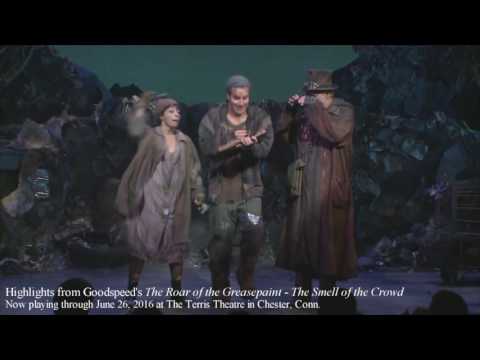
Recent-staging comparison: Goodspeed Musicals’ 2016 production description leaned into end-of-the-world imagery, pitching the story as survival theatre where “show tunes and music hall merriment” try to reboot hope. That is a sharp pivot from the original “game” framing, and it suits the material. When you literalize ruin, the class allegory stops being an idea and becomes weather.
Listener tip: if you only have 15 minutes, do this sequence and you’ll get the drama arc: “Where Would You Be Without Me?” to “The Joker” to “Who Can I Turn To?” to “Feeling Good.” It’s manipulation, fracture, loneliness, and escape.
Notes and trivia
- The title is a deliberate transposition of the common phrase “the smell of the greasepaint, the roar of the crowd,” which is why so many people reverse it by accident.
- The show opened in Nottingham on August 3, 1964, toured the UK, and never made it to the West End before heading to America.
- Producer David Merrick required Anthony Newley to play Cocky for the US run, turning authorship into a sales tactic: the composer as star.
- The Broadway opening was May 16, 1965 at the Shubert Theatre, and the run lasted 231 performances.
- According to production-history notes, Newley left the Broadway cast after about six months; Orson Bean replaced him, and the show closed a few weeks later.
- The original Broadway cast recording was recorded on February 28, 1965, before the show reached New York, an unusual release strategy for the time.
- Concord’s published orchestration list includes onstage mischief tools like anvil, siren, ratchet, train whistle, and a “raspberry,” which tells you how much this score likes theatrical noise.
Reception then vs. now
In 1965, critics often split their verdict: love the score, argue with the show. That tension still defines the piece. Contemporary write-ups of strong productions keep repeating the same theme: when the acting is specific and the staging commits to a point of view, the evening works. When it plays like a lecture with punchlines, it sags.
“Lively… amusing and exciting theatre.”
That line, attributed by Concord to The New York Times, is fair if you emphasize the word “lively.” The score does the heavy lifting with speed and charm, then slips a knife in when you least expect it.
“Boasts some damned fine songs… The score is undoubtedly worth the cost of admission.”
Also attributed by Concord, this time to The Guardian, and it gets closer to the show’s real reputation: buy the ticket for the songs, and you may or may not stay for the sermon.
“This offbeat tuner… is an enthralling and richly rewarding ride.”
Backstage’s praise (in a regional-production review) is the modern best-case scenario: Roar works when a director treats the allegory like theatre, not homework, and lets the numbers carry character specificity.
Quick facts
- Title: The Roar of the Greasepaint - The Smell of the Crowd
- Year: 1965 (Broadway); first staged 1964 (UK tour)
- Type: Full-length musical; allegorical satire in music hall style
- Book, music, lyrics: Leslie Bricusse and Anthony Newley
- Producer (Broadway): David Merrick
- Broadway venue and run: Shubert Theatre; opened May 16, 1965; closed December 4, 1965; 231 performances
- Most covered songs from the score: “Feeling Good,” “Who Can I Turn To?,” “The Joker,” “A Wonderful Day Like Today,” “Look at That Face”
- Cast album: Original Broadway Cast Recording (RCA Victor). Recording date documented as February 28, 1965.
- Selected notable placements: “The Joker” referenced in Joker: Folie a Deux (2024); “A Wonderful Day Like Today” appears on episode soundtrack listings for The Marvelous Mrs. Maisel (Season 1, Episode 1).
- Rights/licensing: Concord Theatricals
Frequently asked questions
- Is this the show that originated “Feeling Good”?
- Yes. The song began life inside Roar as a breakthrough moment for a new competitor in the “Game,” which is why it plays as liberation rather than just mood.
- Why do people keep getting the title wrong?
- Because it is intentionally flipped from the familiar phrase about theatre life. The inversion is branding and a warning: this show likes turning expectations inside out.
- Is there a definitive version to start with?
- The Original Broadway Cast Recording is the baseline because it documents the score at the moment it entered pop culture. If you want modern performance energy, Goodspeed’s 2016 materials and clips show how directors now reframe the piece.
- What is the show “about” in plain language?
- It’s a rigged contest between a man with power and a man without it, staged as a series of games. Cocky keeps trying to win; Sir keeps rewriting the rules.
- Why does it still get produced if the book is controversial?
- Because the score is unusually durable, and the show’s stylized structure invites directors to solve the narrative problems with concept and staging choices. It is a playground for interpretation, provided the cast can sing it.
- Is it appropriate for every group?
- It depends on how a company handles the racialized character and the satire’s targets. Concord flags a role for a Black actor and frames the piece as experimental. Thoughtful contextual work matters.
Key contributors
| Name | Role | Contribution |
|---|---|---|
| Leslie Bricusse | Book, composer, lyricist | Co-created the score’s pop-ready lyric clarity and the show’s satirical framing. |
| Anthony Newley | Book, composer, lyricist; original director; original Cocky | Built the score around performable charisma and originated the lead role on Broadway. |
| David Merrick | Producer | Brought the show to the US, pushed an early cast-album strategy, and sold the songs as the headline. |
| Gillian Lynne | Choreographer (Broadway) | Shaped movement in a piece that lives halfway between musical and music hall. |
| Herbert Grossman | Music director (Broadway) | Conducted the Broadway production; helped translate the score’s theatrical precision to performance practice. |
| Concord Theatricals | Licensing and materials | Current rights-holder providing synopsis, song list, and orchestration details. |
Sources: Concord Theatricals, Ovrtur (Database of Musical Theatre History), IBDB, Backstage, Goodspeed Musicals, Polygon, Wikipedia (show and song background), MoviesOST (episode soundtrack listing).