
Queen of the Mist Lyrics: Song List
- Act 1
- Opening
- There Is Greatness In Me
- A Letter to Jane/The Tiger
- Charity
-
Glorious Devil/The Waters

-
The Barrel/Cradle or Coffin
-
Types Like You
-
Do the Pan!
-
Floating Cloud/Cradle or Coffin Reprise
-
Laugh at the Tiger
- On the Other Side
-
Act One Finale
- Act 2
-
The Quintessential Hero
-
Million Dolla’ Momma
-
Expectations
-
Bookings (Part One)
-
Break Down the Door
-
The Green
-
Bookings (Part Two)
-
Postcards
-
The Fall (Act Two Finale)
About the "Queen of the Mist" Stage Show
The staging is based upon a real story of a well-known American adventurer – A. E. Taylor. M. J. LaChiusa, an outstanding composer, became the creator of this show, being responsible for music, book and words. Transport Group Company produced the musical for Off-Broadway displays.
This spectacle was first staged in 2011. Its premier took place at Gym at Judson (Judson Memorial Church). J. Cummings III was selected to be a director of performance, while Ch. Fenwick became musical director. S. Rink and his assistant Megan Kelley were responsible for choreography. K. Rohe created design of costumes (with wigs by P. Huntley) and S. Goldmark with assistant A. Sheckler made set design. Lightning was created by R. L. Kennedy and his assistant R. Eshleman.
As for the music, W. Trarbach was chosen for sound design and M. Starobin was responsible for orchestration. The music band for the show included the following performers: D. B. Marrow, Ch. Fenwick, S. French, M. Hyde, J. Levine, M. Mitchell and A. Oulianine. As for cast, the actors were M. Testa (for the leading role), D. C. Anderson, Th. McCarthy, J. Murney, A. Samonsky, S. Bahorek and T. Sessions.
This spectacle was created with great support of Shen Family Foundation. The staging obtained Frederick Loewe Award for the music. It was also nominated in categories of Outstanding Musical and Musical Director during Drama Desk Award. The leading actress was nominated for Special Achievement Award during the same ceremony. The show got nominated as the Best Musical at Off-Broadway Alliance Award.
Release date of the musical: 2011
“Queen of the Mist” – The Musical Guide & Song Meanings
Review: what the lyrics are really doing
“Queen of the Mist” (2011) is a musical about a woman who refuses to be correctly sized. Annie Edson Taylor, 63, cash-poor and ego-rich, decides to go over Niagara Falls in a barrel and live. The show’s big question is not “Will she survive?” You already know the headline. The question is whether surviving a stunt can manufacture a life, or only extend a loneliness.
Michael John LaChiusa writes the lyrics like a courtroom transcript with water damage. People talk past each other. Annie rebrands herself mid-sentence. Frank Russell, her manager, sells the myth and resents the labor. Even when the lines are funny, they land with a bite. That is the point. Celebrity is a language of self-defense, and this score is fluent.
Musically, LaChiusa builds an early-20th-century American collage: marches, ragtime, turn-of-the-century Broadway brightness, then a sudden harmonic bruise when Annie’s bravado cracks. The lyric work rides on that contradiction. When the music smiles, the text often tells you why smiling is a tactic.
Viewer tip: this is the rare show where you benefit from knowing two songs in advance. Listen to “There Is Greatness In Me” to understand Annie’s self-mythology, then “Million Dolla’ Momma” to hear the cost of building that myth for her. Everything else is fallout.
How it was made: commission, space, and voice
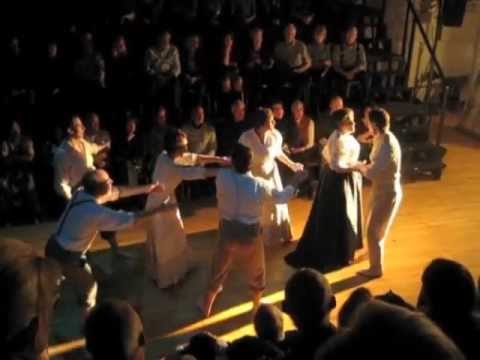
The show was commissioned and produced by Transport Group, and premiered Off-Broadway at The Gym at Judson Memorial Church in 2011 with environmental staging. That venue choice matters: a flexible room, audience on bleachers, and the feeling of being pressed up against the event rather than safely observing it. Niagara is not painted scenery here. It is an argument the characters keep hearing in their own heads.
Mary Testa’s Annie was not incidental casting. Multiple interviews and program materials describe the role as written for her, which helps explain the lyric’s particular blend of brass and bruising vulnerability. Annie’s rhetoric is big. Her self-knowledge is smaller. Testa can play both at once without softening either.
Origin detail worth keeping: in one interview about developing new work, Testa recalls that Jack Cummings III connected her to source material about Annie Edson Taylor and that the emotional hit was immediate. That kind of early, personal lock-in often predicts what the lyrics obsess over later. In this case, the obsession is not the barrel. It is the hunger behind the barrel.
LaChiusa has also spoken about the specific thrill and risk of writing originals, where the composer is the primary source. “Queen of the Mist” sounds like a writer enjoying that freedom while also daring the audience to keep up.
Key tracks & scenes: 8 lyrical pressure points
“There Is Greatness In Me” (Anna Edson Taylor)
- The Scene:
- Annie plants her feet on the edge of a new century and announces herself like she’s filing paperwork with God. In stagings that embrace the Gym-at-Judson intimacy, this often lands as a direct address, eye contact doing half the orchestration.
- Lyrical Meaning:
- It is not just confidence. It is self-hypnosis. The lyric repeats because repetition is how Annie keeps panic from getting a vote.
“Letter to Jane / The Tiger” (Anna, Jane)
- The Scene:
- A family channel opens, briefly. Jane is a tether to a life Annie has already rejected. The writing flickers between affection and accusation, like a lamp with a loose wire.
- Lyrical Meaning:
- This is the show’s private vocabulary: animals, omens, and metaphors that let Annie speak about fear without admitting fear.
“The Barrel / Cradle or Coffin” (Anna)
- The Scene:
- Design becomes destiny. Annie talks through the barrel as if she’s building a machine and a philosophy at once. Good productions treat the room itself as the workshop, with the audience effectively drafted as witnesses.
- Lyrical Meaning:
- The lyric frames the barrel as protection and threat, maternal and murderous. “Cradle or coffin” is not decoration. It is the thesis of her gamble.
“Do the Pan!” (Company, Anna, Mr. Russell)
- The Scene:
- A burst of period showmanship. Photographers, barkers, and hustlers whip the moment into saleable spectacle. The rhythm has a grin. The situation does not.
- Lyrical Meaning:
- Language turns into marketing. Annie’s identity gets flattened into a pose, and the lyric’s brightness is the warning label.
“Floating Cloud” (Rivermen, Anna)
- The Scene:
- The water becomes a chorus. Rivermen carry the atmosphere, and Annie’s inner life finally gets room to breathe. Lighting, in most stagings, cools into something like weather.
- Lyrical Meaning:
- It is the score letting Annie be small for a minute. The lyric’s poetry is not escape. It is the closest thing she has to truth.
“On the Other Side” (Mr. Russell)
- The Scene:
- Russell, alone with the business end of Annie’s dream, tries to bargain with fate. Depending on staging, this can read as confession or sales pitch. Often it is both.
- Lyrical Meaning:
- The lyric reveals the manager’s real terror: not that Annie will die, but that she will live and still not be saved by the story he is selling.
“Million Dolla’ Momma” (Mr. Russell)
- The Scene:
- Ragtime energy, bitter undertow. Russell drinks and belts, turning Annie’s legend into a ledger. The number is showy on purpose. Grief often is.
- Lyrical Meaning:
- This is the lyric admitting how American fame works: profit first, reverence later, if at all. Russell’s bravado is a mask for dependence.
“Break Down the Door” (Carrie Nation, Company)
- The Scene:
- The moralizers arrive with blunt-force certainty. Carrie Nation’s presence shifts the air in the room. Suddenly Annie’s ambition is not just risky, it is indictable.
- Lyrical Meaning:
- The lyric pits reform against desire. It is not subtle, and it shouldn’t be. This is righteousness as choreography, and Annie is the target.
“The Fall (Act Two Finale)” (Anna, Company)
- The Scene:
- The show returns to its central image. Not as reenactment, but as reckoning. In productions that lean into the story’s late-life coda, the finale lands as memory made physical.
- Lyrical Meaning:
- The title carries a double load: the plunge that made her famous, and the slow decline that fame could not prevent. The lyric asks what, exactly, she won.
Live updates: 2025–2026 status
Information current as of 1 February 2026.
The most significant recent activity is the February 20–23, 2025 staged concert production presented by PEAK Performances at Montclair State University’s Alexander Kasser Theater. Mary Testa returned to the role of Anna Edson Taylor, with direction by Kirsten Sanderson and musical direction/conducting by Jude Obermüller, and orchestrations credited to Michael Starobin.
In the UK, the piece continued to prove it can travel: Pint of Wine Theatre Company’s production premiered at the Jack Studio Theatre in 2019 and transferred to Charing Cross Theatre later that year, picking up Off West End Awards attention for its creative team. That matters for the show’s long-term life because “Queen of the Mist” tends to thrive in intimate rooms that can make its shifting viewpoints feel like close-range testimony.
As of early February 2026, there is no announced commercial Broadway run or national tour. The practical path is licensing and small-to-mid-scale revivals, and the show is available for licensing through Concord Theatricals.
Notes & trivia
- The 2011 premiere used environmental staging at The Gym at Judson Memorial Church, with audience seated on bleachers facing each other.
- The original cast recording was released June 19, 2012.
- Entertainment Weekly singled out both “There Is Greatness In Me” and “Million Dolla’ Momma,” and noted how the score samples period styles such as march and ragtime.
- A Chicago production review described “There Is Greatness In Me” as the defining song, and praised its vocal demands.
- Myth-check: many people describe Annie as “the first woman” over the Falls. Historically, she is widely cited as the first person to go over Niagara Falls intentionally and survive, full stop.
- In a development interview, Mary Testa described the show as commissioned with her in mind, underscoring how specifically Annie’s lyric voice was tailored to her strengths.
- The plot is not triumphalist. Multiple summaries emphasize that Annie’s burst of notoriety fails to solve her financial reality, and the musical follows her into later life.
Reception: the fight between craft and patience
Critics have tended to agree on the same paradox: the score is frequently gorgeous, and the experience can still feel thorny. That thorniness is not an accident. LaChiusa writes in close-up. He is more interested in contradiction than catharsis. If you demand a neat redemption arc, this show will not comply.
“Beautifully odd,” with period sounds that jump from march to ragtime, and a standout “Million Dolla’ Momma.”
“Quite a challenge to sit through,” even when the music is “beautiful” and the orchestrations superb.
The score is “beguiling,” and the show “a pleasure if you like something different.”
Reputation tends to improve in revival contexts because audiences arrive forewarned. Once you stop expecting a conventional musical book, the lyric craft reads as the point: a portrait of a woman who narrates herself into existence, then watches the story get sold back to her.
Quick facts
- Title: Queen of the Mist
- Year (premiere): 2011 (Off-Broadway)
- Writer: Michael John LaChiusa (book, music, lyrics)
- Based on: The life of Annie Edson Taylor
- Original producing company: Transport Group
- Original venue: The Gym at Judson Memorial Church, New York City
- Orchestrations: Michael Starobin
- Cast album: Original cast recording released June 19, 2012
- Selected notable numbers: “There Is Greatness In Me,” “The Barrel / Cradle or Coffin,” “Do the Pan!,” “Million Dolla’ Momma,” “The Fall”
- Rights/licensing: Available via Concord Theatricals
Frequently asked questions
- Is “Queen of the Mist” sung-through?
- Not strictly, but it leans that way. Reviews often note that spoken text functions like connective tissue between musical monologues and ensemble commentary.
- Who is Annie Edson Taylor?
- A schoolteacher who, on her 63rd birthday in 1901, survived going over Niagara Falls in a barrel. The musical tracks the stunt and the long, harsher aftermath.
- What is the show’s core theme?
- How fame is manufactured and who gets paid for it. Annie’s lyric voice wants dignity; the world wants a product.
- What should I listen to first if I only sample two tracks?
- “There Is Greatness In Me” for Annie’s self-mythmaking, then “Million Dolla’ Momma” for the manager’s bitter economics of that myth.
- Was there a major revival in 2025?
- Yes. A staged concert ran February 20–23, 2025 at Montclair State University’s Alexander Kasser Theater with Mary Testa returning as Annie.
- Is there a Broadway run or tour announced for 2026?
- As of 1 February 2026, no Broadway run or national tour has been announced publicly.
Key contributors
| Name | Role | Contribution |
|---|---|---|
| Michael John LaChiusa | Writer | Book, music, and lyrics; period-style collage writing that frames fame as a system |
| Mary Testa | Original star (Annie Edson Taylor) | Created Annie in 2011; returned for the 2025 staged concert |
| Jack Cummings III | Director (2011) | Staged the Off-Broadway premiere with environmental design choices tied to the venue |
| Michael Starobin | Orchestrator | Orchestrations credited across major productions and concert presentations |
| Andrew Samonsky | Original cast (Frank Russell) | Created the manager role; featured in key Act II numbers |
| Kirsten Sanderson | Director (2025 staged concert) | Directed PEAK Performances concert staging at Montclair State University |
| Jude Obermüller | Music director and conductor (2025 staged concert) | Led the 2025 performances |
| Transport Group | Producing company | Commissioned and produced the 2011 world premiere; supported cast recording media |
| Ghostlight Records | Label | Released the original cast recording (2012) |
Sources: Playbill, Entertainment Weekly, BroadwayWorld, PEAK Performances program site, NJArts.net, Whatsonstage, British Theatre Guide, TheaterMania, Concord Theatricals, WTTW News.