Pride and Prejudice Lyrics – All Songs from the Musical
Pride and Prejudice Lyrics: Song List
About the "Pride and Prejudice" Stage Show
Release date: 2020
"Pride and Prejudice: A New Musical" - The Musical Guide & Song Meanings
Review: What Do the Songs Add to Jane Austen?
Can a musical reveal thoughts that Jane Austen deliberately kept behind drawing-room manners? Paul Gordon's Pride and Prejudice: A New Musical tries to answer that problem through direct, contemporary-sounding confession. The adaptation gives Elizabeth Bennet and Fitzwilliam Darcy private musical spaces where social etiquette temporarily loses control. That method works best when the lyrics expose a contradiction already active in the scene. Elizabeth calls herself perceptive while repeatedly misreading Darcy. Darcy insists on discipline while his melodic lines become less controlled each time Elizabeth challenges him.
Gordon wrote the book, music and lyrics, so the score and dramatic structure speak with one voice. The advantage is clarity. Phrases introduced in songs such as "Headstrong," "Walk Through Mud" and "What Kind of Man" return after new evidence changes their meaning. The disadvantage is repetition. The 29-number program includes several reprises, and some scenes restate information that Austen conveyed through irony, silence or a carefully placed letter. Gordon usually chooses emotional transparency over Austen's strategic ambiguity.
The score uses pop ballads, light musical-comedy writing, ensemble refrains and period-flavored orchestration. It does not attempt strict Regency authenticity. Gordon told BroadwayWorld that Austen's characters felt surprisingly contemporary to him, and the music follows that judgment. Elizabeth's phrasing often sounds conversational and rhythmically flexible. Darcy receives longer melodic lines, held notes and formal harmonic movement. The contrast gives him an audible social stiffness before the plot begins to soften it.
The score's central subject is judgment. Marriage, money, reputation and class are practical pressures rather than decorative period details. "Happiness in Marriage" frames matrimony as an economic argument conducted inside a family comedy. "A Single Man of Good Fortune" turns Austen's famous opening proposition into a recurring social machine. Every eligible man enters a community that has already calculated his income, rank and usefulness.
The musical succeeds when a song changes how a character understands another person. "Not the Man That I Know" revises Elizabeth's view of Darcy after Pemberley and Lydia's crisis. "The Declaration" works because Darcy's emotional language has finally learned restraint. The weaker passages explain motives before the staging has allowed uncertainty to accumulate. Austen trusted readers to detect hypocrisy. Gordon sometimes circles it with a spotlight.
How "Pride and Prejudice: A New Musical" Was Made
Paul Gordon approached Pride and Prejudice after adapting two other Austen novels. His Emma appeared in 2007, and Sense and Sensibility followed in 2012. Pride and Prejudice became the third musical in that informal Austen sequence. Gordon read the novel and studied several screen adaptations, but he resisted copying their restrained musical atmosphere. He wrote in the pop-oriented language that came naturally to him, which explains why Darcy can sound closer to a modern romantic lead than a man preserved in 1813.
TheatreWorks Silicon Valley developed the musical through its 2018 New Works Festival. The company then scheduled the world premiere at the Lucie Stern Theatre in Palo Alto, California. Performances began on December 4, 2019, with the press opening on December 7, and the run closed on January 4, 2020. It was TheatreWorks' 70th world premiere and arrived during founding artistic director Robert Kelley's 50th and final season as the company's leader.
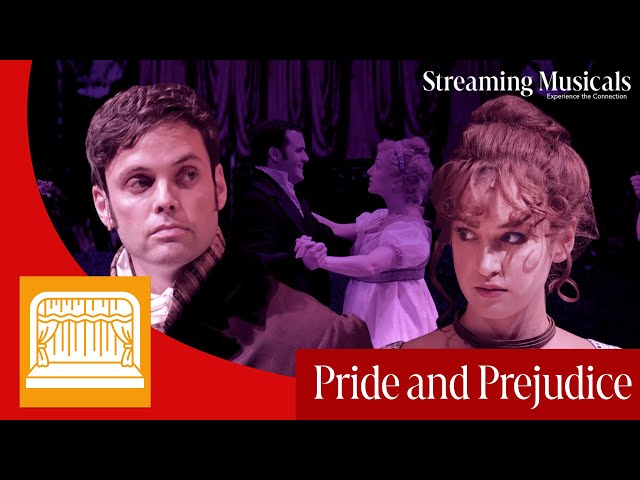
The timing changed the production's future. The stage run ended shortly before COVID-19 closed American theaters. A professional recording had already been made, and Streaming Musicals converted that footage into an online release. TheaterMania hosted a free virtual premiere on April 10, 2020, with Laura Osnes, Beth Leavel and Julie James involved in the presentation. The film later reached commercial streaming services.
The screen version runs 2 hours and 8 minutes, while contemporary listings gave the live production a running time near 2 hours and 25 minutes. The edited recording preserves Robert Kelley's direction and Dottie Lester-White's choreography, but camera selection changes the emphasis. Close shots favor whispered reactions and comic details. Wide stage compositions, including the social geometry of balls and drawing rooms, carry less force on a laptop.
One production detail needs correction because several online summaries misidentify the leads. Mary Mattison plays Elizabeth Bennet, and Justin Mortelliti plays Mr. Darcy. Monique Hafen Adams plays Caroline Bingley and Ann de Bourgh. Seton Chiang appears in the ensemble as a footman and townsperson. The distinction matters because Mattison and Mortelliti carry the score's principal romantic argument.
Important Songs, Lyrics and Scene Placements
"Happiness in Marriage" (The Bennet Family)
- The Scene:
- The musical begins inside the Bennet household, where five daughters and limited family security turn marriage into a daily calculation. Mrs. Bennet pushes the subject with comic urgency while Elizabeth resists the idea that convenience should decide affection.
- Lyrical Meaning:
- The song establishes the show's economic stakes. Happiness is discussed beside inheritance, income and social position. Its reprise near the conclusion tests whether the characters have learned anything or merely secured acceptable matches.
"Headstrong" (Elizabeth Bennet and Company)
- The Scene:
- Elizabeth's independence becomes a public complaint. Family members and neighbors treat her refusal to behave strategically as both a personality defect and an inconvenient threat to household plans.
- Lyrical Meaning:
- The title begins as an accusation, yet Elizabeth partly claims it as an identity. The reprise becomes less comfortable because her confidence has helped her resist pressure and helped her misjudge Darcy. The same quality protects her and traps her.
"A Single Man of Good Fortune" (Company)
- The Scene:
- News of Charles Bingley's arrival travels through the neighborhood. The ensemble converts one unmarried man's property and income into a community event before he has entered the room.
- Lyrical Meaning:
- Gordon expands Austen's opening sentence into a social refrain. The community sings as a market, and eligible men become assets under inspection. Later reprises expose how quickly affection, gossip and financial ambition become indistinguishable.
"Walk Through Mud" (Elizabeth Bennet)
- The Scene:
- Elizabeth crosses wet country to visit Jane after Jane becomes ill at Netherfield. Her muddy clothes offend Caroline Bingley's standards before Elizabeth has spoken at length.
- Lyrical Meaning:
- The walk measures loyalty through action. Elizabeth accepts discomfort and social ridicule because Jane needs her. The muddy hem becomes evidence in two opposing cases: Caroline sees vulgarity, while Darcy sees resolve.
"What Kind of Man" (Elizabeth Bennet)
- The Scene:
- After hearing Wickham's account of Darcy, Elizabeth arranges scattered impressions into a moral verdict. The staging places her inside her own reasoning rather than presenting Darcy's guilt as an established fact.
- Lyrical Meaning:
- The repeated question sounds investigative, although Elizabeth has already chosen an answer. The reprise becomes an act of self-correction once Darcy's letter and later conduct expose Wickham's manipulation.
"Against My Will" (Mr. Darcy)
- The Scene:
- Darcy recognizes that his attraction to Elizabeth has survived every objection he can assemble. Rank, family behavior and wounded pride remain active, yet his controlled exterior has begun to fail.
- Lyrical Meaning:
- The title reveals the defect inside Darcy's first proposal. He experiences love as resistance overcome, then presents that struggle as evidence of sacrifice. The music gives him emotional exposure before his language acquires humility.
"Pemberley" (Elizabeth Bennet and Company)
- The Scene:
- Elizabeth visits Darcy's Derbyshire estate believing that its owner is absent. The household staff, rooms and grounds offer information that conflicts with Wickham's portrait of a cruel, selfish man.
- Lyrical Meaning:
- Pemberley functions as character evidence. Its order suggests responsibility rather than vanity, while the servants' loyalty matters more than the building's cost. Elizabeth begins revising her judgment before Darcy reappears.
"Not the Man That I Know" (Elizabeth Bennet)
- The Scene:
- Darcy's altered behavior and his intervention after Lydia's elopement no longer fit Elizabeth's original verdict. She must compare the man she condemned with the man whose actions she has now witnessed.
- Lyrical Meaning:
- The lyric turns recognition into an ethical problem. Elizabeth does not simply discover Darcy's goodness. She discovers the unreliability of her own certainty. That admission completes the dramatic work begun by "What Kind of Man."
"The Declaration" (Mr. Darcy and Elizabeth Bennet)
- The Scene:
- Darcy approaches Elizabeth after Lady Catherine's failed attempt to prevent the match. The second declaration arrives after both characters have altered their conduct, language and understanding.
- Lyrical Meaning:
- The scene revises the first proposal's emotional grammar. Darcy no longer treats love as a burden imposed upon him, and Elizabeth answers with knowledge rather than wounded pride. The romance becomes credible because the score has documented their errors.
Streaming and Production Updates
Information in this section was checked in July 2026. The original TheatreWorks engagement is no longer running, and no verified Broadway, West End or national touring production has been announced for Paul Gordon's version. The filmed production remains the show's principal public form.
Streaming availability varies by country and month. Current platform listings identify Apple TV and Amazon Video as rental or purchase options in supported territories. JustWatch also lists ad-supported or subscription availability through services including Tubi, Filmzie, YouTube Free and fuboTV in the United States, though catalog rights can change without notice. Streaming Musicals continues to maintain an official page for the recording.
The film's long digital life is commercially important. Streaming Musicals states that the Palo Alto stage production established an all-time TheatreWorks box-office record. The proshot then reached viewers during the first month of widespread theater closures, when an otherwise regional world premiere suddenly had an international audience.
Interest in Austen adaptations remains crowded in 2026. New screen versions and reinterpretations compete for the same search audience, including Netflix's announced Pride and Prejudice series and the television adaptation of The Other Bennet Sister. Gordon's musical has a useful distinction within that field: it is a complete professionally filmed stage production rather than a cast recording, concert excerpt or fan video.
Notes and Trivia
- The musical was developed at TheatreWorks Silicon Valley's 2018 New Works Festival before its 2019 world premiere.
- The world-premiere engagement ran from December 4, 2019, through January 4, 2020, at the Lucie Stern Theatre in Palo Alto.
- The production was TheatreWorks Silicon Valley's 70th world premiere.
- The official filmed edition runs 2 hours and 8 minutes and carries a general-audience rating on several platforms.
- The score contains 29 listed numbers when reprises are counted.
- Paul Gordon wrote the book, music and lyrics rather than dividing those jobs among separate writers.
- The musical followed Gordon's adaptations of Emma and Sense and Sensibility, making it his third Austen musical.
Critical Reception: 2019 Reviews and Later Viewing
The 2019 reviews divided over the production's accessibility. Supportive critics valued the way songs externalized thoughts that Austen kept beneath formal speech. Skeptical critics argued that the adaptation replaced literary precision with generic romantic-pop language. Both reactions identify the same creative choice: Gordon makes the characters emotionally legible as soon as possible.
"TheatreWorks' production uses song and the intimacy of live theater to allow characters to express what they've never been able to say."
Lily Janiak, San Francisco Chronicle
Janiak's observation identifies the production's strongest theatrical argument. Austen's people survive by controlling what they say in company. A solo can suspend that control without forcing the character to confess publicly. "Against My Will" and "What Kind of Man" use this device with particular clarity.
"The best thing about Pride and Prejudice is Austen herself."
Tony Frankel, Stage and Cinema
Stage and Cinema's harsher review questioned whether the musical writing equaled the source material. That skepticism is fair when a lyric repeats a conclusion already supplied by Austen's dialogue. The score is stronger when it reorganizes a scene around a recurring phrase, as "Headstrong" and "A Single Man of Good Fortune" do.
"Paul Gordon brings Jane Austen's classic themes of love, money, status, character...to life in vivid lyrics."
Henry Etzkowitz and Alice Zhou, Splash Magazines
Later streaming responses have generally treated the film as an accessible, family-friendly Austen adaptation. Home viewing also changes the standard of judgment. The recording preserves a regional world premiere rather than pretending to be a fully redesigned movie musical. Visible theatrical conventions, doubled roles and compact scenery belong to the production's stage grammar.
Awards and Recognition
- Paul Gordon previously received a 2001 Tony Award nomination for the music and lyrics of Jane Eyre.
- Pride and Prejudice was selected as TheatreWorks Silicon Valley's 70th world premiere.
- Streaming Musicals reports that the original production established an all-time TheatreWorks box-office record.
- No verified Tony Award, Olivier Award or Broadway production credit applies to this 2019 TheatreWorks staging.
Quick Facts
- Title: Pride and Prejudice: A New Musical
- Source: Jane Austen's 1813 novel Pride and Prejudice
- World-premiere year: 2019
- Filmed-release year: 2020
- Type: Stage musical and professionally filmed live production
- Book, music and lyrics: Paul Gordon
- Director: Robert Kelley
- Choreographer: Dottie Lester-White
- Original venue: Lucie Stern Theatre, Palo Alto, California
- Producer: TheatreWorks Silicon Valley; filmed distribution through Streaming Musicals
- Film running time: 2 hours and 8 minutes
- Lead performers: Mary Mattison as Elizabeth Bennet and Justin Mortelliti as Fitzwilliam Darcy
- Selected dramatic placements: Netherfield, the muddy walk to Jane, Darcy's first proposal, Pemberley, Lydia's disgrace and Darcy's second declaration
- Song-list scope: 29 numbers including reprises
- Album status: No widely verified standalone original-cast soundtrack album is listed by the principal official sources; the complete score is heard in the filmed production.
- Current availability: Streaming, rental and purchase options vary by territory.
Key Contributors
| Name | Role | Contribution |
|---|---|---|
| Jane Austen | Original novelist | Created the characters, plot and social argument in the 1813 novel. |
| Paul Gordon | Book writer, composer and lyricist | Adapted the novel and wrote the complete stage score. |
| Robert Kelley | Director | Directed the TheatreWorks world premiere and filmed staging. |
| Dottie Lester-White | Choreographer | Created the production's ballroom movement and ensemble staging. |
| Mary Mattison | Elizabeth Bennet | Leads Elizabeth's songs of independence, error and revised judgment. |
| Justin Mortelliti | Fitzwilliam Darcy | Charts Darcy's movement from reserve and condescension toward humility. |
| Travis Leland | Charles Bingley | Provides the open romantic counterpart to Darcy's guarded behavior. |
| Sharon Rietkerk | Jane Bennet | Centers the Bingley courtship and Elizabeth's protective loyalty. |
| Monique Hafen Adams | Caroline Bingley and Ann de Bourgh | Plays two figures connected to class pressure and Darcy's expected marriage. |
| Taylor Crousore | George Wickham | Supplies the persuasive false narrative that shapes Elizabeth's prejudice. |
| Lucinda Hitchcock Cone | Lady Catherine and Mrs. Gardiner | Contrasts aristocratic coercion with practical family guidance. |
| Streaming Musicals | Filmed-production distributor | Released the professional stage recording to digital audiences in 2020. |
Sources
References & Verification: Production history and availability were checked through Streaming Musicals, Filmed Live Musicals, TheaterMania, Apple TV, Amazon Video and JustWatch. Creative history was checked against BroadwayWorld's 2019 interview with Paul Gordon. Critical response was compared through the San Francisco Chronicle, Stage and Cinema, Talkin' Broadway and Splash Magazines. Cast credits were cross-checked through official platform listings and film databases. Information was current on July 9, 2026.