Peter Pan Lyrics – All Songs from the Musical
Peter Pan Lyrics: Song List
- Overture
- Tender Shepherd
- Peter Arrives at the Darling House
- I've Got to Crow
- Never Never Land
- I'm Flying
- Journey to Neverland
- Pirate Song
- Hook's Tango
- Indians!
- Wendy
- Tarantella
- I Won't Grow Up
- Oh, My Mysterious Lady
- Ugg-a-Wugg / The Pow Wow Polka
- Distant Melody
- Captain Hook's Waltz
- Captain Hook's Waltz (Reprise)
- Pirate Ship Duel
- I Gotta Crow (Reprise)
- Tender Shepherd (Reprise)
- We Will Grow Up
- Finale: Never Never Land
About the "Peter Pan" Stage Show
Release date: 1954
"Peter Pan" – The Musical Guide & Song Meanings
Information current as of 31 January 2026. This article analyzes lyrical function and album storytelling. It does not reproduce lyrics.
Review
“Peter Pan” (1954) is a curious Broadway animal: a family title that behaves like a star vehicle, a stunt show, and a lyric laboratory at the same time. Its central premise is simple (refuse adulthood, win eternal play), but the score complicates it. The songs keep slipping between bragging, lullaby, and menace, as if Neverland is less a place than a mood swing.
The lyric writing splits cleanly into two voices. Carolyn Leigh’s work tends to feel conversational and sharp, like a child talking too fast because the thought is already running away. The Betty Comden and Adolph Green additions, often paired with Jule Styne’s music, have a different shine: broader comedy, bigger hooks, more “show-business” shape. That tug-of-war is not a flaw. It is the show’s sound. Peter is both a kid and a myth. Hook is both a threat and a vaudeville act. The score meets them where they are.
Listen for how the show uses “flight” as a lyric strategy. Sometimes it is literal (fairy dust, happy thoughts, wires). Sometimes it is moral. “I Won’t Grow Up” is not just a childhood anthem; it is a refusal to be accountable. And Hook’s musical material keeps proving the counterpoint: adulthood is ridiculous, violent, and extremely well dressed.
On album, the 1954 cast recording plays like a postcard from a specific Broadway era: short tracks, fast pivots, and a lot of narrative packed into very little runtime. It is charming. It is also sneakily dark, especially once you notice how often the show treats “mother” as a job title assigned by boys.
How it was made
This “Peter Pan” began as a plan for a play-with-music built around Mary Martin. Producer Edwin Lester and director Jerome Robbins assembled Moose Charlap (music) and Carolyn Leigh (lyrics) as the primary writers, then changed course after the West Coast tryouts landed with less sparkle than hoped. The fix was not subtle: Robbins brought in Comden, Green, and Styne to add new numbers that better showcased the stars and helped turn the piece into a full-scale musical.
You can hear that history in the score’s seams. Some songs feel like they were born inside the scene (Peter’s crowing, Wendy’s lullaby). Others arrive with a more engineered “number” logic, built to stop time and let the audience feel the brand of the show. That mixture is precisely why “Peter Pan” remains so producible. It has intimate storytelling and big theatrical levers, often in the same five minutes.
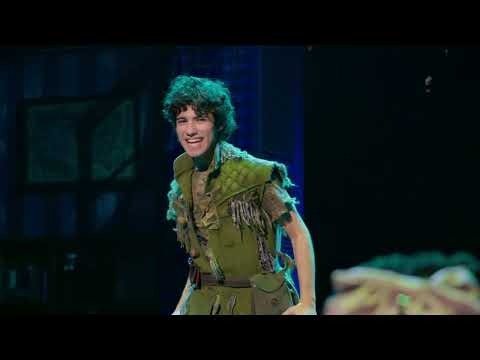
The modern touring version embraces this dual identity while also confronting what earlier productions treated as background noise: racial caricature and lazy “tribe” jokes. The new book work, credited to Larissa FastHorse, is not just a sensitivity pass. It is structural maintenance. If you want families to clap for fairies in 2026, you cannot ask them to swallow 1954’s weakest material in the same breath.
Key tracks & scenes
Scene placements below follow the 1954 story flow as documented in production synopses and musical-number listings, plus how these moments are typically staged in major revivals.
"Tender Shepherd" (Mrs. Darling, Wendy, John, Michael)
- The Scene:
- Nursery at night. The household quiets into bedtime ritual. Soft lighting, a domestic hush, and the faint sense that “safe” is a performance adults do for children.
- Lyrical Meaning:
- This lullaby is a baseline. It defines “home” as warmth and rules. Everything Peter offers later is measured against this tone: comfort that costs responsibility.
"I've Gotta Crow" (Peter)
- The Scene:
- Peter finds his shadow, loses it, gets it reattached, then explodes in triumph. The moment is often staged with quick physical comedy and a sudden brightening of the room.
- Lyrical Meaning:
- It is a brag song with an emotional tell. The lyric makes swagger sound like survival. Peter crows because he is terrified of being ordinary, and ordinary is one step from growing up.
"Never Never Land" (Peter)
- The Scene:
- Still in the nursery, Peter sells Wendy on a place that behaves like a dare. Directors usually let the stage picture widen here: more air, more possibility, less furniture.
- Lyrical Meaning:
- This is recruitment. The lyric is not a travel brochure; it is an argument that rules are optional. The song’s sweetness is strategic. It has to beat “Tender Shepherd” at its own game.
"I'm Flying" (Peter, Wendy, John, Michael)
- The Scene:
- Fairy dust. Happy thoughts. The first lift. Flying effects take over the stage grammar, usually with bright, upward lighting that makes the room look taller than it is.
- Lyrical Meaning:
- The lyric teaches a philosophy disguised as a trick: belief becomes physics. It also sets up the show’s recurring question, whispered through comedy: what happens to a person who needs belief more than truth?
"Hook's Tango" (Hook, Smee, Pirates)
- The Scene:
- Neverland, pirate territory. The music shifts into controlled menace with a comic bite. Hook plots in public like a performer who thinks his own villainy deserves applause.
- Lyrical Meaning:
- Hook’s songs are where the show admits it enjoys danger. The lyric keeps the threats witty, which is exactly why the character lands: fear becomes entertaining, then sneaks back into fear again.
"I Won't Grow Up" (Peter, Lost Boys)
- The Scene:
- Forest or hideout area. A boyish anthem staged as a rally. The movement usually turns percussive and repetitive, like a chant that works because everyone wants it to work.
- Lyrical Meaning:
- This is the show’s thesis in plain language. It is also a defense mechanism. The lyric turns fear of change into a badge of honor, which is thrilling until you realize it is also a trap.
"Distant Melody" (Peter)
- The Scene:
- Nighttime calm. Peter sings a lullaby-styled story-song to the boys, often with a warmer spotlight and minimal stage motion, as if the show finally stops running.
- Lyrical Meaning:
- The lyric reveals Peter’s most human skill: he can make fantasy feel like care. It is also the moment where “mothering” in Neverland starts to look like emotional labor assigned by children who refuse adulthood.
"Never Never Land (Reprise)" (Peter)
- The Scene:
- Endgame. Peter returns for spring cleaning and finds Wendy grown, then turns to Jane. The stage picture often mirrors the opening nursery, now shaded with time.
- Lyrical Meaning:
- The reprise is the musical’s quiet punch. The lyric sells enchantment again, but the audience hears the cost now. Neverland does not change. People do.
Live updates
The most significant current “Peter Pan” activity is the newly imagined North American tour that launched in 2024, directed by Lonny Price with choreography by Lorin Latarro and additional book credit to Larissa FastHorse. Official tour materials list additional lyrics by Amanda Green and position the production as an update rather than a museum piece.
The update that has drawn the most attention is the handling of the show’s Indigenous portrayal. Reporting and interviews around the tour confirm that “Ugg-a-Wugg” was removed, with replacement material built to avoid parody and to reframe the Neverland “tribe” idea in a less harmful way. Some coverage describes a replacement dance titled “Friends Forever,” emphasizing shared movement rather than mock language.
Tour stops and ticketing remain active through at least 2025 on venue announcements and major ticketing platforms, and the tour’s online presence continues to promote ongoing dates. For the most reliable, current availability snapshot, follow the venue on-sale notices (they update faster than long-lead press releases) and cross-check against official Ticketmaster event listings.
Notes & trivia
- The original Broadway run opened 20 October 1954 at the Winter Garden Theatre and closed 26 February 1955 (152 performances).
- The show’s songwriting credits are hybrid by design: Moose Charlap and Carolyn Leigh wrote the core score; Comden, Green, and Styne added songs during development to strengthen the star “showcase” factor.
- Mary Martin (Peter) and Cyril Ritchard (Hook) both won Tony Awards for their performances.
- The 1954 cast recording remains widely available in modern distribution, commonly presented as a compact 17-track album under later reissue rights.
- Major modern revisions to the script and staging have focused on cultural representation as well as pacing and flying spectacle.
- “I Won’t Grow Up” functions as both anthem and warning label, which is why it survives every era’s taste cycle.
- If you want a “lyrics-first” listening path: start with “Tender Shepherd,” “Never Never Land,” “I Won’t Grow Up,” and “Distant Melody.” That sequence tells you what the show believes.
Reception
In 1954, critics and audiences largely treated “Peter Pan” as a feat: a beloved story converted into a star-driven musical machine, with Hook’s comedy acting as a pressure valve for the darker edges of the myth. Later commentary has tended to sharpen the lens, noticing what the show’s lyrics say about gender, parenting, and the fantasy of “forever boyhood.” Today, the production history reads like an ongoing negotiation between wonder and what we are willing to excuse in the name of tradition.
Brooks Atkinson called her “the liveliest Peter Pan in the record book.”
Martin caught Peter’s sad side as well as his exuberance, and that sad side has become even more interesting in the intervening years.
Titled “Friends Forever,” the “Ugg-a-Wugg” replacement is an upbeat friendship dance.
Quick facts
- Title: Peter Pan
- Broadway year: 1954
- Type: Musical comedy / family classic with flying effects
- Primary music: Morris “Moose” Charlap
- Primary lyrics: Carolyn Leigh
- Additional music: Jule Styne
- Additional lyrics: Betty Comden, Adolph Green (and, for the modern tour materials, Amanda Green)
- Original direction/choreography/adaptation credit: Jerome Robbins
- Original Broadway stars: Mary Martin (Peter), Cyril Ritchard (Hook/Mr. Darling)
- Selected notable song placements: “I’m Flying” in the Darling nursery flight lesson; “Pirate Song” and Hook material in Neverland threats; “I Won’t Grow Up” as Lost Boys anthem; “Distant Melody” as story-lullaby
- Cast album (key reference): Original 1954 cast recording widely reissued; commonly listed as 17 tracks, about 48–49 minutes, with later label reissue rights
- Current stage status (2025/2026): Newly imagined national tour launched 2024; touring activity and ticketing remain live via official tour marketing and major ticketing platforms
Frequently asked questions
- Who wrote the lyrics for the 1954 musical?
- Carolyn Leigh wrote the primary lyrics, with additional lyrics credited to Betty Comden and Adolph Green for added songs developed during production.
- Which songs are essential for understanding the story fast?
- “Tender Shepherd” (home), “Never Never Land” (temptation), “I’m Flying” (belief becomes action), and “I Won’t Grow Up” (the moral argument).
- Is the touring version the same as the 1954 script?
- No. The current tour is marketed as a new adaptation with additional book work and updated handling of culturally sensitive material, while keeping the core song identity audiences expect.
- What happened to “Ugg-a-Wugg” in recent productions?
- It has been removed in the current tour, with replacement material designed to avoid caricature and reduce harm.
- Is there a “best” cast recording to start with?
- If you want the original Broadway sound, start with the 1954 cast recording. If you want a modern performance style, consider later TV-cast releases, but the 1954 album is still the cleanest map of the score’s bones.
- Why is Captain Hook’s music so different from Peter’s?
- Because Hook lives in performance. His songs often treat villainy like cabaret. Peter’s material tends to be direct, impulsive, and childlike, which makes Hook’s polish feel even more adult and dangerous.
Key contributors
| Name | Role | Contribution |
|---|---|---|
| Morris “Moose” Charlap | Composer | Wrote the core musical language of the 1954 score, balancing lullaby warmth with quick comedy rhythms. |
| Carolyn Leigh | Lyricist | Primary lyric voice; shaped Peter’s brashness and the show’s brisk storytelling style. |
| Betty Comden | Additional lyricist | Co-wrote added songs that broadened the “number” palette and sharpened comic propulsion. |
| Adolph Green | Additional lyricist | Co-wrote added songs; helped build Hook’s theatrical swagger and the score’s big, audience-facing hooks. |
| Jule Styne | Additional composer | Composed added numbers during development, contributing several of the show’s best-known melodic statements. |
| Jerome Robbins | Original director / choreographer / adaptation credit | Shaped the piece as a star-driven theatrical event and steered the creative expansion into a full musical. |
| Mary Martin | Original star | Defined the role’s vocal-physical vocabulary and anchored the show’s mixture of bravado and melancholy. |
| Cyril Ritchard | Original star | Made Hook a comic performance engine, giving the score its most adult, satirical counterweight. |
| Larissa FastHorse | Additional book (touring adaptation) | Helped modernize the touring version’s storytelling and representation choices while preserving the show’s recognizable musical identity. |
| Lonny Price | Director (touring adaptation) | Leads the newly imagined tour staging; public-facing materials emphasize spectacle, pacing, and updated approach. |
| Lorin Latarro | Choreographer (touring adaptation) | Shapes the dance language of the new tour, including revised community moments designed to replace outdated material. |
Sources: IBDB; Playbill; MTI; Masterworks Broadway; Ordway; Ticketmaster; Los Angeles Times; Star Tribune; BroadwayWorld; Apple Music; Spotify.