Paradise Square Lyrics – All Songs from the Musical
Paradise Square Lyrics: Song List
About the "Paradise Square" Stage Show
Set in 1863, this is a galvanizing story of racial harmony undone by a country at war with itself, we meet the denizens of a local saloon called Paradise Square: Nelly Freeman, the indomitable Black woman who owns it; Annie O’Brien, her Irish-Catholic sister-in-law and her Black minister husband, Rev. Samuel Jacob Lewis; Owen Duignan, a conflicted newly arrived Irish immigrant; Washington Henry, a fearless freedom seeker; Frederic Tiggens, an anti-abolitionist political boss, and Milton Moore, a penniless songwriter trying to capture it all. They have conflicting notions of what it means to be an American while living through one of the most tumultuous eras in our country’s history.Release date: 2022
"Paradise Square" – The Musical Guide & Song Meanings
Information current as of January 2026. If you are here for the songs, start with “Paradise Square,” then jump to “Heaven Save Our Home,” and only then hit “Let It Burn.” The emotional math makes more sense in that order.
Review
What happens when a musical wants to sing about interracial solidarity, class panic, and state violence, all at once, while still giving you a roof-raising eleven o’clock number? “Paradise Square” answers: you get a show with a beating heart, a messy spine, and lyrics that work hardest when they stop trying to sound inspirational and start sounding cornered.
Set in the Five Points, the book frames the saloon as a fragile commons: a place where Irish immigrants and Black New Yorkers share music, money, and temporary safety. The score by :contentReference[oaicite:0]{index=0}, with lyrics by :contentReference[oaicite:1]{index=1} and :contentReference[oaicite:2]{index=2}, keeps circling one idea: belonging is transactional until it becomes dangerous. The best lyric writing is less “we are one” and more “we are stuck together, so choose carefully.”
Musically, it’s a Broadway engine that flirts with Irish and Black idioms without fully surrendering to either. That’s partly the point. The show keeps staging cultural exchange as performance and competition: dance-offs, crowd choruses, call-and-response. When the lyrics flatten into generic uplift, the drama leaks out. When the words get specific, the story tightens: draft notices, paid exemptions, the price tag on survival.
One more complicating layer: the piece grew out of a Stephen Foster remix impulse, then moved toward newer, original material. Several critics clocked the tradeoff: a richer historical frame, but a score that sometimes feels like it is still negotiating its own identity. That tension is audible in the lyric palette: plainspoken declarations for the public story, sharper verbs and images for the private one.
How it was made
The project’s DNA is older than its Broadway opening. It traces back to “Hard Times,” an earlier concept by :contentReference[oaicite:3]{index=3} that reimagined Foster-era material through a Civil War social lens. Over the years, the focus shifted from “composer portrait” toward “neighborhood pressure cooker,” which helps explain why the lyric writing toggles between period echo and contemporary directness.
In development, the show leaned hard on dance as argument. :contentReference[oaicite:4]{index=4} has talked about using the Five Points as both promise and warning, with movement traditions bumping up against each other long before the riot sequences land. That choreographic mission shapes how lyrics function: many numbers are written to be danced as much as sung, with rhythmic hooks built for footwork and ensemble punctuation.
By the time it reached Broadway under :contentReference[oaicite:5]{index=5}, the musical-number architecture was clear, but the show was still rewriting. One useful case study is “I’d Be a Soldier,” which had existed in earlier form and was later presented as an entirely new song, lyric, and arrangement. That kind of surgery matters for lyric analysis: you are hearing a show argue with itself, in public, about what its central thesis should sound like.
Key tracks & scenes
Note on “specific placements”: the musical’s official study materials publish the Broadway song order by act. The descriptions below map those songs to the show’s major beats and staging language (saloon, streets, uptown parlors) as documented in reviews and production notes, with additional interpretive detail where the sources stay silent.
"Paradise Square" (Nelly, Annie, Willie, Reverend, Ensemble)
- The Scene:
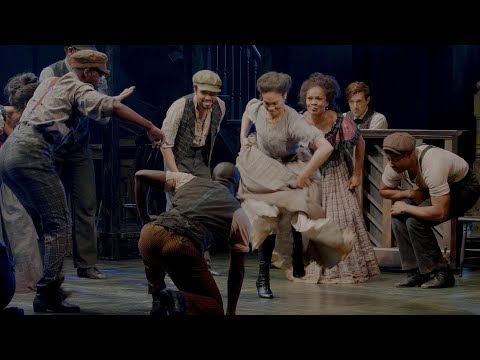
- The saloon opens as a working machine: bodies, tables, and rhythms. Warm, crowded stage pictures. The neighborhood sells itself as a truce you can dance in.
- Lyrical Meaning:
- This is the show’s sales pitch and its warning label. The lyric stakes out “home” as a place you build nightly, not a place you inherit. Every later betrayal lands harder because this opening insists the community is real.
"Camptown Races" (Owen, Washington, Milton)
- The Scene:
- A public number that plays like a jam session and a dare. The saloon becomes a lab for cross-pollination: Irish step vocabulary beside Juba-derived attack. Bright front light, competitive spacing, the crowd as jury.
- Lyrical Meaning:
- The lyric uses familiarity as camouflage. A “known” tune turns into a social test: who gets to lead, who gets laughed at, who gets paid. It’s cultural exchange with receipts.
"Why Should I Die in Springtime?" (Owen, Ensemble)
- The Scene:
- A draft-haunted soliloquy that widens into ensemble pressure. Cooler lighting, less beer-hall warmth. Movement shifts from celebration to bracing, as if the room itself is marching.
- Lyrical Meaning:
- The lyric is a moral argument disguised as self-pity: Owen’s fear is personal, but the song keeps glancing toward the system that can buy rich men out and conscript poor ones in.
"I’d Be a Soldier" (Reverend, Washington, Ensemble)
- The Scene:
- Part sermon, part recruitment fantasy, part trap. The staging often frames the Reverend as a moral center while the ensemble becomes a chorus of consequences.
- Lyrical Meaning:
- It’s aspiration under constraint. The lyric’s power comes from its double edge: service as dignity, service as coercion, service as bargaining chip in a country that keeps moving the goalposts.
"Heaven Save Our Home" (Nelly, Ensemble)
- The Scene:
- End-of-Act intensity, with Nelly holding the room together as the outside world turns. Lighting tightens, bodies cluster, the saloon’s “safe” perimeter suddenly feels thin.
- Lyrical Meaning:
- Listen to the verbs. This is not passive prayer. The lyric makes “home” an active defense, and it reframes community as something you can lose in a night.
"Someone to Love" (Annie, Nelly)
- The Scene:
- A quieter two-hander that plays like a temporary ceasefire. Softer light, tighter focus, less crowd commentary.
- Lyrical Meaning:
- The lyric is about intimacy as shelter, but it also reveals the show’s core political irony: the characters can imagine personal peace more easily than civic peace.
"Breathe Easy" (Angelina, Washington, Ensemble)
- The Scene:
- A reunion song shaped by fugitives’ caution. Even when it swells, it never fully relaxes. The staging tends to keep exits visible, as if the room must be escaped at any second.
- Lyrical Meaning:
- The lyric treats breath as both romance and logistics. “Easy” is a fantasy word. The song measures how far safety is from being normal.
"Let It Burn" (Nelly)
- The Scene:
- The show’s volcanic climax. The world contracts to Nelly’s body and voice as riot violence closes in. Red and amber cues dominate, and the number plays like a controlled ignition rather than a sudden explosion.
- Lyrical Meaning:
- The lyric is refusal, not catharsis. The title phrase reads like permission, but the performance makes it sound like strategy: if the old order only understands fire, then fire becomes language.
Live updates
The Broadway run ended at :contentReference[oaicite:6]{index=6} in July 2022, after a season of high visibility and harsh backstage finance headlines. In 2022, producers publicly pointed toward a future national tour; later reporting and union actions made that path look far less straightforward.
For listeners, the bigger “where are we now?” question was the cast recording. In spring 2022, trade announcements described a fast rollout: record in April, release digitally, then physical editions. Instead, the album became a slow-moving saga. In early 2023, the composer began sharing tracks via social platforms amid legal and financial disputes around the production, a rare case of a Broadway score surfacing sideways rather than through standard label channels.
As of mid-2025, there was finally a cleaner consumer-facing answer: :contentReference[oaicite:7]{index=7} scheduled a CD release (with a full-lyrics booklet and production photography) while streaming and downloads remained available. If you are researching the text itself, that physical booklet matters: it stabilizes the lyric canon that had previously circulated in fragments.
Practical listener tip: “Let It Burn” works best as Act Two payoff, not as a standalone inspirational clip. If you only know that song, you are missing the show’s main rhetorical move: the way it turns “community entertainment” into “community combustion.”
Notes & trivia
- The published Broadway song list places “Heaven Save Our Home” as the Act One closer, with “Let It Burn” late in Act Two.
- “I’d Be a Soldier” was presented in 2021 publicity as a newly written number since the Berkeley run, with a new lyric and arrangement.
- The show’s creative lineage includes a pre-Broadway Chicago engagement at :contentReference[oaicite:8]{index=8} and earlier development at :contentReference[oaicite:9]{index=9}.
- Several reviews singled out the choreography as the clearest storytelling tool, especially in the dance-off vocabulary, even when the book felt overloaded.
- In 2022, mainstream coverage frequently cited “Let It Burn” as the performance centerpiece, with :contentReference[oaicite:10]{index=10} later winning the Tony for leading actress after performing the number on the telecast.
- Ticketing write-ups for the Broadway run listed a wide price spread, with top orchestra seats marketed far above entry-price options.
- Myth check: the show is often summarized as “Stephen Foster jukebox.” On Broadway, it is more accurate to call it an original-score musical that strategically repurposes older musical material as reference points rather than as the whole engine.
Reception
Critics mostly agreed on two things: the ambition is serious, and the storytelling load is heavy. Where they diverged is on whether the lyric writing and score justify the scale, or whether the show’s big moral questions outgrow its musical language.
“The thrilling exception… is Nelly’s final number, ‘Let It Burn.’”
“Kalukango’s voice is an embarrassment of riches… making sense of… banal pop lyrics.”
“A stone soup musical… still edible if you’re willing to take the risk.”
Read those together and you get the show’s critical fingerprint. The lyrics were rarely accused of being incoherent. They were accused of being safe. And when the writing does finally take a risk, the performance turns that risk into the night’s headline.
Quick facts
- Title: Paradise Square
- Broadway year: 2022
- Setting: :contentReference[oaicite:11]{index=11}, New York City, during the Civil War and the 1863 Draft Riots
- Music: Howland
- Lyrics: Tysen; Asare
- Book: Christina Anderson; Craig Lucas; Kirwan
- Director: Kaufman
- Choreography: Jones
- Signature numbers (Broadway order by act): “Paradise Square” (opening); “Heaven Save Our Home” (Act One closer); “Let It Burn” (late Act Two)
- Cast recording status: Recorded in 2022; partial social release surfaced in 2023; later physical CD release announced with full lyrics booklet
- Awards snapshot: 10 Tony nominations; lead actress win
Frequently asked questions
- Is “Let It Burn” the finale?
- No. It lands late in Act Two as the emotional peak, followed by a finale sequence.
- Is this a Stephen Foster jukebox musical?
- Not in the strict sense. The Broadway version is primarily an original score that references and reworks older material as part of its historical argument.
- Why do the lyrics sometimes sound contemporary?
- Because the show is not trying to be a museum label. The lyric strategy often favors clarity under pressure, especially around the draft and riot material.
- Was there an original Broadway cast album?
- Yes, it was recorded. Its release history was delayed and complicated, with tracks surfacing before later physical-release plans were publicized.
- Is the show currently running or touring?
- The Broadway production is closed. Tour plans were discussed during the run; check current official announcements and presenter listings for any newly scheduled engagements.
Key contributors
| Name | Role | Contribution |
|---|---|---|
| Howland | Composer, musical director, orchestrator | Built the hybrid Broadway score; produced the cast recording sessions. |
| Tysen | Lyricist | Wrote contemporary-facing lyric text; shaped the show’s anthems and narrative clarity. |
| Asare | Lyricist | Co-authored lyrics with an emphasis on character-driven declarations and ensemble propulsion. |
| Kirwan | Co-book writer; source-concept lineage | Originated the earlier “Hard Times” framework and remained part of the Broadway authorship. |
| Kaufman | Director | Staged the large-scale historical narrative with pageantry and crowd choreography. |
| Jones | Choreographer | Made dance the central storytelling grammar, especially in the saloon sequences. |
| Kalukango | Original Broadway leading performer | Defined Nelly’s arc and anchored the show’s signature performance moment. |
| :contentReference[oaicite:12]{index=12} | Original Broadway principal performer | Played Annie with a vocal style that sharpened the show’s domestic and moral conflicts. |
| :contentReference[oaicite:13]{index=13} | Original Broadway principal performer | Embodied Owen’s draft-era volatility and dance-driven ambition. |
| :contentReference[oaicite:14]{index=14} | Original Broadway principal performer | Played Washington (Joah), a key hinge between romance plot and political threat. |
Sources: Playbill; Broadway Inbound (study guide PDF); Time Out; New York Theatre Guide; TheaterMania; American Theatre; IrishCentral; DC Theater Arts; Broadway.com.