On The Town Lyrics – All Songs from the Musical
On The Town Lyrics: Song List
- Act 1
- I Feel Like I'm Not Out of Bed Yet
- New York! New York!
- Miss Turnstiles
- Come Up To My Place
- Carried Away
- Lonely Town
- Carnegie Hall Pavane
- Lucky to Be Me
- I Understand
- I Can Cook Too
- Times Square Ballet
- Act 2
- So Long Baby
- I Wish I Was Dead
- Ya Got Me
- Pitkin's Song
- Subway Ride
- Some Other Time
- The Real Coney Island
- Finale
About the "On The Town" Stage Show
Scriptwriters are A. Green & B. Comden. Composer was L. Bernstein. Premiere on Broadway was held in December 1944 on the stage of Adelphi Theater. They closed the show in February 1946 after 462 performances. Director was G. Abbott, choreographer – J. Robbins. In the show were involved: J. Battles, C. Alexander, A. Green, S. Osato, N. Walker & B. Comden. Updated staging took place in the Imperial Theatre from October 1971 to January 1972 with 73 performances. The director and choreographer was R. Field. The musical had such cast: D. McKechnie, P. Newman & B. Peters.The second updated version was shown in the Delacorte Theatre in August 1997, directed by G. C. Wolfe. In the musical participated: L. Delaria, M. Testa, J. Llana, L. Mugleston and others. Broadway’s exhibitions took place in the Public Theater from November 1998 to January 1999 and went for 65 regular performances. In November 2008, the musical was held on the stage of New York City Center Encores! for 4 days, directed by J. Rando & choreographed by W. Carlyle. The cast included: J. Bohon, C. Borle, T. Yazbeck & J. Lee Goldyn.
Other try-outs of the show on Broadway began from September 2014. Production took place at Lyric Theatre from October 2014 to September 2015 with 28 preliminaries & 368 regular performances. Director – J. Rando. Choreographer – J. Bergasse. In the show participated such cast: J. A. Johnson, C. Alves, E. Stanley, M. Rupert & A. Guinn. The London premiere took place in May 1963 in the Prince of Wales Theatre. There were shown 63 performances. The director & choreographer was J. Layton. The show had cast: E. Gould, D. McKay, C. Arthur, A. Jaffe & G. Lewis. From April to May 2007 the histrionics was held in English National Opera in the London Coliseum.
Release date: 1944
"On the Town" – The Musical Guide & Song Meanings
Review: what the lyrics are really doing
“On the Town” sells itself as a 24-hour pinball game: three sailors, one city, too many wrong turns. The trick is that the show’s best writing is not the plot mechanics. It is the verbal rhythm. Comden and Green write lyrics that behave like street traffic: interruptions, side-swipes, sudden honesty at a red light. When the book looks like it is bouncing from place to place, the language is quietly doing the job of continuity, turning New York into the show’s real leading character. The sound is Bernstein at his most hybrid: classical muscle with jazz snap, plus dance breaks that are not decorative but diagnostic, the body translating what the characters cannot admit out loud.
The lyrical themes are blunt and sneaky at the same time: romantic projection (“Miss Turnstiles” as a paper fantasy), performance as survival (Ivy’s split life), and the city as both promise and threat. Notice how often the text toggles between public bravado and private fear. The bravado is fast, joke-dense, and crowd-friendly. The fear arrives in clean, plain lines that almost feel too simple for a show this busy. That simplicity is the point. In “Lonely Town” and “Some Other Time,” the writing stops doing bits and starts doing time.
One practical listening tip: if you are new to the score, start with the 2015 two-disc Broadway revival album for narrative clarity, then jump to the 1992 Barbican concert recording when you want to hear how symphonic the piece can sound when it is treated like a bona fide Bernstein work and not just “classic Broadway.”
How it was made: the Fancy Free pipeline
The origin story is unusually traceable because the creative chain is so direct: Robbins and Bernstein’s ballet “Fancy Free” detonates in 1944, then quickly mutates into a full musical comedy with the same sailor DNA. Bernstein’s own archival account gets specific about the personnel pivot: Robbins initially had other writers in mind, but Bernstein pushed for Betty Comden and Adolph Green, then had the producers go see them perform at the Blue Angel nightclub. That live-comedy sensibility is all over the finished lyric voice: playful, slightly sharp, always aware of the audience’s breath. The show opens on Broadway on December 28, 1944, with Robbins in the engine room of the dance storytelling and George Abbott steering traffic. The whole enterprise reads like young artists moving at wartime speed, because they were.
There is also a small but revealing authorship wrinkle: “I Can Cook, Too” is the rare “On the Town” standard with a lyric contribution from Bernstein himself, a reminder that he was not merely pasting tunes onto jokes. He could write a pointed line when he wanted to, especially when the song’s job is character seduction with a wink.
For modern productions, the show’s behind-the-scenes legacy is not only musical. Robbins insisted a New York story should look like New York, and the work is often cited for its early commitment to a more diverse stage picture than many contemporaries allowed.
Key tracks & scenes: 8 lyrical hinge-points
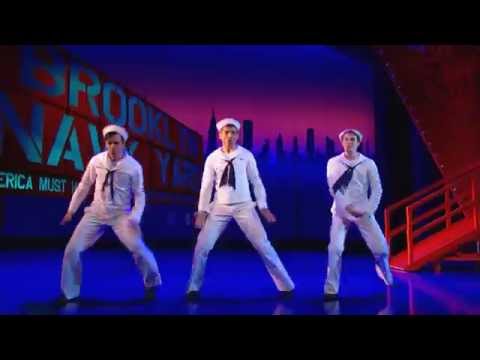
"New York, New York" (Gabey, Chip, Ozzie)
- The Scene:
- On a New York City dock at 6 a.m., the whistle blows and the boys spill into daylight like kids released from school, scanning the skyline for a whole life they can borrow in one day.
- Lyrical Meaning:
- This is not just a travel poster. The lyric is a manifesto for speed, appetite, and denial. They sing to convince themselves that the city can outshout the war waiting at the harbor.
"Come Up to My Place" (Hildy, Chip)
- The Scene:
- Chip lands in Hildy’s cab. She does not flirt so much as take command, steering him away from tourist fantasy and toward a real apartment with real heat and real consequences.
- Lyrical Meaning:
- The lyric is an argument against the guidebook version of New York. Hildy’s language is direct, bodily, practical. It is also a power grab: she is writing Chip’s day for him.
"Carried Away" (Claire, Ozzie)
- The Scene:
- At the Museum of Modern Art, Claire studies Ozzie as if he is a specimen. The flirtation begins as misread science, then turns into mutual momentum. The chase chaos literally starts here.
- Lyrical Meaning:
- The song’s title is the thesis: desire as slapstick physics. Comden and Green load the lyric with accelerating syntax so the text itself sounds like losing control.
"Lonely Town" (Gabey)
- The Scene:
- Gabey wanders. The crowd does not help. The lights feel less like Broadway sparkle and more like fluorescent distance as the city becomes a place you pass through without being seen.
- Lyrical Meaning:
- This is the show’s emotional trapdoor: the language goes spare and the jokes vanish. New York is no longer “helluva.” It is a mirror for wartime isolation.
"Carnegie Hall Pavane" (Madame Dilly, Ivy)
- The Scene:
- Inside Carnegie Hall’s training bubble, Ivy studies with Madame Dilly, who is drunk and dispensing cynical life rules like they are vocal exercises.
- Lyrical Meaning:
- The lyric pits “art” against “sex” as competing obsessions. It frames Ivy’s dilemma as a problem of categories: can she be taken seriously if she is also desired?
"I Can Cook, Too" (Hildy)
- The Scene:
- In Hildy’s apartment, a small domestic space turns into a stage. She clears the room, turns up the charm, and sells herself as a full-service myth with a grin.
- Lyrical Meaning:
- The lyric is seduction by résumé. It is funny, yes, but also very New York: identity as a list of skills, delivered fast before anyone can interrupt.
"Lucky to Be Me" (Gabey)
- The Scene:
- After meeting Ivy, Gabey’s inner monologue finally speaks. The stage can go softer here, because the song is a private confession wearing a public melody.
- Lyrical Meaning:
- The lyric redefines “luck” as temporary permission to hope. It is gratitude mixed with dread, the show’s central wartime emotion in one neat package.
"Some Other Time" (Claire, Hildy, Ozzie, Chip)
- The Scene:
- On the subway, the chase splinters. In a different car from Gabey, the others suddenly picture tomorrow, and the light feels colder because the clock is winning.
- Lyrical Meaning:
- This is the score’s grown-up song. The lyric does not bargain with fate. It names the cost of a one-day romance and makes the show’s comedy sound fragile.
Live updates (2025/2026)
Information current as of January 29, 2026. “On the Town” is not on Broadway right now, but it is actively circulating through serious institutions and inventive houses, which suits a title that lives equally well as dance-theatre and as concert-like Bernstein. Oper Graz has mounted a full production running from late October 2025 into February 2026, with listed ticket prices spanning budget seats to premium. In the U.S., conservatory and regional calendars keep the piece in motion; for example, Shenandoah Conservatory scheduled performances in October 2025. On the licensing side, Concord Theatricals continues to make the show available for new productions, which matters because “On the Town” often thrives when a company can actually dance it instead of merely “stage” it.
Notes & trivia
- The original Broadway production opened December 28, 1944 and ran 462 performances, transferring theaters during the run.
- Bernstein’s archival notes credit the writers’ discovery to a night seeing Comden and Green perform at the Blue Angel nightclub, a clue to why the lyric voice feels like comedy with musical discipline.
- “I Can Cook, Too” is commonly cited as having a lyric contribution from Bernstein, not only Comden and Green.
- The Concord-licensed synopsis makes the “Miss Turnstiles” poster vandalism the plot’s first big choice, setting up the show’s theme of desire triggered by an image.
- There is a historically important thread in discussions of the original production’s casting and representation, tied to Robbins’s insistence that a New York show should look like New York.
- If you want a snapshot of how the score plays at different scales, compare the 1944 Decca-era singles collection (a highlights package) with the more expansive later recordings.
Reception: then vs. now
Modern critics tend to agree on the fundamentals: the score is the star, the dance is the motor, and the book can feel like a purposeful zigzag rather than a straight line. The disagreements are revealing. Some reviewers celebrate the show’s youth and velocity, reading the episodic structure as the point. Others find the story jumpy, even when they admire the music and lyric craft.
“On the Town is a heartbreakingly youthful work: both about youth and by youth.”
“From bluesy ballads … ‘Lonely Town,’ ‘Some Other Time’ …”
“The plot … is a fitful affair, flicking inconsequentially from scene to scene.”
My read: the “fitful” quality is partly structural, but it is also musical design. Bernstein writes in montage. Comden and Green write like the city talks. When a production leans into that, the evening feels intentional. When it tries to smooth the edges into conventional romance, the seams show.
Quick facts (show + albums)
- Title: On the Town
- Broadway premiere: December 28, 1944
- Setting: New York City, 1944 (wartime)
- Music: Leonard Bernstein
- Book & lyrics: Betty Comden and Adolph Green
- Based on: Jerome Robbins’s idea (via the ballet “Fancy Free”)
- Original Broadway run: 462 performances
- Selected notable song moments (plot placements): “New York, New York” (dock/shore leave launch), “Lonely Town” (Gabey alone in the city), “Some Other Time” (subway reflection before the clock runs out)
- Licensing: Available via Concord Theatricals
- Key album options:
- 1944 Decca-era singles collection (highlights package)
- 1961 studio cast recording (a later, more complete studio approach)
- 2015 “New Broadway Cast Recording” (two-disc, PS Classics; strong for following the show’s shape)
- 1993 Deutsche Grammophon live concert recording (Barbican Hall performances recorded in 1992; symphonic scale)
Frequently asked questions
- Is “On the Town” connected to “Fancy Free”?
- Yes. The musical grows directly out of Jerome Robbins and Leonard Bernstein’s 1944 ballet “Fancy Free,” expanding its sailor-on-leave premise into a full book musical.
- Who wrote the lyrics?
- Betty Comden and Adolph Green wrote the book and lyrics, with Bernstein also credited for a lyric contribution in “I Can Cook, Too.”
- What is the best recording to start with?
- If you want story clarity, the 2015 two-disc Broadway revival cast album is a smart entry point. If you want to hear the piece as a Bernstein work at full orchestral strength, the Deutsche Grammophon concert recording is a strong second stop.
- Is it touring in 2025/2026?
- It is not on a major commercial Broadway tour circuit in the sources cited here, but it is being produced in 2025/2026 by institutions such as Oper Graz and in conservatory settings, and it remains available for licensed productions.
- Why does “Some Other Time” hit so hard?
- Because it stops the show’s comic sprint and lets the characters admit the truth: this day is borrowed, and the future is not guaranteed. The lyric’s restraint is the emotional punch.
- Is there a film version?
- Yes. MGM released a 1949 film adaptation, often used as a gateway for new listeners before they graduate to the stage score’s fuller structure.
Key contributors
| Name | Role | Contribution |
|---|---|---|
| Leonard Bernstein | Composer | Music; also credited with a lyric contribution in “I Can Cook, Too.” |
| Betty Comden | Book & Lyricist | Co-wrote the book and lyrics; signature comedic lyric voice. |
| Adolph Green | Book & Lyricist | Co-wrote the book and lyrics; razor timing in character banter. |
| Jerome Robbins | Concept originator / Choreography legacy | Idea based on “Fancy Free”; dance-driven storytelling DNA. |
| George Abbott | Director (original Broadway) | Directed the 1944 Broadway premiere. |
| Concord Theatricals | Licensing | Current licensing home; provides official synopsis and production materials. |
| PS Classics | Label | Released the 2015 two-disc Broadway revival cast album. |
| Deutsche Grammophon | Label | Released the concert recording associated with the 1992 Barbican Hall performances. |
Sources: IBDB; LeonardBernstein.com; Concord Theatricals; Playbill; TheaterMania; Variety; Vulture; The Guardian; Oper Graz; Operabase; Jerome Robbins Foundation (timeline); LA Opera blog; Apple Music; Overtur.