Nine Lyrics – All Songs from the Musical
Nine Lyrics: Song List
- Act 1
- Overture Delle Donne
- Germans At The Spa
- Not Since Chaplin
- Guido's Song
- My Husband Makes Movies
- A Call from the Vatican
- Only With You
- The Script
- Folies Bergeres
- Nine
- Ti Voglio Bene/Be Italian
- The Bells of St. Sebastian
- Act 2
- A Man Like You
- Unusual Way
- Contini Submits
- The Grand Canal
- Every Girl in Venice
- Amor
- Only You
- Finale
- Simple
- Be On Your Own
- I Can't Make This Movie
- Getting Tall
- Reprises
About the "Nine" Stage Show
The musical was created by M. Yeston in 1973. Writer was A. Kopit. Songs were written by M. Yeston. The plot’s center is a motion picture by Fellini «8 ½». Broadway premiere took place on May 1982. Director – T. Tune, choreographer – T. Walsh. In the spectacular were involved: R. Julia, B. Convy, S. Franchi, K. Akers, M. McGovern, E. Barnett, L. Montevecchi, P. Lopez, A. Morris, W. Richert, S. Burch & B. Stock. The show was completed in February 1984 after 729 performances. In 1984, has been executed the US tour.In 1992, the show has been exhibited on the stage of London's Royal Hall. 165 persons took part in this histrionics under direction of A. MacBean. The cast involved: B. Norman, J. Pryce, K. Copstick, A. Crumb, L. Montevecchi, E. Sastre & E. Paige amongst others. On December 1996, it was staged on the scene of Donmar Warehouse. The show lasted for 3 months. Director is D. Leveaux, choreographer is J. Butterell. The show had cast: L. Lamb, S. Fellows, C. Burt, S. Kestelman, E. David, J. Galloway & D. Laye.
In April 2003 at the Eugene O'Neill Theatre stage has been premiered a new Broadway production. 238 shows were made under directing of D. Leveaux with choreography by J. Butterell. Cast included: A. Banderas, J. Stamos, M. S. Masterson, J. Krakowski, S. Gettelfinger, C. Rivera, E. Kitt, L. Benanti & R. Luker. In 2011, the show took place on the stage of Phoenix Theatre. Musical had been showed in 9 countries. The productions were nominated for several awards: Broadway (1982) – Tony (12 nominations, 5 wins), Drama Desk (9 nom., 8 wins), Theatre World (1 win); London (1996) – Laurence Olivier; Broadway (2003) – Tony (8 nom., 2 wins), Drama Desk (6 nom., 3 wins), Theatre World (2 wins).
Release date: 2003
"Nine" – The Musical Guide & Song Meanings
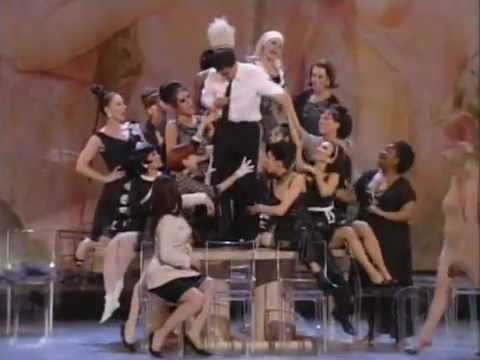
Review: the show that turns a lyric sheet into a conscience
Why does Nine keep winning revivals when its hero can be, bluntly, exhausting? Because Maury Yeston’s lyrics are not written to flatter Guido Contini. They are written to corner him. The score keeps handing him language that almost sounds sophisticated, then forces him to confront what that sophistication is hiding: fear, vanity, a creative block dressed up as fate. The women do not simply “support” his plot; they are the plot. Each voice is a different argument with the same man, and the argument is conducted in rhyme, in rhythm, in recurring musical ideas that return like an unfinished edit.
Yeston writes with a classical-musical spine, then lets it flirt with cabaret, film-score glamour, and nightclub snap depending on who has the microphone. That shift matters. When Luisa sings, the lyric line tightens and clarifies, the emotional math is brutal. When Carla sings, the words are tactile, hungry, impatient with metaphor. When Liliane enters, the language becomes show-business as seduction, and the orchestra behaves like a spotlight. The 2003 revival made this mechanism easier to read by stripping the stage picture down to a modern, “movie-studio” starkness, so the lyric and the body had nowhere to hide.
Listener tip (yes, this is practical): if you are new to the score, play the 2003 cast album in order once, no skipping. Several numbers are built as echoes and reprises; hearing them out of sequence flattens the story into “great songs,” which is not the point.
How it was made
Yeston’s origin story for Nine is unusually precise: teenage encounter with Fellini’s 8½, then years later, the first real composing runway at the BMI Lehman Engel Musical Theatre Workshop, where he started writing it as a project. Even the title is a composer’s joke with teeth: take 8½, add music, you earn “another half a point.” That wink tells you the aesthetic, too. This is cinema translated into stage language, not copied.
The piece changed shape before it became “the” Nine. Early book work went through multiple hands before Arthur Kopit’s version locked in the musical’s defining angle: Guido’s crisis is told through the women he consumes, remembers, and mythologizes. The 2003 Broadway revival, produced by Roundabout, leaned into revision without rewriting the DNA: less clutter, sharper storytelling, and staging choices that made the lyric content land with more sting.
Key tracks & scenes
"Not Since Chaplin" (Company)
- The Scene:
- A Venetian spa. Reporters swarm like gulls. Guido is “relaxing” the way a man relaxes while being hunted. The lights feel clinical, the tempo feels like bad news on deadline.
- Lyrical Meaning:
- The song is an ambush disguised as publicity. The lyric keeps trying to turn Guido into a headline. His problem is not that he has no answers; it is that he cannot speak honestly without losing the persona that sells tickets.
"My Husband Makes Movies" (Luisa)
- The Scene:
- Luisa stands inside Guido’s machinery and narrates it back to him. In the 2003 staging, the surrounding space was intentionally spare, which made her stillness feel louder than the orchestra.
- Lyrical Meaning:
- This is not “the wife’s lament.” It is a field report on genius as collateral damage. The lyric is loaded with plain verbs and sharp observations; she is translating the artist into something the audience cannot romanticize.
"A Call from the Vatican" (Carla)
- The Scene:
- Carla calls from a hotel room, turning distance into foreplay. The 2003 revival reportedly staged the moment with a comic, architectural entrance that underlined how powerfully sex can be choreographed as spectacle.
- Lyrical Meaning:
- Carla weaponizes devotion. The lyric is funny, yes, but it is also a portrait of someone who confuses attention with love because Guido has trained her to.
"Folies Bergères" (Liliane La Fleur)
- The Scene:
- Producer as ringmaster. The stage becomes a fantasy showroom, feathers and confidence, with Guido pulled into her vision of what will sell. In later stagings, black-and-white fashion lines and visible stage lighting grids have emphasized the “film set” artifice.
- Lyrical Meaning:
- The lyric is show business talking to art: seductive, relentless, convinced that style is truth. It is also the score openly admitting that Guido’s imagination is commercial as much as it is personal.
"Be Italian" (Saraghina)
- The Scene:
- A beach memory detonates into a full-body lesson. Little Guido watches, learns, and is marked. Modern productions often stage this with kinetic choreography that feels like a ritual and a warning at once.
- Lyrical Meaning:
- The lyric is Guido’s origin story told as permission: be bold, be sensual, be yourself. The catch is that he hears permission and mistakes it for entitlement. The song is his first draft of “women,” and he never fully revises it.
"Unusual Way" (Claudia)
- The Scene:
- Claudia is often staged in an emotional close-up, even in a big theatre. The music slows the room down. The words arrive like someone finally speaking without performance.
- Lyrical Meaning:
- She refuses to be a muse-shaped object. The lyric’s tenderness is conditional: she will love him, but she will not be consumed by his need for inspiration.
"I Can't Make This Movie" (Guido)
- The Scene:
- Guido, alone, finally trapped with himself. This number plays like a breakdown in the editing bay. The world that used to flatter him goes quiet.
- Lyrical Meaning:
- The title line is literal and metaphoric. He cannot make the film because he cannot make a life that is not built on avoidance. The lyric exposes the central fraud: “artist” as excuse.
Live updates (2024–2026)
Information current as of January 2026. Nine has not announced a new Broadway run for 2025–2026, but it has had meaningful, visible life in high-profile limited engagements. The Kennedy Center mounted it as part of Broadway Center Stage in August 2024 with Steven Pasquale as Guido, and reviews emphasized how the production’s design choices (visible lighting grid, gauzy curtains, black-and-white costuming) made the piece read like Fellini through a modern theatre camera. Ticketing for that run was publicly listed in a wide band, typical of a major arts-center event.
In the U.K., Hope Mill Theatre announced a concert staging at The Lowry in Salford for February 1–2, 2025, led by Ramin Karimloo, and notable for a programming choice: interpolating “Cinema Italiano” (written for the 2009 film) into the stage score. That kind of interpolation is becoming a mini-trend in concert presentations, where “completists” and “best-of” instincts can share the same stage without pretending the edition is standard.
What this means for listeners: the 2003 cast recording remains the cleanest “revival-as-written” audio document, while 2024–2025 activity suggests directors are increasingly framing the piece as a critique of the male gaze rather than a valentine to it.
Notes & trivia
- The 2003 Broadway revival played the Eugene O’Neill Theatre, opening April 10, 2003, and running through December 14, 2003.
- Concord Theatricals’ licensed materials lay out the score’s structure in unusually granular detail, including many short, filmic bridges and numbered segments.
- The PS Classics 2003 cast album was released June 17, 2003, and was recorded with the cast in late April 2003.
- That PS Classics release was marketed as a complete revival score document, with a synopsis, an essay by director David Leveaux, and full lyrics in the package.
- At least one recent major presentation (Hope Mill’s 2025 concert) explicitly planned to fold “Cinema Italiano” from the 2009 film into the stage score.
- Two different revivals have been framed as “film set” theatre: the 2003 production used a relatively stark set with multi-level walkways, while the 2024 Kennedy Center staging emphasized an unfinished soundstage with visible lighting infrastructure.
Reception: then vs. now
In 2003, the critical conversation split in a familiar way: admiration for the score’s craft and theatrical punch, impatience with Guido’s self-mythology. Some reviewers argued that the revival finally solved the piece’s staging problem by letting the women read as people, not décor. Others still bristled at the language’s sophistication when it hit a non-native-English star.
Two decades later, the conversation has shifted again. Critics covering 2024 were more likely to foreground context, asking what it means to revive a show built around a charismatic man’s appetite after #MeToo, and whether a director can reframe the material without sanding off its teeth.
“With Antonio Banderas as the lightning rod... the production... isn’t a revival: It’s a revelation.”
“I called it ‘Nine,’ because... I’m adding a little music, so that’s worth at least another half a point.”
“After the #MeToo era... reviving Nine feels... a bit fraught. The question arises: ‘Why now?’”
Quick facts
- Title: Nine
- Focus year here: 2003 Broadway revival (Roundabout Theatre Company)
- First Broadway opening: 1982 (source material: Fellini’s 1963 film 8½)
- Book: Arthur Kopit (adapted from the Italian by Mario Fratti in the musical’s development history)
- Music & lyrics: Maury Yeston
- 2003 key cast (highlights): Antonio Banderas (Guido), Mary Stuart Masterson (Luisa), Jane Krakowski (Carla), Laura Benanti (Claudia), Chita Rivera (Liliane La Fleur)
- 2003 venue/run: Eugene O’Neill Theatre, previews March 21, 2003, opening April 10, 2003
- 2003 cast album: PS Classics, released June 17, 2003; widely available on major streaming platforms
- Selected notable placements (score moments): “Not Since Chaplin” (press scrum at the spa), “My Husband Makes Movies” (Luisa’s diagnosis), “Be Italian” (beach memory), “Unusual Way” (Claudia’s boundary-setting)
- Recent high-profile stagings: Kennedy Center Broadway Center Stage (Aug 2024); Hope Mill Theatre concert at The Lowry (Feb 2025)
Frequently asked questions
- Is there a movie version of Nine?
- Yes. A feature-film adaptation was released in 2009, and it uses only a portion of the stage score while adding new songs written for the film.
- Who wrote the lyrics for Nine?
- Maury Yeston wrote both the music and lyrics for the stage musical.
- What is the “Nine” in the title referring to?
- It is a play on Fellini’s 8½: adding music nudges the number upward, and it also points to a formative childhood age within the story’s memory structure.
- Which recording should I start with?
- If your goal is to understand the 2003 revival that reintroduced the show to Broadway audiences, start with the 2003 New Broadway Cast Recording on PS Classics and listen in order.
- Is Nine touring in 2025 or 2026?
- There is no widely announced commercial tour on the scale of a national Broadway tour in that window, but major limited engagements and concert presentations have been staged recently, including the Kennedy Center (2024) and The Lowry (2025).
Key contributors
| Name | Role | Contribution |
|---|---|---|
| Maury Yeston | Composer-Lyricist | Wrote the score and lyrics; developed the piece from early workshop writing through Broadway productions. |
| Arthur Kopit | Book Writer | Shaped the stage narrative around Guido’s crisis and its impact on the women in his life. |
| David Leveaux | Director (2003 Broadway revival) | Led the Roundabout revival; the cast album package included his essay. |
| Scott Pask | Set Designer (2003 Broadway revival) | Created the revival’s stark, multi-level “film-world” environment noted by critics. |
| Jonathan Butterell | Choreographer (2003 Broadway revival) | Reframed signature numbers with a sharper, wittier movement vocabulary, per reviews. |
| PS Classics (Tommy Krasker, et al.) | Record Label / Producers | Released the 2003 New Broadway Cast Recording and produced the album with Yeston. |
Sources: IBDB; Playbill; Concord Theatricals; PS Classics; DC Theater Arts; The Lowry; TheaterMania; Apple Music; MusicBrainz.