New Brain, A Lyrics – All Songs from the Musical
New Brain, A Lyrics: Song List
- Frogs Have So Much Spring ('The Spring Song')
- Calamari
- 911 Emergency/I Have So Many Songs
- Heart And Music
- Trouble In His Brain
- Mother's Gonna Make Things Fine
- I'd Rather Be Sailing
- Family History
- Gordo's Law Of Genetics
- And They're Off
- Just Go
- Poor, Unsuccessful And Fat
- Sitting Becalmed In The Lee Of Cuttyhunk
- An Invitation To Sleep In My Arms
- Change
- Yes
- In The Middle Of The Room
- Throw It Out
- A Really Lousy Day In The Universe
- Brain Dead
- Whenever I Dream
- Eating Myself Up Alive
-
The Music Still Plays On
- Don't Give In
-
You Boys Are Gonna Get Me in Such Trouble/ Sailing (reprise)
-
The Homeless Lady's Revenge
-
Time
- Time And Music
-
I Feel So Much Spring
About the "New Brain, A" Stage Show
A musical created following the autobiography of William Finn. Songs composed by him too. The final script was written in 1997, in co-authorship with J. Lapine. Off-Broadway premiere took place on the stage of Mitzi Newhouse Theater, located in Lincoln Center. The show started from the mid of May (previews) and was surviving through October 1998, directed by G. Daniele. The cast involved: M. Gets, C. Invar, N. Lewis, M. Mandell, P. Fuller, C. Zien, L. Larsen, M. Testa, K. Chenoweth, J. Jellison & K. B. Kirk among others.The exhibition at Rice University represented by S. Richardson in season of 99/00. It visited UC Berkeley Bare Stage in 00/01 season. Shotgun Players Theatre hosted this theatrical in 2001. Production also resurrected in March 2002. The British premiere was in 2005 at the local Festival. In 2006, it was hosted in English Littlehampton, located in West Sussex.
In June 2015, this histrionics was in frames of Encores! in NY City Center. This version included some changes created by the authors. Director of this performance was J. Lapine. In the production acted: J. Groff, D. Fogler, A. Gasteyer, A. Lazar and others. Musical recordings were made in 1998 (by RCA Victor) and 2015 (by PS Classics).
Release date: 1998
"A New Brain" (1998) – The Musical Guide & Song Meanings
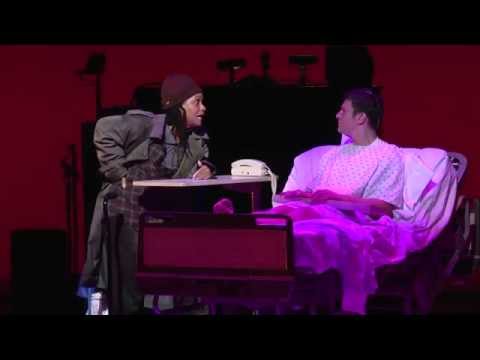
Review: a medical musical that refuses to behave
How do you write about brain surgery without turning the audience into sympathetic statues? William Finn’s trick is to keep the lyrics moving. Even at their most sincere, they are built like thinking in real time: quick pivots, ugly jokes, sudden tenderness, then a hard cut back to logistics. The show is basically a race between Gordon Schwinn’s imagination and the hospital schedule, and the text keeps score.
The lyric voice also tells you who has agency. Mr. Bungee gets imperatives and slogans because he is pressure in mascot form. Mimi gets emotional weather: she sings care as control, love as panic, grief as housecleaning. Roger’s language is steadier, more nautical and physical, because he functions as a hand on the shoulder. Rhoda’s lyrics are all velocity and triage. Lisa, the homeless woman, is the show’s moral friction; she is the one character who refuses sentimentality about survival.
Musically, the score sits in that Finn sweet spot: comedy that lands like percussion, then ballads that refuse to polish the pain. The show can sound “too many songs” on paper because it came out of a post-hospital song cluster. In performance, the density becomes the point. Gordon is terrified that he will die with his best work still inside him, so the musical responds by making the inside audible.
How it was made
"A New Brain" is openly autobiographical. Finn and James Lapine built it from Finn’s own medical crisis and recovery, including the diagnosis of an arteriovenous malformation. In one of the cleanest origin accounts, Lapine pushed Finn to write down what he was living through, and those notes organized themselves into songs. The project began as a concert of those songs at The Public Theater before it grew into a staged musical, with workshops leading to the 1998 Off-Broadway run at Lincoln Center’s Mitzi E. Newhouse.
The show’s creation story matters because it explains the lyrics’ texture. They do not behave like “perfectly engineered” book songs. They behave like survival paperwork, scribbled fast, then turned into music. Even the title reads like a post-trauma rebrand: same person, different wiring, less patience for pretending.
For listeners, the major “making” pivot is the recording history. The 1998 cast album exists, but the 2015 Encores! Off-Center staging led to a 2016 PS Classics two-disc release that preserves the full show and restores material missing from the earlier album. If you want the lyrics as narrative, the 2016 set is the one that plays like a complete screenplay.
Key tracks & scenes
"Heart and Music" (Gordon, ensemble)
- The Scene:
- Hospital room. Machines, visitors, the fear of “unfinished.” The staging often gathers the cast into Gordon’s orbit, like the room itself is singing at him.
- Lyrical Meaning:
- The lyric is Finn’s mission statement in plain language: craft matters, feeling matters, and the act of making is a form of staying alive. In the 2015 review context, it is singled out as a “joyous” philosophy song that turns clinical sound into accompaniment.
"And They’re Off" (Gordon)
- The Scene:
- A memory-sprint about Gordon’s father, staged like a personal horse race you did not buy a ticket for. The energy spikes because the past is still a threat.
- Lyrical Meaning:
- It is exposition that bites. The lyric fills in abandonment as a template for Gordon’s current terror: people leave, time runs out, songs stay trapped.
"Sitting Becalmed in the Lee of Cuttyhunk" (company)
- The Scene:
- MRI day. Claustrophobia meets escapism. Many productions treat this as a lighting and sound playground: a hospital procedure becomes sea air, then snaps back.
- Lyrical Meaning:
- The lyric turns “escape” into a precise image. It is not vague romance; it is geography and sensation as coping mechanism. The specificity is the comfort.
"In the Middle of the Room" (Gordon)
- The Scene:
- After the “Yes” song is rejected, the room empties emotionally even if people are still present. The light tends to narrow, and the joke rhythm drops out.
- Lyrical Meaning:
- This is the creative person’s nightmare: being alive, being busy, being ignored. The lyric frames artistic failure as physical isolation.
"Throw It Out" (Mimi)
- The Scene:
- Gordon’s apartment. Mimi cleans like she is exorcising fear. It often plays under bright, too-harsh light, the way cleaning can feel like violence.
- Lyrical Meaning:
- The lyric is love that cannot stop controlling. Mimi’s devotion becomes destructive, and the text never lets her off the hook, which is why the number lands.
"Change" (Lisa)
- The Scene:
- Lisa addresses the audience directly, asking for money while also demanding a shift in how people see her. The staging tends to isolate her in a single pool of light.
- Lyrical Meaning:
- It is the show’s ethical interruption. The lyric refuses the comforting myth that survival makes everyone grateful and kind. It pushes the plot toward a wider world.
"The Music Still Plays On" (Mimi)
- The Scene:
- A late-show still point. The chaos softens, and a mother tries to sing her way through dread. In recent revival coverage, performers describe the song as gut-level emotional impact.
- Lyrical Meaning:
- The lyric insists that continuity exists even when the body feels fragile. It is a lullaby aimed at the singer as much as the patient.
"Time and Music" / "I Feel So Much Spring" (company)
- The Scene:
- Recovery, then release. The finale usually returns you to the frog-song problem from the opening, only now it plays like proof of life. The light tends to open up, as if the room finally has air.
- Lyrical Meaning:
- Finn ties mortality to craft in the simplest possible way: you get time, you make something with it, and you try to mean it. The children’s-TV assignment becomes a victory lap with teeth.
Live updates (2025/2026)
Information current as of January 29, 2026. "A New Brain" is active in the repertory ecosystem, with a clear pattern: limited runs, community and regional productions, and strong LGBTQ+ seasonal programming.
In Chicago, PrideArts opened its 2025-26 season with "A New Brain" at the Hoover-Leppen Theatre at Center on Halsted, running August 22 through September 14, 2025, with a ticket price publicized at $35. That production mattered beyond the title because it also helped inaugurate PrideArts’ new home space.
In North Carolina, Blumenthal Arts lists "A New Brain" at the Stage Door Theater for March 20-21, 2026, with ticket pricing shown as starting around $25.52 at the time of listing. In California, SDMT listed a two-night presentation on August 25-26, 2025. New York also remains a frequent stop for this piece in the smaller-theatre lane, with an October 2025 listing for St. Bart’s Players.
Listener tip for 2026 audiences: check which recording the production is using as its musical “spine.” Some companies pull from the fuller 2016 PS Classics material, which changes how the lyric narrative tracks, especially in the second half.
Notes & trivia
- Finn wrote the show as a direct response to his own medical crisis, including an arteriovenous malformation, and the musical’s premise mirrors that experience.
- The project began as a post-hospital batch of songs presented in concert at The Public Theater before it became a staged musical.
- The 1998 premiere ran Off-Broadway at Lincoln Center’s Mitzi E. Newhouse Theater, directed by Graciela Daniele.
- The original cast recording was made after Christopher Innvar left the production, with Norm Lewis singing Roger on the album.
- The 2016 PS Classics two-disc release preserves the show in full and adds previously unrecorded material, making it the most complete audio document.
- "Sitting Becalmed in the Lee of Cuttyhunk" names a real place, which is part of the lyric’s coping strategy: specificity as calm.
- Academic writing on Finn’s work often points to his reprise tactics, including how "Heart and Music" returns with altered lyric intent.
Reception then vs. now
In 1998, critics respected the wit and the ambition while also arguing about structure. The show’s joy can read “private” if you expect a tight plot machine, which is basically what one major review complained about. Later assessments, especially around the 2015 Encores! Off-Center revival, tend to be kinder about the messiness because the messiness feels earned: a mind in crisis does not tell stories in clean arcs.
The modern critical frame also focuses more directly on Finn’s lyric habits. Reviewers admire the emotional candor and also side-eye the rhyme-mania, which is part of the charm and part of the abrasion. That tension is the show.
“Happiness is definitely a blander muse than anxiety.”
“He never saw a rhyme he wouldn’t hitch a ride with.”
“It sort of hits me in the gut.”
Quick facts
- Title: A New Brain
- Year (premiere): 1998 (Off-Broadway, Lincoln Center Theater)
- Type: Contemporary musical (near sung-through structure in many versions)
- Music & lyrics: William Finn
- Book: William Finn, James Lapine
- Original venue: Mitzi E. Newhouse Theater at Lincoln Center
- Key recording options: 1998 Original Cast Recording (RCA Victor Broadway); 2016 PS Classics two-disc recording from the 2015 Encores! Off-Center production
- Selected notable placements: Collapse into lunch leading to "911 Emergency"; "Heart and Music" as the early thesis; "MRI Day" into "Cuttyhunk"; the rejected spring song crash into "In the Middle of the Room"; coma-suite sequence into "Don’t Give In"; finale turning the spring song into release
- Availability: Major streaming platforms carry both the 1998 and 2016 recordings
Frequently asked questions
- Is "A New Brain" autobiographical?
- Yes. It is based on William Finn’s medical crisis and recovery, filtered through the fictional composer Gordon Schwinn.
- What recording should I start with?
- If you want the story cleanly, start with the 2016 PS Classics two-disc recording from the 2015 Encores! Off-Center production, since it preserves the full show.
- Where does "Heart and Music" happen in the plot?
- Early, after Gordon’s hospital admission, when his fear is specific: dying with songs still inside him. It functions like the show’s artistic credo.
- Why is there a frog children’s-TV song at the center of this?
- Because it is the cruelest joke for a serious artist: a deadline for fluff, right when life demands depth. The finale reclaims that assignment as proof Gordon can create again.
- Are there recent productions in 2025 and 2026?
- Yes. Listings include PrideArts in Chicago (August to September 2025) and Blumenthal Arts in Charlotte (March 2026), among other regional and community runs.
Key contributors
| Name | Role | Contribution |
|---|---|---|
| William Finn | Composer, lyricist, co-book writer | Wrote the score as a personal survival document, pairing anxious comedy with blunt tenderness. |
| James Lapine | Co-book writer | Helped shape the songs into a staged narrative and pressed for specificity in the writing process. |
| Graciela Daniele | Director (1998 Off-Broadway) | Staged the original Lincoln Center production, balancing intimacy and theatrical slapstick. |
| Malcolm Gets | Original Gordon | Created the original onstage voice of Gordon Schwinn and anchored the 1998 recording identity. |
| Jonathan Groff | Gordon (2015 Encores! Off-Center) | Led the revival that produced the definitive full-show 2016 audio document. |
| PS Classics | Record label | Released the 2016 two-disc recording preserving the complete revised score. |
| Concord Theatricals | Licensing | Current licensing home for productions, keeping the title in steady circulation. |
Sources: Lincoln Center Theater (via reference summaries); Concord Theatricals; Playbill; Vulture; TheaterMania; PrideArts / Center on Halsted; Blumenthal Arts; SDMT; Wikipedia; Oakland University program PDF; academic thesis material on reprise technique.