Myths And Hymns Lyrics – All Songs from the Musical
Myths And Hymns Lyrics: Song List
About the "Myths And Hymns" Stage Show
The creator of the musical is A. Guettel. The works are based on Greek myths & lyrics that have been found in the ancient hymnal. Initially production had a different name. Off-Broadway premiere was staged in the Public Theater. The show was held from March to April in 1998 with 16 performances, directed by T. Landau. The cast involved: V. Cherry, A. Golden, T. McCarthy, J. Llana, B. Stillman & L. Clayton. This theatrical does not have traceable storyline.In the mid of 2007 at London's Finborough Theatre, there was the premiere of this play. It was planned to exhibit only twice – April 29th and 6th of May, but because of large number of requests from spectators, show was prolonged with 2 more exhibitions. Director of these productions was T. Cooper. Music editor – J. Hood. In the musical played: C. Purnell, A. Gray, H. Holder, C. Sheen, D. Randall & L. Craig.
A reworked version of the histrionics with a new name went to the stage of New York Prospect Theater in February 2012. The director and screenwriter was E. Lucas. This performance had the story line. Such actors were involved: L. Balgord, A. Larsen, B. Stillman, L. Steele, M. Farcher & D. J. Foreman. The show took place on the stage of Chicago BoHo Theatre from June to July 2014. Director was P. Robel. The cast involved: S. Charles, M. McNabb, S. Souza, K. Webb, N. Stratman & E. Telford.
The original musical was a collection of songs that were based on Greek myths and biblical theme. The author tried, using his work, to get people to think about the meaning of life, and what place takes the faith in Almighty in the life.
Release date: 1998
"Myths & Hymns" – The Musical Guide & Song Meanings
Review: faith songs for people who don’t want to join anything
“Myths & Hymns” is a song cycle that keeps asking the same rude question in different outfits: what do you do with the hunger inside you when you do not trust the institutions that claim to feed it? Adam Guettel’s lyrics are the bait and the blade. They move between Greek myth and hymn text, but the real subject is modern restlessness, the kind that sounds like ambition until it starts sounding like loneliness.
These are not “character songs” in the Broadway sense. The lyric voice is often a collective “we,” a soloist speaking as an emblem, or a narrator slipping into confession. That makes the meaning elastic in performance, which is why the piece keeps getting re-framed: a concert in 1998, a narrative staging in 2012, a chaptered digital film series in 2021, and recent concert events that lean into the score’s devotional-pop hybridity. The common thread is how the text makes longing feel physical: flight, work, love, faith, each one a different attempt to touch something larger than the room.
Listener tip that pays off: do not treat it like a cast album for an unseen show. Treat it like a sequence of arguments. If you listen straight through, notice how the cycle keeps returning to motion. Flying up, pushing through, crossing water, walking a highway. Guettel’s people are always traveling toward meaning, and always suspicious they may arrive late.
How it was made: Guettel’s two source books
The origin story is clean and slightly odd, which fits the piece. The cycle began life as “Saturn Returns,” performed at the Joseph Papp Public Theater in 1998, and it draws from two textual wells: Greek myths (Icarus, Pegasus, Hero and Leander, Sisyphus) and Protestant hymn texts found in an antique hymnal. That is not a mash-up for novelty points. It is a practical way to compare two systems that both promise transcendence, then admit how often that promise collapses under human weight.
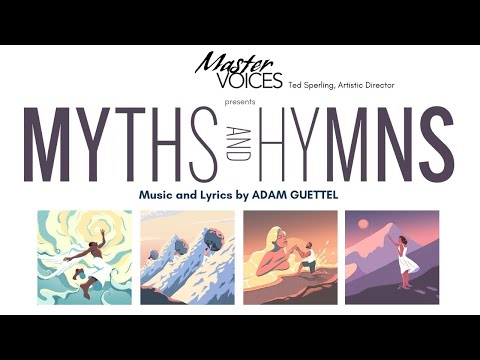
Later versions underline the work’s flexibility. Concord Theatricals’ licensing history traces a London premiere (Finborough Theatre, 2007) and a 2012 New York run by Prospect Theater Company with a narrative treatment by Elizabeth Lucas. MasterVoices’ 2021 digital project goes further, explicitly organizing the cycle into four chapters, “Flight,” “Work,” “Love,” and “Faith,” and adding credited “additional lyrics” for that edition. Guettel himself has described the piece as clay for directors and a vessel for imaginative singers, which is about as close as this score gets to a mission statement.
Key tracks & scenes: 8 lyrical pressure points
"Prometheus" (Ensemble)
- The Scene:
- A jaunty prologue, often staged like an invitation to the room. Bright light, quick tempo, the sense that a storyteller is testing the audience’s attention.
- Lyrical Meaning:
- The lyric establishes a dangerous promise: knowledge and fire are gifts, and also curses. It sets up the cycle’s obsession with reaching too far and paying for it later.
"Saturn Returns" (Soloist)
- The Scene:
- A pivot into interior time. In MasterVoices’ framing, it sparks the “Flight” chapter, laying out the central “hunger inside” that the cycle keeps trying to name.
- Lyrical Meaning:
- The song is a midlife audit written as prophecy. The lyric treats reassessment as gravitational force: you do not choose the reckoning, you only decide how honest you will be inside it.
"Icarus" (Icarus / Daedalus)
- The Scene:
- A myth staged like a family argument with a sunlit exit sign. The father’s warning and the son’s blaze of wanting are both true, which is why the crash feels inevitable.
- Lyrical Meaning:
- Guettel turns ambition into theology. The lyric makes flight feel like selfhood, then shows the cost of confusing freedom with invincibility.
"Migratory V" (Soloists)
- The Scene:
- After the fall, the lighting often softens and widens. Voices overlap like a small flock forming in air, less heroic, more communal.
- Lyrical Meaning:
- The lyric argues for shared lift: we rise farther together than alone. It is one of the cycle’s rare moments of uncomplicated hope, which makes it ring louder.
"Sisyphus" (Soloist)
- The Scene:
- Work as ritual. A steady musical engine and staging that can be as minimal as a single body repeating an action until it becomes its own set.
- Lyrical Meaning:
- The lyric refuses to sentimentalize labor. It asks whether repetition is punishment or practice, and whether meaning is built or merely endured.
"Hero and Leander" (Soloist / Company)
- The Scene:
- Love as distance. Often staged with separated playing areas or a visible “crossing,” the feeling of water between people even when the stage is dry.
- Lyrical Meaning:
- The lyric romanticizes devotion, then tightens the screws by making it perilous. Desire becomes a dare, and the song asks what we call it when commitment starts to resemble risk addiction.
"Come to Jesus" (Ensemble)
- The Scene:
- A full-voiced gospel eruption that changes the room’s temperature. In performance, it often becomes the cycle’s public square, with bodies in motion and voices layered high.
- Lyrical Meaning:
- It is the score’s most direct confrontation with faith language. The lyric can sound like invitation, warning, or satire depending on how a production aims it, and that ambiguity is the point.
"How Can I Lose You?" (Soloist)
- The Scene:
- A quiet reversal after the big communal sound. One singer, close focus, the sense of someone bargaining with absence.
- Lyrical Meaning:
- The lyric is an argument with impermanence. It treats loss as a logic puzzle that refuses to solve, which is why it hits like confession rather than story.
"There’s a Land" (Ensemble)
- The Scene:
- A closing hymn-like reach outward. Many stagings simplify here: fewer gestures, fewer jokes, a steadier gaze into the audience.
- Lyrical Meaning:
- It offers a destination without pretending the road ends. The lyric’s power is restraint: it suggests completion, but keeps the door open for doubt to follow you home.
Live updates: 2025-2026 status
Information current as of January 29, 2026. “Myths & Hymns” is not a touring commercial musical. It lives as a concert-theatre event, a licensed title, and a prestige song cycle that keeps surfacing when performers want smart material and producers want a strong night without a book musical’s infrastructure.
Concrete recent activity: Union Chapel in London presented a one-night performance on July 18, 2025 with a named West End-heavy cast and credited direction and musical direction. Hope Repertory Theatre in Michigan listed a run from July 20 to July 27, 2025. And Orange County School of the Arts scheduled “MT: Myths & Hymns” across February 19 to February 28, 2026, a useful indicator of the work’s educational afterlife and the way it can be programmed in repertory seasons.
Programming tip for 2026: when a venue bills it as “Myths & Hymns” rather than “Saturn Returns,” expect the marketing to lean toward spiritual yearning and pop-classical crossover. When a company highlights “Flight/Work/Love/Faith,” expect a more curated, chaptered evening. Same songs, different emphasis, and the lyrics can take the shift.
Notes & trivia
- The piece premiered at the Joseph Papp Public Theater in March 1998 under the title “Saturn Returns.”
- Nonesuch released the recording in 1999, with a lineup that mixes theatre and concert voices (including Guettel, Audra McDonald, Mandy Patinkin, Kristin Chenoweth, and Billy Porter).
- The album’s track list includes both myth songs (“Icarus,” “Pegasus,” “Sisyphus,” “Hero and Leander”) and hymn-derived titles (“Children of the Heavenly King,” “At the Sounding,” “There’s a Land”).
- Playbill reported the 1999 release with Ted Sperling as musical director and Tommy Krasker as producer.
- Concord Theatricals’ history notes a London premiere in 2007 and a 2012 New York production featuring a narrative treatment by Elizabeth Lucas.
- MasterVoices’ 2021 digital series organized the cycle into four chapters and credited additional lyrics by Ellen Fitzhugh for that edition.
Reception: critics and the afterlife
On release, critics tended to focus on Guettel’s genre-hopping craft and the way the score refuses a single stylistic “home.” Later commentary often treats it as a director’s playground and a singer’s showcase, with debates centering on what happens when you impose narrative on songs built to be more meditative than plotty.
“Influences tumble over each other in musical somersaults.”
“Blends pop, gospel and classical influences.”
“Intriguing but unsatisfying.”
Quick facts: album, credits, availability
- Title: Myths & Hymns (originally Saturn Returns)
- Year: 1998 (Public Theater concert-theatre premiere)
- Type: Theatrical song cycle
- Book: None (concert-theatre structure; variable narrative treatments in later stagings)
- Music & lyrics: Adam Guettel
- Recorded label: Nonesuch Records (1999 recording)
- Music supervision / musical direction (recording reporting): Ted Sperling
- Producer (recording reporting): Tommy Krasker
- Selected notable “placements” inside the cycle: Prologue “Prometheus” leading into “Saturn Returns” as the thematic ignition; myth sequence peaks in “Icarus”; labor reckoning in “Sisyphus”; late-cycle hymns (“The Great Highway,” “There’s a Land”) as arrival without certainty
- Availability: Widely available on major streaming platforms under “Myths and Hymns” (1999)
- Licensing: Available via Concord Theatricals
Frequently asked questions
- Is “Myths & Hymns” a traditional musical with characters and a plot?
- No. It is a song cycle. Some productions add narrative framing, but the core work is a curated sequence of songs.
- Why was it first called “Saturn Returns”?
- The title references Saturn’s roughly 29-year cycle and the idea of reassessment. It also became shorthand for the cycle’s midlife audit mood.
- What are the main lyrical sources?
- Greek myths (such as Icarus and Sisyphus) and texts drawn from Protestant hymnody, placed in conversation rather than blended into one belief system.
- What should I listen to first?
- Try “Saturn Returns,” “Icarus,” and “How Can I Lose You?” first. That sequence shows the cycle’s engine: yearning, consequence, and grief.
- Is it being performed now?
- As of January 2026, it appears mostly as concerts and licensed productions. Recent dates include London (July 18, 2025) and scheduled school performances in February 2026.
Key contributors
| Name | Role | Contribution |
|---|---|---|
| Adam Guettel | Composer-lyricist | Wrote the cycle, merging myth narrative with hymn text to examine faith, longing, and self-reckoning. |
| Ted Sperling | Musical director / arranger (various editions) | Reported musical director for the 1999 release; later led MasterVoices’ chaptered digital staging. |
| Tommy Krasker | Producer (recording) | Produced the 1999 recording as reported by Playbill. |
| Tina Landau | Director (1998 staging reporting) | Credited by Playbill reporting for the Public Theater presentation under the original title. |
| Ellen Fitzhugh | Additional lyrics (MasterVoices edition) | Credited for additional lyrics in the MasterVoices digital series materials. |
| Don Sebesky | Orchestrations (MasterVoices edition) | Credited orchestrator for the MasterVoices edition alongside Jamie Lawrence. |
| Jamie Lawrence | Orchestrations (MasterVoices edition) | Credited orchestrator for the MasterVoices edition alongside Don Sebesky. |
Sources: Nonesuch Records, Time, Playbill, Concord Theatricals, MasterVoices, Union Chapel, What’s On Stage, BroadwayWorld, Backstage.